In the Alps region there it is an area (formerly very huge) populated by neolatin populations that survives assimilation only in three small territories: in Switzerland (Canton Grisons) and in Italy (Trentino-AltoAdige & Friuli). In these areas are spoken respectively: Romansh, Ladin and Friulan, the languages actually of more than 800000 inhabitants in Switzerland and Italy.

When the Romans conquered the Alpine region known as Raetia, the local Celtic and Rhaetic peoples gradually adopted the language of their conquerors: Vulgar Latin. For centuries, this Alpine Latin evolved in relative isolation, separated by formidable mountain barriers from the developing Romance languages in what would become France and Italy. This isolation allowed a unique set of linguistic features to develop and solidify.
The result is a group of languages that don’t fit neatly into the Italo-Romance (Italian) or Gallo-Romance (French) families. Instead, they form a kind of linguistic bridge between them, sharing features of both while retaining their own distinct character.The very idea of them being a unified “family” was a subject of fierce academic debate known as the Questione Ladina (“Ladin Question”).
It was the pioneering Italian linguist Graziadio Isaia Ascoli who, in 1873, first convincingly argued that Romansh, Ladin, and Friulian were not simply dialects of Italian but remnants of a once-widespread "Latin Continuum" that stretched across the Alps. He and other linguists calculated that approximately:
- 1)Romansh is 66% Romance & 33% German
- 2)Ladin is 75% Romance & 25% German
- 3)Friulan is 85%Romance,9%German,6%Slav
HISTORY
Since the 3rd century, the Latinization of the Cisalpine, Alpine, and Transalpine lands in the vast triangle between Lake Constance, the Danube, and Istria was an established reality, while in the Dolomite & Alto Adige mountain area it was only completed towards the end of the Roman Western Empire with the decisive contribution of Christian preaching.
In the provinces of the Roman Empire south of the Danube called "Noricum" and "Rhaetia", the Latinized inhabitants did not completely disappear when the barbarian invasions devastated the region. Many were exterminated and others took refuge in Italy, but some survived in the Alps mountains.
Those who lived in Rhaetia gave rise to the Ladin and Rhaeto-Romance languages of Switzerland and northern Italy, but those of Noricum survived only a few centuries until the time of Charlemagne (but in southern Austria survived cities like Aguntum -actual Dolsach near Lienz- possibly until the late ninth century).
That is to say, the Ladin/Rhaeto-Romance language exists today, but the Romance language of Noricum (which roughly coincides with present-day Austria) has disappeared. The explanation seems to be that Noricum and, in general, present-day central and eastern Austria were more exposed than Switzerland to the devastating invasions of the Huns of Attila and later of the Avars.
The following are brief essays about the two areas were Germanization has been more assimilative & successful: eastern Switzerland and Italian Alto Adige:
Switzerland (Romansh)
During the Middle Ages, there were now-extinct Rhaeto-Romance populations in northern Switzerland and in Austria/Bavaria, in areas called: Walchental, Wakhen, Walchengag, Wakhensef, and Winkhen. For example Saltzburg (Austria) was called with the Roman name "Iuvavum" until 740 AD, showing that it was populated by a few remaining neoromanized citizens until the mid-eight century.

Romansh in the early Middle Ages was spoken over a much wider Swiss area, stretching north into the present-day swiss cantons of Glarus and St. Gallen, to the Walensee in the northwest, and Rüthi and the Alpine Rhine Valley in the northeast.
Additionally in the east, most of modern-day Austria's Vorarlberg were Romansh-speaking, as were parts of Tirol.
The northern areas, called Lower Raetia, became German-speaking by the 12th century; and by the 15th century, the Rhine Valley of St. Gallen and the areas around the Walensee were entirely German-speaking. This language shift was a long, drawn-out process, with larger, central towns adopting German first, while the more peripheral areas around them remained Romansh-speaking longer.
The shift to German language was caused in particular by the influence of the local German-speaking élites (with the help of the local church priests) and secondarily by German-speaking immigrants from the north, with the lower and rural classes retaining Romansh longer. If interested read https://web.archive.org/web/20131104161427/http://www.liarumantscha.ch/data/media/pdf/facts_figures/facts_figures_english.pdf.
Furthermore, until the time of Napoleon, Rhaeto-Romance was spoken in some areas of the Austrian Vorarlberg, while in the Val Venosta of the Italian "Alto Adige" (called also "South Tirol") there were Ladin/Rhaeto-Romance communities until the end of the 19th century.
Currently in the Canton Grisons in southeastern Switzerland, exists the Romansh -with its own literature and many dialects- that is considered the fourth official language of Switzerland (with German, French and Italian) and is the primary language of 60000 inhabitants. It is fragmented into five main dialects (Sursilvan, Sutsilvan, Surmiran, Puter, and Vallader). In the 1980s, a standardized written form, Rumantsch Grischun, was created to unify the language for official use, a move that remains controversial among speakers of the individual dialects.
 Map of actual (2020) Raetho-Romance languages
Alto Adige (Ladin)
Around the year 1000, the ethnic composition of Alto Adige was predominantly Romance/Ladin, with a slowly increasing but still scarce Germanic presence (mainly Bavarians) in the more inland areas.
The main ethnic groups present were:
Ladin-Romance populations: They were the predominant group, descendants of the Rhaeto-Roman populations that had inhabited the region since Roman times. Their language, Ladin, was widely spoken before the significant subsequent Germanization. They were a "continuum" romance population, linking the Romansh with the Friulans (from actual Switzerland to actual Friuli-Venezia Giulia) and their main cities were Bolzano, Merano and Bressanone. The Alto Adige area south of Chiusa Pass and Bolzano was fully romance speaking and famous for the wine production with significant commerce with the Po/Adige valley since Roman times (it was later included in the Napoleon 's kingdom of Italy).
Germanic populations (Bavarians): The Germanic presence, particularly of the Bavarian tribes, dated back to the migrations of the 6th century, but until the 11th century it was a minority mainly concentrated in the northern valleys and along the borders. It was with the Ottonian dynasty (after the year 1000) that a more significant impetus began towards the "in-depth" Germanization of the upper Adige basin, a process that was initially slow and gradual. The epidemic of the “Black Death” which struck hard the whole of Europe in the middle of the fourteenth century (beginning in 1348) led to the collapse of the romance population, which was filled in part by an influx of German settlers from regions in which the disease had a lesser impact. After 1363 all the area of Alto Adige (that in German language was called "Tirol" -name taken from the ladin village that Dante called "Tiralli", north of Merano) went to the Habsburg and the process of Germanization became very strong. These Habsburgs, intensified the process of Germanization through their feudal lords and their ecclesiastics, who, being owners of enormous estates, transplanted German settlers. In addition, Habsburg rule facilitated the immigration of merchants from Germany to urban centers south of the Brenner Pass.
Entire valleys of Alto Adige which were still Ladin, and the major part of the Val Venosta, which had spoken a neo-Latin language until the beginning of the eighteenth century, were Germanized by force during the Maria Theresia reign (that lasted from 1740 to 1780). First, the Habsburg authorities imposed a series of repressive measures, which required the exclusive use of German in a number of fields: in public meetings, in church sermons, in confession and in general pastoral activity, etc. Second, discriminatory measures were promoted against those who spoke Ladin in their own home and family life, limiting their rights, such as the possibility of exercising certain professions or even of contracting marriages. Third, many customs characteristic of the Ladins were banned, again in order to make them lose their identity. Fourth, the Empress Maria Theresa in person issued a secret decree, which required the Germanization of Ladin surnames in South Tyrol, using the clergy to carry out this work, who were loyal to the empire and imposed the German language. Even today there are many Ladin surnames Germanized through the addition of an –er ending (as happened to Elemunt, which became Elemunter, or Melaun, which became Melauner), or by a translation into German (for example, changing Costalungia to Kastlunger, Granruac to Großrubatscher, etc.).
Most of Val Venosta was thus Germanized under the government of the sovereigns Maria Theresa and -later- Joseph II, who are regarded by Austrian nationalists as the more open and tolerant sovereigns of the house of Austria. The Ladins who managed to resist such Germanizing pressure were gradually assimilated during the nineteenth century, so that very few Romansh groups remained in Val Venosta at the beginning of the nineteenth century. An enthusiastic supporter of the Germanization of the Ladins and the Romansh before the Theresian era was the abbot of Marienberg Abbey (Abbey of Monte Maria) in upper Val Venosta, Mathias Lang.
Similar Germanizing behaviours were common to the activity of the government of Maria Theresa, who was responsible for initiatives similar to those described above, or even worse, in different parts of the empire, such as in Bohemia, Croatia, Hungary and Romania. The Empress also issued an edict in which she authorized the abduction of children born to Gypsy (and to poor Ladin) families, in order to enlarge the German sphere and render it Austrian in culture: the cases of authorized abductions were many thousands.
Furthermore. it is important to note that the scholar Piccottini asserts that an extinct "Austrian Romance language" (spoken for some centuries -after the Roman empire fall- in central & southern Austria, like in Aguntum) belongs to the Rhaeto-Romance group (or at least was a proto-Rhaeto-Romance language), based on its geographical proximity to the current Romansh/Ladin/Friulian areas in the Swiss-Italian Alps. He even believes that it assimilated some words from the pre-Roman Raetic language, especially in Austrian Tirol.
Indeed, in the Tirolean region of western Austria, between Innsbruck and Vaduz (the name of the capital of Liechtenstein comes from the Neo-Latin word "avadutz," meaning aqueduct in Romansh), Rhaeto-Romance was also spoken until the time of the French Revolution.
The Alto Adige line of haplogroup "R1b-U152"
| Map of R1b-U152 in western Europe (it coincides approximately with West Roman Empire) |
The area around Bolzano has always been the most populated in Alto Adige with a huge romance speaking community; and in Napoleon times it was united to his Kingdom of Italy because ethnically romance speaking. Furthermore the valley "Venosta" west of Merano until the second half of the Settecento (XVIII century) was populated mostly by Ladins.
These facts -together with the existence of Ladins in Val Gardena and surroundings even now- clearly explains why Tolomei and other Italian academics & historians considered that the German-speaking Tiroleans were not an autochthonous population in the Alto Adige region.
The Italian irredentist Tolomei looked as a reference for the "re-italianization" of Alto adige to the process of assimilation done in France after WW1 with the former mostly German speaking Alsace-Lorraine regions. He was well esteemed by the French authorities: in 1935 Tolomei -promoted to "Senator of the Kingdom of Italy"- received the "Légion d'honneur" from the "République française". The award motivation was: "In giving you this high distinction, the Government of the French Republic has taken care to recognize the outstanding services that you have rendered to the Latinity before, during and after the war (...) with your action in the Alto Adige defense outpost of the Latin block against Germanism".
Tolomei correctly pinpointed that the Germanization was huge north of Merano and Bolzano, but in the val Venosta area it has only happened since the century before the French Revolution and in the Bolzano area only since the XIX century. So he indicated that there was an approximate line related to the presence of less or more than 20% of blonde hair in the population, that clearly divided in two the Alto Adige: north of the line there were people mostly German speaking since the Middle Ages, while south of the line the presence of romance population was evident in the darker hair of most people.

Curiously in recent years the genetic studies have confirmed this line, with the genetic signature of the haplogroup "R1b-U152". Indeed the ancient Romans, from the original founders of Rome to the patricians of the Roman Republic, should have been essentially R1b-U152 people. See the above map for further understanding, showing the orange line (related to 33% of the population) of the haplogroup "R1b-U152" that is similar to the one of the 20% blonde hairs in the population (north of the line the habitants are more blonde and Germanized, while south are less -because more than the 33% of the total population has this kind of haplogroup- like in northern Italy).
Finally we must remember in detail -also graphically- the biggest process of (often forced) German assimilation that happened in the alpine northern region of Italian Alto Adige. Here it is a good "precise" map of the ethnicity in the Alto Adige in 1900, showing in red the areas of Romance language and in blue those German speaking:
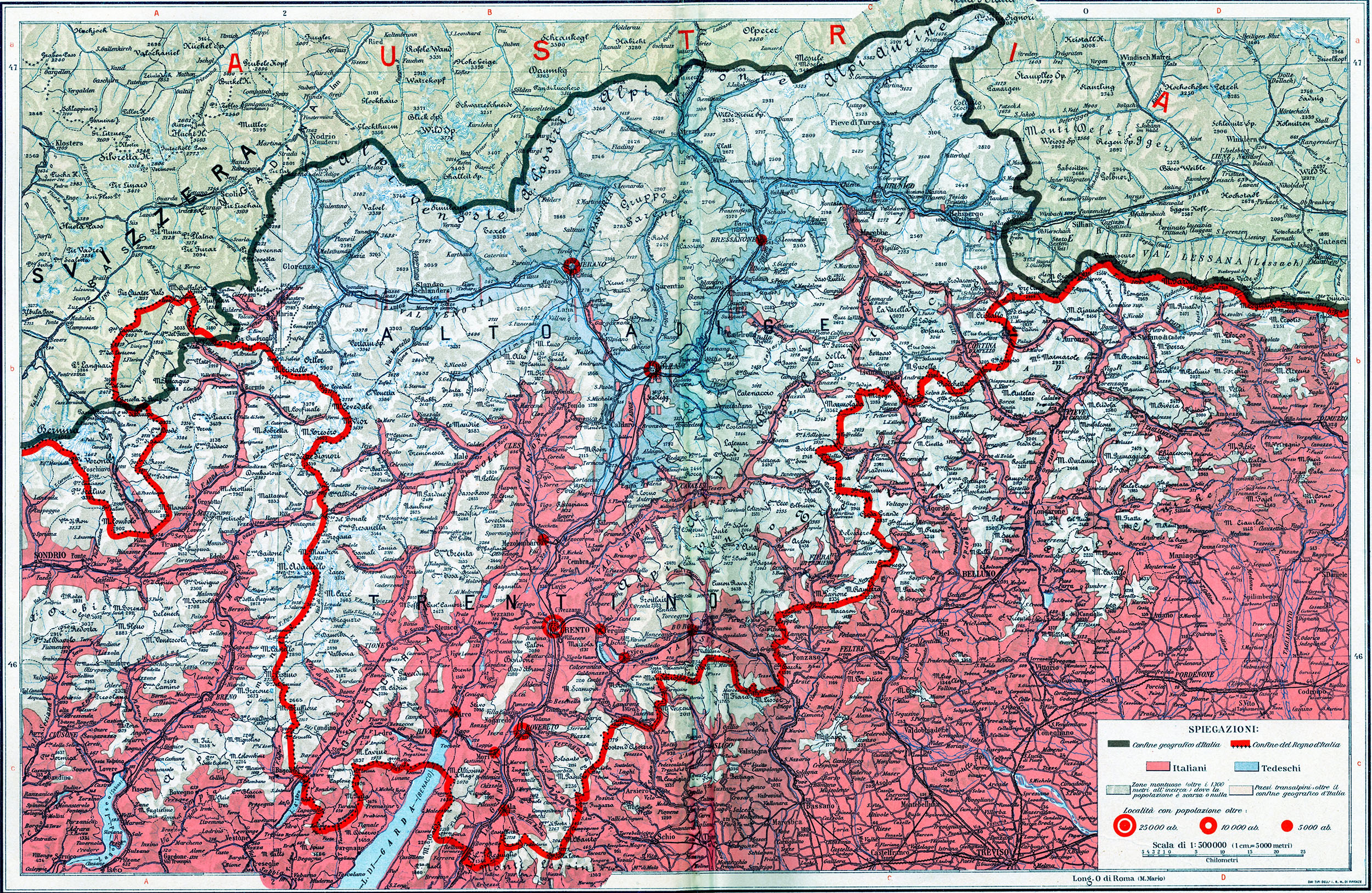
It is noteworthy to pinpoint that it is possible to see in the map that there were areas of Alto Adige with a majority of Italians/Ladins (in red), that now have disappeared, like around Salorno, Merano and near Switzerland (for example, in Val Venosta -near the Switzerland border- until the 1820s was spoken the "Romansh language"). The following is an interesting essay about this forced assimilation:
(read:also Archivio Alto Adige; Italiani a Merano e dintorni nell'Ottocento)
The Forced Germanization of the Italian Val Venosta
One of the last Ladin areas to pass to the German language was the Upper Val Venosta (Vinschgau). It was not a voluntary transition from Ladin to a new language, but a forced assimilation which is not often cited or discussed in Tyrolean historiography; indeed, it is often ignored. In the past, Tyrolean historiography was mainly focused on attempting to demonstrate the long history of German culture in South Tyrol from the conquest of the Bavarii onward. Even today, this attitude does not seem to have changed much among German authors.
However, in the 14th and 15th centuries Romansh was the only language used in the court of Glorenza (Glurns). This is an irrefutable sign that the population was exclusively Romansh and monolingual. Up to that time there were many cultural, social and economic contacts with the neighboring people of Müstair and the Engadine, who spoke the same language, which has left an impact on the local culture (architecture, toponymy). The Val Venosta, moreover, belonged to the diocese of Chur.
Around 1600, Romansh in the Val Venosta was in a position very similar to that of Ladin in the Val Gardena today, in other words quite strong. Until about 1620 the Abbey of Monte Maria (Marienberg) called upon the Capuchins of Müstair to preach to the people in Romansh. This demonstrates that the population of the Val Venosta was hardly bilingual at that time.
In 1898 a German historian wrote:
“The Val di Mazia (near Malles Venosta) was still Romansh in the 1600's, and even a century later Romansh was still very common in the Val Venosta. It has already been mentioned that Tubre in the Val Monastero passed to the German language only about 70 years ago, while in nearby Müstair (in Switzerland) Ladin is still spoken today, and even in Stelvio at the beginning of the 19th century there were still people who spoke Ladin.” [1]“Tubre was cleansed of the Romansh language only after 1750”, says an old history book. [2] The use of the term ‘cleansed’ (German: geräumt) demonstrates quite well the attitude of the Germans at that time. Indeed, the Romansh language was wiped out as a result of a prohibition against using the language. The German language was required for meetings, while the Ladin language was prohibited. Likewise the employment of Romansh maids and servants was prohibited, Romansh customs were prohibited, and even marriages with Romansh people were prohibited. The main promoter of these prohibitions was the abbot of Marienberg Abbey, Mathias Lang, infamous for his fanaticism.
The motive or excuse for this Germanization was the Reformation: it was feared that Protestant ideas could penetrate Catholic Tyrol through the Romansh language (“barbaric Romansh”, as it was also called), since the inhabitants of the neighboring Grisons are partly Protestant. It is of little importance that the prohibition of the language was said to be motivated by these fears. The truth is that when the leader does not understand the language of his subjects, the use of this language is criminalized.
Thus the Upper Val Venosta was Germanized. Despite the methods adopted — methods which anticipated those later used for the assimilation of minorities in the 20th century — the extinction of the Ladin language did not have such a rapid success. According to glottologists, Romansh-speakers still lived in the Upper Val Venosta in the 1820's. Today there are still many testimonies of Ladin heritage in the region: it can be observed in the local dialect, as well as in many toponyms.

The Romansh area during Charlemagne rule in the IX century.


The Rhaeto-Romance linguistic group occupied an area which in the medieval past included (using current geographical terminology) the Grisons, Alto Adige, Friuli, the eastern Alps, southern Bavaria and western Austria. Today, however, it includes only the small Romansh-speaking community in the Grisons, the even smaller community of Ladins on the Italian side of the Alps, and the Friulians. Note that the gradual disappearance of Raetians occurred due to extermination and forced assimilations performed by Germanics. In fact, all of current Austria, the eastern Alps, and a good part of the central Swiss Alps were linguistically Rhaeto-Romance before the arrival of these invaders; except for the small Romansh community in Switzerland, the Raetians beyond the Alps became extinct. Even the Italian Alto Adige was latinophone, while today the Ladins survive only in a very small area (Badia, Gardena, Fassa, Livinallongo, Ampezzano) and are reduced to a few tens of thousands of people.
This true genocide, cultural but also in part physical in the phase of the barbarian invasions of the Middle Ages, saw the areas of Rhaeto-Romance population gradually eroded (like a tide hitting the Alps).

the maps are very good
ReplyDelete