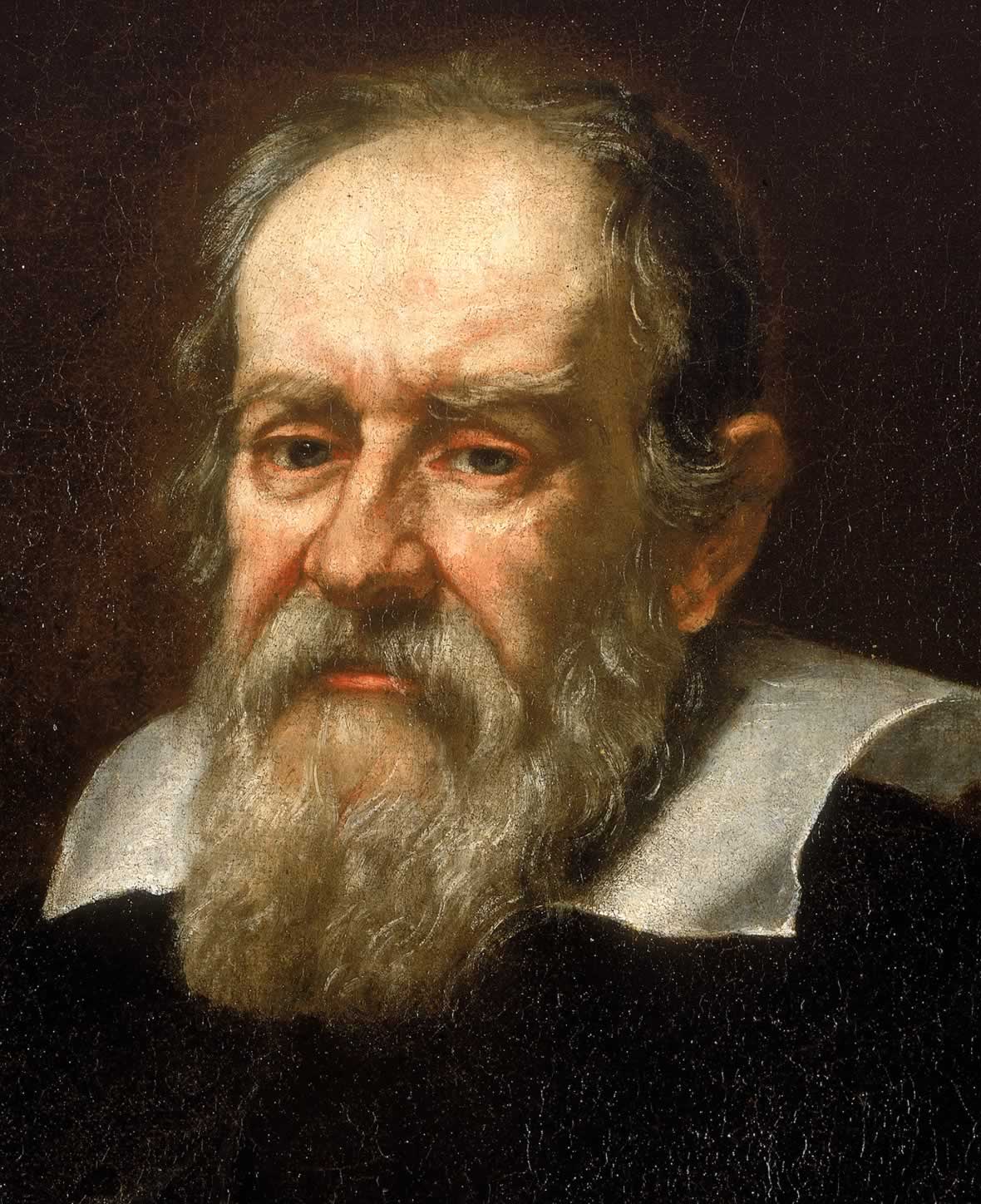
"There are several categories of scientists in the world; those of second or third rank do their best but never get very far. Then there is the first rank, those who make important discoveries, fundamental to scientific progress. But then there are the geniuses, like Galilei and Newton. Majorana was one of these". Enrico Fermi
This month I am going to write about Ettore Majorana, an Italian supergenius (https://pos.sissa.it/cgi-bin/reader/conf.cgi?confid=37) who disappeared in 1938 -just before WW2- and who seems to have emigrated to Venezuela. I remember to have had an interesting conversation about him with a nice cousin I had in Caracas, Velia: she died of cancer years ago, but I still remember her warm & friendly personality and I want to dedicate to her memory this month article.
I still remember -also- when she gave me thanks for having helped her sister to remain in her university and complete the 'Alma mater' graduation (I spent ten days -requested by her mother- going around in Caracas with this sister only in order to let her "survive" the terrible depression she had, because continuously "attacked" in the Universidad Central Venezuela while being labeled as a "sifrina engreida" (a rich & proud girl of Caracas top society): it seems that my "connections" in the communist groups of that university -of which I have spoken in my January article- helped to stop the harassment she was having and that was probably forcing Velia's sister to quit her studies in "periodismo".
About Ettore Majorana and his disappearance there are different explanations written in a lot of books and even in a few movies. The one I think is the most probable is the one that is related to his emigration to Venezuela (https://roma.corriere.it/notizie/cronaca/15_febbraio_04/procura-ettore-majorana-vivo-venezuela-il-1955-1959-d1a6aeda-ac7f-11e4-88df-4d6b5785fffa.shtml).
And that he was an Italian emigrant in Venezuela was "possibly" confirmed to my father personally by one of the managers working under his supervision, in the Banco Latino of Puerto La Cruz/Barcelona (eastern Venezuela): his surname was Majorana, born in Catania but not family related to Ettore Majorana. This manager told my father that he lived in Valencia in the 1950s and that he met in that city with Ettore Majorana, who admitted -talking privately in "catanese dialect" to him- to have left Italy in 1938 because he did not want to collaborate in the development of the atomic weapon. Sincerely, my father didn't know if this declaration was true or invented by this manager, but he always wondered: for what reason this serious person had to create this lie? This manager was the director of a bank branch and was considered a respected professional who only said serious things: for what reason he should have "invented" this lie?
Of course, we all know that this worldwide famous Ettore Majorana was born in the region of Sicily where was born more than two thousands years ago another supergenius: Archimedes, the father of the "Mathematical Physics". Since his twenties he was working with Enrico Fermi (the 1938 Nobel in Physics) -in the so called "Group of Spanisperma" of Rome- in the studies for the development of the first atomic bomb, a powerful armament that could have given the Axis the victory in WW2: it seems that he preferred to disappear in 1938, in order not to give the information about his studies & discoveries to Mussolini's fascism. Indeed, Majorana’s comprehension of the Physics of his time, according to Enrico Fermi, had a profundity and completeness that few others in the world could match: Majorana was one of the first researchers to understand the Quantum physics of the Black Holes in the Universe. He discovered the anti-particles now called -in order to honor him- the "Majorana Fermions".
Furthermore recently, on August 2018, a strong evidence for the existence of Majorana bound states (or "Majorana anyons") in an iron-based superconductor, which many alternative trivial explanations cannot account for, was reported by researchers in Prof. Gao Hong-jun's team and Prof. Ding Hong's team at Institute of Physics (Chinese Academy of Sciences and University of Chinese Academy of Sciences), when they used scanning tunneling spectroscopy on the superconducting Dirac surface state of the iron-based superconductor. It was the first time that Majorana particles were observed in a bulk of pure substance.
Finally, let me pinpoint that if true that Majorana died in Valencia, the only way to know if he really lived in Venezuela would be to find his tomb and get his DNA checked with the one of his relatives in Catania. But that is going to be very hard to be done....
The following are excerpts from an article written by M. Hanks about Majorana's life, disappearance and possible last years in Valencia (Venezuela):
Ettore Majorana was born in Catania and at an early age joined Enrico Fermi’s “Via Panisperna boys”, a group of young researchers credited with the first discovery of slow neutrons, encompassing an energy range of 1–10 eV. This famous discovery would lead to the development of the nuclear reactor, which later helped facilitate construction of the atomic bomb. Majorana had a penchant for mathematics, and having attended university to study engineering in 1923, shifted his focus to physics within five years, following his uncle Quirino, whose background in physics had perhaps influenced the young scientist.
Majorana’s early papers dealt with atomic spectroscopy, but in 1932, he had taken interest in the work of Joliot and Joliot-Curie, giving consideration to the idea of a new particle bearing a neutral charge. Impressed with the idea, Enrico Fermi urged the young physicist to flesh out the idea in a scientific article, but considering many of his ideas to be either obvious, or simply boring, he neglected to do so. Within the year, the discovery of a new particle, the neutron, was awarded to James Chadwick, along with a Nobel Prize for his work.
The self-dismissive attitude Majorana espoused in regard to his 1932 discovery would dog him throughout his life, despite authoring a number of papers, some of them unpublished until long after his death, which dealt with subjects ranging from atomic spectroscopy and relativity, to the creation of what is known today as the "Majorana equation", as well as its associated "Majorana mass" and "Majorana particles". Lengthy manuscripts, as well as entire issues of scientific journals, have focused on his work and contributions to the study of Quantum physics, and he worked alongside many of the great minds of his day, including Werner Heisenberg and Niels Bohr. Following a period of heath difficulties and family issues, Majorana in 1937 became a professor of theoretical physics at the University of Naples, where his attitudes led to him becoming increasingly withdrawn from the world.
Majorana's last-published paper, in 1937, was an elaboration of a symmetrical theory of electrons and positrons. In that year, Majorana predicted that in the class of particles known as Fermions there should be particles that are their own antiparticles (the so-called "Majorana Fermions"). Indeed the solution of Majorana's equation yields particles that are their own anti-particle, now usually referred to as "Majorana Fermions", that seems -possibly- linked to the "Black Holes" of the Universe. In April 2012, some of what Majorana predicted may have been confirmed in experiments on hybrid semiconductor-superconductor wire devices. These experiments may potentially lead to a better understanding of Quantum mechanics and may help build a Quantum computer. There has also been speculation that at least some part of the "missing mass" in the universe, which cannot be detected except by inference of its gravitational influences, may be composed of Majorana particles.
Majorana disappeared in unknown circumstances during a boat trip from Palermo to Naples on 25 March 1938. Despite several investigations, his body was not found and his fate is still uncertain. He had apparently withdrawn all of his money from his bank account prior to making his trip to Palermo. Of course, in the opinion of many researchers, if he was going to commit suicide or go to a monastery because of a religious crisis -as someone has suggested- why he withdrew a lot of his money from his own bank account just before this boat trip? Obviously that money was going to be used for something, like a travel to South America where he could have lived for decades without being discovered.
In 2008, a strange series of events led to what many would view as a breakthrough in the case, when a caller phoned in to an Italian television program called "Chi l’ha visto" (Who saw him), telling an unusual story. The caller claimed that in 1955, while in Caracas, Venezuela he had talked with a friend who claimed he had met Majorana while living in Argentina. The caller was introduced to this man, now living in Caracas, who went by the name “Bini”, though it was confirmed by the friend that Bini was, in fact, the missing physicist.
Tommaso Dorigo, an experimental physicist at CERN translated the caller’s testimony in a blog post in June, 2011, which reads as follows:
"I left to Venezuela because of disagreements with my father in April 1955. Once in Caracas, I went to Valencia with Ciro, a Sicilian friend, who presented me to a Mr. Bini. I connected Bini to Majorana thanks to Carlo, an Argentinian. He said “Do you realize who that guy is ? He’s a scientist. He’s got a brain you can’t imagine. He is mr. Majorana”. They had met in Argentina. He was of average height, with white hair, few and wavy. The white hair of a man who was once black-haired. One could see it from the fact that he wore his watch over his shirt, so to wash his hands he opened his sleeves and black hair could be seen. He was shy, often silent, and if you invited him to a night club he wouldn’t come. He might have been 50-55 years old. He had a roman accent but one could see he was not. One could also see he was well-learned. He looked like a prince. I sometimes told him “What the hell do you live for ? You are always sad”. He said he worked, we dined together, then he would disappear for 10-15 days. He had a yellow Studebacker. He only paid for the gas, otherwise he looked always penniless. Sometimes I used to tell him “You care so much for this car and have all these papers”. These were sheets with numbers and commas, bars. He never wanted to be photographed, and since I once had to lend him 150 bolivars, I sort of blackmailed him, I asked him to get a picture of him to send it to my family. He was shorter than I was. When I found the picture I decided to speak, otherwise it was useless for me to say I had known Majorana."
The story, if true, is certainly interesting, and most interesting of all had been the caller’s claim that a photograph had been obtained of the man he thought had been Majorana. In fact, this information was considered compelling enough that the Rome Attorney’s office began its own inquiry into the case, which resolved in an analysis of the photograph in question by the Carabinieri (Italy’s military police), which alleged that there were ten specific points which drew similarities between the subject in the photo, purportedly taken in 1955 in Argentina, and earlier photos of Ettore Majorana.
Finally, in February of 2015, an official statement was issued by the Rome Attorney’s Office, stating that Majorana had indeed lived well after his disappearance, having retreated to South America where he lived until his death. “Ettore Majorana, the brilliant physicist… that some experts rank among Newton and Einstein [and thought to have] died mysteriously in 1938, was alive in the period 1955-1959, and was voluntarily living in the Venezuelan city of Valencia,” reported the Italian Corriere della Sera.
Indeed some of the Majorana family members, as well as researchers involved, felt that Majorana had gone into hiding, fearing the ethical and logistical implications on his work could help facilitate the creation of atomic weaponry.
Friday, February 1, 2019
Wednesday, January 2, 2019
ITALIANS IN VENEZUELA
We are in 2019 and I want to dedicate this month issue of my "Researchomnia" to two relatives I have in Venezuela and that I remember making my life happy since the distant 1959: Gloria & Susy. In those year we were 3 kids playing together every weekend Draughts, Chess, Chinese checkers, Chopsticks, Battleships and many other games that left a nice memory in my childhood. Later circumstances divided us and we had our personal life with different studies, works, marriages, etc...but every time we got in contact some "special" brotherly feeling arose between us.
For example, I remember that in my twenties I was always complaining that in Venezuela the political-economical-social situation was going to deteriorate and a lot of people smiled at me thinking that I was half-crazy or something similar...but Gloria & Susy always showed respect toward me and my ideas.
I pinpointed in those years that I was going to left the country (that in those years was enjoying the petro-boom after the 1973 oil crisis and was called the "Venezuela saudita" because of the richness created by the oil revenues) and move back to Italy, the country were I was born. My father was one of the 300,000 Italians who moved to the oil-rich Venezuela after WW2 devastated Italy. As a consequence I was brought to Caracas since child and -while doing between Italy and Venezuela my primary and secondary schoolyears- I was seeing & understanding (as an Italian in Venezuela) the differences between the two countries
Let me explain better in more detail.
Italy in those decades was a country that had a population with similar ethnic characteristics, the same language and religion but that historically has been divided in small political entities since the Middle Ages (because the Popes wanted to have his own state in central Italy and until the XIX century, when they started to lose power in Europe, they did not allow a unified Italy). Venezuela had one fundamental difference with Italy: it was the typical Latin-American country were nearly all the rich were Whites (mostly descendants from the Spanish colonists) while the majority of local population was poor and made of Blacks, Indians, Mulattos & mixed-race people (and sadly a huge amount of them -may be more than one third- was extremely poor).
When the Italians started to move to Venezuela mainly in the 1950s, they did it together with hundreds of thousands of Spanish, Portuguese and other Europeans. They found a country of just 6 million Venezuelans and many of them soon started to enrich with the development of the country. Most of these local Venezuelans were uneducated and poor, but with the improvements created partially by the European emigrants came also the betterment of all the Venezuela society. And came also the social ideals of equality that characterized the European society since the French revolution.
Venezuela had also a special characteristic, according to some historians and researchers (please read -for example and if interested- "The Whitening Project in Venezuela, ca.1810-1950 " by A.Alvarez https://etd.library.vanderbilt.edu/available/etd-12072016-162442/unrestricted/Alvarez.pdf): in the XIX century it was a country a bit similar to Haiti where the whites were "wiped out" by the non-whites (mostly Blacks) . I mean that after the white-ruled independence period, when Bolivar (a Vasque descendant) seemed to have created a country that would be at the level of the United States, the mixed-race "llaneros" of Paez took control of the country and in some cases killed the Spanish-descendants white population of Venezuela (as formerly did Boves and his bloody "llaneros" in 1814: https://www.aporrea.org/internacionales/a96542.html). The result was a political anarchy that practically reduced Venezuela to a very low level of development. The only luck for Venezuela was that the massacre of Whites was not full & complete like in Haiti (that is now the poorest country in the Caribbean) and so in the early XX century the country started to return to the civilized levels reached during Bolivar leadership.
But this "special" characteristic of Venezuela started to show up again in the late XX century: I remember to have personally experienced the "hostile feeling" of the majority of mixed-race Venezuelans against the million of Europeans immigrated in the 1950s (and who had enriched in the oil rich country while in many cases were controlling the economy, mainly in the industrial and service areas). It was a bit like a time-bomb waiting to explode: only the local Venezuelans who were Whites accepted the integration of the Europeans, but for the mixed-race people the rejection was growing year after year (in 2013 the Washington Post wrote that "Venezuela was the most racist country in America": please read http://elestimulo.com/climax/la-venezuela-multicultural-aun-esconde-racismo/). And it was aggravated by the growing corruption of the rich people (nearly all white, as said before) of Venezuela
Anyway, I want to pinpoint that I disagree with the theory that Venezuela has "real" racism (of Whites and/or non-Whites). I think it is a country where the economical situation between rich Whites and poor mixed-race people is used as an excuse for political reasons. In Venezuela Blacks can reach top levels in the society without a lot of difficulties (while this has not happened in the USA -for example- until the 1970s). Furthermore, I personally know many "mulatto" and "mestizo" friends who enjoyed top socio-economical positions in Caracas, and in some cases were happily married with White women. Of course some problems and difficulties between people of different races & ethnicity existed in Venezuela, but were similar -more or less- to the ones experienced by a dark haired southern Italian living in blonde haired north France or Holland, to give an example.
However the Italians in Venezuela -going back to our initial topic- soon reached top economical positions in Venezuela and I myself enjoyed some of this situation thanks also to my father who become a vice-president of one of the best banks in Caracas. But when I started to study in the Universidad Central de Venezuela (UCV) for "Administracion y Contaduria", I found myself in a place practically dominated by leftist organizations. After the first months there, I was continuously contacted for possible enrollment in some of the many "revolutionary" movements that existed in this 'Ateneum'. I always refused any inscription, but I had a love flirt -during those months- with a girl who was the daughter of the secretary of the Venezuela Communist Party. She opened to me the door of the inner circle of this organization (that was weak in those years) and so with her I participated in some of their political reunions, where I did a bit of friendship with their leader Gustavo Machado and some former guerrilla militants.
I remember that some of them usually discussed about how to get political control of the country: the guerrilla movement seemed at a loss in the 1970s, but they pinpointed that they could win the vote (in normal elections) of the masses made of poor Venezuelans if the could find the leader able to do this achievement. They argued that the instructional levels of the poor citizens were improving after years of alphabetization and so they could be instructed to vote for themselves against the parties of the "capitalists" (like AD & Copei); and they noted also that the rich class of Venezuelans were falling more and more in a corruption process, that was creating a gap of confidence in the society and alienating the poor mixed-race people against the minority of rich "capitalist" Whites.
Sincerely, I had to accept that something of their "plan" was effectively going on, when I saw the corruption of president Carlos Andres Perez who was considered the richest man in South America with his powerful "12 apostles" & related families (the Mendoza, the Boulton, the Cisneros, the Pocaterra, etc..) supporting him. The first clear evidence came in 1989 with the "Caracazo", followed in 1992 by the "golpe" of Chavez (a Barinas "llanero", who was the perfect leader "dreamed" in the 1970s by the Venezuelan communists).
Chavez was a typical mixed-race Venezuelan born in Barinas plains and so he was a "llanero", who seemed the heir of the Paez "llaneros": he has damaged Venezuela development in a similar way to what happened after the Bolivar era. As of 2018 nearly 3 million Venezuelans have moved out of the country -with the economy dangerously shrinking- since he become president in 1999 (I still remember the smile of those who looked at me as if I were an half-crazy doomsayer, when I predicted all this disaster thanks to my 1970s "contacts" in the UCV's communist party)........and what is more worrisome is that the International Monetary Fund has predicted a monster-inflation in Venezuela of nearly ten million percent by the end of 2019! Now in January 2019 is at an astonishing 1300,000 percent: imagine that the 300,000 percent was the inflation in 1930 Germany that opened the doors to Nazism! That means that nobody knows what can happen in Venezuela.....
An anti-Chavez march in 2004 eastern Caracas Anyway, let's hope that something good can appear on the horizon of the beautiful country that is Venezuela....and so the remaining community of the Italians in Venezuela can enjoy again something of the wonderful 1950s/1960/1970s.
These decades were a period when Caracas was like the Abu Dhabi of today and the country was nicknamed the "Venezuela saudita" (please read my 1981 essay http://researchomnia.blogspot.com/2012/02/estudio-sobre-los-aspectos-etnico.html, done for the "Universita di Genova"). It was the country judged rich & famous in Miami, where the Venezuelan tourists were nicknamed "..'ta barato, dame dos" (meaning that they bought everything two times, because they were very rich and everything seemed to them to be "cheap")
The following are excerpts written by me on the Spanish Wikipedia inside the article "Italianos en Venezuela" (if interested the reader can see the reduced English version here: https://en.wikipedia.org/wiki/Italo-Venezuelans):
ITALIANS IN VENEZUELA (Inmigración italiana en Venezuela)
La inmigración italiana en Venezuela es muy destacada y sobresaliente en este país sudamericano. Se compone de ciudadanos venezolanos con progenitores o antepasados venidos de Italia, así como de ciudadanos italianos con la residencia en el país suramericano. El término italo-venezolano está muy extendido y se refiere a alguien nacido en Italia con residencia o nacionalización en Venezuela, como también a alguien nacido en Venezuela con algún antepasado italiano.
Historia
La presencia de italianos en Venezuela se remonta al navegante genovés Cristobal Colón que desembarcó en Macuro en 1498, seguido del explorador Américo Vespucio (1499) y del marino Giacomo Castiglione (hispanizado cual "Santiago Castellón") fundador de Nueva Cádiz en la Isla de Cubagua en 1500 (asentamiento creado para la explotación de las perlas). Francisco de Graterol, nacido hacia 1517, escribano de Venecia, forma parte de los 600 colonos de la expedición del alemán Jorge von Spira, alto funcionario de la casa Welser, que desembarca en Santa Ana de Coro, el 6 de febrero de 1535. Tiempo después viaja con el segoviano Juan de Villegas para fundar a Barquisimeto y se establece en El Tocuyo donde ejerce cargos importantes de gobierno local. Entre los años 1544-1553, vivió en la población de El Tocuyo, el florentino Galeotto Cei, que años después publicó "Viaggio e Relazione delle Indie 1539-1553", y aquí, se hace mención por primera vez, de la palabra hallaca, en italiano florentino "ayacca".
En la época colonial solamente algunos centenares de italianos (como Filippo Salvatore Gilii, José Cristóbal Roscio, Francisco Isnardi) llegaron a Venezuela con un leve incremento durante la guerra de independencia, entre los que se incluyen el corsario Giovanni Bianchi, el coronel Agostino Codazzi, Constante Ferrari, Gaetano Cestari, y el general Carlos Luis Castelli.
Varios italianos dedicaron sus vidas por la independencia de Venezuela en los campos de batalla, como Luigi Santinelli (de Napoli), Bartolomeo Chaves Gandulfo (de Genova), Carlo Cavalli y Cristòbal Pallavicini (del norte de Italia). Algunos murieron: Antonio Pareto, probablemente el primer italiano en sacrificar su vida por la independencia de Venezuela (junto al Dr. Antonio Nicolás Briceño formuló y actuó un plan para liberar a Venezuela en 1813); Teniente Coronel Passoni, luchó al lado de Bolívar y murió en batalla el 16 de febrero de 1818 (fue el edificador del Fuerte Brión); Manfredo Berzolani, fusilado por el ejército español en Valencia el 10 de junio de 1818; Gaetano Cestari, nombrado en 1818 teniente coronel ayudante general en Angostura, murió en combate en la campaña del Sur; el Capitán Mayor Perrego, muerto en la batalla de La Gamarra, el 27 de marzo de 1819 (su nombre fue celebrado por el mismo Simón Bolívar).
El jurista y diputado Juan Germán Roscio fue el redactor de la primera constitución republicana de la América Hispana promulgada en Caracas el 21 de diciembre de 1811. Roscio es considerado un precursor de la defensa de los derechos civiles y la lucha contra la discriminación en Venezuela y toda América, por su defensa de la madre mestiza (Paula María Nieves, nativa de La Victoria).
En 1841 el general Castelli viajó a Italia y trató de hacer llegar a Venezuela un barco con unos 300 italianos, que desafortunadamente se hundió en el Mediterráneo apenas salido del puerto de Livorno (Toscana). Aunque la mayoría de estos italianos renunció a completar el viaje hacia La Guaira, uno de ellos de nombre Domenico Milano logró realizar el viaje y llegó a Caracas en 1843. Milano (que era un ingeniero agrónomo) fundó los primeros "estudios agronómicos superiores" de Venezuela con el establecimiento de la Escuela Normal de Agricultura (actual Facultad de Agronomía de la Universidad Central de Venezuela) por la Diputación Provincial de Caracas el 9 de diciembre de 1843.
Otros italianos destacados hasta finales del siglo XIX serían Giovanni Battista Dalla Costa (quien siendo gobernador de Guayana erige en Angostura la primera estatua del Libertador Simón Bolívar el 28 de octubre de 1869) y el general Nicolás Rolando, caudillo militar y político. Cuando se unifica el Reino de Italia el 18 de febrero de 1861 y Venezuela se encuentra bajo la dictadura del general José Antonio Páez (1861-1863), ambos gobiernos suscribieron el denominado "Tratado de Amistad, Comercio y Navegación", firmado en Madrid el 19 de junio de 1861, con Ratificación Ejecutiva del 6 de agosto de 1862 y Canje de las Ratificaciones en París, el 20 de septiembre de 1862
En 1874 el presidente Antonio Guzmán Blanco compra gran parte de la Hacienda Araira con la finalidad de crear una colonia agrícola con inmigrantes franceses. El 21 de septiembre de ese año, mediante decreto, creó la Colonia Bolívar. Los primeros en asentarse en el lugar fueron quince familias francesas: los Clement, los Olivier, los Penau, entre otros. No todos permanecieron mucho tiempo en el lugar. Tres años más tarde, el 17 de febrero de 1877 llega al puerto de La Guaira el barco Il Veloce con sesenta y cuatro familias de origen italiano, específicamente de la provincia de Belluno. Esas familias se asentarán en la Colonia Bolívar. Entre ellos están: los Begnosi, Bertorelli, Blondi, Brignole, los Dall' Ó (Daló), Dal Magro, De Lion, Fregona, Livinalli, Melcior (Melchor), Pittol, Pellin, Possamai, Sandon, Sponga, Sumabila, Zanella, entre otros.
En el año 1882, José María González, gobernador de la Colonia Bolívar, gestionó para que estas familias, que estaban dispersas en distintos lugares del distrito, se establecieran en dicha colonia. El Gobierno nacional entonces, deslindó parcelas a las familias italianas en la Colonia Bolívar, en donde fundaron el pueblo de Araira.
El censo venezolano de 1891 registró 3030 inmigrados procedentes del Reino de Italia, es decir, poco más del 6% del total de la población extranjera en Venezuela. Muchos de estos italianos (que reclamaban deudas del dictador Cipriano Castro) sufrieron persecuciones en ocasión del Bloqueo naval a Venezuela de 1902-1903 hecho por Italia junto a Inglaterra y Alemania, pero con Juan Vicente Gómez en 1908 la situación se normalizó.
A principios del siglo XX varios miles de italianos emigraron a Venezuela (la mayoria desde localidades del sur de Italia, como Salerno -https://www.youtube.com/watch?v=xDhdEhOP77s- y alrededores), consiguiendo buenas condiciones de trabajo, aunque la comunidad siguió siendo relativamente pequeña. Pero en los años 1950 el presidente Marcos Pérez Jiménez promovió la inmigración europea, y así más de 300 000 italianos llegaron a Venezuela representando para la época más del 7% de la población venezolana. Cabe destacar la presencia de muchos italianos en 1952 en la creación de la Colonia agrícola de Turén, la más ambiciosa experiencia de este tipo jamás realizada en un país caribeño.
Los italianos en el censo nacional de 1961 eran la Comunidad Europea más grande de Venezuela (delante de la española y portuguesa). En 1976 la Dirección de Estadísticas de Venezuela declaró que había 210.350 residentes italianos y 25.858 italianos "naturalizados" (o sea que habían obtenido la ciudadanía venezolana).
La escritora Marisa Vannini calculaba que en los años ochenta los ítalo-venezolanos eran casi 400.000, incluyendo (además de los italianos emigrados de Italia) más de 120.000 descendientes de la segunda generación, lo que representaba el 3% de la población. Actualmente la lengua italiana en Venezuela está influenciando con algunos modismos y palabras prestadas al español venezolano y está experimentando un renacimiento notable entre los ítalo-venezolanos de la segunda y tercera generación.
Santander Laya-Garrido estimaba que los venezolanos con por lo menos un abuelo italiano pueden ser casi un millón al principio del siglo XXI (como el presidente de Venezuela Raúl Leoni, cuyo abuelo era un refugiado italiano masón del siglo XIX). El embajador de Italia en Venezuela en 2010 estimaba que un 5% a 6% de la población venezolana actual tiene un origen italiano, aunque algunos estudiosos calculan que se alcanza el 10% si se incluyen todos los descendientes de italianos desde los tiempos de Cristoforo Colombo (cuando varios italianos —para evitar la prohibición española de no autorizar la llegada al Nuevo Mundo a los no nacidos en la península ibérica— llegaron ilegalmente cambiándose el apellido en forma hispanizada y omitiendo el lugar de nacimiento).
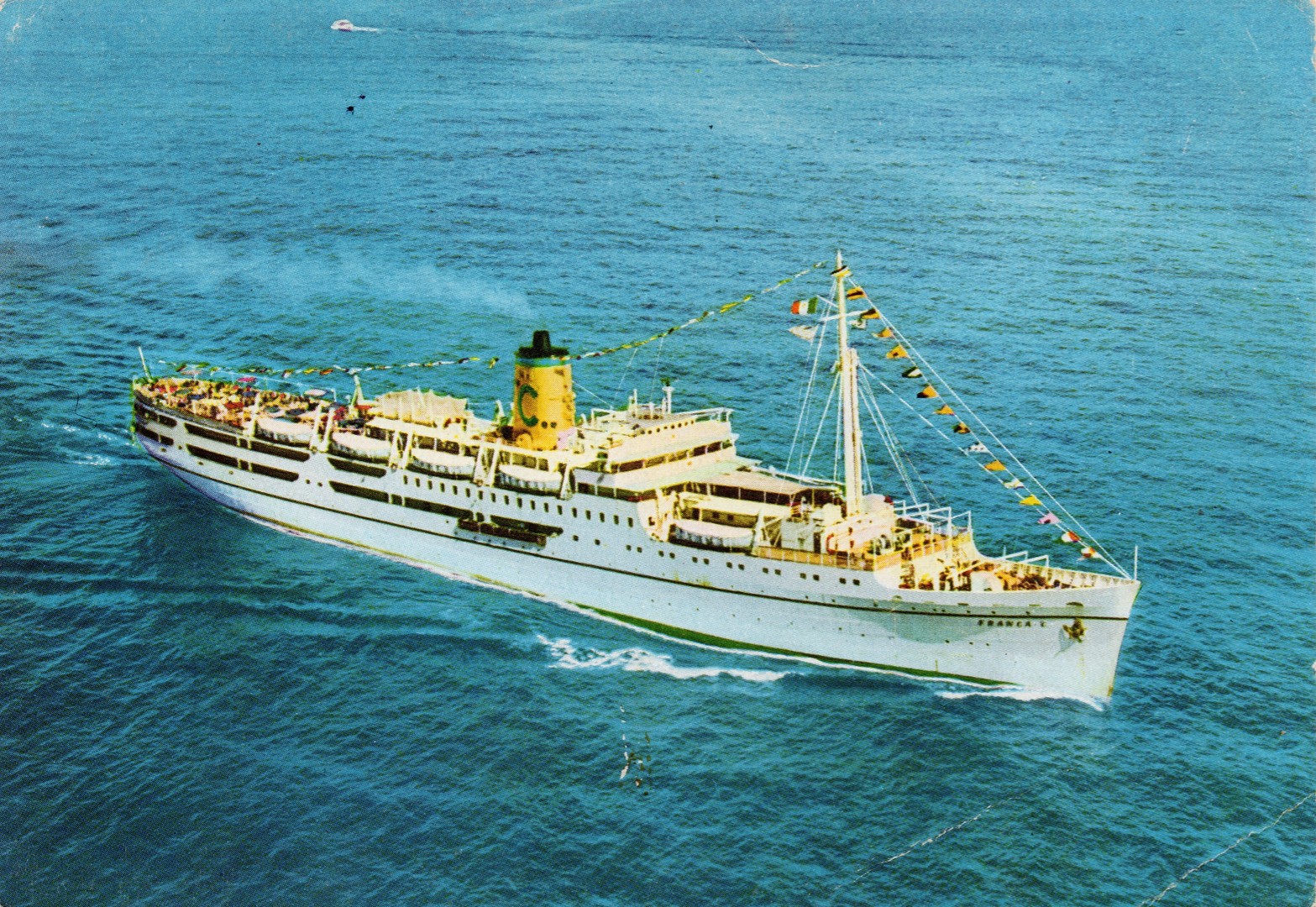
El Transatlantico italiano "Franca "C" trajo muchos italianos -como yo y mis padres- desde Italia al puerto de La Guaira en los años cincuenta (the Italian "Franca C" transported in the 1950s many Italians -like me & my family- to La Guaira from Italy) Actividades principales
Inicialmente la agricultura era una de las actividades principales de la comunidad italiana en Venezuela. En los años cincuenta muchas familias italianas se mudaron de áreas pobres de la península a comunidades agrícolas venezolanas, como la "Colonia Turén" del estado Portuguesa. La inmigración italiana fue un factor decisivo en la modernización de la producción (industrial y agropecuaria) y en las actividades comerciales en áreas urbanas y rurales venezolanas, como también en la mejoría del nivel de vida.
Pero la mayoría de los italianos se concentró en actividades comerciales, industriales y de servicios terciarios en la segunda mitad del siglo XX. En estos sectores los italianos alcanzaron lugares de predominio en la economía venezolana.
Los principales periódicos italianos son "Il Corriere di Caracas" y "La Voce D'Italia", publicados en Caracas. La principal institución educativa es la escuela "Agustin Codazzi" de Caracas (con cursos desde la primaria hasta el bachillerato italiano).
Desde 2002, el gobierno italiano se ha hecho promotor de una provisión legislativa para hacer obligatorio el estudio del idioma italiano, como segunda lengua (extranjera) en las escuelas secundarias públicas de Venezuela.
Tambien en el deporte los italianos obtuvieron resultados importantes, como en el futbol donde Mino D'Ambrosio fue responsable con el hermano Pompeo de la época de oro del Deportivo Italia. En efecto el principal equipo de fútbol de los italo-venezolanos es el Deportivo Italia, con sede en Caracas, que alcanzó en la llamada "Era D'Ambrosio" renombre mundial al ganar varios campeonatos nacionales y participar en la Copa Libertadores en los años sesenta y setenta (consiguiendo el famoso "Pequeño Maracanazo").
Los italo-venezolanos han obtenido significantes resultados en la sociedad contemporánea de Venezuela. La embajada italiana calcula que en el año 2002 casi 1/3 de las industrias venezolanas, no relacionadas con la actividad petrolera, eran de propiedad y/o administradas por los italo-venezolanos directamente o indirectamente. Por ejemplo, una de las áreas de la sociedad venezolana que ha sido mayormente influenciada por los italianos es la de la gastronomía, con su industria alimentaria relacionada. En efecto el consumo de pasta en Venezuela es segundo en el mundo solamente al de la misma Italia: los espaguetis son considerados un plato fundamental en la dieta de los venezolanos.
Otro sector de la economía donde los italianos privilegiaron fue la industria del calzado, especialmente en el área metropolitana de Caracas. Entre los años 1950 y 1970 se produjo en Venezuela un auge espontáneo de la industrialización y muchos de los grandes talleres de producción fundados por los inmigrantes se convirtieron con el paso del tiempo en fábricas e industrias de distribución masiva. Entre ellas se encontraba el área del calzado, un negocio que fue dominado hasta en un 70% por los inmigrantes italianos en este país.
En la comunidad italiana —actualmente una de las más importantes de Venezuela— hay Presidentes de la República (como Jaime Lusinchi y Raúl Leoni), empresarios (como Giacomo Clerico y el ing. Enrique Delfino Arriens, que con su "Constructora Delpre" ha levantado en Caracas los más altos rascacielos de Sudamérica (Parque Central), empresarios (como Pompeo D'Ambrosio, Tito Abbo y Eddo Polesel), deportistas (como Johnny Cecotto, Gabriel Cichero, Francisco Cervelli, Giovanni Savarese), artistas (como Renny Ottolina, Aldo Donà, Yordano y Franco De Vita), modelos internacionales (como Daniela Di Giacomo y Viviana Gibelli), escritores como Vicente Gerbasi y Edoardo Crema; ingenieros navales como Mario Masciulli, pintores como Emilio Boggio y Nedo Mion Ferrario, periodistas como Antonio Pasquali y Margarita D'Amico; científicos como (Luis Razetti, Augusto Bonazzi, Fernando Giuliani) y muchas otras personalidades. Cabe destacar que habían doce parlamentarios de origen italiano en el Congreso de Venezuela en 2001.
Los italianos censados por el consulado en Venezuela son alrededor de 130.000 en el 2008, lo que sigue colocando a Venezuela como el país con la tercera comunidad italiana en toda América Latina luego de Argentina y Brasil. A pesar de los problemas económicos y sociales del país que afectan también la colonia, esta sigue siendo una presencia importante y recibe mucho apoyo del Consulado General en Caracas con la acción de Giovanni Davoli, cónsul desde 2009.
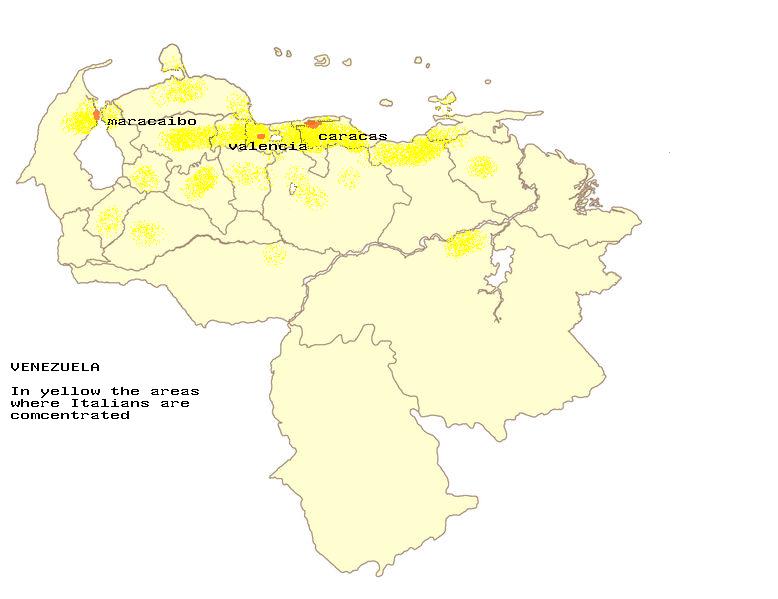
En las áreas metropolitanas de Caracas, Valencia y Maracay se concentra la mayoría de los italianos llegados después de la Segunda Guerra Mundial. En efecto actualmente la principal comunidad de italianos en Venezuela es la de Caracas, que cuenta como principales puntos de congregación la "Iglesia de Pompei" en la Alta Florida, la "Casa de Italia" con la Plaza Italia (especialmente en la segunda mitad del siglo XX) y ahora el "Centro Italo-Venezolano".
For example, I remember that in my twenties I was always complaining that in Venezuela the political-economical-social situation was going to deteriorate and a lot of people smiled at me thinking that I was half-crazy or something similar...but Gloria & Susy always showed respect toward me and my ideas.
I pinpointed in those years that I was going to left the country (that in those years was enjoying the petro-boom after the 1973 oil crisis and was called the "Venezuela saudita" because of the richness created by the oil revenues) and move back to Italy, the country were I was born. My father was one of the 300,000 Italians who moved to the oil-rich Venezuela after WW2 devastated Italy. As a consequence I was brought to Caracas since child and -while doing between Italy and Venezuela my primary and secondary schoolyears- I was seeing & understanding (as an Italian in Venezuela) the differences between the two countries
Let me explain better in more detail.
Italy in those decades was a country that had a population with similar ethnic characteristics, the same language and religion but that historically has been divided in small political entities since the Middle Ages (because the Popes wanted to have his own state in central Italy and until the XIX century, when they started to lose power in Europe, they did not allow a unified Italy). Venezuela had one fundamental difference with Italy: it was the typical Latin-American country were nearly all the rich were Whites (mostly descendants from the Spanish colonists) while the majority of local population was poor and made of Blacks, Indians, Mulattos & mixed-race people (and sadly a huge amount of them -may be more than one third- was extremely poor).
When the Italians started to move to Venezuela mainly in the 1950s, they did it together with hundreds of thousands of Spanish, Portuguese and other Europeans. They found a country of just 6 million Venezuelans and many of them soon started to enrich with the development of the country. Most of these local Venezuelans were uneducated and poor, but with the improvements created partially by the European emigrants came also the betterment of all the Venezuela society. And came also the social ideals of equality that characterized the European society since the French revolution.
Venezuela had also a special characteristic, according to some historians and researchers (please read -for example and if interested- "The Whitening Project in Venezuela, ca.1810-1950 " by A.Alvarez https://etd.library.vanderbilt.edu/available/etd-12072016-162442/unrestricted/Alvarez.pdf): in the XIX century it was a country a bit similar to Haiti where the whites were "wiped out" by the non-whites (mostly Blacks) . I mean that after the white-ruled independence period, when Bolivar (a Vasque descendant) seemed to have created a country that would be at the level of the United States, the mixed-race "llaneros" of Paez took control of the country and in some cases killed the Spanish-descendants white population of Venezuela (as formerly did Boves and his bloody "llaneros" in 1814: https://www.aporrea.org/internacionales/a96542.html). The result was a political anarchy that practically reduced Venezuela to a very low level of development. The only luck for Venezuela was that the massacre of Whites was not full & complete like in Haiti (that is now the poorest country in the Caribbean) and so in the early XX century the country started to return to the civilized levels reached during Bolivar leadership.
But this "special" characteristic of Venezuela started to show up again in the late XX century: I remember to have personally experienced the "hostile feeling" of the majority of mixed-race Venezuelans against the million of Europeans immigrated in the 1950s (and who had enriched in the oil rich country while in many cases were controlling the economy, mainly in the industrial and service areas). It was a bit like a time-bomb waiting to explode: only the local Venezuelans who were Whites accepted the integration of the Europeans, but for the mixed-race people the rejection was growing year after year (in 2013 the Washington Post wrote that "Venezuela was the most racist country in America": please read http://elestimulo.com/climax/la-venezuela-multicultural-aun-esconde-racismo/). And it was aggravated by the growing corruption of the rich people (nearly all white, as said before) of Venezuela
Anyway, I want to pinpoint that I disagree with the theory that Venezuela has "real" racism (of Whites and/or non-Whites). I think it is a country where the economical situation between rich Whites and poor mixed-race people is used as an excuse for political reasons. In Venezuela Blacks can reach top levels in the society without a lot of difficulties (while this has not happened in the USA -for example- until the 1970s). Furthermore, I personally know many "mulatto" and "mestizo" friends who enjoyed top socio-economical positions in Caracas, and in some cases were happily married with White women. Of course some problems and difficulties between people of different races & ethnicity existed in Venezuela, but were similar -more or less- to the ones experienced by a dark haired southern Italian living in blonde haired north France or Holland, to give an example.
However the Italians in Venezuela -going back to our initial topic- soon reached top economical positions in Venezuela and I myself enjoyed some of this situation thanks also to my father who become a vice-president of one of the best banks in Caracas. But when I started to study in the Universidad Central de Venezuela (UCV) for "Administracion y Contaduria", I found myself in a place practically dominated by leftist organizations. After the first months there, I was continuously contacted for possible enrollment in some of the many "revolutionary" movements that existed in this 'Ateneum'. I always refused any inscription, but I had a love flirt -during those months- with a girl who was the daughter of the secretary of the Venezuela Communist Party. She opened to me the door of the inner circle of this organization (that was weak in those years) and so with her I participated in some of their political reunions, where I did a bit of friendship with their leader Gustavo Machado and some former guerrilla militants.
I remember that some of them usually discussed about how to get political control of the country: the guerrilla movement seemed at a loss in the 1970s, but they pinpointed that they could win the vote (in normal elections) of the masses made of poor Venezuelans if the could find the leader able to do this achievement. They argued that the instructional levels of the poor citizens were improving after years of alphabetization and so they could be instructed to vote for themselves against the parties of the "capitalists" (like AD & Copei); and they noted also that the rich class of Venezuelans were falling more and more in a corruption process, that was creating a gap of confidence in the society and alienating the poor mixed-race people against the minority of rich "capitalist" Whites.
Sincerely, I had to accept that something of their "plan" was effectively going on, when I saw the corruption of president Carlos Andres Perez who was considered the richest man in South America with his powerful "12 apostles" & related families (the Mendoza, the Boulton, the Cisneros, the Pocaterra, etc..) supporting him. The first clear evidence came in 1989 with the "Caracazo", followed in 1992 by the "golpe" of Chavez (a Barinas "llanero", who was the perfect leader "dreamed" in the 1970s by the Venezuelan communists).
Chavez was a typical mixed-race Venezuelan born in Barinas plains and so he was a "llanero", who seemed the heir of the Paez "llaneros": he has damaged Venezuela development in a similar way to what happened after the Bolivar era. As of 2018 nearly 3 million Venezuelans have moved out of the country -with the economy dangerously shrinking- since he become president in 1999 (I still remember the smile of those who looked at me as if I were an half-crazy doomsayer, when I predicted all this disaster thanks to my 1970s "contacts" in the UCV's communist party)........and what is more worrisome is that the International Monetary Fund has predicted a monster-inflation in Venezuela of nearly ten million percent by the end of 2019! Now in January 2019 is at an astonishing 1300,000 percent: imagine that the 300,000 percent was the inflation in 1930 Germany that opened the doors to Nazism! That means that nobody knows what can happen in Venezuela.....
An anti-Chavez march in 2004 eastern Caracas Anyway, let's hope that something good can appear on the horizon of the beautiful country that is Venezuela....and so the remaining community of the Italians in Venezuela can enjoy again something of the wonderful 1950s/1960/1970s.
These decades were a period when Caracas was like the Abu Dhabi of today and the country was nicknamed the "Venezuela saudita" (please read my 1981 essay http://researchomnia.blogspot.com/2012/02/estudio-sobre-los-aspectos-etnico.html, done for the "Universita di Genova"). It was the country judged rich & famous in Miami, where the Venezuelan tourists were nicknamed "..'ta barato, dame dos" (meaning that they bought everything two times, because they were very rich and everything seemed to them to be "cheap")
The following are excerpts written by me on the Spanish Wikipedia inside the article "Italianos en Venezuela" (if interested the reader can see the reduced English version here: https://en.wikipedia.org/wiki/Italo-Venezuelans):
ITALIANS IN VENEZUELA (Inmigración italiana en Venezuela)
La inmigración italiana en Venezuela es muy destacada y sobresaliente en este país sudamericano. Se compone de ciudadanos venezolanos con progenitores o antepasados venidos de Italia, así como de ciudadanos italianos con la residencia en el país suramericano. El término italo-venezolano está muy extendido y se refiere a alguien nacido en Italia con residencia o nacionalización en Venezuela, como también a alguien nacido en Venezuela con algún antepasado italiano.
Historia
La presencia de italianos en Venezuela se remonta al navegante genovés Cristobal Colón que desembarcó en Macuro en 1498, seguido del explorador Américo Vespucio (1499) y del marino Giacomo Castiglione (hispanizado cual "Santiago Castellón") fundador de Nueva Cádiz en la Isla de Cubagua en 1500 (asentamiento creado para la explotación de las perlas). Francisco de Graterol, nacido hacia 1517, escribano de Venecia, forma parte de los 600 colonos de la expedición del alemán Jorge von Spira, alto funcionario de la casa Welser, que desembarca en Santa Ana de Coro, el 6 de febrero de 1535. Tiempo después viaja con el segoviano Juan de Villegas para fundar a Barquisimeto y se establece en El Tocuyo donde ejerce cargos importantes de gobierno local. Entre los años 1544-1553, vivió en la población de El Tocuyo, el florentino Galeotto Cei, que años después publicó "Viaggio e Relazione delle Indie 1539-1553", y aquí, se hace mención por primera vez, de la palabra hallaca, en italiano florentino "ayacca".
En la época colonial solamente algunos centenares de italianos (como Filippo Salvatore Gilii, José Cristóbal Roscio, Francisco Isnardi) llegaron a Venezuela con un leve incremento durante la guerra de independencia, entre los que se incluyen el corsario Giovanni Bianchi, el coronel Agostino Codazzi, Constante Ferrari, Gaetano Cestari, y el general Carlos Luis Castelli.
Varios italianos dedicaron sus vidas por la independencia de Venezuela en los campos de batalla, como Luigi Santinelli (de Napoli), Bartolomeo Chaves Gandulfo (de Genova), Carlo Cavalli y Cristòbal Pallavicini (del norte de Italia). Algunos murieron: Antonio Pareto, probablemente el primer italiano en sacrificar su vida por la independencia de Venezuela (junto al Dr. Antonio Nicolás Briceño formuló y actuó un plan para liberar a Venezuela en 1813); Teniente Coronel Passoni, luchó al lado de Bolívar y murió en batalla el 16 de febrero de 1818 (fue el edificador del Fuerte Brión); Manfredo Berzolani, fusilado por el ejército español en Valencia el 10 de junio de 1818; Gaetano Cestari, nombrado en 1818 teniente coronel ayudante general en Angostura, murió en combate en la campaña del Sur; el Capitán Mayor Perrego, muerto en la batalla de La Gamarra, el 27 de marzo de 1819 (su nombre fue celebrado por el mismo Simón Bolívar).
El jurista y diputado Juan Germán Roscio fue el redactor de la primera constitución republicana de la América Hispana promulgada en Caracas el 21 de diciembre de 1811. Roscio es considerado un precursor de la defensa de los derechos civiles y la lucha contra la discriminación en Venezuela y toda América, por su defensa de la madre mestiza (Paula María Nieves, nativa de La Victoria).
En 1841 el general Castelli viajó a Italia y trató de hacer llegar a Venezuela un barco con unos 300 italianos, que desafortunadamente se hundió en el Mediterráneo apenas salido del puerto de Livorno (Toscana). Aunque la mayoría de estos italianos renunció a completar el viaje hacia La Guaira, uno de ellos de nombre Domenico Milano logró realizar el viaje y llegó a Caracas en 1843. Milano (que era un ingeniero agrónomo) fundó los primeros "estudios agronómicos superiores" de Venezuela con el establecimiento de la Escuela Normal de Agricultura (actual Facultad de Agronomía de la Universidad Central de Venezuela) por la Diputación Provincial de Caracas el 9 de diciembre de 1843.
Otros italianos destacados hasta finales del siglo XIX serían Giovanni Battista Dalla Costa (quien siendo gobernador de Guayana erige en Angostura la primera estatua del Libertador Simón Bolívar el 28 de octubre de 1869) y el general Nicolás Rolando, caudillo militar y político. Cuando se unifica el Reino de Italia el 18 de febrero de 1861 y Venezuela se encuentra bajo la dictadura del general José Antonio Páez (1861-1863), ambos gobiernos suscribieron el denominado "Tratado de Amistad, Comercio y Navegación", firmado en Madrid el 19 de junio de 1861, con Ratificación Ejecutiva del 6 de agosto de 1862 y Canje de las Ratificaciones en París, el 20 de septiembre de 1862
En 1874 el presidente Antonio Guzmán Blanco compra gran parte de la Hacienda Araira con la finalidad de crear una colonia agrícola con inmigrantes franceses. El 21 de septiembre de ese año, mediante decreto, creó la Colonia Bolívar. Los primeros en asentarse en el lugar fueron quince familias francesas: los Clement, los Olivier, los Penau, entre otros. No todos permanecieron mucho tiempo en el lugar. Tres años más tarde, el 17 de febrero de 1877 llega al puerto de La Guaira el barco Il Veloce con sesenta y cuatro familias de origen italiano, específicamente de la provincia de Belluno. Esas familias se asentarán en la Colonia Bolívar. Entre ellos están: los Begnosi, Bertorelli, Blondi, Brignole, los Dall' Ó (Daló), Dal Magro, De Lion, Fregona, Livinalli, Melcior (Melchor), Pittol, Pellin, Possamai, Sandon, Sponga, Sumabila, Zanella, entre otros.
En el año 1882, José María González, gobernador de la Colonia Bolívar, gestionó para que estas familias, que estaban dispersas en distintos lugares del distrito, se establecieran en dicha colonia. El Gobierno nacional entonces, deslindó parcelas a las familias italianas en la Colonia Bolívar, en donde fundaron el pueblo de Araira.
El censo venezolano de 1891 registró 3030 inmigrados procedentes del Reino de Italia, es decir, poco más del 6% del total de la población extranjera en Venezuela. Muchos de estos italianos (que reclamaban deudas del dictador Cipriano Castro) sufrieron persecuciones en ocasión del Bloqueo naval a Venezuela de 1902-1903 hecho por Italia junto a Inglaterra y Alemania, pero con Juan Vicente Gómez en 1908 la situación se normalizó.
A principios del siglo XX varios miles de italianos emigraron a Venezuela (la mayoria desde localidades del sur de Italia, como Salerno -https://www.youtube.com/watch?v=xDhdEhOP77s- y alrededores), consiguiendo buenas condiciones de trabajo, aunque la comunidad siguió siendo relativamente pequeña. Pero en los años 1950 el presidente Marcos Pérez Jiménez promovió la inmigración europea, y así más de 300 000 italianos llegaron a Venezuela representando para la época más del 7% de la población venezolana. Cabe destacar la presencia de muchos italianos en 1952 en la creación de la Colonia agrícola de Turén, la más ambiciosa experiencia de este tipo jamás realizada en un país caribeño.
Los italianos en el censo nacional de 1961 eran la Comunidad Europea más grande de Venezuela (delante de la española y portuguesa). En 1976 la Dirección de Estadísticas de Venezuela declaró que había 210.350 residentes italianos y 25.858 italianos "naturalizados" (o sea que habían obtenido la ciudadanía venezolana).
La escritora Marisa Vannini calculaba que en los años ochenta los ítalo-venezolanos eran casi 400.000, incluyendo (además de los italianos emigrados de Italia) más de 120.000 descendientes de la segunda generación, lo que representaba el 3% de la población. Actualmente la lengua italiana en Venezuela está influenciando con algunos modismos y palabras prestadas al español venezolano y está experimentando un renacimiento notable entre los ítalo-venezolanos de la segunda y tercera generación.
Santander Laya-Garrido estimaba que los venezolanos con por lo menos un abuelo italiano pueden ser casi un millón al principio del siglo XXI (como el presidente de Venezuela Raúl Leoni, cuyo abuelo era un refugiado italiano masón del siglo XIX). El embajador de Italia en Venezuela en 2010 estimaba que un 5% a 6% de la población venezolana actual tiene un origen italiano, aunque algunos estudiosos calculan que se alcanza el 10% si se incluyen todos los descendientes de italianos desde los tiempos de Cristoforo Colombo (cuando varios italianos —para evitar la prohibición española de no autorizar la llegada al Nuevo Mundo a los no nacidos en la península ibérica— llegaron ilegalmente cambiándose el apellido en forma hispanizada y omitiendo el lugar de nacimiento).
El Transatlantico italiano "Franca "C" trajo muchos italianos -como yo y mis padres- desde Italia al puerto de La Guaira en los años cincuenta (the Italian "Franca C" transported in the 1950s many Italians -like me & my family- to La Guaira from Italy) Actividades principales
Inicialmente la agricultura era una de las actividades principales de la comunidad italiana en Venezuela. En los años cincuenta muchas familias italianas se mudaron de áreas pobres de la península a comunidades agrícolas venezolanas, como la "Colonia Turén" del estado Portuguesa. La inmigración italiana fue un factor decisivo en la modernización de la producción (industrial y agropecuaria) y en las actividades comerciales en áreas urbanas y rurales venezolanas, como también en la mejoría del nivel de vida.
Pero la mayoría de los italianos se concentró en actividades comerciales, industriales y de servicios terciarios en la segunda mitad del siglo XX. En estos sectores los italianos alcanzaron lugares de predominio en la economía venezolana.
Los principales periódicos italianos son "Il Corriere di Caracas" y "La Voce D'Italia", publicados en Caracas. La principal institución educativa es la escuela "Agustin Codazzi" de Caracas (con cursos desde la primaria hasta el bachillerato italiano).
Desde 2002, el gobierno italiano se ha hecho promotor de una provisión legislativa para hacer obligatorio el estudio del idioma italiano, como segunda lengua (extranjera) en las escuelas secundarias públicas de Venezuela.
Tambien en el deporte los italianos obtuvieron resultados importantes, como en el futbol donde Mino D'Ambrosio fue responsable con el hermano Pompeo de la época de oro del Deportivo Italia. En efecto el principal equipo de fútbol de los italo-venezolanos es el Deportivo Italia, con sede en Caracas, que alcanzó en la llamada "Era D'Ambrosio" renombre mundial al ganar varios campeonatos nacionales y participar en la Copa Libertadores en los años sesenta y setenta (consiguiendo el famoso "Pequeño Maracanazo").
Los italo-venezolanos han obtenido significantes resultados en la sociedad contemporánea de Venezuela. La embajada italiana calcula que en el año 2002 casi 1/3 de las industrias venezolanas, no relacionadas con la actividad petrolera, eran de propiedad y/o administradas por los italo-venezolanos directamente o indirectamente. Por ejemplo, una de las áreas de la sociedad venezolana que ha sido mayormente influenciada por los italianos es la de la gastronomía, con su industria alimentaria relacionada. En efecto el consumo de pasta en Venezuela es segundo en el mundo solamente al de la misma Italia: los espaguetis son considerados un plato fundamental en la dieta de los venezolanos.
Otro sector de la economía donde los italianos privilegiaron fue la industria del calzado, especialmente en el área metropolitana de Caracas. Entre los años 1950 y 1970 se produjo en Venezuela un auge espontáneo de la industrialización y muchos de los grandes talleres de producción fundados por los inmigrantes se convirtieron con el paso del tiempo en fábricas e industrias de distribución masiva. Entre ellas se encontraba el área del calzado, un negocio que fue dominado hasta en un 70% por los inmigrantes italianos en este país.
En la comunidad italiana —actualmente una de las más importantes de Venezuela— hay Presidentes de la República (como Jaime Lusinchi y Raúl Leoni), empresarios (como Giacomo Clerico y el ing. Enrique Delfino Arriens, que con su "Constructora Delpre" ha levantado en Caracas los más altos rascacielos de Sudamérica (Parque Central), empresarios (como Pompeo D'Ambrosio, Tito Abbo y Eddo Polesel), deportistas (como Johnny Cecotto, Gabriel Cichero, Francisco Cervelli, Giovanni Savarese), artistas (como Renny Ottolina, Aldo Donà, Yordano y Franco De Vita), modelos internacionales (como Daniela Di Giacomo y Viviana Gibelli), escritores como Vicente Gerbasi y Edoardo Crema; ingenieros navales como Mario Masciulli, pintores como Emilio Boggio y Nedo Mion Ferrario, periodistas como Antonio Pasquali y Margarita D'Amico; científicos como (Luis Razetti, Augusto Bonazzi, Fernando Giuliani) y muchas otras personalidades. Cabe destacar que habían doce parlamentarios de origen italiano en el Congreso de Venezuela en 2001.
Los italianos censados por el consulado en Venezuela son alrededor de 130.000 en el 2008, lo que sigue colocando a Venezuela como el país con la tercera comunidad italiana en toda América Latina luego de Argentina y Brasil. A pesar de los problemas económicos y sociales del país que afectan también la colonia, esta sigue siendo una presencia importante y recibe mucho apoyo del Consulado General en Caracas con la acción de Giovanni Davoli, cónsul desde 2009.
En las áreas metropolitanas de Caracas, Valencia y Maracay se concentra la mayoría de los italianos llegados después de la Segunda Guerra Mundial. En efecto actualmente la principal comunidad de italianos en Venezuela es la de Caracas, que cuenta como principales puntos de congregación la "Iglesia de Pompei" en la Alta Florida, la "Casa de Italia" con la Plaza Italia (especialmente en la segunda mitad del siglo XX) y ahora el "Centro Italo-Venezolano".
Monday, December 3, 2018
ITALOPHILIA
This essay is dedicated to a friend -Massimo Canepari- who was born in Venezuela from an Italian father but who initially has had a low judgment of Italy and the Italians, as sometimes happens in the Italian communities (mainly) in the Americas. Sadly some descendants of Italian emigrants are "brainwashed" by the local establishment in order to get them assimilated since their early schoolyears and are often forced to reject their roots in order to be fully accepted into their local society. In the case of Massimo this rejection -or bad judgment- was fully reversed thanks to his knowledge and study, that allowed him to become an italophile in his country Venezuela. His turning point: his visit to Italy when he personally admired the wonderful "Pieta" of Michelangelo in Rome ("seeing the perfection of this masterpiece -he said to me- I understood why the art of Italy is unique in the word")
The Spanish steps in Rome are worldwide appreciated by millions of italophiles in the world
Indeed we all know that all the American countries -that are independent- have an Italian community that has reached top socio-economical positions and all of these country have had at least one president with Italian roots (from Argentina and Brasil to the little Panama and Costa Rica), but there it is one exception: the United States. The reason: in the USA the Italians are poorly judged with an ethnic classification based on the triangle "Mafia/crime" - "pizza/food" - "Nero cruelty/dishonesty". In other words: Italians are good for eating matters, but are criminally related to the Sicilian Mafia (from Sicily comes nearly 1/5 of all the Italoamericans!) and are often dishonest ("cheating" with deceptions & lies at work and a bit cruel like emperor Nero). Of course many academics argue that this is a prejudice created by the "Wasp" (white-anglo-saxon-protestants), who rule the US society, in order to maintain their centuries old leadership: the reader must remember -for example- that some US black leaders argue that Obama has been elected president because he is a "mulatto" whose mother was a typical Wasp, and that they also argue that if he would have been a real black he would have never been elected!
Of course we have to remember that Italy has forty-seven UNESCO World Heritage Sites in 2016, more than any other country in the world. According to UNESCO, the cultural and educational agency for the United Nations, over 60 percent of the entire world’s art treasures are found in Italy, which draws tourists, scholars, artists and art historians from everywhere in the world.
But what most of us often forget is that Italy is the country with most "super genius" in the world History: from Augustus, Caesar, Archimedes to Leonardo, Galileo and Marconi, to name a few, no other country has such amount of important personalities. During Fascism the nationalists even pinpointed that Napoleon was not French, but Italian, because born in Corsica (an island that has always been Italian until one year before his birth)! Of course this was an exaggeration, but why all this concentration? One explanation -that I want to study further in the next years- seems to be related to the fact that Italy is the place in Europe with most lighting strikes. Let me explain better: the "metallic mountains" (Colline Metallifere) of Tuscany have produced the best iron in Antiquity for the famous roman "gladius" (an armament that literally allowed the creation of the Roman empire by the legionaries), but are also responsible for the strongest lighting thunderstorms in the western world. Actually we know that some of the best world genius were born during these thunderstorms (like Nicola Tesla, see my http://researchomnia.blogspot.com/2013/02/the-neolatin-genius-of-nicola-tesla_8.html), that seems to have "charged" the brain neurons of the newborns. Of course, this is a matter that is being studied by academics only in the last decades and needs a lot of further research & confirmations.....but I think it is worth to remember this fact as a possible explanation (by the way, the second country in Europe with excessive lightings is Scotland, and we all know that many clever inventors have been born there).
Consequently here I add some excerpts taken from an essay in Wikipedia, named "Italophilia", that I have partially written years ago:
ITALOPHILIA
Italophilia is the admiration, general appreciation or love of Italy, its culture, society, arts and people. It is often related to the emulation of Italy's ideals and civilization.
Italophilia is very strong -for example- in the USA, mainly between the Italian communities, as was seen even in New York during the 2006 WorldCup celebrations of the Italian soccer team victory (see https://www.youtube.com/watch?v=z4OPnqhQlsY). The term is used in two basic contexts: in international politics and in cultural context. "Italophilia", "Italophile", and "Italophilic" are the terms used to denote pro-Italian sentiments, usually in politics and literature.
Historically, a huge italophilia started to develop in Europe during the centuries of the Italian Renaissance.
William Shakespeare is a famous example of an Italophile of the 16th century
Actually one of the main reasons of Italophilia in the world is that Italy is home to more World Heritage Sites than any other nation in the world. Another reason is the worlwide appreciation for Italian culinary and foods. For example, the Pizza -created in Napoli- is one of the most appreciated foods in nearly all the countries of the modern world, from Europe to the Americas and Australia.
Italy is also a big wine producer. In 2005 it made over 5 million tonnes, and many italian wines are very famous in the world, like the "Chianti".
Indeed in the American countries with a huge Italian emigration (since the early XIX century, nearly 2/3 of the more than 28 millions of Italian emigrants moved there!), there it is a widespread italophilia: Argentina, Brasil, Uruguay, Canada and the USA have millions of Italian descendants who promote in their society the love and appreciation for Italy.
Actually Giorgio Silvestri (director of the "Assemblea legislativa della Liguria") has calculated that there are more than 250 million italophiles in the world.
Italophilia in History
The extent to which Italic civilization has shaped Western civilization and, by extension, the civilization of the whole world, is widely recognized and acknowledged. Appreciation of the legacy of Italic ideals, civilization and culture has existed for many centuries, into the present day.
Some of the most famous "italophiles" in History are William Shakespeare, Thomas Jefferson, Benjamin Franklin, Francis I, Catherine the Great, Goethe, John Ruskin and Lord Byron. In the last two centuries even Queen Victoria, Napoleon, Simon Bolivar, Francisco Franco, Juan Perón and other politicians showed some form of italophilia.
Roman era
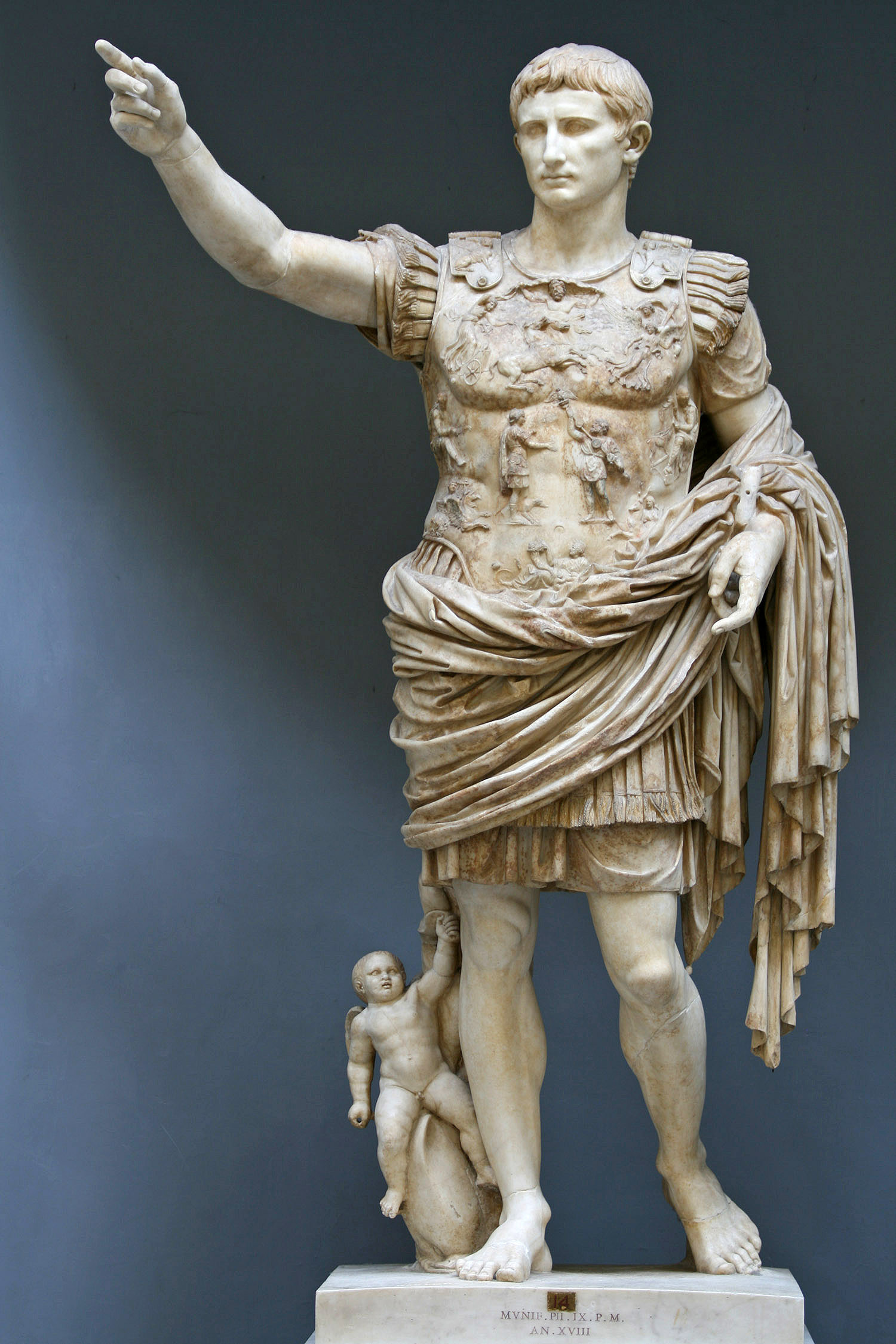
Statue of Augustus, first Roman emperor and first creator of "Italia" as political entity
Rome was the center of an empire that stretched across a large segment of the then-known world, and later became the center of the Christian faith.
Roman civilization was transplanted to most parts of Europe, the Mediterranean basin and the Near East in the form of law, architecture, engineering, roads, aqueducts, public baths, sanitation, trade, literature, art, libraries, hospitals and agriculture.
It was possible for the people in the provinces to attain Roman citizenship, rise to the Senate, and even to become Roman emperor. The Roman provinces, having received much of the benefits of Roman civilization, became Romanized to a large degree.
Winston Churchill states -in his famous "History of the English Speaking Peoples"- that :
The Christian religion was viewed in Rome as contrary to prevailing religious and political beliefs and, consequently, was suppressed. Many Christians in Rome and elsewhere were persecuted. After the conversion of the Emperor Constantine to Christianity in 312 AD, Christianity flourished and became an integral part of Roman life. Roman Catholicism, in a form easily recognizable today, emerged and took root in Rome and much of the Roman Empire.
The Church adopted many religious customs and forms common in pre-Christian Rome, such as the stole and other vestments, the use of incense and holy water in purifications, burning candles before the altar, the veneration of saints, the architecture of the basilica, the law of Rome as a basis for canon law, the title Pontifex Maximus for the Pope, and Latin as the language of Catholic ritual.
After the fall of the Roman Empire, its vast governmental network provided a structure for the Church’s ecclesiastic rule. The bishops, rather than the Roman prefects became the source of order and the seat of power. In many important ways, the Roman Catholic Church became the successor of the Roman Empire. The Church and its Pope were major stabilizing influences in Europe in the centuries that followed. In the words of historian Will Durant (in his "Caesar and Christ, The Story of Civilization"):
The cultural patrimony of Roman literature, architecture and sculpture inspired many of the achievements of the Middle Ages and Renaissance in Italy and the rest of Europe. Works by poets, authors and historians, such as Ovid, Horace, Catullus, Cicero, Virgil, Livy and Tacitus had a far reaching impact on the Western world.
The legacy of Rome is clearly evident in the Western world, and elsewhere, in numerous ways, such as:
*The Roman alphabet
*Roman numerals
*Names of the planets
*Names of the months
*Names of the days of the week (in Romance-language countries)
*Julian Calendar (used for almost 1500 years)
*Systems of government and law based on Roman models
*Latin-derived languages in Italy, France, Spain, Portugal and Romania
*Languages heavily influenced by Latin, such as English (approximately 55% Latin based)
*The Roman arch in architecture
*Techniques used in building roads, bridges, aqueducts, viaducts, etc.
*Use of concrete as a building material
*The stadium & the acqueduct
*Wine-making cultures in Italy, France, Spain, Portugal, Austria and Southern Germany
*Creation of political-administrative entities ( "Italia", "Hispania", "Britannia", etc…)
Medieval period
After the fall of the Roman Empire, the civilization of Italy continued to be a cultural force that helped preserve Greco-Roman civilization and ideals. Latin, the indigenous language of the Italic people, became the universal language of the Catholic Church and, generally, of culture and learning in Europe.
Western Monasticism, as first practiced by the followers of Saint Benedict, born in Nursia in 480 AD, spread from Italy to all parts of Europe. The Benedictine monks were a very important factor in preserving Greco-Roman culture and learning for later centuries. Saint Francis of Assisi (born Giovanni di Bernardone in Assisi in 1181) was a friar who founded the men's Order of Friars Minor and the women’s Order of St. Clare, both of which attracted many followers from all over Europe. He became one of the most venerated religious figures in Catholic Church history.
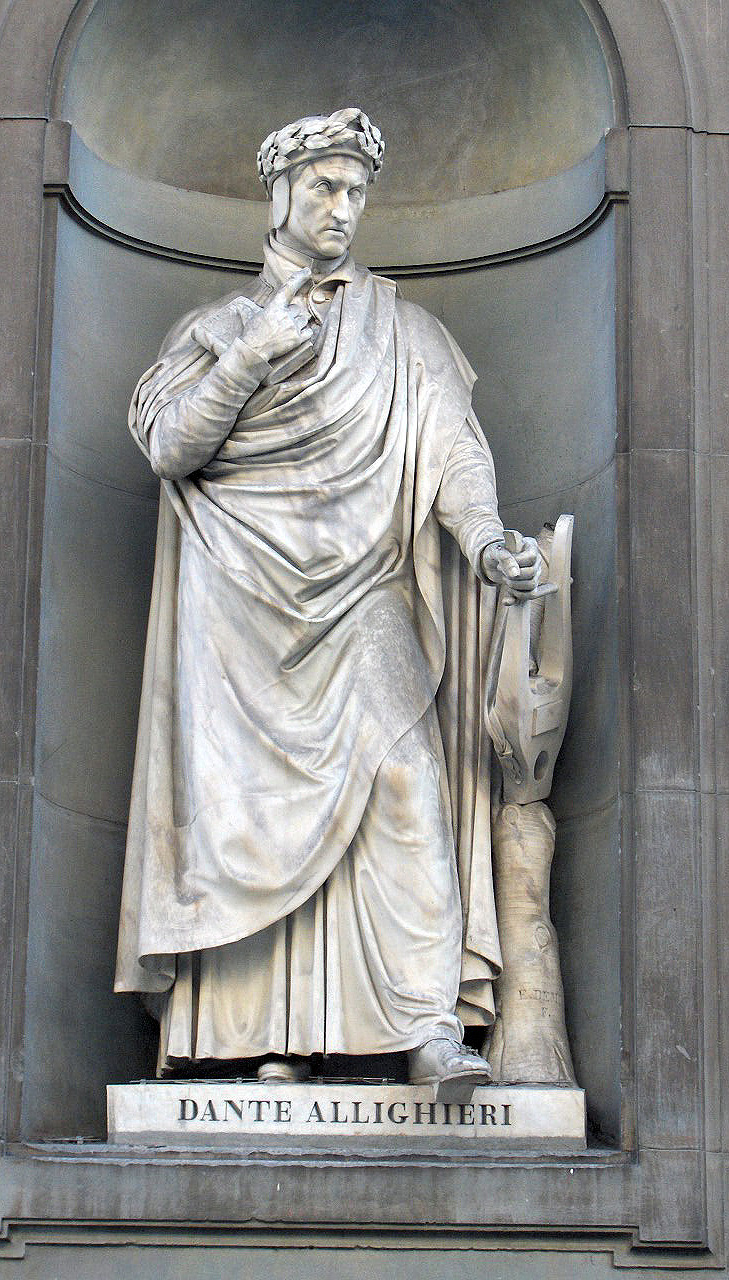
Statue of Dante at the "Uffizi Gallery", Florence
Saint Thomas Aquinas, a Dominican priest born in Aquino in 1225, was an influential philosopher and theologian. He was one of the greatest minds of the Middle Ages, and his influence on Western thought was immense. He was considered then, as he is now, to be the greatest theologian and philosopher of the Catholic Church. He is best known for his monumental work, the Summa Theologica.
The Gregorian Chant, an outgrowth of Roman plain chant, strongly influenced both liturgical and secular music during the Middle Ages. An Italian monk, Guido of Arezzo, developed the form of musical notation that became the basis of Western music and, subsequently, of music worldwide.
Educated people in Europe were familiar with the works of Dante and Boccaccio, which dominated the literature of the Middle Ages, and with their contemporary Petrarch, who had established the most important lyric poetry tradition in Europe. These works had a great influence on Shakespeare, Chaucer, John Milton, Tennyson and many other English writers of the Middle Ages, Renaissance and later periods. Dante's reputation grew and solidified during the Renaissance and the following Enlightenment Era: by 1865, the 600th anniversary of his birth, he had become established as one of the greatest literary icons of the Western world. Dante's "Inferno" is famous and still (in the English version) read in the contemporary so called "English speaking world" (UK, Canada, Australia, Ireland and of course the USA) to the point that the world 'inferno' is often used in normal conversations.
Students and scholars came from all over Europe to study at institutions of higher learning in Italy. The University of Bologna, the first modern university, was founded in Bologna in 1088. The University of Padua, the second oldest university in Italy, was founded in 1222 as a school of law. The University of Naples Federico II, founded in 1224, was the world's first state-supported university. The Schola Medica Salernitana, founded in the ninth century, was the world's first medical school, and unrivalled in the Middle Ages.
During the Middle Ages, the vitality of Italian merchants was evident throughout Europe, and the resultant trade prompted their invention of financial and business practices which provided the foundation for modern banking, commerce and capitalism. The original banks were "merchant banks" that Italian grain merchants first invented in the Middle Ages. Merchants and bankers grew in stature based on the strength of the Lombard plains cereal crops, and capitalism evolved based on these banks. The same word "capital" was created by Italians and is made of the latin words "caput" (meaning 'head/center') and Italia: "cap ital" - meaning the center of a nation and/or the center of economic power! Many words in banking are from the Italian language: for example, the word 'bankrupt' is a corruption of the Italian 'banca rotta', or broken bench, which is what happened when someone lost his traders' deposits; and the word 'cash' is from the Italian "cassa" (meaning "box"), the word 'money' is from Italian "moneta" (meaning "valuables"), the word 'management' is from archaic Italian ''maneggiamento" (meaning "handlement"), etc..etc...
Indeed, banking (from the Italian word 'banco' for "bench") can be traced to medieval and early Renaissance Italy, to the rich cities in the north such as Florence, Milan, Venice and Genoa. The Bardi and Peruzzi families dominated banking in 14th century Florence, establishing branches in many other parts of Europe. Perhaps the most famous Italian bank was the Medici bank, established by Giovanni Medici in 1397. The development of banking spread from northern Italy through Europe during the early Renaissance. In 1407, the Bank of Saint George, the first state-bank of deposit, was founded in Genoa and was to dominate business in the Mediterranean: it was this bank that initially financed most of the creation of the Spanish empire in the newly discovered Americas (read https://www.jstor.org/stable/2114781?seq=1#page_scan_tab_contents).
1994 Italian 750-lira postage stamp commemorating the 500th anniversary of the Luca Pacioli's Summa publication on accounting & bookkeeping
Indeed Luca Pacioli -a friar mathematician born in Tuscany- is referred to as the "Father of Accounting and Bookkeeping" in Europe. He was the first person to publish a work on the double-entry system of book-keeping on the continent. Pacioli dramatically affected the practice of accounting by describing the double-entry accounting method used in parts of Italy in his masterpiece "Summa de arithmetica". This revolutionized how businesses oversaw their operations, enabling improved efficiency and profitability. His Summa's section on accounting was used internationally as an accounting textbook up to the mid-16th century. The essentials of double-entry accounting have for the most part remain unchanged for over 500 years. Historian Smith wrote that "Accounting practitioners in public accounting, industry, and not-for-profit organizations, as well as investors, lending institutions, business firms, and all other users for financial information are indebted to Luca Pacioli for his monumental role in the development of accounting".
The Renaissance
The Italian Renaissance was to a large extent an expression of Italian "Humanism", and led to one of the most productive and significant periods in human history in the arts, literature, medicine and science.
Giotto, born in 1267, was recognized as the first great artistic genius of the Italian Renaissance. His ability to portray human emotions distinguished him from the artists of the Middle Ages, and he established a style of painting that would be widely emulated in Italy and, later, elsewhere in Europe. Italian Renaissance painters and sculptors, such as Leonardo da Vinci and Michelangelo Buonarroti, and scores of others of the first rank, were greatly admired and acclaimed, and had a widespread influence on artistic concepts and esthetic standards throughout Europe.
Leonardo, born in 1452 in Vinci, was a painter, sculptor, architect, musician, mathematician, engineer, inventor, anatomist, geologist, cartographer, botanist, and writer. His genius, perhaps more than that of any of his contemporaries, epitomized the creative energy of the Renaissance. He is widely considered to be one of the greatest painters of all time, and his Mona Lisa is regarded by many to be the most famous painting in the world, and probably the most valuable. His anatomical drawings have never been surpassed in detail and accuracy, and are still used today. Some mechanisms he invented are used in present-day robotic systems.
Michelangelo's Pietà in St. Peter's Basilica
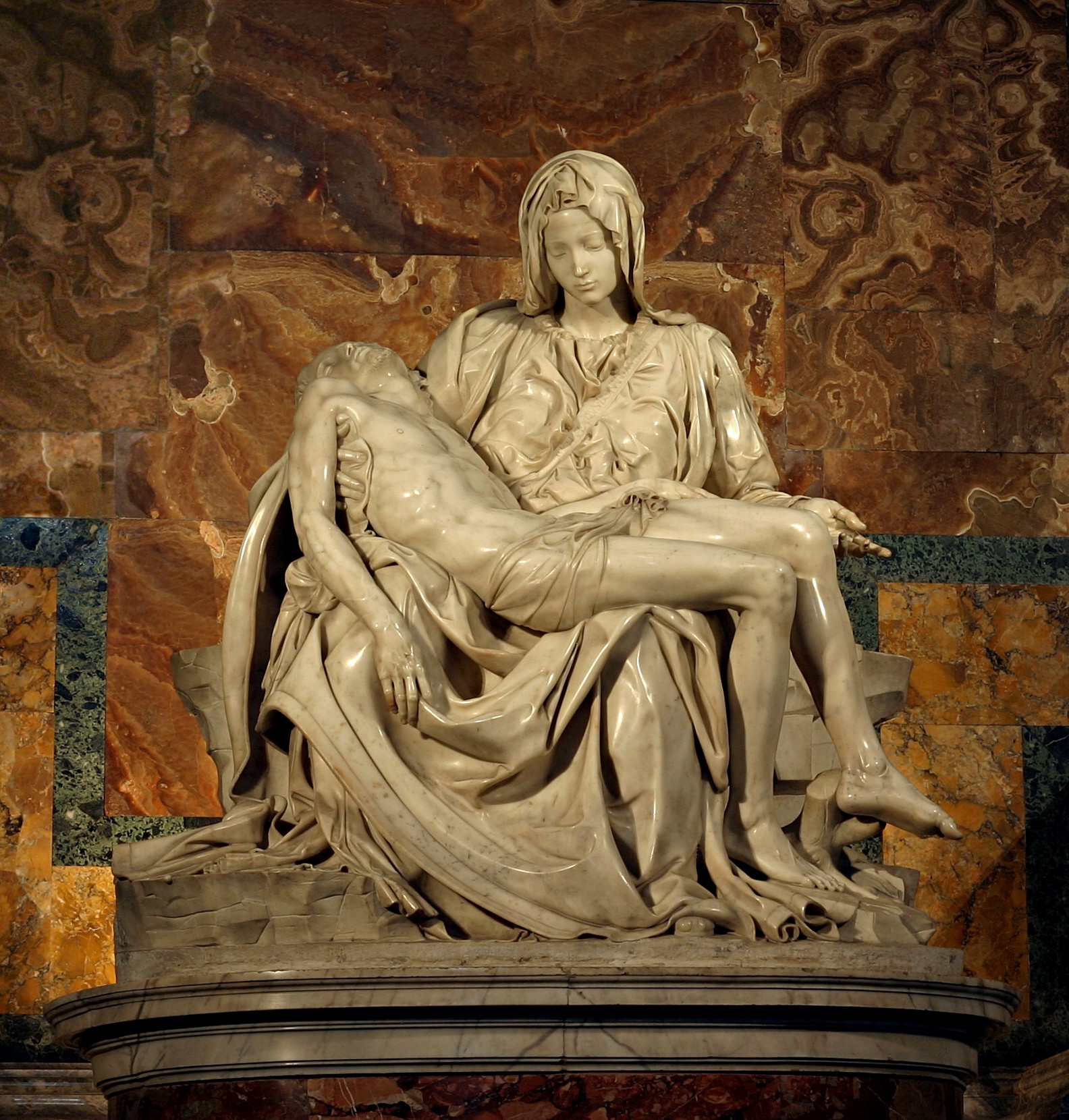
Michelangelo was born in Florence in 1475 and, like Leonardo, was a true Renaissance man. He was a sculptor, painter, architect, poet, and engineer who exerted an unparalleled influence on the development of Western art. He was considered the greatest living artist in his lifetime and, since then, one of the greatest artists of all time. His two best-known sculptures, the Pietà and David, are famous throughout the world. Michelangelo also created two of the most famous and influential frescoes in the history of Western art: the scenes from Genesis covering the ceiling of the Sistine Chapel, and The Last Judgment on the altar wall of the Chapel.
Italian singers, composers, dancers and actors had a great impact on music and the performing arts. Palestrina, Monteverdi and Frescobaldi were responsible for musical innovations that were seminal in the development of Western music. Italian Commedia dell'arte was an art form that had a great influence in the performing arts, not only in Italy but in many other parts of Europe as well.
The flourishing of arts in England during the Hanover dynasty attracted many Italian artists and musicians to the country. William Shakespeare is said to have exhibited Italophilia in his many works with an Italian setting, such as Romeo and Juliet and The Merchant of Venice. Spenser was greatly influenced by Italian epic poems.
Francis I, king of France, initiated the French Renaissance by attracting many Italian artists, including Leonardo da Vinci, to his court. French theatre of the 17th century was rooted in the theatre of 16th-century Italy. Poland was strongly influenced by Italian artisans, painters, sculptors and architects, such as the sculptor, Giammaria Mosca, whose many commissions included the tomb of the king of Poland.
The Spanish writer, Cervantes, was greatly influenced by Italian literature, which is readily discernible in his own works. Spanish theatre of the 17th century was strongly influenced by Italian models.
Italy was a center of commerce and Italian merchants and navigators, such as the Venetian Marco Polo, and the "Italian maritime republics" moved all around the known world. The Genoese explorer Cristoforo Colombo (Columbus) discovered America in 1492, changing world history forever. Another Italian navigator, Amerigo Vespucci, was the source of the name given to the New World. They were followed by other New World navigators from the Italian peninsula, notably the Neapolitans Giovanni Caboto (John Cabot) and Sebastiano Caboto, and the Florentine Giovanni da Verrazzano.
It is noteworthy to pinpoint that three countries in the Americas have their names related to Italy: Colombia (from Columbus), Argentina (from argento, as is called silver in Italian) and Venezuela (from Venezia, as is called Venice in Italy)
Age of Enlightenment
During the 17th and 18th centuries, Italy was an integral part of the European Grand Tour, a period in which learned and wealthy foreign, usually British, German or American, aristocrats visited the country due to its artistic, cultural and archaeological richness. Examples included Goethe, Keats, Lord Byron and Shelley. As a matter of fact, most nobles and royals at the time visited Italy as a part of their education. Keats said that the country was a "paradise of exiles".
In the same centuries, the development of Italian music created many italophiles in western Europe. Indeed Italian innovation in musical scales, harmony, notation, and theatre enabled the development of Opera in the late 16th century, and much of modern European classical music, such as the Symphony and Concerto.
The most renowned figure of late 18th century opera was the italophile Mozart, who began with "opera seria" but is most famous for his Italian comic operas, especially The Marriage of Figaro, Don Giovanni, and Così fan tutte, as well as The Magic Flute, a landmark in the German tradition.
The Victorian era in Great Britain saw Italophilic tendencies. Britain supported its own version of the imperial Pax Romana ("Roman Peace"), called Pax Britannica. John Ruskin was a Victorian Italophile who respected & appreciated the concepts of morality held in Italy.
Germany under Chancellor Otto von Bismarck copied Pax Britannica and Pax Romana and sought to create Pax Germanica in Europe.
Beginning in the 16th century, most of the Italian states came under the political control of more powerful European monarchies; however, Italy continued to be a source of creative energy in art, science, music and medicine. Enlightenment thinkers, like Renaissance thinkers, were interested in pre-Christian Greek and Roman thought.
Galileo Galilei, the founder of modern science
Galileo, born in 1564 in Pisa, was the most famous scientist of his age, and played a major role in the Scientific Revolution. He is often referred to as the “Father of Modern Science.” His achievements include a greatly improved telescope, which he employed in making astronomical observations supporting the heliocentric theory of Copernicus; and also the experiments he carried out leading to his law of falling bodies, which was of key importance in Newton’s synthesis of his own famous three laws of motion.
Bonaventura Cavalieri, a Jesuit priest and mathematician, born in 1598, is known for his work on indivisibles, a precursor of infinitesimal calculus, and for Cavalieri's principle in geometry, which partially anticipated integral calculus.
Italians such as Fallopio, Eustachi, Malpighi, Morgagni and Valsalva were important pioneers of modern anatomy at the University of Bologna and University of Padua, which drew students from all over Europe. Padua's famous anatomical theatre was renowned in Europe at the time, and the great English medical scientist William Harvey received his education there.
Cesare Beccaria, a philosopher, jurist and marquis wrote "On Crimes and Punishments" (1754), dealing with the abolition of torture and capital punishment, which had a great impact throughout Europe and in the United States. It strongly influenced intellectuals and politicians in the age of enlightenment, and led to a revolution and reform of judiciary systems to the prevailing modern concept. In 1786, Grand Duchy of Tuscany was the first to abolish capital punishment.
Giordano Bruno had a great influence on 17th-century scientific and philosophical thought and, ever since, his ideals have been absorbed by many philosophers. Bruno's freedom of thought inspired European liberal movements of the 19th century. The significance of Bruno’s work lies in his cosmological theories, which anticipated some fundamental aspects of the modern concept of the universe; his ethical ideas, in contrast with religious ascetical ethics, which appealed to modern humanistic activism; and his ideals of religious and philosophical tolerance.
Giambattista Vico was a political philosopher, rhetorician, historian, and jurist, who is recognized as one of the great Enlightenment thinkers. He criticized the expansion and development of modern rationalism and was an apologist of classical antiquity. His major work, Scienza Nuova, published in 1725, has been highly influential in the philosophy of history, into the 20th-century.
Opera originated in Italy at the end of the 16th century (with the opera "Dafne", which was composed by Jacopo Peri, and produced in Florence in 1598), and soon spread to the rest of Europe. Italian opera was adapted by French, German and Russian composers, who developed their own national schools of opera.
Italian instrumental music was studied and emulated all over Europe. The sonata, concerto, sinfonia, oratorio and other musical forms all originated in Italy. Italian terminology defining the tempo and mood of a musical passage was universally adopted in Western music. The music of Italian composers, such as Corelli, Scarlatti, and Vivaldi, was studied or transcribed by many other composers of the day, most notably Bach. In addition, many composers, such as Handel, Gluck and Mozart studied or worked in Italy, and subsequently became famous for their instrumental music and operas.
The Fortepiano, the fore-runner of the modern Piano, was invented by Bartolomeo Cristofori in Florence around 1725, and soon replaced the harpsichord as a solo and ensemble keyboard instrument. The family of stringed instruments, consisting of the violin, viola, cello and contrabass evolved in Italy in the mid 16th century. Antonio Stradivari, Andrea Guarneri, Nicolo Amati and other master instrument makers crafted stringed instruments that were highly prized, widely imitated, but never equaled.
The education of upper-class young man was expected to be completed by a "Grand Tour" of Italy to be exposed to the visible legacies of its classical culture, as well as to its contemporary culture of music, literature, art and architecture. Famous examples included Goethe, Keats, Lord Byron and Shelley. Many of the nobility and royalty of the time visited Italy as a part of their education. Keats said that the country was a "paradise of exiles”. John Ruskin was a Victorian Italophile who respected and appreciated the concepts of morality held in Italy.
Italian universities and medical schools attracted students and scholars from across Europe. Luminaries, such as Copernicus and Harvey, were educated in Italy. The University of Bologna, the first modern university, was a leading center of mathematical studies in the 16th and 17th centuries, and it was there that Niccolò Fontana Tartaglia developed the method of solving cubic equations, an achievement previously considered impossible. Extending Tartaglia’s work, Lodovico Ferrari devised a similar method to solve quartic equations, and both solutions were published by Gerolamo Cardano. The solutions to the cubic and quartic equations used, for the first time, what are now known as complex numbers, although it was another Bologna mathematician, Rafael Bombelli, who first explained what complex numbers are, and how they could be used. Complex numbers have since found practical applications in many fields, including physics, chemistry, biology, economics, electrical engineering, and statistics. Later, Cardano published the first systematic treatment of probability.
The US president Thomas Jefferson was a declared italophile who admired Palladio's architecture and created his own "Monticello" imitating him and the Roman Pantheon. The photo shows the "Jefferson Memorial", that was built in 1938 in Washington (USA) as an evident copy of the Pantheon in the "Eternal City".jpg)
At the end of the eighteenth century, Italophilia was not uncommon among the founders of the United States, and some of the creators of the U.S. Constitution, such as Thomas Jefferson and Benjamin Franklin, looked to Roman models upon which to base the American systems of government and law. The founding fathers were also interested in Renaissance political thinkers and humanists like Machiavelli, and how Italian republics functioned.
Jefferson was among the most conspicuous of the early American Italophiles. He was especially impressed with Italian architecture, and based the design of his Virginia residence, Monticello, on prints by Palladio, the 16th-century Italian architect. The "Jefferson Memorial" in Washington DC, erected in honor of Jefferson, is a neo-Palladian imitation of the famous "Pantheon" in Rome. The Palladian style of architecture appears elsewhere in the U.S. Capital, and the White House itself was inspired by it. (Congressional Resolution n. 259 of 6 December 2010 recognized Palladio as "Father of American Architecture".)
The influence of Italian culture and artistry during this era is expressed by the academic Barzini:
XX century era
Italy -after the unification of 1861- was able in only half a century to create an "Italian empire", that went from Libya to Somalia/Eritrea/Ethiopia and reached Tientsin in China. The first accomplishment done by the Italians was the abolition of slavery in those territories: even now many natives (like in Somalia) remember with nostalgia the progress experienced by their countries in those years and show some form of italophilia.
Winston Churchill was a pen-pal of Benito Mussolini until the late 1930s, appreciating his Fascism fights against the Communism in western Europe: he showed some form of italophilia when commented positively in the British parliament about the Italian conquest of the last territory in Africa not ruled by Europeans (Ethiopia in 1936). Only when Mussolini fell in the hands of the crazy Hitler's Nazism after 1938, he rejected this friendship.
Additionally we must remember that Adolf Hitler was an admirer of Benito Mussolini and Italian Fascism: during the Fascist era, several leaders in Europe, including Hitler (Germany), Franco (Spain) and Salazar (Portugal), modeled their government and economic system on Italian Fascism. The admiration and imitation of Italian Fascism also became popular in South America and to a lesser extent Asia. The parties and organizations associated with these leaders also adopted the Roman salute. Perón's admiration for Mussolini is well documented. Many scholars categorize "Peronism" in Argentina as a fascist ideology. Carlos Fayt believes that Peronism was just "an Argentine implementation of Italian fascism". Hayes reaches the conclusion that "the Peronist movement produced a form of fascism that was distinctively Latin American".
After WWII, Italy has enjoyed a huge economic development and is currently admired for many reasons. Between the most famous are the Ferrari cars and the Italian design.
Photo of 22 Ferrari used in F1 racecars competences
There are millions of Ferrari fans in the world and many of them are italophiles.
The Italian fashion is admired all around the world: brands like Gucci and Benetton are imitated by many designers from China to Latin America. Indeed, many Italophiles in the world buy from major Italian fashion houses like Armani, Valentino, Prada, Dolce & Gabbana, Ferragamo, Trussardi, Versace and Fendi.
Actually italophilia is actively fostered by organizations such as the Order Sons of Italy in America, the National Italian American Foundation, the Dante Alighieri Society and the Italic Institute of America.
Contemporary important Italians, appreciated by the italophiles
After Napoleon times there has been a huge number of Italians who are important worldwide and are admired by the italophiles. In 1861 Italy was united for the first time since the fall of the Roman Empire and became a modern industrialized country, where the tradition of creativity, scientific achievement and excellence in manufacturing continued. Here it is a brief list of the most important Italians of contemporary Italy:
*Guglielmo Marconi, a pioneer in the development of wireless telegraphy and long-distance radio transmissions. He is credited as the inventor of the "radio", and received the 1909 Nobel Prize in Physics.
*Enrico Fermi, pioneer of nuclear power, is the creator of the world's first nuclear reactor, the Chicago Pile-1. He has been called the "architect of the nuclear age" and the "architect of the atomic bomb".
*Giuseppe Garibaldi, a central figure in achieving Italian independence, was called the "Hero of Two Worlds" because of his military enterprises to achieve independence for countries in South America as well. Garibaldi was admired by many of the greatest intellectuals of his time, such as Victor Hugo, Alexandre Dumas, and George Sand.
*Maria Montessori, born in 1870, was a physician and educator who became known around the world for the educational method that bears her name, and for her writings on pedagogy. Her methods are in use today in schools throughout the world.
*Toward the end of the 19th century, mathematicians Gregorio Ricci-Curbastro and Tullio Levi-Civita developed tensor calculus, which provided the mathematical framework for Einstein's General Theory of Relativity in the early 20th century.
*Alessandro Volta in 1800 created the first battery. His findings were published by the Royal Society of London in their prestigious journal. The "Volt", the basic unit of electromotive force, was named in his honor. Volta invented the first true electrical battery, known as the voltaic pile. It provided a continuous source of electric current, which greatly benefitted Ampere, Ohm and other electrical experimenters in their development of basic electrical theory.
*Ascanio Sobrero -a doctor and chemist- is remembered as the discovered of nitroglycerine, which lead to Alfred Nobel's invention of dynamite in 1866. Nitroglycerine is also used as a heat medication.
*Pirandello, a Nobel Laureate, was the first European playwright in the early 20th century to radically question the structures of traditional theatre. Since then, film directors and writers such as Fellini, Antonioni, Pasolini, Calvino, Eco and Fo have been recognized around the world. Italian neorealism in films, beginning after the second world war, had a great impact on audiences around the world, and established a new philosophy of filmmaking adopted worldwide.
*The legacy of Italian scientists Majorana (nuclear fusion), Meucci (telephone), and Marconi (radio), whose discoveries and inventions transformed the world, is widely recognized. At the same time that German scientists were making major advancements in physics, beginning with Max Planck, Italian scientists like Fermi's Via Panisperna group in Rome were making important fundamental discoveries in physics as well.
Photo of the first public flight of a jet-engined aircraft in History, done by the Italian "Caproni Campini N.1" on August 27, 1940
*Secondo Campini, an engineer, in 1931 wrote a proposal for the Italian Air Ministry on the value of jet propulsion and in 1932 demonstrated a jet-powered boat in Venice. With support of the Air Ministry, he began work with Italian aircraft manufacturer Caproni to develop a jet plane, the Campini Caproni CC.2, which as a prototype was created in 1938. The first public flight of a jet-engined aircraft was that of his Italian "Caproni Campini N.1" on August 27, 1940. It was briefly regarded as the first successful jet-powered aircraft in History.
*Pier Giorgio Perotto: Italian companies have developed products that are of fundamental importance in contemporary society, such as the Olivetti-developed transistorized mainframe computer systems (Olivetti Elea) and, in 1964, the world's first commercial desktop computer, the Programma 101, invented by Perotto.
*Gucci, Benetton, Armani, Valentino, Prada, Dolce & Gabbana, Ferragamo and Versace are fashion creators that are known worldwide. Today, Italy is admired throughout the world for its design, particularly in the areas of fashion and manufactured goods.
*Enzo Ferrari, a worldwide famous engineer, has created the most famous race-cars in the world, the "Ferrari", admired by millions of fans (in many cases italophiles). The "Ferrari" is the most successful team in the history of Formula One racing, contesting every World Championship season since 1950, winning 15 Drivers' Championships and 16 Constructors' Championships until 2015. Ferrari won the 24 Hours of Le Mans 6 years in a row from 1960 to 1965. In automobile design, the brand names Ferrari, Lamborghini, Alfa Romeo and Maserati are known and admired throughout the world. In Britain in the 1960s the emerging mod subculture championed Italian and French design, with mods adopting the "Vespa" GS and the "Lambretta" LI 150 motor scooters as their preferred means of transport as well as wearing Italian-designed clothes and shoes, and had a lasting effect - Britain remains Vespa's largest market outside of Italy. Italian design and manufacturing in furniture, architecture and interior design is appreciated worldwide.
*Renzo Piano, a famous architect, has designed important modern buildings such as Centre Pompidou in Paris and Kansai International Airport in Osaka. Architect and designer Giò Ponti was a pioneer in industrial design, and inspired many other Italian designers who have established the Italian image of design excellence in the world. Designers such as Ettore Sottsass, and his Memphis Group of designers, are famous for creating postmodern furniture, fabrics, ceramics, glass and metal objects; and lighting manufacturer Artemide is famous for lamps which transcend their common use as objects, and are nowadays considered cult manufacturing artworks, collected in Museums of Modern Art.
Finally, it is noteworthy to remember that Italy was the fourth country in the world to build nuclear power plants, starting in 1955 (now decommissioned due to a popular referendum in 1987), and the third, after The United States and The Soviet Union, to launch a scientific earth satellite in the 1964 San Marco programme, using an American Scout missile as the launch vehicle. The "Broglio Space Centre" of Italy, located on a sea platform offshore the Kenya coast is the only example of a spacecraft launch center built on a floating sea platform.
The Spanish steps in Rome are worldwide appreciated by millions of italophiles in the world
Indeed we all know that all the American countries -that are independent- have an Italian community that has reached top socio-economical positions and all of these country have had at least one president with Italian roots (from Argentina and Brasil to the little Panama and Costa Rica), but there it is one exception: the United States. The reason: in the USA the Italians are poorly judged with an ethnic classification based on the triangle "Mafia/crime" - "pizza/food" - "Nero cruelty/dishonesty". In other words: Italians are good for eating matters, but are criminally related to the Sicilian Mafia (from Sicily comes nearly 1/5 of all the Italoamericans!) and are often dishonest ("cheating" with deceptions & lies at work and a bit cruel like emperor Nero). Of course many academics argue that this is a prejudice created by the "Wasp" (white-anglo-saxon-protestants), who rule the US society, in order to maintain their centuries old leadership: the reader must remember -for example- that some US black leaders argue that Obama has been elected president because he is a "mulatto" whose mother was a typical Wasp, and that they also argue that if he would have been a real black he would have never been elected!
Of course we have to remember that Italy has forty-seven UNESCO World Heritage Sites in 2016, more than any other country in the world. According to UNESCO, the cultural and educational agency for the United Nations, over 60 percent of the entire world’s art treasures are found in Italy, which draws tourists, scholars, artists and art historians from everywhere in the world.
But what most of us often forget is that Italy is the country with most "super genius" in the world History: from Augustus, Caesar, Archimedes to Leonardo, Galileo and Marconi, to name a few, no other country has such amount of important personalities. During Fascism the nationalists even pinpointed that Napoleon was not French, but Italian, because born in Corsica (an island that has always been Italian until one year before his birth)! Of course this was an exaggeration, but why all this concentration? One explanation -that I want to study further in the next years- seems to be related to the fact that Italy is the place in Europe with most lighting strikes. Let me explain better: the "metallic mountains" (Colline Metallifere) of Tuscany have produced the best iron in Antiquity for the famous roman "gladius" (an armament that literally allowed the creation of the Roman empire by the legionaries), but are also responsible for the strongest lighting thunderstorms in the western world. Actually we know that some of the best world genius were born during these thunderstorms (like Nicola Tesla, see my http://researchomnia.blogspot.com/2013/02/the-neolatin-genius-of-nicola-tesla_8.html), that seems to have "charged" the brain neurons of the newborns. Of course, this is a matter that is being studied by academics only in the last decades and needs a lot of further research & confirmations.....but I think it is worth to remember this fact as a possible explanation (by the way, the second country in Europe with excessive lightings is Scotland, and we all know that many clever inventors have been born there).
Consequently here I add some excerpts taken from an essay in Wikipedia, named "Italophilia", that I have partially written years ago:
ITALOPHILIA
Italophilia is the admiration, general appreciation or love of Italy, its culture, society, arts and people. It is often related to the emulation of Italy's ideals and civilization.
Italophilia is very strong -for example- in the USA, mainly between the Italian communities, as was seen even in New York during the 2006 WorldCup celebrations of the Italian soccer team victory (see https://www.youtube.com/watch?v=z4OPnqhQlsY). The term is used in two basic contexts: in international politics and in cultural context. "Italophilia", "Italophile", and "Italophilic" are the terms used to denote pro-Italian sentiments, usually in politics and literature.
Historically, a huge italophilia started to develop in Europe during the centuries of the Italian Renaissance.
William Shakespeare is a famous example of an Italophile of the 16th century
Actually one of the main reasons of Italophilia in the world is that Italy is home to more World Heritage Sites than any other nation in the world. Another reason is the worlwide appreciation for Italian culinary and foods. For example, the Pizza -created in Napoli- is one of the most appreciated foods in nearly all the countries of the modern world, from Europe to the Americas and Australia.
Italy is also a big wine producer. In 2005 it made over 5 million tonnes, and many italian wines are very famous in the world, like the "Chianti".
Indeed in the American countries with a huge Italian emigration (since the early XIX century, nearly 2/3 of the more than 28 millions of Italian emigrants moved there!), there it is a widespread italophilia: Argentina, Brasil, Uruguay, Canada and the USA have millions of Italian descendants who promote in their society the love and appreciation for Italy.
Actually Giorgio Silvestri (director of the "Assemblea legislativa della Liguria") has calculated that there are more than 250 million italophiles in the world.
Italophilia in History
The extent to which Italic civilization has shaped Western civilization and, by extension, the civilization of the whole world, is widely recognized and acknowledged. Appreciation of the legacy of Italic ideals, civilization and culture has existed for many centuries, into the present day.
Some of the most famous "italophiles" in History are William Shakespeare, Thomas Jefferson, Benjamin Franklin, Francis I, Catherine the Great, Goethe, John Ruskin and Lord Byron. In the last two centuries even Queen Victoria, Napoleon, Simon Bolivar, Francisco Franco, Juan Perón and other politicians showed some form of italophilia.
Roman era
Statue of Augustus, first Roman emperor and first creator of "Italia" as political entity
Rome was the center of an empire that stretched across a large segment of the then-known world, and later became the center of the Christian faith.
Roman civilization was transplanted to most parts of Europe, the Mediterranean basin and the Near East in the form of law, architecture, engineering, roads, aqueducts, public baths, sanitation, trade, literature, art, libraries, hospitals and agriculture.
It was possible for the people in the provinces to attain Roman citizenship, rise to the Senate, and even to become Roman emperor. The Roman provinces, having received much of the benefits of Roman civilization, became Romanized to a large degree.
Winston Churchill states -in his famous "History of the English Speaking Peoples"- that :
For nearly 300 years Britain, reconciled to the Roman system, enjoyed in many respects the happiest, most comfortable, and most enlightened times its inhabitants have ever had.
The Christian religion was viewed in Rome as contrary to prevailing religious and political beliefs and, consequently, was suppressed. Many Christians in Rome and elsewhere were persecuted. After the conversion of the Emperor Constantine to Christianity in 312 AD, Christianity flourished and became an integral part of Roman life. Roman Catholicism, in a form easily recognizable today, emerged and took root in Rome and much of the Roman Empire.
The Church adopted many religious customs and forms common in pre-Christian Rome, such as the stole and other vestments, the use of incense and holy water in purifications, burning candles before the altar, the veneration of saints, the architecture of the basilica, the law of Rome as a basis for canon law, the title Pontifex Maximus for the Pope, and Latin as the language of Catholic ritual.
After the fall of the Roman Empire, its vast governmental network provided a structure for the Church’s ecclesiastic rule. The bishops, rather than the Roman prefects became the source of order and the seat of power. In many important ways, the Roman Catholic Church became the successor of the Roman Empire. The Church and its Pope were major stabilizing influences in Europe in the centuries that followed. In the words of historian Will Durant (in his "Caesar and Christ, The Story of Civilization"):
Rome died in giving birth to the Church; the Church matured by inheriting and accepting the responsibilities of Rome
The cultural patrimony of Roman literature, architecture and sculpture inspired many of the achievements of the Middle Ages and Renaissance in Italy and the rest of Europe. Works by poets, authors and historians, such as Ovid, Horace, Catullus, Cicero, Virgil, Livy and Tacitus had a far reaching impact on the Western world.
The legacy of Rome is clearly evident in the Western world, and elsewhere, in numerous ways, such as:
*The Roman alphabet
*Roman numerals
*Names of the planets
*Names of the months
*Names of the days of the week (in Romance-language countries)
*Julian Calendar (used for almost 1500 years)
*Systems of government and law based on Roman models
*Latin-derived languages in Italy, France, Spain, Portugal and Romania
*Languages heavily influenced by Latin, such as English (approximately 55% Latin based)
*The Roman arch in architecture
*Techniques used in building roads, bridges, aqueducts, viaducts, etc.
*Use of concrete as a building material
*The stadium & the acqueduct
*Wine-making cultures in Italy, France, Spain, Portugal, Austria and Southern Germany
*Creation of political-administrative entities ( "Italia", "Hispania", "Britannia", etc…)
Medieval period
After the fall of the Roman Empire, the civilization of Italy continued to be a cultural force that helped preserve Greco-Roman civilization and ideals. Latin, the indigenous language of the Italic people, became the universal language of the Catholic Church and, generally, of culture and learning in Europe.
Western Monasticism, as first practiced by the followers of Saint Benedict, born in Nursia in 480 AD, spread from Italy to all parts of Europe. The Benedictine monks were a very important factor in preserving Greco-Roman culture and learning for later centuries. Saint Francis of Assisi (born Giovanni di Bernardone in Assisi in 1181) was a friar who founded the men's Order of Friars Minor and the women’s Order of St. Clare, both of which attracted many followers from all over Europe. He became one of the most venerated religious figures in Catholic Church history.
Statue of Dante at the "Uffizi Gallery", Florence
Saint Thomas Aquinas, a Dominican priest born in Aquino in 1225, was an influential philosopher and theologian. He was one of the greatest minds of the Middle Ages, and his influence on Western thought was immense. He was considered then, as he is now, to be the greatest theologian and philosopher of the Catholic Church. He is best known for his monumental work, the Summa Theologica.
The Gregorian Chant, an outgrowth of Roman plain chant, strongly influenced both liturgical and secular music during the Middle Ages. An Italian monk, Guido of Arezzo, developed the form of musical notation that became the basis of Western music and, subsequently, of music worldwide.
Educated people in Europe were familiar with the works of Dante and Boccaccio, which dominated the literature of the Middle Ages, and with their contemporary Petrarch, who had established the most important lyric poetry tradition in Europe. These works had a great influence on Shakespeare, Chaucer, John Milton, Tennyson and many other English writers of the Middle Ages, Renaissance and later periods. Dante's reputation grew and solidified during the Renaissance and the following Enlightenment Era: by 1865, the 600th anniversary of his birth, he had become established as one of the greatest literary icons of the Western world. Dante's "Inferno" is famous and still (in the English version) read in the contemporary so called "English speaking world" (UK, Canada, Australia, Ireland and of course the USA) to the point that the world 'inferno' is often used in normal conversations.
Students and scholars came from all over Europe to study at institutions of higher learning in Italy. The University of Bologna, the first modern university, was founded in Bologna in 1088. The University of Padua, the second oldest university in Italy, was founded in 1222 as a school of law. The University of Naples Federico II, founded in 1224, was the world's first state-supported university. The Schola Medica Salernitana, founded in the ninth century, was the world's first medical school, and unrivalled in the Middle Ages.
During the Middle Ages, the vitality of Italian merchants was evident throughout Europe, and the resultant trade prompted their invention of financial and business practices which provided the foundation for modern banking, commerce and capitalism. The original banks were "merchant banks" that Italian grain merchants first invented in the Middle Ages. Merchants and bankers grew in stature based on the strength of the Lombard plains cereal crops, and capitalism evolved based on these banks. The same word "capital" was created by Italians and is made of the latin words "caput" (meaning 'head/center') and Italia: "cap ital" - meaning the center of a nation and/or the center of economic power! Many words in banking are from the Italian language: for example, the word 'bankrupt' is a corruption of the Italian 'banca rotta', or broken bench, which is what happened when someone lost his traders' deposits; and the word 'cash' is from the Italian "cassa" (meaning "box"), the word 'money' is from Italian "moneta" (meaning "valuables"), the word 'management' is from archaic Italian ''maneggiamento" (meaning "handlement"), etc..etc...
Indeed, banking (from the Italian word 'banco' for "bench") can be traced to medieval and early Renaissance Italy, to the rich cities in the north such as Florence, Milan, Venice and Genoa. The Bardi and Peruzzi families dominated banking in 14th century Florence, establishing branches in many other parts of Europe. Perhaps the most famous Italian bank was the Medici bank, established by Giovanni Medici in 1397. The development of banking spread from northern Italy through Europe during the early Renaissance. In 1407, the Bank of Saint George, the first state-bank of deposit, was founded in Genoa and was to dominate business in the Mediterranean: it was this bank that initially financed most of the creation of the Spanish empire in the newly discovered Americas (read https://www.jstor.org/stable/2114781?seq=1#page_scan_tab_contents).
1994 Italian 750-lira postage stamp commemorating the 500th anniversary of the Luca Pacioli's Summa publication on accounting & bookkeeping

Indeed Luca Pacioli -a friar mathematician born in Tuscany- is referred to as the "Father of Accounting and Bookkeeping" in Europe. He was the first person to publish a work on the double-entry system of book-keeping on the continent. Pacioli dramatically affected the practice of accounting by describing the double-entry accounting method used in parts of Italy in his masterpiece "Summa de arithmetica". This revolutionized how businesses oversaw their operations, enabling improved efficiency and profitability. His Summa's section on accounting was used internationally as an accounting textbook up to the mid-16th century. The essentials of double-entry accounting have for the most part remain unchanged for over 500 years. Historian Smith wrote that "Accounting practitioners in public accounting, industry, and not-for-profit organizations, as well as investors, lending institutions, business firms, and all other users for financial information are indebted to Luca Pacioli for his monumental role in the development of accounting".
The Renaissance
The Italian Renaissance was to a large extent an expression of Italian "Humanism", and led to one of the most productive and significant periods in human history in the arts, literature, medicine and science.
Giotto, born in 1267, was recognized as the first great artistic genius of the Italian Renaissance. His ability to portray human emotions distinguished him from the artists of the Middle Ages, and he established a style of painting that would be widely emulated in Italy and, later, elsewhere in Europe. Italian Renaissance painters and sculptors, such as Leonardo da Vinci and Michelangelo Buonarroti, and scores of others of the first rank, were greatly admired and acclaimed, and had a widespread influence on artistic concepts and esthetic standards throughout Europe.
Leonardo, born in 1452 in Vinci, was a painter, sculptor, architect, musician, mathematician, engineer, inventor, anatomist, geologist, cartographer, botanist, and writer. His genius, perhaps more than that of any of his contemporaries, epitomized the creative energy of the Renaissance. He is widely considered to be one of the greatest painters of all time, and his Mona Lisa is regarded by many to be the most famous painting in the world, and probably the most valuable. His anatomical drawings have never been surpassed in detail and accuracy, and are still used today. Some mechanisms he invented are used in present-day robotic systems.
Michelangelo's Pietà in St. Peter's Basilica

Michelangelo was born in Florence in 1475 and, like Leonardo, was a true Renaissance man. He was a sculptor, painter, architect, poet, and engineer who exerted an unparalleled influence on the development of Western art. He was considered the greatest living artist in his lifetime and, since then, one of the greatest artists of all time. His two best-known sculptures, the Pietà and David, are famous throughout the world. Michelangelo also created two of the most famous and influential frescoes in the history of Western art: the scenes from Genesis covering the ceiling of the Sistine Chapel, and The Last Judgment on the altar wall of the Chapel.
Italian singers, composers, dancers and actors had a great impact on music and the performing arts. Palestrina, Monteverdi and Frescobaldi were responsible for musical innovations that were seminal in the development of Western music. Italian Commedia dell'arte was an art form that had a great influence in the performing arts, not only in Italy but in many other parts of Europe as well.
The flourishing of arts in England during the Hanover dynasty attracted many Italian artists and musicians to the country. William Shakespeare is said to have exhibited Italophilia in his many works with an Italian setting, such as Romeo and Juliet and The Merchant of Venice. Spenser was greatly influenced by Italian epic poems.
Francis I, king of France, initiated the French Renaissance by attracting many Italian artists, including Leonardo da Vinci, to his court. French theatre of the 17th century was rooted in the theatre of 16th-century Italy. Poland was strongly influenced by Italian artisans, painters, sculptors and architects, such as the sculptor, Giammaria Mosca, whose many commissions included the tomb of the king of Poland.
The Spanish writer, Cervantes, was greatly influenced by Italian literature, which is readily discernible in his own works. Spanish theatre of the 17th century was strongly influenced by Italian models.
Italy was a center of commerce and Italian merchants and navigators, such as the Venetian Marco Polo, and the "Italian maritime republics" moved all around the known world. The Genoese explorer Cristoforo Colombo (Columbus) discovered America in 1492, changing world history forever. Another Italian navigator, Amerigo Vespucci, was the source of the name given to the New World. They were followed by other New World navigators from the Italian peninsula, notably the Neapolitans Giovanni Caboto (John Cabot) and Sebastiano Caboto, and the Florentine Giovanni da Verrazzano.
It is noteworthy to pinpoint that three countries in the Americas have their names related to Italy: Colombia (from Columbus), Argentina (from argento, as is called silver in Italian) and Venezuela (from Venezia, as is called Venice in Italy)
Age of Enlightenment
During the 17th and 18th centuries, Italy was an integral part of the European Grand Tour, a period in which learned and wealthy foreign, usually British, German or American, aristocrats visited the country due to its artistic, cultural and archaeological richness. Examples included Goethe, Keats, Lord Byron and Shelley. As a matter of fact, most nobles and royals at the time visited Italy as a part of their education. Keats said that the country was a "paradise of exiles".
In the same centuries, the development of Italian music created many italophiles in western Europe. Indeed Italian innovation in musical scales, harmony, notation, and theatre enabled the development of Opera in the late 16th century, and much of modern European classical music, such as the Symphony and Concerto.
The most renowned figure of late 18th century opera was the italophile Mozart, who began with "opera seria" but is most famous for his Italian comic operas, especially The Marriage of Figaro, Don Giovanni, and Così fan tutte, as well as The Magic Flute, a landmark in the German tradition.
The Victorian era in Great Britain saw Italophilic tendencies. Britain supported its own version of the imperial Pax Romana ("Roman Peace"), called Pax Britannica. John Ruskin was a Victorian Italophile who respected & appreciated the concepts of morality held in Italy.
Germany under Chancellor Otto von Bismarck copied Pax Britannica and Pax Romana and sought to create Pax Germanica in Europe.
Beginning in the 16th century, most of the Italian states came under the political control of more powerful European monarchies; however, Italy continued to be a source of creative energy in art, science, music and medicine. Enlightenment thinkers, like Renaissance thinkers, were interested in pre-Christian Greek and Roman thought.
Galileo Galilei, the founder of modern science
Galileo, born in 1564 in Pisa, was the most famous scientist of his age, and played a major role in the Scientific Revolution. He is often referred to as the “Father of Modern Science.” His achievements include a greatly improved telescope, which he employed in making astronomical observations supporting the heliocentric theory of Copernicus; and also the experiments he carried out leading to his law of falling bodies, which was of key importance in Newton’s synthesis of his own famous three laws of motion.
Bonaventura Cavalieri, a Jesuit priest and mathematician, born in 1598, is known for his work on indivisibles, a precursor of infinitesimal calculus, and for Cavalieri's principle in geometry, which partially anticipated integral calculus.
Italians such as Fallopio, Eustachi, Malpighi, Morgagni and Valsalva were important pioneers of modern anatomy at the University of Bologna and University of Padua, which drew students from all over Europe. Padua's famous anatomical theatre was renowned in Europe at the time, and the great English medical scientist William Harvey received his education there.
Cesare Beccaria, a philosopher, jurist and marquis wrote "On Crimes and Punishments" (1754), dealing with the abolition of torture and capital punishment, which had a great impact throughout Europe and in the United States. It strongly influenced intellectuals and politicians in the age of enlightenment, and led to a revolution and reform of judiciary systems to the prevailing modern concept. In 1786, Grand Duchy of Tuscany was the first to abolish capital punishment.
Giordano Bruno had a great influence on 17th-century scientific and philosophical thought and, ever since, his ideals have been absorbed by many philosophers. Bruno's freedom of thought inspired European liberal movements of the 19th century. The significance of Bruno’s work lies in his cosmological theories, which anticipated some fundamental aspects of the modern concept of the universe; his ethical ideas, in contrast with religious ascetical ethics, which appealed to modern humanistic activism; and his ideals of religious and philosophical tolerance.
Giambattista Vico was a political philosopher, rhetorician, historian, and jurist, who is recognized as one of the great Enlightenment thinkers. He criticized the expansion and development of modern rationalism and was an apologist of classical antiquity. His major work, Scienza Nuova, published in 1725, has been highly influential in the philosophy of history, into the 20th-century.
Opera originated in Italy at the end of the 16th century (with the opera "Dafne", which was composed by Jacopo Peri, and produced in Florence in 1598), and soon spread to the rest of Europe. Italian opera was adapted by French, German and Russian composers, who developed their own national schools of opera.
Italian instrumental music was studied and emulated all over Europe. The sonata, concerto, sinfonia, oratorio and other musical forms all originated in Italy. Italian terminology defining the tempo and mood of a musical passage was universally adopted in Western music. The music of Italian composers, such as Corelli, Scarlatti, and Vivaldi, was studied or transcribed by many other composers of the day, most notably Bach. In addition, many composers, such as Handel, Gluck and Mozart studied or worked in Italy, and subsequently became famous for their instrumental music and operas.
The Fortepiano, the fore-runner of the modern Piano, was invented by Bartolomeo Cristofori in Florence around 1725, and soon replaced the harpsichord as a solo and ensemble keyboard instrument. The family of stringed instruments, consisting of the violin, viola, cello and contrabass evolved in Italy in the mid 16th century. Antonio Stradivari, Andrea Guarneri, Nicolo Amati and other master instrument makers crafted stringed instruments that were highly prized, widely imitated, but never equaled.
The education of upper-class young man was expected to be completed by a "Grand Tour" of Italy to be exposed to the visible legacies of its classical culture, as well as to its contemporary culture of music, literature, art and architecture. Famous examples included Goethe, Keats, Lord Byron and Shelley. Many of the nobility and royalty of the time visited Italy as a part of their education. Keats said that the country was a "paradise of exiles”. John Ruskin was a Victorian Italophile who respected and appreciated the concepts of morality held in Italy.
Italian universities and medical schools attracted students and scholars from across Europe. Luminaries, such as Copernicus and Harvey, were educated in Italy. The University of Bologna, the first modern university, was a leading center of mathematical studies in the 16th and 17th centuries, and it was there that Niccolò Fontana Tartaglia developed the method of solving cubic equations, an achievement previously considered impossible. Extending Tartaglia’s work, Lodovico Ferrari devised a similar method to solve quartic equations, and both solutions were published by Gerolamo Cardano. The solutions to the cubic and quartic equations used, for the first time, what are now known as complex numbers, although it was another Bologna mathematician, Rafael Bombelli, who first explained what complex numbers are, and how they could be used. Complex numbers have since found practical applications in many fields, including physics, chemistry, biology, economics, electrical engineering, and statistics. Later, Cardano published the first systematic treatment of probability.
The US president Thomas Jefferson was a declared italophile who admired Palladio's architecture and created his own "Monticello" imitating him and the Roman Pantheon. The photo shows the "Jefferson Memorial", that was built in 1938 in Washington (USA) as an evident copy of the Pantheon in the "Eternal City"
.jpg)
At the end of the eighteenth century, Italophilia was not uncommon among the founders of the United States, and some of the creators of the U.S. Constitution, such as Thomas Jefferson and Benjamin Franklin, looked to Roman models upon which to base the American systems of government and law. The founding fathers were also interested in Renaissance political thinkers and humanists like Machiavelli, and how Italian republics functioned.
Jefferson was among the most conspicuous of the early American Italophiles. He was especially impressed with Italian architecture, and based the design of his Virginia residence, Monticello, on prints by Palladio, the 16th-century Italian architect. The "Jefferson Memorial" in Washington DC, erected in honor of Jefferson, is a neo-Palladian imitation of the famous "Pantheon" in Rome. The Palladian style of architecture appears elsewhere in the U.S. Capital, and the White House itself was inspired by it. (Congressional Resolution n. 259 of 6 December 2010 recognized Palladio as "Father of American Architecture".)
The influence of Italian culture and artistry during this era is expressed by the academic Barzini:
Italian architects and masons built part of the Kremlin in Moscow, and the Winter Palace in Leningrad. Italian artists embellished the Capital in Washington. They have strewn churches, princely palaces and stately villas all over Catholic Europe, especially in Vienna, Madrid, Prague and Warsaw. Their influence on architecture was felt almost everywhere.They also taught poetry, statesmanship and trade to the English; military art to the Germans; cuisine to the French; acting and ballet to the Russians; and music to everyone.
XX century era
Italy -after the unification of 1861- was able in only half a century to create an "Italian empire", that went from Libya to Somalia/Eritrea/Ethiopia and reached Tientsin in China. The first accomplishment done by the Italians was the abolition of slavery in those territories: even now many natives (like in Somalia) remember with nostalgia the progress experienced by their countries in those years and show some form of italophilia.
Winston Churchill was a pen-pal of Benito Mussolini until the late 1930s, appreciating his Fascism fights against the Communism in western Europe: he showed some form of italophilia when commented positively in the British parliament about the Italian conquest of the last territory in Africa not ruled by Europeans (Ethiopia in 1936). Only when Mussolini fell in the hands of the crazy Hitler's Nazism after 1938, he rejected this friendship.
Additionally we must remember that Adolf Hitler was an admirer of Benito Mussolini and Italian Fascism: during the Fascist era, several leaders in Europe, including Hitler (Germany), Franco (Spain) and Salazar (Portugal), modeled their government and economic system on Italian Fascism. The admiration and imitation of Italian Fascism also became popular in South America and to a lesser extent Asia. The parties and organizations associated with these leaders also adopted the Roman salute. Perón's admiration for Mussolini is well documented. Many scholars categorize "Peronism" in Argentina as a fascist ideology. Carlos Fayt believes that Peronism was just "an Argentine implementation of Italian fascism". Hayes reaches the conclusion that "the Peronist movement produced a form of fascism that was distinctively Latin American".
After WWII, Italy has enjoyed a huge economic development and is currently admired for many reasons. Between the most famous are the Ferrari cars and the Italian design.
Photo of 22 Ferrari used in F1 racecars competences
There are millions of Ferrari fans in the world and many of them are italophiles.
The Italian fashion is admired all around the world: brands like Gucci and Benetton are imitated by many designers from China to Latin America. Indeed, many Italophiles in the world buy from major Italian fashion houses like Armani, Valentino, Prada, Dolce & Gabbana, Ferragamo, Trussardi, Versace and Fendi.
Actually italophilia is actively fostered by organizations such as the Order Sons of Italy in America, the National Italian American Foundation, the Dante Alighieri Society and the Italic Institute of America.
Contemporary important Italians, appreciated by the italophiles
After Napoleon times there has been a huge number of Italians who are important worldwide and are admired by the italophiles. In 1861 Italy was united for the first time since the fall of the Roman Empire and became a modern industrialized country, where the tradition of creativity, scientific achievement and excellence in manufacturing continued. Here it is a brief list of the most important Italians of contemporary Italy:
*Guglielmo Marconi, a pioneer in the development of wireless telegraphy and long-distance radio transmissions. He is credited as the inventor of the "radio", and received the 1909 Nobel Prize in Physics.
*Enrico Fermi, pioneer of nuclear power, is the creator of the world's first nuclear reactor, the Chicago Pile-1. He has been called the "architect of the nuclear age" and the "architect of the atomic bomb".
*Giuseppe Garibaldi, a central figure in achieving Italian independence, was called the "Hero of Two Worlds" because of his military enterprises to achieve independence for countries in South America as well. Garibaldi was admired by many of the greatest intellectuals of his time, such as Victor Hugo, Alexandre Dumas, and George Sand.
*Maria Montessori, born in 1870, was a physician and educator who became known around the world for the educational method that bears her name, and for her writings on pedagogy. Her methods are in use today in schools throughout the world.
*Toward the end of the 19th century, mathematicians Gregorio Ricci-Curbastro and Tullio Levi-Civita developed tensor calculus, which provided the mathematical framework for Einstein's General Theory of Relativity in the early 20th century.
*Alessandro Volta in 1800 created the first battery. His findings were published by the Royal Society of London in their prestigious journal. The "Volt", the basic unit of electromotive force, was named in his honor. Volta invented the first true electrical battery, known as the voltaic pile. It provided a continuous source of electric current, which greatly benefitted Ampere, Ohm and other electrical experimenters in their development of basic electrical theory.
*Ascanio Sobrero -a doctor and chemist- is remembered as the discovered of nitroglycerine, which lead to Alfred Nobel's invention of dynamite in 1866. Nitroglycerine is also used as a heat medication.
*Pirandello, a Nobel Laureate, was the first European playwright in the early 20th century to radically question the structures of traditional theatre. Since then, film directors and writers such as Fellini, Antonioni, Pasolini, Calvino, Eco and Fo have been recognized around the world. Italian neorealism in films, beginning after the second world war, had a great impact on audiences around the world, and established a new philosophy of filmmaking adopted worldwide.
*The legacy of Italian scientists Majorana (nuclear fusion), Meucci (telephone), and Marconi (radio), whose discoveries and inventions transformed the world, is widely recognized. At the same time that German scientists were making major advancements in physics, beginning with Max Planck, Italian scientists like Fermi's Via Panisperna group in Rome were making important fundamental discoveries in physics as well.
Photo of the first public flight of a jet-engined aircraft in History, done by the Italian "Caproni Campini N.1" on August 27, 1940
*Secondo Campini, an engineer, in 1931 wrote a proposal for the Italian Air Ministry on the value of jet propulsion and in 1932 demonstrated a jet-powered boat in Venice. With support of the Air Ministry, he began work with Italian aircraft manufacturer Caproni to develop a jet plane, the Campini Caproni CC.2, which as a prototype was created in 1938. The first public flight of a jet-engined aircraft was that of his Italian "Caproni Campini N.1" on August 27, 1940. It was briefly regarded as the first successful jet-powered aircraft in History.
*Pier Giorgio Perotto: Italian companies have developed products that are of fundamental importance in contemporary society, such as the Olivetti-developed transistorized mainframe computer systems (Olivetti Elea) and, in 1964, the world's first commercial desktop computer, the Programma 101, invented by Perotto.
*Gucci, Benetton, Armani, Valentino, Prada, Dolce & Gabbana, Ferragamo and Versace are fashion creators that are known worldwide. Today, Italy is admired throughout the world for its design, particularly in the areas of fashion and manufactured goods.
*Enzo Ferrari, a worldwide famous engineer, has created the most famous race-cars in the world, the "Ferrari", admired by millions of fans (in many cases italophiles). The "Ferrari" is the most successful team in the history of Formula One racing, contesting every World Championship season since 1950, winning 15 Drivers' Championships and 16 Constructors' Championships until 2015. Ferrari won the 24 Hours of Le Mans 6 years in a row from 1960 to 1965. In automobile design, the brand names Ferrari, Lamborghini, Alfa Romeo and Maserati are known and admired throughout the world. In Britain in the 1960s the emerging mod subculture championed Italian and French design, with mods adopting the "Vespa" GS and the "Lambretta" LI 150 motor scooters as their preferred means of transport as well as wearing Italian-designed clothes and shoes, and had a lasting effect - Britain remains Vespa's largest market outside of Italy. Italian design and manufacturing in furniture, architecture and interior design is appreciated worldwide.
*Renzo Piano, a famous architect, has designed important modern buildings such as Centre Pompidou in Paris and Kansai International Airport in Osaka. Architect and designer Giò Ponti was a pioneer in industrial design, and inspired many other Italian designers who have established the Italian image of design excellence in the world. Designers such as Ettore Sottsass, and his Memphis Group of designers, are famous for creating postmodern furniture, fabrics, ceramics, glass and metal objects; and lighting manufacturer Artemide is famous for lamps which transcend their common use as objects, and are nowadays considered cult manufacturing artworks, collected in Museums of Modern Art.
Finally, it is noteworthy to remember that Italy was the fourth country in the world to build nuclear power plants, starting in 1955 (now decommissioned due to a popular referendum in 1987), and the third, after The United States and The Soviet Union, to launch a scientific earth satellite in the 1964 San Marco programme, using an American Scout missile as the launch vehicle. The "Broglio Space Centre" of Italy, located on a sea platform offshore the Kenya coast is the only example of a spacecraft launch center built on a floating sea platform.
Wednesday, November 7, 2018
ISRAELI NAVY CREATION & THE CIVITAVECCHIA MARITIME SCHOOL
A topic that is not well studied by academics is the Israeli Navy creation -thanks to the "Civitavecchia Maritime School" (called sometimes in Israel: "Betar Navy Academy")- with help from Fascist Italy in the 1930s. Many of us don't know that Mussolini had links with the Jewish of Italy, when he started his political movement that was later called "Fascism".
In October 1933 there were 4920 Italian Jews who were members of the Italian Fascist Party, nearly 10% of all the Jews living in Italy (please read the interesting essay in Italian:http://www.storiaxxisecolo.it/fascismo/fascismo18.htm).
Jewish Cadets of the Civitavecchia Maritime School near the "Sarah I" stern in 1937
Indeed one of the main fascist authorities was Maurizio Rava, who was governor of Italian Somalia. He was one of the many members of the "Fascist Party" (like Italo Balbo, Gabriele D'Annunzio, Guglielmo Marconi, Giovanni Gentile, to name a few of the most important) who did not like -and tried to reject, but sadly failed- the Mussolini union with the Hitler Nazism after 1936.
Maurizio Rava was born in a Jewish family in Milan. He enthusiastically joined the "National Fascist Party" ('Partito Fascista' in Italian language) during World War I: in 1919 he was a cofounder of the "Fascio" of Roma. In the EARLY 1930s Rava was vice-Governor of Italian Libya and a general in the fascist militia. From 1 July 1931 to 6 March 1935 Rava was the "Governor" of Italian Somalia. But in the late 1930s he faced problems within the party because of Nazi Germany's influences against Italian Jews. However he was always respected by the fascists (read: http://www.treccani.it/enciclopedia/maurizio-rava_(Dizionario-Biografico)/ ). After being nominated "senator", he died in 1941 because of wounds received in Italian Libya, when was a general of brigade fighting the British. In the last years of his life he was very close to Italo Balbo (the second in charge in fascist Italy after Mussolini) and promoted some links with the Israeli Navy.
Links to Jabotinsky Revisionism
Indeed Rava was linked to Jabotinsky (the main leader of the "Zionist Revisionism") who promoted the "Betar" (youth organization of the Revisionism) and who did the 1931 Betar Conference where was decided to promote the so called "maritime idea" of the 'Rodegal association' (read in Italian: http://www.effedieffe.com/index.php?option=com_content&view=article&id=30882:lasse-roma-berlino-tel-aviv-parte-ii&catid=24&Itemid=143 ). In this conference the captain Irmiyahu Helpern was allowed to create a jewish "group for maritime selfdefense", that was to be prepared in the Italian navy school of Civitavecchia (located near Rome). Maurizio Bendes, responsible for the Betar in Italy, started to contact the Italian authorities for the authorization to open a section school for Jews in the Civitavecchia military compound.
The Jewish Italian Revisionists obtained the official approval from the Italian admiral Thaon de Revel in January 1935. The same Mussolini agreed with this request since early 1934 and welcomed the contacts with the Jewish organizations (previously he had met 3 times with the Jewish leader Chaim Weizmann). Mussolini never met Jabotinski (who has been a student at the Sapienza University of Rome law school and always showed sympathies for the Italian Fascism before it suffered the influence of Hitler). Jabotinski ordered to the young Jewish members of the "Betar" the use of "brown shirts" similar to the "black shirts" of Mussolini, and was nicknamed the "Revisionism Duce" (LEONE CARPI, "Come e dove rinacque la Marina d'Israele, la scuola marittima del Bethar a Civitavecchia" - Nemi, Roma 1965)
Jewish Cadets over the Sarah I masts in the 1938 Tunisia voyage
In 1933 the Italian Foreign ministry (Mussolini was also Foreign Minister) began writing documents arguing that a possible Jewish state would be in the Kingdom of Italy's best interests, against British control of Palestine and the Middle East .
Although Jabotinsky had still not been able to arrange a meeting with Mussolini it became clear that the Italian government did view the Revisionists as potential ideological partners at the end of 1933. It was this change that facilitated the creation of the Betar Naval Academy in the Italian port city of Civitavecchia.
Nicola Fusco, the nominal head of the Academy, was administrative secretary of the local Fascist Party and the relationship between the cadets and the fascist establishment was close.
Indeed Alberto Bianco in 2003 wrote the « Les Sionistes Révisionnistes et l’Italie » (Bulletin du Centre de recherche français à Jerusalem: https://journals.openedition.org/bcrfj/136 ), showing clearly this relationship. The following are excerpts translated from French:
Brief History of the Academy
In October 1934, the first 28 Jewish official students arrived in Civitavecchia to be trained in the Maritime School; in the next three years there will be almost 200 graduates. On the uniforms they carried an anchor, the Menorah (the seven-branched candlestick) and the lictorian bundle, and in some official ceremonies they hailed in Roman style, as recalled by the then group leader Avram Blass, later become admiral of the Israeli Navy.
In 1936 the Second Course began, inaugurated by the Chief Rabbi of Rome. Meanwhile, a 60-meter motor sailboat was also purchased, the 'Quattro Venti', renamed "Sarah I", which in the summer of that same year sailed towards Palestine, where it was welcomed with great celebrations by the Jewish community. It is the first merchant of the modern history of Israel.
The "Sarah I" in the Mediterranean sea in 1938
First commander of the "Sara I" was a professor of the school, Tiberio Paone. The second course was inaugurated on March 29, 1936, in the presence of the Chief Rabbi of Rome. The members increase considerably, going up to 52, with the Poles who were the largest group. The second educational cruise is limited to the Italian ports and the French airports of Nice and Marseille.
In February 1937, Commander Fusco was invited to London to meet with the leaders of the Zionist movement, including Jabotinsky, and some businessmen. There was a discussion about the creation of a Jewish fishing port to exploit the sea in front of the coasts of Palestine.
The third course opened in February 1937 with about seventy students. In the lessons were introduced fishing concepts. In order for the students to receive practical fishing lessons, a trawler, renamed "Neca", was purchased at a judicial auction in Porto Santo Stefano. It was then joined by a smaller one, the "Lea". The cruise of summer 1937 had Palestine as a destination, where at the arrival of "Sarah I" grand celebrations were unleashed in honor of the students of the school. The Palestine Post reported that visitors from Tel Aviv, Jerusalem and the settlements visited the ship to greet the "Jewish seagoing pioneers".
But in 1938 the school had to close after the fourth course was held. The sad reason: Mussolini government has now changed its political acceptance towards Judaism, under the terrible influence of Adolf Hitler and his Nazism. But the courses were very successful and the Revisionists also contacted in December 1935 and in April 1937 the Italian consulate in Haifa to see if they could send some youths to train with the Italian air Force (The Jews in Fascist Italy; p.262 https://books.google.com/books?id=U0zfCgAAQBAJ&pg=PT262&lpg=PT262&dq=la+scuola+marittima+del+bethar+a+civitavecchia&source=bl&ots=Brdvr98pZp&sig=Ixi5wYW3eR0EXSDNlL2UDSAU_ZI&hl=en&sa=X&ved=2ahUKEwju1rGvtL7eAhWB71MKHcf9AOkQ6AEwCXoECAoQAQ#v=onepage&q=la%20scuola%20marittima%20del%20bethar%20a%20civitavecchia&f=false )
Future commanders of Israeli Navy and the start of "Skayetet 13"
However in those few years the Academy trained nearly 200 Jewish cadets from all over Europe, Palestine and South Africa and produced some of the future commanders of the Israeli Navy.
A few of these cadets were successively trained by an Italian fascist sailor named Fiorenzo Capriotti to use Italian explosive motorboats and obtained an important sinking during the 1948 Israeli war of independence: the Israelis deployed an underwater demolition commando unit with high speed torpedo boats, that was the first military action of the special unit called "Skayetet 13".
Indeed in late October 1948, the Israeli Navy performed a feat of daring and resourcefulness. For some days a flotilla of Egyptian vessels had been coming very close to the Tel-Aviv coastline. This included the flagship of the Egyptian Navy, the "Emir Farouk". For a number of days the Israeli and Egyptian Navies had been acting in a threatening manner which was liable to escalate at any time. This mini-escalation took place amidst the largest israeli offensive of the war -Opeation Yoav, which was a major Israeli advance into the Negev, all the way down to Eilat and the Red Sea. The Emir Farouk's actions were seen as a threat to Operation Yoav and the Israel General Staff ordered action. The Emir Farouk was to be sunk.
Photo showing the Italian explosive motorboats used to sink the "Emir Farouk"
We have to pinpoint that in March 1948 David Ben-Gurion ordered Ze'ev HaYam (literally, "Sea Wolf"), one of the main figures in Israel's early navy and merchant marine, to go to Italy to find ships that could be procured for the naval service. While Ze'ev HaYam procured two large motor boats and two landing craft, he wanted to acquire the Decima Flottiglia MAS's MT explosive motorboats that had been used in the "Raid on Souda Bay (Crete)" to ram into and destroy larger ships. Ze'ev HaYam believed that these boats could turn the tide of the war. With the help of a relative and Ben-Gurion's consent, he bought six refurbished boats for $3,000 each from an ailing Italian factory, and while the factory owners were told what the boats were for, to the outside they were disguised as racing boats. In June the MT explosive motorboats were deployed in the "Sea of Galilea" lake and there Capriotti (who had received a silver medal for sinking a British destroyer in 1941 using these boats) trained a "commando" group of Israelis to use this navy weapon.
However this would not be an easy operation. The Emir Farouk moved about with two ships for escort, including a minesweeper, "and both usually stayed within protective range of coastal batteries." The small Israeli Navy could not sink it with conventional methods. So, a small assault force would have to be found: it was - a specially trained group of naval commandos using special Italian torpedo-ships.
They had four specially designed crafts filled with explosives which were intended to carry their operator to within 100 yards of their target. From there, the operator would aim his craft at the enemy ship, set the ship speeding off towards its target, and then seconds later, jump out, his legs attached to a flotation device. From there the craft worked something like a torpedo.
On October 22, 1948 the four boats were assembled for action. The first one took aim, fired, and the operator ejected well before the boat struck the Emir Farouk and detonated. The operator was safe, and the Emir Farouk was now badly damaged, but not destroyed. A second boat opted to have another go at the Emir Farouk. The impact and detonation broke the ship in two. Minutes later, it sank.
This was a tremendous feat for the young Israeli Navy.
Some years later, Capriotti was awarded by Israeli authorities, even if he has recently been a member of the neofascist party of Italy called MSI (Fiorenzo Capriotti, "Diario di un fascista alla Corte di Gerusalemme", 2002).
Wikipedia article
The following are excerpts taken from the Wikipedia article "Betar Naval Academy":
"The Revisionists and Italy"
Italy was a source of ideological, historical and cultural inspiration for the Zionist Revisionists of the 1920s and 1930s.The country under Mussolini was seen as a historical reminder of the roots of the Jewish people and as a contemporary example of a once glorious culture reclaiming its role in the world through the affirmation of power and national pride. From the early 1930s onwards Jabotinsky believed that the United Kingdom could no longer be trusted to advance the Zionist cause and that Italy, as a growing power capable of challenging Britain for dominance in the region, was a natural ally. Jabotinsky had been scheduled to meet Benito Mussolini as early as 1922, but for various reasons the meeting did not take place. However, in a letter to Mussolini, Jabotinsky attempted to win his support for the Zionist cause by arguing that for cultural reasons Italy's pro-Arab policy was misguided.Jabotinsky predicted that Italy and the Arabs would inevitably come into conflict and that a Jewish state in the Middle East could act as a buffer between Europe, Asia and Africa. In the second half of the 1920s Revisionism became a growing force among Italian Zionists and the first branch of the movement, the Raggruppamento d'Italia, was founded in 1925. In 1930 the first issues of Leone Carpi's L'Idea Sionistica advanced an anti-British stance and in 1932 the first Revisionist Zionist conference in Italy took place in Milan.
"Mussolini and the Revisionists"
In 1933 the Italian foreign ministry (Mussolini was also foreign minister) began circulating internal policy documents arguing that a strong Jewish state would be in Italy's best interests. Although Jabotinsky had still not been able to arrange a meeting with Mussolini it became clear that the Italian government did view the Revisionists as potential ideological partners. It was this change that facilitated the creation of the Betar Naval Academy in the Italian port city of Civitavecchia. Nicola Fusco, the nominal head of the Academy, was administrative secretary of the local Fascist Party and the relationship between the cadets and the fascist establishment was close. This was perhaps seen most clearly following the drowning of a cadet in 1935. On 28 May 1935 the Italian newspaper Popolo di Roma's report on the funeral ceremony illustrated the closeness of the relationship: an emotional commemoration took place on board the Italian ship the Domenico, which was flying its flag at half mast; all of the cadets were present, as were Halpern, Fusco, the mayor's representative, the port supervisor and all of the cadets from Lazio naval academy. The paper reported: "In the place where the accident occurred, the dead cadet's comrades prayed according to their own tradition, performed a military ceremony, and tossed a bouquet of flowers to the sea. All who were present then performed the Saluto Romano with their heads uncovered." In a clear expression of the solidarity between the Revisionist Academy and the Italian military the official publication of the Italian professional maritime schools, the Bollettino del Consorzio Scuole Profesionali per la Maestranza Maritima, stated, "In agreement of all the relevant authorities it has been confirmed that the views and the political and social inclinations of the Revisionists are known and that they are absolutely in accordance with the fascist doctrine. Therefore, as our students they will bring the Italian and fascist culture to Palestine."
See also: https://researchomnia.blogspot.com/2020/03/venezia-giulias-jews-in-campagna.html (Jews in Campagna internment camp)
In October 1933 there were 4920 Italian Jews who were members of the Italian Fascist Party, nearly 10% of all the Jews living in Italy (please read the interesting essay in Italian:http://www.storiaxxisecolo.it/fascismo/fascismo18.htm).
Jewish Cadets of the Civitavecchia Maritime School near the "Sarah I" stern in 1937
Indeed one of the main fascist authorities was Maurizio Rava, who was governor of Italian Somalia. He was one of the many members of the "Fascist Party" (like Italo Balbo, Gabriele D'Annunzio, Guglielmo Marconi, Giovanni Gentile, to name a few of the most important) who did not like -and tried to reject, but sadly failed- the Mussolini union with the Hitler Nazism after 1936.
Maurizio Rava was born in a Jewish family in Milan. He enthusiastically joined the "National Fascist Party" ('Partito Fascista' in Italian language) during World War I: in 1919 he was a cofounder of the "Fascio" of Roma. In the EARLY 1930s Rava was vice-Governor of Italian Libya and a general in the fascist militia. From 1 July 1931 to 6 March 1935 Rava was the "Governor" of Italian Somalia. But in the late 1930s he faced problems within the party because of Nazi Germany's influences against Italian Jews. However he was always respected by the fascists (read: http://www.treccani.it/enciclopedia/maurizio-rava_(Dizionario-Biografico)/ ). After being nominated "senator", he died in 1941 because of wounds received in Italian Libya, when was a general of brigade fighting the British. In the last years of his life he was very close to Italo Balbo (the second in charge in fascist Italy after Mussolini) and promoted some links with the Israeli Navy.
Links to Jabotinsky Revisionism
Indeed Rava was linked to Jabotinsky (the main leader of the "Zionist Revisionism") who promoted the "Betar" (youth organization of the Revisionism) and who did the 1931 Betar Conference where was decided to promote the so called "maritime idea" of the 'Rodegal association' (read in Italian: http://www.effedieffe.com/index.php?option=com_content&view=article&id=30882:lasse-roma-berlino-tel-aviv-parte-ii&catid=24&Itemid=143 ). In this conference the captain Irmiyahu Helpern was allowed to create a jewish "group for maritime selfdefense", that was to be prepared in the Italian navy school of Civitavecchia (located near Rome). Maurizio Bendes, responsible for the Betar in Italy, started to contact the Italian authorities for the authorization to open a section school for Jews in the Civitavecchia military compound.
The Jewish Italian Revisionists obtained the official approval from the Italian admiral Thaon de Revel in January 1935. The same Mussolini agreed with this request since early 1934 and welcomed the contacts with the Jewish organizations (previously he had met 3 times with the Jewish leader Chaim Weizmann). Mussolini never met Jabotinski (who has been a student at the Sapienza University of Rome law school and always showed sympathies for the Italian Fascism before it suffered the influence of Hitler). Jabotinski ordered to the young Jewish members of the "Betar" the use of "brown shirts" similar to the "black shirts" of Mussolini, and was nicknamed the "Revisionism Duce" (LEONE CARPI, "Come e dove rinacque la Marina d'Israele, la scuola marittima del Bethar a Civitavecchia" - Nemi, Roma 1965)
Jewish Cadets over the Sarah I masts in the 1938 Tunisia voyage
In 1933 the Italian Foreign ministry (Mussolini was also Foreign Minister) began writing documents arguing that a possible Jewish state would be in the Kingdom of Italy's best interests, against British control of Palestine and the Middle East .
Although Jabotinsky had still not been able to arrange a meeting with Mussolini it became clear that the Italian government did view the Revisionists as potential ideological partners at the end of 1933. It was this change that facilitated the creation of the Betar Naval Academy in the Italian port city of Civitavecchia.
Nicola Fusco, the nominal head of the Academy, was administrative secretary of the local Fascist Party and the relationship between the cadets and the fascist establishment was close.
Indeed Alberto Bianco in 2003 wrote the « Les Sionistes Révisionnistes et l’Italie » (Bulletin du Centre de recherche français à Jerusalem: https://journals.openedition.org/bcrfj/136 ), showing clearly this relationship. The following are excerpts translated from French:
Moreover, Jabotinsky wants the cruise to serve the propaganda of the Jewish Navy. He is convinced that it is in the interest of the Italian government that this cruise be conducted under the auspices of the fascist regime. But he is also aware that after the problems have occurred, it is necessary to obtain the agreement of the authorities before starting this second trip. The Directorate General of the Merchant Navy asks for the authorization, informing the excellent results obtained by the students and the extreme recognition of the young of the Betar with regard to the regime. In addition, she asks that the students can cruise aboard the Sara I along the Italian coast, stopping only in the foreign ports of Nice and Marseille. She also recalled that previous trips made in April 1936 had not caused any problem. Mussolini gives his authorization on October 20, 1936. The start of the second cruise also looks like a grand ceremony. The speech delivered by Isacco Sciaky is indicative of his attachment to Zionism and fascism: "Students! Greet the Italian flag flying on your Jewish boat. Always remember what Fascist Italy has given you!...The waters of "Mare Judaicum" will mix amicably with the waters of the "Mare Nostrum" of Italy
Brief History of the Academy
In October 1934, the first 28 Jewish official students arrived in Civitavecchia to be trained in the Maritime School; in the next three years there will be almost 200 graduates. On the uniforms they carried an anchor, the Menorah (the seven-branched candlestick) and the lictorian bundle, and in some official ceremonies they hailed in Roman style, as recalled by the then group leader Avram Blass, later become admiral of the Israeli Navy.
In 1936 the Second Course began, inaugurated by the Chief Rabbi of Rome. Meanwhile, a 60-meter motor sailboat was also purchased, the 'Quattro Venti', renamed "Sarah I", which in the summer of that same year sailed towards Palestine, where it was welcomed with great celebrations by the Jewish community. It is the first merchant of the modern history of Israel.
The "Sarah I" in the Mediterranean sea in 1938
First commander of the "Sara I" was a professor of the school, Tiberio Paone. The second course was inaugurated on March 29, 1936, in the presence of the Chief Rabbi of Rome. The members increase considerably, going up to 52, with the Poles who were the largest group. The second educational cruise is limited to the Italian ports and the French airports of Nice and Marseille.
In February 1937, Commander Fusco was invited to London to meet with the leaders of the Zionist movement, including Jabotinsky, and some businessmen. There was a discussion about the creation of a Jewish fishing port to exploit the sea in front of the coasts of Palestine.
The third course opened in February 1937 with about seventy students. In the lessons were introduced fishing concepts. In order for the students to receive practical fishing lessons, a trawler, renamed "Neca", was purchased at a judicial auction in Porto Santo Stefano. It was then joined by a smaller one, the "Lea". The cruise of summer 1937 had Palestine as a destination, where at the arrival of "Sarah I" grand celebrations were unleashed in honor of the students of the school. The Palestine Post reported that visitors from Tel Aviv, Jerusalem and the settlements visited the ship to greet the "Jewish seagoing pioneers".
But in 1938 the school had to close after the fourth course was held. The sad reason: Mussolini government has now changed its political acceptance towards Judaism, under the terrible influence of Adolf Hitler and his Nazism. But the courses were very successful and the Revisionists also contacted in December 1935 and in April 1937 the Italian consulate in Haifa to see if they could send some youths to train with the Italian air Force (The Jews in Fascist Italy; p.262 https://books.google.com/books?id=U0zfCgAAQBAJ&pg=PT262&lpg=PT262&dq=la+scuola+marittima+del+bethar+a+civitavecchia&source=bl&ots=Brdvr98pZp&sig=Ixi5wYW3eR0EXSDNlL2UDSAU_ZI&hl=en&sa=X&ved=2ahUKEwju1rGvtL7eAhWB71MKHcf9AOkQ6AEwCXoECAoQAQ#v=onepage&q=la%20scuola%20marittima%20del%20bethar%20a%20civitavecchia&f=false )
Future commanders of Israeli Navy and the start of "Skayetet 13"
However in those few years the Academy trained nearly 200 Jewish cadets from all over Europe, Palestine and South Africa and produced some of the future commanders of the Israeli Navy.
A few of these cadets were successively trained by an Italian fascist sailor named Fiorenzo Capriotti to use Italian explosive motorboats and obtained an important sinking during the 1948 Israeli war of independence: the Israelis deployed an underwater demolition commando unit with high speed torpedo boats, that was the first military action of the special unit called "Skayetet 13".
Indeed in late October 1948, the Israeli Navy performed a feat of daring and resourcefulness. For some days a flotilla of Egyptian vessels had been coming very close to the Tel-Aviv coastline. This included the flagship of the Egyptian Navy, the "Emir Farouk". For a number of days the Israeli and Egyptian Navies had been acting in a threatening manner which was liable to escalate at any time. This mini-escalation took place amidst the largest israeli offensive of the war -Opeation Yoav, which was a major Israeli advance into the Negev, all the way down to Eilat and the Red Sea. The Emir Farouk's actions were seen as a threat to Operation Yoav and the Israel General Staff ordered action. The Emir Farouk was to be sunk.
Photo showing the Italian explosive motorboats used to sink the "Emir Farouk"
We have to pinpoint that in March 1948 David Ben-Gurion ordered Ze'ev HaYam (literally, "Sea Wolf"), one of the main figures in Israel's early navy and merchant marine, to go to Italy to find ships that could be procured for the naval service. While Ze'ev HaYam procured two large motor boats and two landing craft, he wanted to acquire the Decima Flottiglia MAS's MT explosive motorboats that had been used in the "Raid on Souda Bay (Crete)" to ram into and destroy larger ships. Ze'ev HaYam believed that these boats could turn the tide of the war. With the help of a relative and Ben-Gurion's consent, he bought six refurbished boats for $3,000 each from an ailing Italian factory, and while the factory owners were told what the boats were for, to the outside they were disguised as racing boats. In June the MT explosive motorboats were deployed in the "Sea of Galilea" lake and there Capriotti (who had received a silver medal for sinking a British destroyer in 1941 using these boats) trained a "commando" group of Israelis to use this navy weapon.
However this would not be an easy operation. The Emir Farouk moved about with two ships for escort, including a minesweeper, "and both usually stayed within protective range of coastal batteries." The small Israeli Navy could not sink it with conventional methods. So, a small assault force would have to be found: it was - a specially trained group of naval commandos using special Italian torpedo-ships.
They had four specially designed crafts filled with explosives which were intended to carry their operator to within 100 yards of their target. From there, the operator would aim his craft at the enemy ship, set the ship speeding off towards its target, and then seconds later, jump out, his legs attached to a flotation device. From there the craft worked something like a torpedo.
On October 22, 1948 the four boats were assembled for action. The first one took aim, fired, and the operator ejected well before the boat struck the Emir Farouk and detonated. The operator was safe, and the Emir Farouk was now badly damaged, but not destroyed. A second boat opted to have another go at the Emir Farouk. The impact and detonation broke the ship in two. Minutes later, it sank.
This was a tremendous feat for the young Israeli Navy.
Some years later, Capriotti was awarded by Israeli authorities, even if he has recently been a member of the neofascist party of Italy called MSI (Fiorenzo Capriotti, "Diario di un fascista alla Corte di Gerusalemme", 2002).
Wikipedia article
The following are excerpts taken from the Wikipedia article "Betar Naval Academy":
"The Revisionists and Italy"
Italy was a source of ideological, historical and cultural inspiration for the Zionist Revisionists of the 1920s and 1930s.The country under Mussolini was seen as a historical reminder of the roots of the Jewish people and as a contemporary example of a once glorious culture reclaiming its role in the world through the affirmation of power and national pride. From the early 1930s onwards Jabotinsky believed that the United Kingdom could no longer be trusted to advance the Zionist cause and that Italy, as a growing power capable of challenging Britain for dominance in the region, was a natural ally. Jabotinsky had been scheduled to meet Benito Mussolini as early as 1922, but for various reasons the meeting did not take place. However, in a letter to Mussolini, Jabotinsky attempted to win his support for the Zionist cause by arguing that for cultural reasons Italy's pro-Arab policy was misguided.Jabotinsky predicted that Italy and the Arabs would inevitably come into conflict and that a Jewish state in the Middle East could act as a buffer between Europe, Asia and Africa. In the second half of the 1920s Revisionism became a growing force among Italian Zionists and the first branch of the movement, the Raggruppamento d'Italia, was founded in 1925. In 1930 the first issues of Leone Carpi's L'Idea Sionistica advanced an anti-British stance and in 1932 the first Revisionist Zionist conference in Italy took place in Milan.
"Mussolini and the Revisionists"
In 1933 the Italian foreign ministry (Mussolini was also foreign minister) began circulating internal policy documents arguing that a strong Jewish state would be in Italy's best interests. Although Jabotinsky had still not been able to arrange a meeting with Mussolini it became clear that the Italian government did view the Revisionists as potential ideological partners. It was this change that facilitated the creation of the Betar Naval Academy in the Italian port city of Civitavecchia. Nicola Fusco, the nominal head of the Academy, was administrative secretary of the local Fascist Party and the relationship between the cadets and the fascist establishment was close. This was perhaps seen most clearly following the drowning of a cadet in 1935. On 28 May 1935 the Italian newspaper Popolo di Roma's report on the funeral ceremony illustrated the closeness of the relationship: an emotional commemoration took place on board the Italian ship the Domenico, which was flying its flag at half mast; all of the cadets were present, as were Halpern, Fusco, the mayor's representative, the port supervisor and all of the cadets from Lazio naval academy. The paper reported: "In the place where the accident occurred, the dead cadet's comrades prayed according to their own tradition, performed a military ceremony, and tossed a bouquet of flowers to the sea. All who were present then performed the Saluto Romano with their heads uncovered." In a clear expression of the solidarity between the Revisionist Academy and the Italian military the official publication of the Italian professional maritime schools, the Bollettino del Consorzio Scuole Profesionali per la Maestranza Maritima, stated, "In agreement of all the relevant authorities it has been confirmed that the views and the political and social inclinations of the Revisionists are known and that they are absolutely in accordance with the fascist doctrine. Therefore, as our students they will bring the Italian and fascist culture to Palestine."
See also: https://researchomnia.blogspot.com/2020/03/venezia-giulias-jews-in-campagna.html (Jews in Campagna internment camp)
Subscribe to:
Posts (Atom)