Showing posts sorted by relevance for query 1933. Sort by date Show all posts

Wednesday, April 12, 2017

THE TRUTH ABOUT THE UFO IN 1933 ITALY

In the last years there has been a lot of discussions about the UFO (Unidentified Flying Object) that possibly crashed in northern Italy in 1933. To understand the truth -because this is a highly controversial topic- about this UFO story, I am going to research data & information about this case in the following article:

WHAT HAS HAPPENED?

June 13, 1933. A circular craft -resembling a pair of saucers joined at their outer rims- crashes near the town of Maderno, in Lombardy, northern Italy. The object, made of thin, silvery-grey metal, was about fifty feet in diameter and less than seven feet thick…. No occupants in the object were found (but some researchers think that there were recovered two bodies inside). This crash happened 14 years before the worldwide famous Roswell, New Mexico crash. Successively a spaceship was allegedly stored in the hangars of the SIAI Marchetti in Vergiate near Milan, a building destroyed by a fire in 1940.

Photo showing Benito Mussolini (to the left), who appointed Guglielmo Marconi (to the right) as head of the Gabinetto RS/33 to study the possible UFO that crashed in 1933 in Lombardy.


Indeed there were many UFO-sightings between 1933 and 1940 in Italy and a special secret Commission, during fascism, studied it. It was founded by Mussolini (with pilot Italo Balbo and Galeazzo Ciano; headed by Guglielmo Marconi and senator Luigi Cozza and astronomer Gino Cecchini). The first UFO-case was in 1931 near Venice; the second is this famous case, when on June 13, 1933 there was a UFO-landing in Lombardy, with UFO-recovery.

After this episode, Mussolini created the secret UFO-commission 'Gabinetto RS/33' (Cabinet Research and Espionage/33); he believed UFOs were Allied (or German) secret weapons, but Marconi was for the Extra Terrestral-hypothesis. We have three telegrams (there are four) about the UFO recovery near Milan in 1933, and a 'protocol' to the Prefect, for the Italian secret services and for newspapers, to cover this news. 'Gabinetto RS' investigated, between 1933 and 1940, many different Italian UFO sightings: in a case, an Italian fighter plane intercepted an UFO between Ravenna and Rome; in August 1936 there was a multiple UFO sighting (ad Adamskyan-cygar and two UFOs like Saturn) over Mestre and Venice. It is also possible that the German V-7 (a revolutionary discoidal aircraft) was initially developed after this Italian research about UFOs.

More detailed information can be read at Mussolini's 1933 UFO, by Rob Arndt


FIRST OPINION (by Antonio Huneeus)

First of all we have to remember that Roberto Pinotti, Italy's leading UFO expert and director of CUN (National Ufological Center, now the world's largest civilian UFO research organization), and Alfredo Lissoni, another CUN researcher and writer, gave a lecture, during the annual International UFO Symposium in San Marino in 2000, on the sensational discovery of alleged files going back to the 1930s, when Italy was ruled by the Fascist regime of Benito Mussolini.

Copies of 18 secret documents from the Fascist era (handwritten notes and telegrams), as well as a forensic report authenticating one of the the papers (with a drawing of an UFO), were released by CUN to the Italian media. It received considerable coverage in Italy, including the national TV network RAI Uno and leading newspapers like Il Resto del Carlino, La Nazione and La Repubblica. Although these articles were posted in Italian on the web, the Mussolini UFO documents were hardly noticed by the American UFO community, so this is the first time the full story is told in any detail outside Italy.

It all began in early 1996 when Roberto Pinotti received a handful of handwritten notes on stationery bearing the seal of the "Kingdom's Senate". (Mussolini ruled Italy with an iron grip, nominally under the king). The year is 1936 and the secret agent uses simply a first name "Andrea" (Andrew in Italian) and also includes a sketch of the "mysterious airship". "It was sighted in the morning (and not in the evening) of Monday - he writes - it was a metallic disc, polished and reflecting light, with a length of ten or twelve meters. Two fighters from a near base took off, but were not able to reach it even at 130 km/h. It didn't emit sound, which would lead one to consider an aerostat. But nobody knows of balloons that can fly faster than the wind. I know for sure that it was seen by other aviation pilots ... it [report] has arrived to the hands of Ciano."

Count Ciano was Mussolini's son-in-law and Italy's Minister of Foreign Affairs; he was later executed after participating in the cabal to overthrow the Duce and surrender to the Allies in 1943. Andrea's report continues: "Then, after approximately at least an hour and after passing over Mestre, it was seen as a sort of metallic tube, gray or slate." A drawing by a confidential informant was redrawn by Andrea, who explained that "A was described like a kind of aerial torpedo, with very clear windows ... and alternating, white and red lights.'B' were two 'hats, two hats like those used by priests: wide, round, with a dome in the center, metallic and following the torpedo without changing their relative positions."

The document mentions that "the Prefecture has opened an inquiry, but you can imagine that it will make little inroad and will have a similar outcome to that of '31. The Duce has expressed his worries, because he says that if it were a matter of real English or French aircraft, his foreign policy would have to start all over again."

Although Andrea's report is only one of several received since 1996, you can see that its contents are sensational - they describe a classic flying saucer report with aircraft scramble and multiple witnesses in 1936! It also, discloses that Mussolini and Ciano, Italy's number one and two leaders at the time, were intimately appraised of the situation. Indeed, other caches of documents received, always anonymously, by CUN and the newspaper Il Resto del Carlino, mention a mysterious department known as "Cabinet RS/33." It was charged with both investigating and covering up what the documents call "unconventional aircraft" or "aeromobiles."

'Cabinet RS/33' had links with the Fascist secret police OVRA and with "Agenzia Stefani," the regime's news agency in charge of disseminating Fascist propaganda. Italys most famous scientist and inventor, Guglielmo Marconi, was the director of the Cabinet, which also included several other prominent Italian astronomers, scientists and aeronautical engineers.

When WW2 began the Cabinet's secrets were shared with and literally shipped to Nazi Germany. As Lissoni points out, rumors of Nazi discs have plagued the UFO literature for decades, and one Italian scientist, Giuseppe Belluzzo, is always mentioned in conjunction with the Germans Miethe, Schriever and Habermohl. Much nonsense has been written about the so-called Nazi flying saucers - some of it unabashed neo-Nazi propaganda - yet undoubtedly there is at least some truth to the matter. The names of Miethe, et al., are confìrmed by FBI and other U.S. and German documents.

Are the "Fascist UFO Files" authentic? To Lissoni (who made principal search), Pinotti,and the CUN, they appear so. To the investigators'credit, however, the whole affair was kept strictly confidential under Antonio Garavaglia's forensic analysis was completed. Only then were the documents released to the Italian press and published in a series of articles beginning with the March issue of UFO Notiziario (and now, in a book). Garavaglia conduced a series of chemical tests of the paper and ink - remember he had originals and not copies - and he concluded they seemed authentic handwritten documents from the Fascist era. The color of the paper and ink aging process led him to believe they were genuine and not modern forgeries.

Lissoni also consulted with Andrea Bedetti, a historian and expert on Italy's Fascist period. "I cannot exclude the real existence of a Cabinet RS/33," said Bedetti. He also examined the documents vis-à-vis "the lexicon and the bureaucratic style of the period", as well as the stationery ("Kingdoms Senate" and Stefani agency telegrams) and aeronautical terminology utilized. Bedetti found that all of it was consistent with genuine Fascist-era documents. This didn't rule out a skilled forger, but it would have to be someone deeply knowledgeable of Fascist style, vocabulary and terminology. Bedetti also pointed out that in the period 1933-40 - coinciding with the alleged Cabinet RS/33- Mussolini's power was at his peak and Italy was one of the world's leading nations in aviation and military aeronautics.

SECOND OPINION (by Alfredo Lissoni)

My hypothesis is in fact that the saucer recovered in 1933 had been hidden in one of the nearest and most discrete hangars in that region - namely the hangars of the aeronautical establishments of the Siai Marchetti at Vergiate or of the Sesto Calende in the Varese region of Ticino, which at that date were under the control of General Italo Balbo (indicated by a member of the RS/33 CABINET).

The "Varese trail" had been suggested to me through several clues: namely that the messages about recovery of the UFO came from the nearby Telegraphic Office of Milano; that in those very days Blackshirts were suddenly dispatched to that region; that indeed a Varese newspaper, the *Cronaca Prealpina*, of June 20, 1933, gave the first report, emphasising that forms of life on Mars were in contact with men of Earth - almost as it were a matter of official revelation; that at the Marchetti at Sesto there was a Director with the name of Moretti; and that at the time of the Italian Social Republic, it was precisely a man named Moretti who having gone over to the Resistance, had set fire to the hangars at Vergiate (which maybe were guarding some unmentionable Space secret). And, finally, that, when the War was over, the U.S. Air Force and members of the Nazi Secret Service were infiltrated precisely into Sesto Calende, simultaneously with "voices" regarding the presence of terrestrial flying saucers kept at Vergiate, and that the entire region, from time immemorial, was at the centre of a most intense ufological activity - to such a degree that it gained the nickname of being "The Ticino Triangle".

Indeed the 'RS/33 CABINET' had continued to work right up to the time of the Italian Social Republic, the period in which a part of the documentation on UFOs, in several sealed boxes, had been sent to Berlin, while a part - "a not irrelevant part" - remained in Italy.

And, in this latest consignment of material, there were included copies of new documents which possibly demonstrated the existence of agreements between Hitler and Mussolini for the study of alien technology, agreements that had been made in 1938.

These documents were: an Agency Stefani message from Florence containing an interview with the Fuhrer Hitler when he was visiting Italy; a banknote of the nominal value of a million Lire (maybe "black funds of the RS/33 CABINET); minutes regarding the oath of secrecy given by the professors who collaborated with the Fascist Government; an invitation (registered) to Benito and Rachele Mussolini to Villa Torlonia (said to be for a "riunione riservatissima dedicada al Gabinetto RS/33" - "*an extremely private meeting dedicated to the RS/33 CABINET*").

THIRD OPINION (by George Filer)

On June 13, 1933, a bell shaped UFO crashed near Magenta, Italy just west of Milano. The occupants were tall blond Nordics with oriental like features on their light blue eyes. The Italians called the UFO la Campania; the Germans called it Die Locked.

Benito Mussolini -the Prime Minister of Italy- informed Pope Pius 11 of the crash and placed Guglielmo Marconi in charge of the special "RS-33" Study Group, which later served as a model for the US "MJ-12" group. The Japanese told the Italians and Germans that those tall blonde-haired people were in their legends; this led to the Axis Alliance. Pope Pius 11 was furious and informed President Roosevelt about the UFO crash in 1938. Winston Churchill and Mussolini also carried on secret correspondence about the 1933 crash.

In April of 1945, the 1st Armored Division captured the Marchetti Aviation Facility where the 1933 Magenta UFO was kept and it was brought to the United States.

President Eisenhower met with the tall blonde-haired people involved with the 1933 Italy crash at Edwards AFB on February 20, 1954.  Eisenhower invited Cardinal John McIntyre to the meeting since Pope Pius 11 had told Roosevelt about the Nordic 1933 Magenta, Italy crash. Two of the early model F-102 jets were being tested at Edwards AFB on the flight line, when the tall blonds met with Eisenhower and Cardinal McIntyre.

MY PERSONAL CONCLUSIONS

Sincerely I don't think that are fully true all these opinions about a fascist UFO in 1933.

We don't even know -as stated by researcher Francesco Dioniso- if REALLY existed the so called ''Gabinetto RS/33' (that in Italian would be: Gabinetto Ricerca spionaggio/33)! And the hypothesis that Guglielmo Marconi was working as head of this Gabinetto -for the development of Italian aircrafts similar to UFO or something similar - seems totally fantasy to me. Furthermore, there are no photos (or videos) of the alleged UFO and not even one single photo of the place where happened the crash, showing the inevitable damage in the area

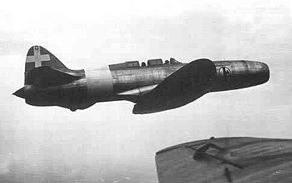
The first jet airplane (the "Campini Caproni 1") in History was created just a few years after the supposed 1933 UFO crash in Lombardy.


But I have some questions in my mind related to this 1933 UFO

1) The first question that I get in my mind is: why Mussolini concealed all this? He could have done the same that was done 14 years later with the famous Roswell case, when the media was informed (even if superficially): and no damage would have hit his fascism regime in Italy. On the contrary, he could have used the 1933 case to show how fascism was dealing with this problem and studying successfully the UFO.

And this is the most intriguing area where I have to admit that may be it is true something of all these facts......Indeed, we know that the Italians were able to create a few years later the first jet airplane (the "Campini Caproni 1") in History, but we also know that the aviation industry of Italy was the last in western Europe at the end of WW1.

2) So, my second question is: Can it be that the study of the UFO stored in hangars near Milano gave the Italians the needed technology? We have to remember that Italian engineer Secondo Campini submitted a report on the potential of jet propulsion to the Regia Aeronautica, and demonstrated a jet-powered boat in Venice: in 1934, the Regia Aeronautica granted approval for the development of a jet aircraft to demonstrate the principle used by Campini and made a contract with him in order to receive 2 aircrafts with "propulsione a reazione" (jet propulsion) in the second half of the 1930s

It strikes me the coincidence that all this "jet" development started to happen exactly one year after the 1933 Fascist UFO crash.

3) Another question is related to the original idea of the disc called "Turboproietti", created during WW2 by Giuseppe Belluzzo (read for further information GIUSEPPE BELLUZZO TURBO PROIETTI (TURBINA PROIETTILE), by Rob Arndt


Working with the SS after 1943, Belluzzo designed a three motor jet pipe system that would rotate an annular wing. Belluzo had been inspired by Hermann Oberth’s orbital platform concepts since the 1930’s so he put his own engineering skill to work with this design. Here is a brief description of the design, made by Rob Arndt:

  "Jet pipes on the edge of the disc had a variable diameter. A turbine drove the pipes initially until air accelerated through the pipes. At the widest section of each pipe oil was injected and ignited. The temperature was raised quickly and at the end of each underside pipe the air reached a speed of  700 meters/second, able to allow the circular craft to spin at a rotation speed of 400 meters/second. When the fuel ran out , the explosive-laden "Turboproietti" simply dropped to the ground in similar fashion to the German V-1 missile. Hopefully, the target would receive a direct hit."

While the SS entertained the idea of this operation, an unmanned aerial "Flakmine" version was considered more important and that was what Giuseppe Belluzzo was working on in 1945 when the war ended. No prototypes were ever constructed.

And so a third question arises in my mind and it is: Is it possible that the size and form of the Belluzzo's Turboproietti can be related to the 1933 UFO, allegedly stored in the hangars of the SIAI Marchetti in Vergiate near Milan after 1933?

4) Finally a fourth question makes me indirectly think that there it is a nearly 100% probability that the 1933 UFO crash happened really and was not a simple crash of an experimental aircraft created by Germans or English scientists:

If some news of this accident appeared on local Italian newspapers and magazines (the copies are easily found in local public libraries and this fact confirms that "something" happened), why all this story about an UFO has been created in a decade when practically nobody knew about this phenomenon and nobody was going to be interested in?

According to researcher Phil H. Clark, news of the downed craft reached Italian Fascist Benito Mussolini who issued three directives: one to recover the downed UFO, the second to remove it to a secure location away from people and the third to hide all information, while creating the Gabinetto RS with Marconi to study it. But why all this mess if nobody cared about this topic, in all the countries of the 1933 world? The UFO problem was created after WW2, mainly after the famous Roswell crash....but in 1933 nobody was informed about UFOs! And not even existed the word UFO (or "flying saucers"), that appeared for the first time in 1947!

Mussolini and his Fascism was not going to get anything from all this UFO crash...So, why to invent all this? Why if there was no reason? Why -if it is fake- it was created all this UFO story, full of so many detailed & discussed events lasting until the hangar fire of 1940?


Post Scriptum: There are interesting related informations in the italian article https://www.secoloditalia.it/2023/06/ufo-di-mussolini-nellarea-51-secondo-un-ex-funzionario-usa-e-in-una-base-militare-con-altri-mezzi-alieni/

NB: The following 2023 essay repeats exactly some excerpts of my above article: https://www.theblackvault.com/casefiles/the-ufo-files-of-mussolini-fascist-ufo-files-by-roberto-pinotti/.....and I 'd appreciate to be "remembered" by the authors.Thanks anyway. Bruno D.

Tuesday, August 5, 2025

FASCISM IN LATIN AMERICA BEFORE WW2 (AND UNTIL THE 1970S)

 A brief account of Fascism & fascist movements in Latin America in the 1920s, 1930s and 1940s:

The question of Fascism in Latin America (including French Canada) dates back to the 1920s and 1930s. Certain fascist-type movements emerged in Brazil, Argentina, Chile, Uruguay, Peru, Venezuela and Mexico, among others, while in Europe, Fascism was on the rise amidst an atmosphere of intellectual and political radicalism.

There was even a relatively small number of Italians in Latin America who were members of the "Italian Fascist Party", but this will be researched in another future monthly issue. And we must pinpoint that the Casa d'Italia (Italian House) Bulletin in Caracas wrote in 1939 that there were "Fascio all'Estero" in Caracas, Valencia, Puerto Cabello, Duaca, Santa Cruz de Mora (in the state of Mérida), San Cristóbal, Valera, and Villa de Cura (and that these organizations had more than 1000 members).

However it is noteworthy to pinpoint that the important fascist Giuseppe Bastianini in 1922 was appointed in Roma as head of the "Fasci Italiani all'Estero", a movement aimed at co-ordinating the activities of Italian fascists not currently living in Italy. He called on members to seek to diffuse proper Italian fascist ideals wherever they were living. This group gained a considerable following amongst Italian expatriates in the mid-1920s, mainly in South America. Indeed, in 1925 he submitted a report to the Fascist Grand Council claiming to have groups in 40 countries worldwide, most of them in Latin America.

 However the Italian fascists had a partially negative opinion of the fascist movements that were arising in Latinoamerica (please read and google-translate from spanish: https://www.academia.edu/64653626/Fascismo_en_Am%C3%A9rica_Latina_La_Perspectiva_Italiana_1922_1943_?email_work_card=view-paper ). The only major movement recognized by the Italian fascists as "fascist" was the Brazilian Integralist Action (AIB). Diplomats, publications, the press, and Ciano all expressed this view. Everything else that appears fascist, however, was viewed with skepticism or rejected. The documentation of the Italian Ministry of Foreign Affairs (MAE) was particularly forceful in this regard. Similar fascist movements, or those reputed to be such, that emerged in many countries during the 1930s, such as the Argentine Fascist Party (1932), the National Socialist Movement of Chile (1932), and the Mexicanist Revolutionary Action (1934), aroused more pessimism than hope among Italian observers.

 Another factor behind the development of forms of Italian Fascism in Latin America was the huge emigration of Italians in the region. Countries like Argentina had half of its population made of Italians and their descendants in the first half of the XX century.

We will now briefly review these movements in Latin America:

Argentina fascists in 1939: the "Fascio" of Buenos Aires had more than 4000 members. After the WW2 disappearance of Fascism, nearly all of them become fanatical supporters of Peronism


In 1922, the year Mussolini became prime minister of Italy, a reactionary and anti-communist group called "The Leopards" was founded in Colombia, inspired by the ideas of the Duce (nickname of Mussolini). In 1933, as Hitler consolidated his totalitarian regime, the "Golden Shirts" (called "Camisas Doradas" in Spanish) were founded in Mexico, an anti-Semitic and anti-Chinese movement inspired by the Führer's National Socialism. In Brazil, in 1932, the largest fascist group in Latin America, the Brazilian Integralist Action, was born, led by Plínio Salgado claimed as many as 200,000 member.  In 1937 many thousands of Brasilian fascists militants used the Greek letter sigma (∑) as the equivalent of the Italian "Fascio" and united under the motto "God, Homeland, and Family."

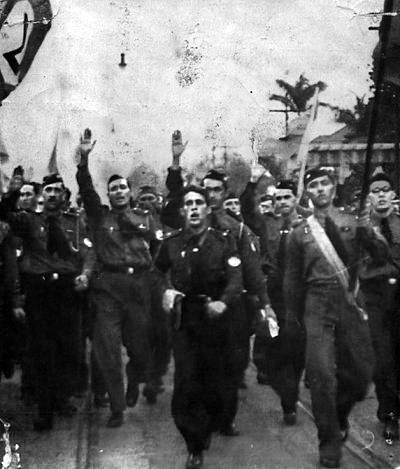
Imitating the Nazis, Brazilian fascists raised their right arms in greeting. Unlike the Germans, they added something extra to the greeting: "Anauê!", an indigenous Tupi word meaning something similar to "you are my comrade".  A short word to indicate that the Latin-American fascists were similar to their European friends, but not entirely the same. 

Of course, the country in Latin-America where Fascism was more followed and powerful -because it was the most populated by Italians- was Argentina. Even Uruguay experienced a similar situation.

Argentina

In 1919, the "Argentine Patriotic League" emerged in Argentina during the presidency of Hipólito Irigoyen. This event coincided with the rise of Fascism in Italy. The Patriotic League had a nationalist program that combined right-wing politics and liberalism in economics. It enjoyed broad support from the government, the military, the Catholic Church, and the upper class, and formed civilian paramilitary squads called "White Guards"  (similar to Mussolini's "Black Shirts")  to suppress strikers, anarchists, Jews, and Catalans. 

Vittorio Valdani, vice president of the Argentine Industrial Association, was charged by the Italian Fascist Party with organizing and directing Italian fascist groups in Argentina, creating in 1930 the main fascist press organ in South America, the newspaper "Il Mattino d'Italia", which was published in Italian language until October 1944.

"In order to disseminate the Fascist ideology abroad, different organizations were built up by Mussolini, most importantly the "Fasci italiani all’estero", which operated in many countries and had 8 million members worldwide. The local Fascio in Buenos Aires was the first to be founded on Latin American soil, even before the March on Rome in October 1922 and in the continental comparison also remained the most important. Further Fasci in other Argentine cities followed. Claiming the interpretative monopoly of italianità, which under fascism coincided with the Fascist ideology, the Fasci in Argentina tried to instigate patriotic sentiments and resuscitate emotional connections towards the former homeland among the otherwise ideologically heterogeneous Italian community in Argentina. Therefore, the Fasci engaged in the social, cultural and educational sphere, rivaling among others with the various traditional associations of Italian immigrants in Argentina, mostly of charitable, social or cultural nature. Katharina Schembs"

There were other fascist-type movements in the 1920s, such as the "Argentine Social League", whose objective was to fight modernism and tendencies they considered subversive. From 1930 to 1943 (the "infamous decade"), several dictatorships followed one another: Uriburo, Justo, Ortíz, and Castillo. In 1930, the coup-monger General Uriburo attempted to create a fascist regime, but failed due to opposition from broad sectors, including conservatives linked to the USA.

In 1923 was created the "National Fascist Party" (Partrido Nacional Fascista) of Argentina, a fascist political party that was directly linked to Mussolini. It had five thousand members in 1927 and was centered in Buenos Aires and Cordoba. 

In 1932 the "Argentine Fascist Party" (Partido Fascista Argentino) was founded\ by Italo-argentines, as a split from one of the factions of the National Fascist Party. The PFA was founded on the ideological and doctrinal basis of Italian Fascism, and in fact in 1935 it was recognized by the Italian National Fascist Party. In the 1930s the party became a mass organization, especially in the city of Córdoba. Nicholas Vitelli led the Córdoba faction of the Argentine Fascist Party until his death in 1934, when Nimio de Anquín took the reins of the party leading it towards a new orientation close to Catholic nationalism,

The "National Fascist Union" (Union Nacional Fascista) was a fascist political party formed in Argentina in 1936, as the successor to the Argentine Fascist Party. It was dismantled during WW2.

         Flag of the "Partido Fascista Argentino", created by the Italian-Argentine  Nicola Vitelli


Between 1943 and 1946, the so-called United Officers Group ("GOU") took power and imposed a dictatorship. Its main leaders included high-ranking officers Farrell, Ávalos, Vernengo, and Colonel Juan Domingo Perón. Before Perón prevailed over this group of officers, who at one point conspired, imprisoned him, and forced his retirement, masses of mostly workers demanded his release on October 17, 1945, and later prevailed in the 1946 elections.

It's important to note that Peron publicly admired Mussolini. His support for Mussolini is well documented, and during a trip to Europe in 1938 he said:

"Italian Fascism made people's organizations participate more on the country's political stage. Before Mussolini's rise to power, the state was separated from the workers, and the former had no involvement in the latter."

Payne emphasizes the fascist characteristics of Peronism, especially the years Perón spent in power between 1946 and 1955, but not the subsequent history of the "Peronist Party" as a mass labor union movement. Several scholars of the early stages of the Peronist movement argue that it shared many characteristics of Italian Fascism.

Although Perón's goal was to found a single party, it was never achieved in practice. Peronism enjoyed strong support from the Union sector and was based on a limited authoritarianism that tolerated pluralism. Germani defined Peronism as a "national populism," adding a populist approach to the discussion. Lipset, on the other hand, classified it as "left-wing Fascism," highlighting that its largely union-based social base could shift from right to left.

Brazil

In Brazil, between 1932 and 1938, a movement with fascist influences emerged, the "Ação Integralista Brasileira" (Brazilian Integralist Action, AIB), founded by the writer Plinio Salgado. The AIB was inspired by an anti-parliamentary, traditionalist, and monarchist Portuguese movement, known as "Lusitanian Integralism". It was an important mass political movement that at one point had more than 500,000 members and met virtually all the conditions of a fascist organization. However, the ruler Getulio Vargas, after flirting with the movement, finally demobilized and banned it under US influence during WW2. 

In Integralism, the attitude and production of its ideologues, its publications and propaganda, and its rigorously hierarchical structure tend to demonstrate its eminently fascist character, obviously in a different historical context. Integralism possesses characteristics of European fascist movements with certain indigenous elements, without being a simple replica of those movements.

 In the Italian fascist organizations, both immigrants and their descendants were accepted, such as in the case of the "Fascio di Sao Paolo", one of the main organizations of Italian fascism in Brazil. 

The Fascio di Sao Paolo was formed in March 1923 approximately 6 months after the fascists took power in Italy; it achieved huge success among the Italians of the city and rapidly spread to other cities and Italian communities. In November 1931, a branch of the Opera Nazionale Dopolavoro, which had existed in Italy since 1925, was founded in São Paulo and subsequently placed under the control of the Fascio di Sao Paulo. The Fascio was responsible for spreading the fascist doctrine among the popular classes. 

Another institution at the time was the Circolo Italiano di Sao Paolo which was established in 1910 and still active today. Its aim has been to preserve and disseminate Italian culture to Italian-Brazilians and Brazilians in general. In the mid-1920s, the fascist doctrine began to infiltrate the community and institution through the influence of Serafino Mazzolini, the Italian consul to Brazil

In 1927, it was reported that many in Brazil "felt strongly Italian" and supported Mussolini. According to that 1927 report, Brazil had 52 fascist groups, and by 1934, this number had increased to 82. Of these, 35 were concentrated in São Paulo alone. By 1938, there were nearly 100 Fasci groups in the country

Brasilian integralist in a 1935 Sao Paulo manifestation doing the fascist salute


Regarding Vargas's government from 1930 to 1937, it fluctuated between the anti-oligarchic "dictatorship" (1930 to 1934) and the constitutional-liberal government from 1934 to 1937; in the next stage, before the election of his successor, he carried out a coup d'état with the support of the Armed Forces and imposed an authoritarian and repressive system ("Estado Novo", 1937 to 1945); finally, Vargas was elected President of the Republic by universal suffrage in 1950 through the Brazilian Labor Party.

Under his successor, he carried out a coup d'état with the support of the armed forces and imposed an authoritarian and repressive system (Estado Novo, 1937 to 1945). Finally, Vargas was elected President of the Republic in 1950 by universal suffrage through the Brazilian Labor Party.

Uruguay

In Uruguay, a group of far-right intellectuals and politicians took advantage of the 1929 depression and began to criticize the executive branch for its poor handling of the economic situation. The Uruguayan economic elite founded the "Vigilance Committee" with the intention of promoting a change in economic policies. 

In Uruguay there was a huge Italian community (that was nearly one third of the total population of Uruguay) and the influence of Italian Fascism was very strong and important like in nearby Argentina (please read with google translation:.http://www.chasque.net/frontpage/relacion/9909/uruguay.htm).

Indeed elected President Gabriel Terra (an italo-uruguayan), who had already expressed fascist ideas, led a coup d'état and dissolved Parliament and the National Administrative Council in 1933. The "March on Montevideo" (similar to the March on Rome led by Mussolini) was called in support of him in April 1933.

Gabriel Terra's followers became known as "Marzists" due to their adherence to the "March Revolution," the official name of the coup. Elections were called for the Constituent Assembly that drafted the 1934 Constitution. The constitution, founded on corporatist principles, formally recognized the human rights to education, health care, and work, as well as freedom of assembly and association. Terra broke off diplomatic relations with the USSR and the Second Spanish Republic, recognizing Franco's Spain.

The "March regime" developed anti-immigration policies, such as controlling Jewish immigration and establishing a minimum of 80% Uruguayan labor in public works. Despite holding favorable opinions about the system, the 1934 Constituent Assembly rejected the full implementation of corporatism in Uruguay, considering it too radical.

Indeed during the Terra regime (1933-1938), several political leaders expressed their intentions to incorporate certain fascist premises into Uruguay. Gabriel Terra and César Charlone made no secret of their fascist sympathies. The latter emphasized the need to introduce corporatism into Uruguayan legislation, proposing "union pacts" and concepts of "the newest labor rights" taken from Mussolini's "Carta del Lavoro". These ideas were put into practice with the creation of the Higher Council of Labor in 1933, which required it to be composed of Unions that would enjoy legal status. 

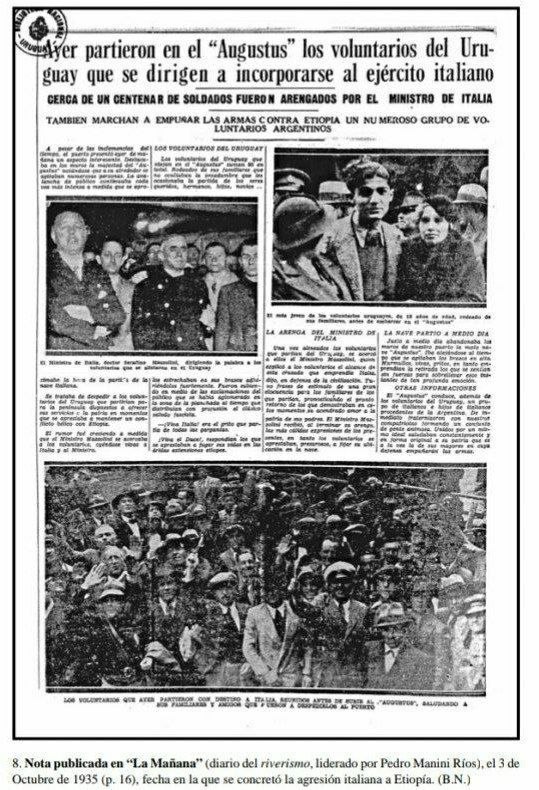
It is noteworthy to remember that president Terra allowed 100 Uruguayans to fight as volunteers in the Italian conquest of Ethiopia in October 1935. Terra was also the first south-american politician to recognize the Franco regime in Spain.

The Italian language acquired considerable importance in Uruguay in those years under Terra and his successors: in 1942, under the presidency of Baldomir Ferrari (who admired Italian Fascism), its study became compulsory in all the high schools of Uruguay.

Uruguayan newspaper showing the 100 Uruguayan volunteers who went to Ethiopia to fight for Mussolini's conquest of this African country in 1935. In the headlines there it is written: "Yesterday sailed in the Augustus (ship) the volunteers of Uruguay who go to unite to the Italian Army (in Ethiopia)...Nearly one hundred soldiers were enrolled by a Minister of Italy...Also, a huge group of volunteers from Argentina goes to fight Ethiopia with armaments "
Chile

The Fascist Party of Chile (PFC) was founded in 1932 by Carlos Keller. The PFC was inspired by Italian fascism and Spanish Falangism and promoted national unity, dictatorship, and corporatism. Unlike the MNS, the PFC had a more limited social base, composed primarily of intellectuals and members of the lower middle class.

Chilean fascism was characterized by its strong nationalism and authoritarianism. Fascist leaders emphasized the importance of Chile as a nation and the need for charismatic and authoritarian leadership to address the country's problems.

Chilean fascism championed corporatism, a system in which workers organized into their respective unions and participated in the management of the economy, and in which the antagonism between capital and labor was suppressed. Furthermore, Chilean fascism was openly anti-communist, which earned it the support of a significant segment of the Chilean population, who viewed communism as a threat to property and individual freedoms.

The Chilean Fascist Party participated in the 1938 presidential elections but was defeated by the Popular Front candidate, Pedro Aguirre Cerda. From that moment on, Chilean fascism lost ground and ceased to be a relevant political option in Chile.

Despite its short life, Chilean fascism left a lasting legacy in Chilean politics. The nationalist and authoritarian discourse it championed influenced the formation of later political groups, such as the National Union and the military dictatorship of Augusto Pinochet. Furthermore, some historians argue that elements of Chilean fascism are present in contemporary Chilean politics, especially in the populist and authoritarian currents that have emerged in recent years.

Furthermore , in 1933 Chile, a movement emerged that aspired to adopt the principles of Nazism. The National Socialist Movement of Chile, or Nazi Party (MNS), was created. The MNS was configured with a hierarchical command structure, which was completed in 1933 with the "Nacist Assault Troops." 

In 1938, before the elections, it organized a demonstration called "The Victory March." The following day, a group from the MNS took over the Workers' Insurance Fund and the University of Chile's main campus to launch a coup against President Arturo Alessandri and impose General Ibáñez on power. The coup failed, and the government ordered the execution of the insurgents. 

In 1939, the MNS was renamed the Popular Socialist Vanguard (VPS), adopting a leftist stance, which caused most of its members to abandon the party, which dissolved in 1942.

Mexico

In Mexico, especially after the economic crisis of 1929, groups of ultranationalists, xenophobes, or racists emerged, among whom one was anti-Semitic and another anti-Chinese.

The "Revolutionary Mexicanist Action"  (Spanish: Acción Revolucionaria Mexicanista), better known as the Gold Shirts (Camisas Doradas), was a Mexican fascist, anti-Semitic, anti-Chinese, anti-communist, ultra-nationalist paramilitary organization; it originated on March 10, 1934 in Mexico City and disbanded in 1936. It was led by Nicolas Carrasco, an admirer of Mussolini and Hitler.

The National Synarchist Union defended the values of Catholicism and anti-communism. It was inspired by the National Catholicism of the Spanish Falangist movement.

The Traditionalist Spanish Phalanx also emerged, gaining the support of Mexican President Lázaro Cárdenas, who facilitated the integration of Spanish Republican exiles into Mexico.

Peru

In Peru, the "Revolutionary Union" (RU) was created in 1931 by Sanchez Cerro, who admired Mussolini. In 1933, it was led by the Prime Minister of Peru -Luis A. Flores Medina- and became an openly fascist party that opposed liberalism and communism, and in particular the APRA party. They promoted xenophobia against Japanese and Chinese immigrants. They proposed a corporatist and totalitarian society similar to the model of European fascist movements of the interwar period. 

Beginning in 1933 and after the murder of President of Peru Sanchez Cerro, the Revolutionary Union propagated a resoundingly fascist discourse similar to that used in Mussolini's Italy. At the end of 1933, the "Blackshirt Legion" was created, comprised of youth, following the authoritarian line. Furthermore,  the RU promoted the rights of equality for women under the leadership of the Italo Peruvian Yolanda Coco Ferrero. She is considered one of the first feminist leaders in world History.

Indeed under the leadership of Luis A. Flores, who sought to mobilize mass support and even set up a Blackshirt movement in imitation of the Italian model (called "Camicie Nere" in Italy),  the Revolutionary Union successively planned a coup d'état which was discovered in 1937, leading to Flores exile in Chile.

Flores was allowed to return to Peru in the early 1940s and reorganized his political fascist party, which never achieved the same results it reached in 1936 and disappeared with the final defeat of Fascism in 1945 WW2.

Photo of funeral for murdered President of Peru Sanchez Cerro in 1933, showing behind the priest the leader of the "Revolutionary Union" (RU) Luis Flores (dressed with fascist black shirt) and the Italo Peruvian feminist RU leader Yolanda Ferrero (who was the first to equalize woman rights in Peru).


Bolivia

The governments of David Toro and Germán Busch were vaguely committed to corporatism, ultra-nationalism, and national syndicalism, but they lacked coherence in their ideas. Such concepts were later adopted by the "Revolutionary Nationalist Movement" (MNR), which openly acknowledged its ideological debt to Fascism and joined the military under Gualberto Villarroel's pro-Axis government in 1943. But after WW2 the MNR moved away from the defeated Fascism.

Because historically the Bolivian army contained some German advisors and German-trained soldiers, the President Busch (of part-German ancestry himself) was suspected to have sympathy for Fascism and have Nazi tendencies; this was reinforced by the fact that only a week after taking power in 1937, he had requested economic and oil advisors from the German legation. On 9 April 1939, shortly before his declaration of dictatorial rule on the 24th, Busch had spoken with Ernst Wendler, the German minister in Bolivia, to request "moral and material support" for the establishment of "order and authority in the state through [...] the transition to a totalitarian state form". To do this, Busch asked for German advisors in almost every field of government administration. 

While Wendler expressed interest, the final reply by the German government on 22 April cordially denied Busch's request, stating that it wished to avoid "conspicuous measures, such as the sending of a staff of advisors". The possible reason was the refusal of Bush to accept the racism of Hitler and accept the immigration of Jews into Bolivia while escaping from Europe in 1939. 

Furthermore from an initially oppositional stance, Óscar Únzaga's "Bolivian Socialist Falange" was an important group in the 1930s that sought to incorporate the ideas of the leader of fascism in Spain, the falangist José Antonio Primo de Rivera, in Bolivia. However, like the MNR, it gradually de-emphasized its faith in Fascism over time after 1945.

Paraguay

Paraguay has been often declared as "The paradise of the extreme-right fanatics in South America", because the first Nazi party in the Americas was created there in 1929, 4 years before Hitler took power in Germany. The ideals of Fascism were promoted in the capital La Asuncion by the relatively huge Italian and German communities of the country during the 1920s and 1930s.

Indeed the "Febrerista movement", active during the second half of the1930s, demonstrated some support for Fascism by seeking revolutionary change, endorsing strong nationalism, and seeking to partly introduce corporatism of Italian Fascism. Their revolutionary Rafael Franco-led government, however, proved decidedly non-radical during its brief presidential tenure in 1936. 

The Febreristas have since regrouped as the "Revolutionary Febrerista Party", that supported after WW2 the 35 years of the dictatorship of the Paraguay President Stroessner (a declared admirer of Mussolini's Fascism).

Ecuador

In Ecuador there was a small Italian community concentrated in Guayaquil (with nearly two thousand members), where was created an italian  "Fascio" in 1933 with 82 members. However politically Fascism in Ecuador was without importance in the 1930s.

Only in 1942 Jorge Luna Yépes formed the "Accion Revolucionaria Nacionalista Ecuatoriana" (ARNE) party, inspired by the European fascist political parties of the first half of the 20th century, particularly the Spanish Falangism of Francisco Franco. His party described itself as "nationalist, anti-communist and anti-capitalist".  During its existence it had an important political participation, both in the legislative and executive branches, being part of the government of Ecuador president José María Velasco Ibarra in 1944.

Panama

The Central American leader who came closest to being an important domestic fascist was Arturo Arias who in Panama during the 1940s, became a strong admirer and advocate of Italian Fascism, following his ascension to presidency in 1940. 

Arias in the 1930s was Panama ambassador in Mussolini's Italy and this fact led some historians to claim he was pro-Axis. During his presidency he created the "Doctrina Panamista" promoting  independence from the USA and some forms of fascist corporativism. As a consequence he was forced to resign by a coup  (probably ruled by Roosevelt) and go in exile in October 1941.

Costa Rica

 In Costa Rica there was a big community of Italians (nearly half a million descendants actually) and also a relatively huge of Germans, mainly in the San Jose capital's region.

The existence of figures who were sympathetic to Fascism and Nazism in high political positions has been pointed out in the administrations of León Cortés Castro and Rafael Ángel Calderón Guardia.

 Cortés,  having spent some time in Italy and Nazi Germany, was publicly viewed as an important sympathizer of Mussolini's Fascism. He was President fro 1936 to 1940 and during his presidency, he appointed as "immigration advisor" the German-Costarican Max Effinger, who restricted immigration for "Non-Aryans". In particular, he prevented many Polish Jewish refugees from entering Costa Rica

In the late 1930s, a movement which was sympathetic to Nazism developed among a large community of Germans. Supporters of Nazism (numbering 66 in 1939) met in a local German Club of San Jose, but during WW2 all Germans and Italians were sent to concentration camps for security reasons promoted by the USA .

Quebec (French Canada)

Among the right-wing nationalists in French Canada in the 1930s, the "National Social Christian Party" (NSCP) was founded. Its founder, Adrien Arcand, would be known as the “Canadian Duce/Fuhrer.” 

European influence, anti-Semitism, Christianism, and the Great Depression all played an important role in the expansion of extremist right-wing nationalism in Quebec. There were two main groups among the nationalists of the extreme right in the 1930s: the separatist group of Abbé Lionel Groulx, and the federalist group of Adrien Arcand.

Groulx was an historian and a teacher at the University of Montreal. Pro-separatist, Catholic, racist, and anti-democracy, he was very influential among his fellow ultranationalists. Groulx was the mentor of the radical nationalist group Les Jeune Canada (“The Young Canadians”). Also linked to his circle was the magazine L’Action Nationale and intellectual newspaper Le Devoir, which published anti-Semitic articles.

Adrien Arcand was a professional journalist. In 1929, he and his friend Joseph Ménard started Le Goglu, a satirical review. Later on, they added Le Miroir and Le Chameau. The three weekly newspapers served as a platform for fascist propaganda. When the economic crisis started to strongly affect Quebec, they announced the creation of a “proto-fascist” movement called the "Ordre Patriotique des Goglus". The Order held mass meetings promoting racism and proudly wore blue shirts with swastika logos. 

Pierre Trudeau -when young- was sympathetic with Fascism and promoted the French language as official in Quebec (French Canada) when was Prime Minister of Canada after WW2.


Recently the academic Esther Delisle wrote that Pierre Trudeau (Prime Minister of Canada and creator of bilingualism in French Canada) was sympathetic with Fascism, when was a young university student. She wrote that "In his memoirs, Trudeau remains mute on the anti-liberal and anti-democratic ideology of many of his Jesuit teachers at the college Jean-de-Brébeuf. He also fails to mention the support for Fascism and Nazism in Le Quartier latin, his membership of Les Frères Chasseurs/LX and the Bloc Universitaire and his deep attachment to La Laurentie that lasted into adulthood"). Please read:https://journals.uclpress.co.uk/ljcs/article/id/3154/ "Hidden in Plain sight: Fascism in Quebec during the Second World War", by Esther Delisle.

With WW2 all the fascist organizations in Quebec were outlawed and closed.

Colombia

The fascist-style politics of the conservatism of the "Leopardos" would be closely linked to the actions of the different elements of Colombian conservatism at the beginning of the 20th century.

These different ideological orientations would begin their career as fascist-style cultural and economic movements, eventually revealing their true purpose and minimally achieving their political goals and projects. They imitated practices of the fascist models that would triumph in Europe, such as those of Italy, but also of Germany and Spain.

The year 1936 saw the proliferation of Fascist and Falangist groups. In January, El Tiempo of Bogotá announced the creation of a fascist group called "Haz de Fuego" (Fire Beam) and the appointment of the Falangists from the "Primo de Rivera" center as its leader. Fascist groups were formed in Bogotá's universities. In Medellín, a military organization called "La Cruz de Malta" (The Cross of Malta) and another group with a clearly fascist character called "Haz de Juventudes Godas" (God Youth Beam) appeared. Under the auspices of the Antioquia's "Haz Godo" (God Youth Beam) were created, several phalanxes of university students, workers, "rearguard of children," and also a phalanx of women.

Some right-wingers promoted the formation of a right-wing organization separate from the Conservative Party, structured around a program directly inspired by Hitler, Mussolini, and Oliveira Salazar.

This led to the emergence of various support organizations for these fascist models, influenced by the results and support obtained as a political movement before WW2.

Venezuela

Dictator Gomez from 1908 until 1935 ruled Venezuela with a "colonial" dictatorship that had only a few fascist characteristics, mostly related to Germany's racism. He favored the "Blanqueamiento" (whitening) of the Venezuelan population, blocking the immigration of Chinese, Asian & African people into oil-rich Venezuela and promoting the creation of the Nazi party of Venezuela.

The Italo venezuelan Alberto Adriani, who was the creator of the famous "Sembrar el petroleo" phrase when was minister of Economy & Finance in 1936 Venezuela, in 1923 wrote:

"Fascism is not a passing episode. It has its roots in the purest Latin and Italian tradition. The fascist state is the Roman state that the Church maintained in its ironclad organization; the same state as Machiavelli's "The Prince." Despite the diversity of starting points, the same results are reached as with liberalism. For Fascism, the nation is paramount; it accepts freedom from a national perspective; it desires equality, but focuses on possibilities; it wants, if possible, to turn the entire country into a vast aristocracy, but it refuses to destroy the elite to place everyone at the level of the least" A.Adriani (please read for complete info: https://albertoadriani.substack.com/p/liga-de-naciones-y-fascismo).  

In 1939 there was an Italian "Fascio" in Venezuela with more than one thousand Italian members, of which 200 were in the capital Caracas:  this fascist organization was ordered to be closed in 1941, following political pressures from USA's president Roosevelt (please read https://lombardinelmondo.org/italiani-venezuela-fascismo/ with google translator from Italian language).

The renowned writer and key figure of the literary "Magical Realism" movement of Venezuela, Arturo Uslar Pietri (whose mother was Italian), held pro-Axis and anti-US sentiments, attempting to sway President Medina Angarita towards aligning with Germany and Italy during the beginning of WW2. Subsequently, Pietri went on to serve as a senator and establish the Nationalist party known as the National Democratic Front (Frente Nacional Democrático). 

A noteworthy detail of fascist Venezuelans is that Ettore Chimeri, recognized as the first Venezuelan to compete in Formula 1, was a member of Squadron 73 in the Royal Italian Aeronautics during World War II, serving in the African campaign.

Enrique Parra Bozo, who was noted for his admiration of Franco & Mussolini as well as his Catholicism and anti-communism, led the Partido Auténtico Nacionalista along Fascist lines. The group lent its support in the 1950s to the military regime of Perez Jimenez and even attempted, though unsuccessfully, to nominate him as their candidate for the 1963 presidential election.

Conclusions:

In short, there is no doubt that during the 1920s and 1930s, fascist models emerged in Latin America that mimicked Italian, German, or Spanish Fascism, in some cases a minority, such as "Nacism" in Chile, or broad and well-rooted movements such as "Integralism" in Brazil or "Marzism" in Uruguay, clearly founded on European interwar Fascism. 

However, in no case were these truly consolidated fascist regimes. The Italian fascist government always "separated" himself from these movements and created a fascist organization only for Italians residents in Latin America & the World: the "Fascio degli Italiani all'Estero" (the "Fascism of Italians in the World"). It promoted mainly the italianita' (italianity) in Latin America, while obtained only the official use of the Italian language in Uruguay's schools and the participation of hundreds of Argentine & Uruguayan volunteers in the Italian army (during the Italian conquest of Ethiopia).

The case of Peronism is special, because presents native complexities as it is a populist movement with fascist features, based on Trade Unions, which has a broad mass base, and which brings it closer to a left-wing Fascism, but accepting pluralism at first to a greater extent and then to a lesser extent, as it shifted toward repression in its final stage.

The Second World War sealed, in a certain sense, the fate of the Fascism overseas in Latin America. Patriotic pride of Italy was followed by the humiliation of defeat. But the fascists did not disappear, nor did they lose prestige. Nor did the corporatist ideology, anti-Americanism, distrust of democracy, and the cult of the leader that these Italians and their descendants had professed disappear, and which merged with other ideologies in the rhetoric and practice of subsequent populisms (like Peronism in Argentina).

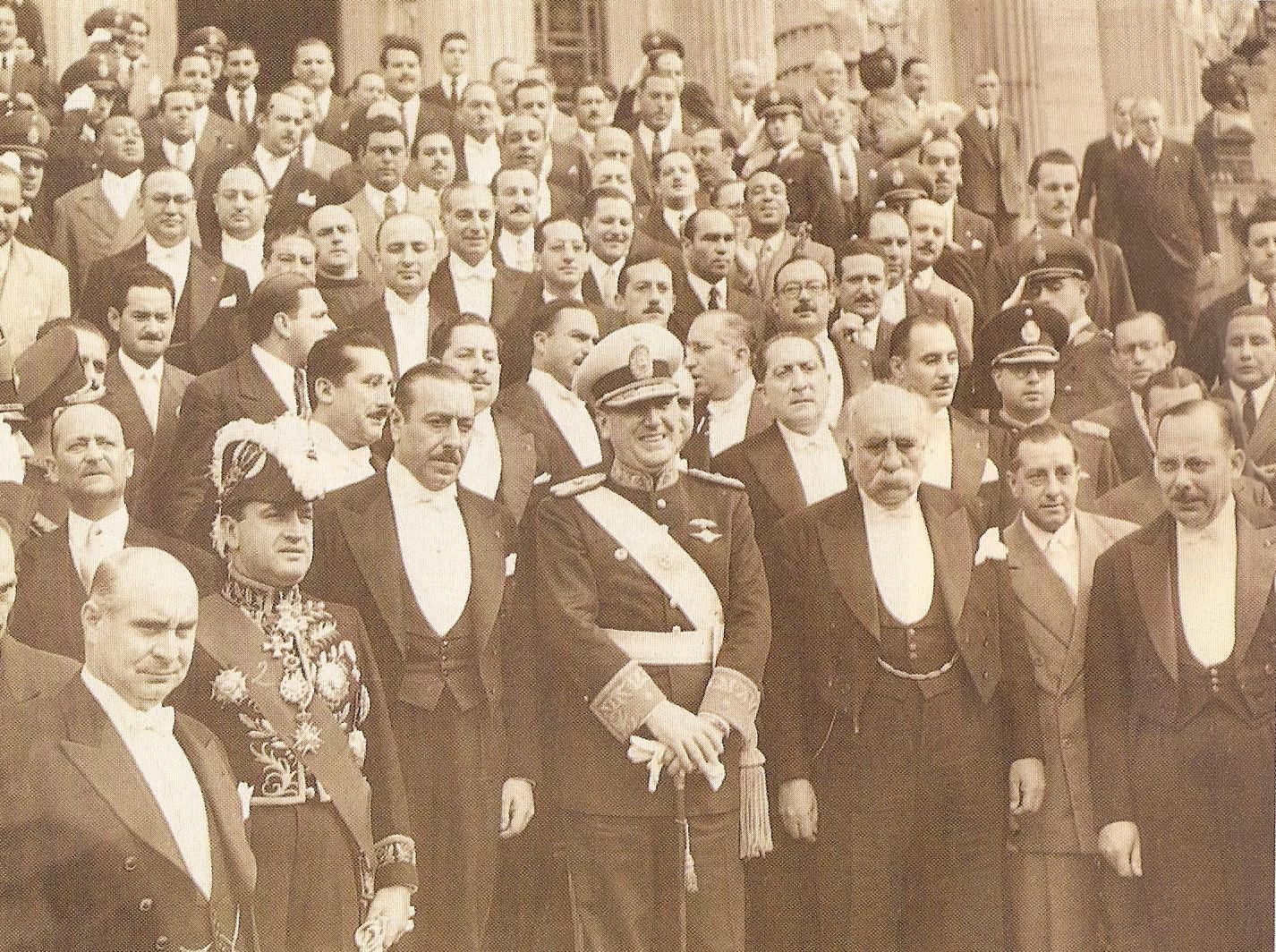
Juan Domingo Perón (in the photo center), President of Argentina from 1946 to 1955 and from 1973 to 1974, admired Italian Fascism and, according to some authors, modeled his economic policies on those followed by fascist Italy.


Latin America dictatorships and Fascism until the 1970s.

Some academics identify a group of dictatorships in Latin America with Fascism (for furtherr info read http://www.loeser.us/flags/hate.html#top) :

According to them, the first dictatorships in Latin America classified as fascist were those imposed in the Dominican Republic by Rafael Trujillo, giving rise to "Trujillismo" (1930–1961), in El Salvador by Maximiliano Hernández Martínez, giving rise to the "Martinato" (1931–1944), and in Nicaragua by General Anastasio Somoza, giving rise to what is known as "Somocismo" (1937–1979). 

All three imposed types of state without the possibility of political opposition, which extended over several decades, with the support of the United States and the economic elites, characterized by an ideology with a marked anti-communist accent, profoundly liberal in economics, and repressive of union, student, indigenous movements, and politicians with social justice programs. 

The first dictatorship in Argentina also dates from that early period, explicitly -according to them- inspired by Italian Fascism, led by General José Félix Uriburu (1930-1932), whose aim was to prevent the Yrigoyenist Radicalism, with its broad popular base, from governing the country, an objective which it achieved although it did not manage to consolidate its hold on power.

Furthermore, certain dictatorships sparked a widespread debate about whether or not they constituted fascist regimes after WW2

In this group, we include the coups d'état in Brazil (1964), Uruguay (1973), Chile (1973), and Argentina (1976). Many scholars questioned how similar or different they were to the dictatorships of historical interwar fascism.

In Venezuela the dictatorship of Perez Jimenez (that had some characteristics of a moderate Fascism) lasted from 1952 until 1958 and promoted the "Europeization" of the country allowing nearly one million emigrants from Europe to reside in Venezuela (that had only 5 million inhabitants in the early1950s).

In 1959 took control of Cuba the communist leader Fidel Castro, who in his youth was an admirer of Mussolini, according to one of his teachers at the Colegio Belén, the Jesuit priest Armando Llorente.

According to Tzeiman, the 1960s, following the impetus of the Cuban Revolution, witnessed a growing intensification of class struggle in various parts of Latin America, whether through national-popular or socialist political movements. This climate of radicalization spread throughout the early 1970s. The military coup that took place in Chile in 1973 initiated a wave of dictatorships that would spread to other Latin American nations. 

Thus, by the end of the 1970s, the southern cone of Latin America was invaded by military dictatorships whose establishment acted as a brake on the aforementioned popular advance. Cueva paints a bleak picture of the 1970s. Brazil's military dictatorship seemed fully consolidated after twelve years. In Bolivia, the Banzer dictatorship seemed to have imposed a stable pro-imperialist order. Uruguay and Chile were suffering the effects of the fascist regimes established since 1973; while in Argentina, the government of Mrs.Estela Martínez de Perón was dying, giving way to the dictatorship of General Videla. And in Uruguay, the Stroessner tyranny had remained unshaken in power since 1954. 

In 1971, Nicos Poulantzas, who studied the processes of fascistization, examined these processes, concluding that, amidst the imperialist phase and class struggle, Fascism arose from a political and ideological crisis of the ruling group that generated a new hegemony of monopoly and financial capital. It is a political reaction to reinvent itself as a hegemonic power. 

In other words, this bourgeoisie, in the midst of a crisis, "changes its clothes" and presents itself to the masses as the "solution," which includes elements such as order, corporatism, nationalism, and stability. Its displacement culminates in the obliteration of the opposition and the emergence of a fascist police state. 

According to O'Donell, some of the inherited characteristics of historical Fascisms in Latin America are: hierarchical social organization, political exclusion, repression of the popular Marxist sector, suppression of foreign citizenship and participation, reconsideration and defense of the nation, violent elimination of dissent, patriotic and militarized discourse, promotion of Catholicism with Latin History & Culture links and  -of course- sympathy for European Fascisms (mainly the Italian).


1936 photo showing in Roma the "Legion of Italians emigrants" (Legione Italiani all'Estero)  parading in front of Mussolini (who was saluting them), after their return from conquering Ethiopia.  Nearly all these "Legionaries" were volunteers Italians and Italian descendants from Argentina, Brasil, USA, Paraguay, Chile and Uruguay.

Monday, May 2, 2016

ITALIAN INFLUENCE IN BRITISH PALESTINE & EGYPT (1934-1942)

Italy did in the 1930s some attempts to export the Fascist revolution to areas formally and informally controlled by Britain in Egypt and Palestine. The challenge mounted by the Italian government to the British imperial structure rested upon the development of preferential relations with nationalist movements throughout the empire; such relationship would be forged by propaganda in a region, the southern and eastern shores of the Mediterranean, which was central to Mussolini’s foreign policy.

The promotion of Fascist ideology among the Middle Eastern populations, and in particular in Egypt and Palestine, was driven by political priorities rather than ideological imperatives insofar as propaganda was carefully employed to expand the economic and military capacity of Fascist Italy.

While the Italians in Palestine were a few thousands (mostly Italian jews), the size of the community in Egypt had reached around 55,000 persons just before World War II, forming the second largest expatriate community in Egypt and greatly influencing the local society. The expansion of the colonial Italian Empire after World War I was even directed toward Egypt by Benito Mussolini, in order to control the Suez Canal.

So, the Italian "Duce" created in the late 1920s/early 1930s some sections of the National Fascist Party (NFP) in Alexandria and Cairo, and many hundreds of Italian Egyptians become members of it. Even some Italo-egyptian intellectuals, like Filippo Tommaso Marinetti (founder of the "Futurism") and the famous poet Giuseppe Ungaretti, were supporters of the Italian nationalism in their native Alexandria and promoted the Italian influence in Egypt. Furthermore, some egyptians were influenced by the ideals of the fascism promoted by the NFP sections in Egypt, like the founder of the "Muslim Brotherhood" Al-Hasan Al-Banna. As a consequence, during World War II the British authorities interned in concentration camps nearly 8,000 Italian Egyptians with sympathy for Italian fascism, in order to prevent sabotage after the Italian Army attacked western Egypt in summer 1940. However until 1941 the king Faisal of Egypt (famous for his pro-Italian attitude & sympathies) always successfully blocked those internments.


An X pinpoints the young Gamal Abdel Nasser in a group of fascist "Green shirts"

Consequently many young arabs were influenced by Italian fascism. The most famous were Anwar Sadat and Gamal Abdel Nasser, two important presidents of Egypt after WWII. Sadat was active in many political movements, including the "Muslim Brotherhood", the fascist "Young Egypt", the pro-palace "Iron Guard", and a secret military group called the "Free Officers", which sought to liberate Egypt from British influence with help from the Axis powers. He spent much of World War II in jail for aiding Italy & Germany in their efforts to force the British from Egypt. Nasser was a member of the fascist organization "Young Egypt" for 2 years just before WWII. When the Italo-german troops of Rommel attacked Egypt in 1941, Nasser -then a young officer of the Egyptian Army- declared that he was ready for a "revolt" against the British empire in case the Axis reached the Nile delta.

Indeed in the summer of 1942, when Rommel's Afrikakorps stood just over 100 kilometers from Alexandria and were poised to march into Cairo, Sadat, Nasser and their buddies were in close touch with the Italo-german attacking force and —even with Muslim Brotherhood help— preparing an anti-British uprising in Egypt's capital. A treaty with the Axis including provisions for recognition of an independent, but pro-Axis Egypt had been drafted by Sadat, guaranteeing that “no British soldier would leave Cairo alive”. When Rommel's push east failed at El Alamein in the fall of 1942, Sadat and several of his co-conspirators were arrested by the British and sat out much of the remainder of the war in jail.

For about five years, from the end of 1933 to the end of 1938, political life in Egypt saw the rise of paramilitary youth groups known as the "Green Shirts", founded by the fascist Young Egypt Society ("Misr al-Fatah") that was created in October 1933 by the attorney Ahmed Hussein, and the "Blue Shirts", founded by the Wafd nationalist (and half-fascist) Party for its younger members. Mussolini openly supported the Green Shirts, who were said to be even connected to the main adviser of king Faruk, the Italo-egyptian Antonio Pulli until his forced resignation on February 4, 1942.

After 1939 grew in importance the secret military organization called Free Officers ("Al-Dubbat al-Hahrar") that even worked with the Italian secret services (SIM) to create manifestations & revolts in Egypt against the British rule, mainly in summer 1942 (read Italian SIM and Egypt fascists during WW2, in Italian language
). Indeed when the Axis troops reached El Alamein in summer 1942, the Italian & German secret services -according to the British Intelligence service- promoted huge demonstrations in the main Egyptian cities, where crowds of thousands of Egyptians screamed "Away the British empire" and "Welcome Axis" and a popular revolt was feared by the Allies. As a consequence in 1942/43 nearly 6000 egyptian officers (like Sadat) were interned for security reasons in concentration camps by the British military for some years.


In Palestine the Italian influence was not strong as in Egypt and was practically limited to radio propaganda in arab language from the famous "Radio Bari", even because Mussolini had a good relationship with the Zionist Revisionist forces. Indeed the military Navy of Israel was initially created in the late 1930s by Italy thanks to Maurizio Rava, an Italian jew who was a fascist leader and a colonial governor: the Betar Naval Academy was a Jewish naval training school established in Civitavecchia, near Rome, in 1934 by the Revisionist Zionist movement under the direction of Ze'ev Jabotinsky, with the agreement of the same Mussolini.

Furthermore, Mussolini in 1934 sought to gain favourable support for Italy's intervention in Ethiopia, and appealed to Zionists by offering them a solution to the Jewish question, in which Italy would set aside a certain amount of territory from conquered Ethiopia to be a homeland for Jews. Mussolini claimed that territory from conquered Ethiopia would make an ideal homeland for the Jews, noting that there were large numbers of "Falasha" (black jews) already living there who identified as Jews. However Zionist leaders rejected this proposal, saying that they would only live in the Holy Land in the Levant. Mussolini viewed this as an offensive snub, and responded in frustration saying "If Ethiopia is good enough for my Italians why isn't it good enough for you Jews?". Afterwards Mussolini's relations with the Zionist movement cooled, and he did not maintain his tentative to increase the Italian presence/influence between Palestine's jews.

However during the 1930s the italian secret service SIM was always connected to the muslim "Mufti" of Jerusalem (Amin al-Husseini). After Mussolini's alliance with Hitler, the local arab fascists started to be helped even with some money support. Indeed Italian involvement (read Mussolini's help to the arab revolt in British Palestine (1936 - 1939)
) in the Arab Revolt in Palestine, from 1936 to 1939, was an attempt to destabilize London's position in the Middle East. In 1941 there was even a meeting in Rome between the Mufti and Mussolini, when he took refuge in Italy after escaping from the Middle East.

The following are excerpts from a book written by Manuela Williamsand and titled "Mussolini's War of Words: Italian Propaganda and Subversion in Egypt and Palestine, 1934-1939":

-------------------------------------------------------------------------------------------------

"....In the 1920s, the Fascist regime attempted to establish its presence in the international arena by targeting primarily the numerous Italian communities overseas. The "fascistizzazione" of Italian society went hand in hand with the process of expansion of Italian culture abroad and the gradual centralisation of Italian diplomatic and cultural institutions such as the "Direzione Generale delle Scuole Italiane all’Estero and the Fasci all’Estero", which were brought under the umbrella of the Ministry of Foreign Affairs.14 In 1927, new reforms were introduced to tie Italian nationals living overseas to the metropole, which led to the creation of the "Direzione Generale degli Italiani all’Estero" and of the "Comitato per l’Espansione della Cultura all’Estero"; however, the vigorous drive towards the rapid fascistizzazione and ideological mobilisation of Italians abroad carried the risk of sowing division within the Italian communities and alienate them from the political and social environment in which they had until then prospered. At the heart of the cultural, political and economic expansion of Fascist Italy was the "Società Nazionale Dante Alighieri", established in Rome in 1899 to disseminate the Italian language and culture overseas. Throughout the 1920s the Dante Alighieri society was gradually incorporated into the propaganda machine of the regime, although it would be fair to say that despite the initial resistance of the Dante Alighieri, the relationship between the society and the government was based on collaboration and common nationalist ideals; such strong nationalist component furthered «the rapid identification of the objectives of the society itself with those of the regime».

In the 1930s, the organisation of propaganda overseas received new impetus as the regime became increasingly keen to proclaim the international and universal nature of Fascism. The process of expansion of Italian propaganda overseas, which would no longer target Italian nationals but engage foreign audiences in a bid to overturn prejudices and stereotypes that had marred perceptions and understanding of the Fascist regime, was mainly driven by Italian Ministry of Foreign Affairs. In 1932, Mussolini took over the interim direction of the Ministry and reformed its structure: as a result, five distinct sections emerged based on a subject-area division: Political Affairs – that since the 1887 Pisani-Dossi reform had retained clear primacy – Economic Affairs, Treaties and Private Affairs, Personnel, Italians Abroad and Schools.

The centralization of Italian propaganda and cultural diplomacy was supported by La Farnesina (the Italian Foreign Ministry) and culminated with the creation of an office for overseas propaganda, under the aegis of the Press Office of the Head of the Government, led since 1933 by Galeazzo Ciano, Mussolini’s son-in-law. The propaganda apparatus that began to emerge in 1934 was the brainchild of Ciano, who had been inspired by the establishment of the German Ministry of Popular Enlightenment and Propaganda in March 1933. The newly created overseas propaganda section was initially located within the building of the Ministry of Foreign Affairs with which it kept close relations over time. The strong interdependence between foreign policy and overseas propaganda was also emphasised by the presence of Galeazzo Ciano head first of the Ministry of Press and Propaganda (established in 1935 and renamed Ministry of Popular Culture in 1937) and then of the Ministry of Foreign Affairs.
The strategies adopted by Italian propagandists overseas aimed to provide the most suitable response to local socio-political conditions, and mostly rested on the existing consular and community structures. The activities of the Italian communities overseas have been the subject of recent historical research. In particular, the role of Italian immigrants to the United States and the extent to which they were actively promoting Fascist policies, culture and values, have received considerable attention. Efforts were made to accelerate the process of fascistizzazione of the Italian immigrants and the second generation of Italo-Americans. The Fascist regime engineered the systematic penetration of the numerous cultural and leisure organisations of the Italian community: the Ordine Figli d’Italia, Società Nazionale Dante Alighieri, the Italian Library of Information in New York, the Italy-America Society, the Italian Historical Society, the Casa Italiana at Columbia University among the most renowned. Membership of community institutions was particularly high among the socalled prominenti, a class of successful Italo-American professionals and businessmen that became one of the most important and effective conduits of Fascist propaganda, although once Mussolini fell out of favour in America, the prominenti did not hesitate to denounce Fascism as quickly as they had embraced it.Cannistraro highlights the importance of the immigrant communities «as points of leverage and reference for Italian interests abroad – that is, an Italy lobby in foreign countries».19 Establishing a modus operandi that would be perfected in the Middle East, from the late 1920s Italian propagandists weaved a network that rested on cultural institutions as well as some Catholic parishes and that was dedicated to the promotion of Fascist ideals among Italian immigrants; the outcome was what Italian historian Gaetano Salvemini termed as a «Fascist transmission belt».Propaganda activities would be ultimately coordinated by Italian consular offices, and in particular by the local cultural agent. Italy would thus attempt to influence international perceptions and affairs through soft power as well as diplomatic manoeuvring and military agreements.

The Italian communities overseas were particularly keen to promote the image of a triumphant Italy. For example, in August 1935, when Ciano arrived in Port Said, British sources reported that approximately 3,000 Fascists travelled from all over the country to the town. A crowd of 20,000 people, including those resident in the area, invaded Port Said: «Those who travelled by car scattered coloured leaflets bearing fascist slogans in the streets. Some were in uniforms [...]. They were noisy and aggressive [...]. The demonstration has not done any good to Italian name. The overbearing behaviour of the Fascist contingents has disgusted local people».In Egypt Italian nationals appeared particularly proactive and vociferous; Italian diplomats and intelligence agents and their Egyptian contacts relied on the infrastructures and support of a broad Italian community settled in Cairo, Alexandria and Port Said. Italian communities in Egypt had enjoyed a degree of prosperity and amicable relations with their Muslim neighbours at least until the Abyssinian crisis, when suspicion and resentment towards Italy’s aggression rapidly spread among the Egyptian population. The size and internal structure of the Italian community in Egypt offered a solid base of support to the regime’s propagandists.

Italian census data revealed that in 1936 18,548 Italians lived in Alexandria, some 17,300 in Cairo and around 600 in Port Said. Community life was centred upon a number of cultural, political and recreational associations such as the Fascio, the Società Nazionale Dante Alighieri, the Circolo Italiano Dopolavoro and the Associazione Nazionale Combattenti, all controlled by the government in Rome. These organisations – whose members often operated behind the scenes on behalf of the Italian authorities – did not always appear directly involved in promoting Fascist political propaganda or other activities designed to undermine the internal stability of Egypt and the relations between the Egyptian government and its British counterpart.The Italian authorities appeared extremely proud of the status and achievements of Italian residents in Egypt. At the end of 1936, The Italian Ministry of Foreign Affairs – assessing the activities of Italian nationals in the upper Nile valley – claimed that the «solid, close and patriotic Italian community in Egypt was still providing an outstanding example of the achievements of Italian citizens abroad under the direction of the [Fascist] regime». The social profile of the Italian population of Egypt was rather diversified, including skilled workers, clerks, professionals and entrepreneurs. Some had achieved positions of responsibility within the structures controlled by the Fascist government, others had attempted to enter the high circles of the Egyptian political establishment. A small influx of Italian doctors and foreign doctors holding an Italian degree into the Sudan began in 1934, raising concerns that foreign professionals could be used by the Italian authorities to penetrate social and political circles in the Anglo-Egyptian condominium

Italy and the Middle East in the 1920s and 1930s

The history of Italian propaganda activities in the Middle East dates back to the end of the First World War. In the aftermath of the war, the newly born Fascist movement seemed to sympathise with the nationalistic aspirations of the Middle Eastern peoples with which it shared suspicion and resentment towards the British and French colonial systems. The Fascist leadership established close relations with Arab nationalists whose initiatives were soon championed and amplified by the Italian press, generating among British officials fear of a possible collusion between Italy and the Islamic activists.In the late 1920s, having consolidated his power Mussolini appeared prepared to undertake a more active role in the international arena and sought to build and consolidate an empire, occupying those few territories in North and East Africa that still remained independent. Central to the Fascist ideology and political programme was the notion of empire initially conceived as economic and “spiritual” expansion of the proletarian nation. Towards the end of the 1920s the imperial vocation led the regime to become engaged in the Balkans and in Africa aiming eventually to assert Italian hegemony in the Mediterranean and secure access to the Oceans.Italian foreign-policy makers soon realised that to achieve a position of power in the mare nostrum, Italy had to seek an alliance with forces that could challenge the British imperial and mandatory system from within. The most interesting aspect of Italy’s complex Middle Eastern policy was the unlikely partnership between an aspiring colonial power and an anticolonial movement. In other words, anti-colonialism became in the hands of the regime a tool for colonial expansion. In order to further its political and economic interests in the Middle East and Levant, Italy needed to ensure the friendship and compliance of the Arab nationalists, who in turn would gain the protection of Mussolini’s government, the necessary diplomatic and political leverage, and financial and military support, to force British and French colonial administrators to withdraw from the region. In Syria, for example, the nationalist Misak Party was keen to reach an understanding with the Fascist regime, which would lead to the recognition of an independent Syrian state under a constitutional monarchy, while the Italian government would provide for the security of the Syrian coastline. The alliance between Fascist Italy and Arab leaders would be forged by propaganda. The main task awaiting Italian propagandists was to erase the violent colonial record of Italy in North Africa and Ethiopia, and to promote the image of Mussolini as the champion of modern Islam. However, the response generated by Italian propaganda in the Arab world did not necessarily match the objectives of Fascist foreign policy makers. Suspicion towards the real aims of Mussolini’s policy in the Middle East and resentment at his colonial undertaking in Africa remained widespread, eventually leaving the success of Italian propaganda confined to limited factions of the nationalist movement. The initial thrust consisted mainly of cultural propaganda aimed at strengthening Italian ties with the Arab peoples «by praising Italy and the Fascist system.The Italian government organised a number of initiatives, along with the sponsorship of Arab press, distribution of Italian publications, the foundation of schools and hospitals, the creation of a news agency in Cairo and the institution of Radio Bari, which began to broadcast programmes of music and news in Arabic in March 1934. The aim was originally to restore Italian prestige after the Senussi massacre and the dramatic events in Libya, but the outbreak of hostilities in Abyssinia produced a sudden change in the propaganda campaign orchestrated by the government in Rome. Attacks on British policy in the Middle East became more frequent and direct; attempting to encourage Arab unrest in a region where Britain’s presence was strongly resented, the Italians were hoping to keep British troops engaged in security duties and therefore prevent them from intervening in the Ethiopian war.

Italian cultural propaganda in the Middle East and North Africa dramatically increased in the early 1930s, and targeted mainly students and the Arab nationalist intelligentsia. The considerable variety of publications sent directly from the Ministry of Popular Culture to Italian embassies, consulates and representatives abroad was instrumental in promoting the messages of the Fascist regime. The production of a wide range of books, journals and periodicals increased noticeably with the outbreak of hostilities in East Africa and was primarily designed to praise the achievements of the Fascist regime and emphasise Italian role in the international, and more specifically Middle Eastern, political arena. Academic and cultural institutions also opened to a larger Arab membership, Italian schools organised trips to Italy for Arab students, while the Italian government encouraged and promoted the creation of a Confederation of Oriental Students in Europe based in Rome. The Confederation was launched in December 1933 with great pomp in Rome, where 600 Asian students (including a large Egyptian contingent) were hosted by the Gruppi Universitari Fascisti. Mussolini’s speech was delivered in Italian and English then translated into French and German. The Duce reminded his audience that under the auspices of the Roman empire East met West, and the emerging union of cultures became central to the development of Western civilisation. Such fusion of Eastern and Western values was kept alive by the Fascist regime and would acquire renewed importance during times of political and social instability: «Today Rome and the Mediterranean, with the Fascist spiritual rebirth, are reclaiming their “unifying mission”».However, Mussolini’s attempts to win Arab support were not always successful: Italian manoeuvres were still regarded with suspicion in some Arab circles such as the Arab Youth Committee of Geneva, which boycotted the rally organised in Rome by the Oriental Students in 1933 and denounced it as «an instrument of Italian imperialism».

Cultural and educational exchanges had always been regarded as a key area for the activities of Italian propagandists. This was acknowledged by British officials in the Middle East who had urged the government in London to co-operate with its regional counterparts in order to establish regular exchange programmes for parties of teachers and students who wished to visit the United Kingdom during the summer vacation. The Italians had successfully and ruthlessly exploited their connections with education institutions in Egypt and Palestine providing special discounts for parties interested in visiting Italy; for example, the equivalent of £10 per person would cover a return ticket from Palestine as well as two to three weeks staying in Italy. Undoubtedly, the Italian government’s longstanding ability to manipulate education and leisure for propaganda purposes proved to be invaluable. In 1939, the British Foreign Office expressed anxiety about the inroads made by Italian and German agents into Egyptian schools and universities, where young people had been offered free travelling to Italy and Germany in order to study and understand the Fascist and Nazi movements and their achievements; British officials anticipated that many of the young Egyptians might return home «ardent admirers of the totalitarian states […] and would thereafter act as German and Italian propaganda agents». On the eve of the outbreak of the conflict in Europe, the Foreign Office appeared uncertain about the friendship of the Egyptian people and fearful of losing control of an area that was vital for the defence of the empire.

Palestine

Although the geopolitical map of Italian propaganda activities covers a vast area, from South America to South East Asia, the examination of Egypt and Palestine offers a clear insight into patterns of propaganda and strategies of information adopted by the Fascist regime. Throughout the 1930s, as the Arab-Jewish dispute over Palestinian land grew in intensity, the Italian government adopted a distinct position in support of Arab claims. The directions of Italian policy in Palestine were not based on racial antiSemitic prejudices, but on political and strategic considerations: in the eyes of the Italians, a powerful and independent Jewish community in Palestine, and eventually a Jewish state, would provide a solid and permanent base for Britain in the Mediterranean. Italian endorsement of the Arab cause became even more explicit as a clear division of camps gradually emerged both in Europe and in the Middle East. Thus Italian propaganda bluntly presented the Axis coalition as the saviour of the Arab world. Despite Italian outright support of Arab nationalist demands, Italy’s prestige in the Arab world had been seriously undermined by the war in Abyssinia. Italian officials complained that the Palestinian press had expressed strong disapproval of Italian policies in East Africa. However, officials in Rome were quite certain that, after their initial rejection of Italy’s military campaign in Abyssinia, Palestinian Arab nationalists would come to realise that an alliance with the Fascist regime offered them the best prospects of future independence. All this was cause for concern in London, where British Foreign Office and intelligence officials believed that Italian activities in the Middle East – of which they claimed to have seen substantial evidence – were also part of Mussolini’s war plans, intended to keep Britain ‘fully occupied in her Mandated Territories’ during the hostilities.

Looking at Palestine in the critical years 1935 and 1936, it is possible to observe that the operational pattern adopted to conduct propaganda in that area rather differed from the one that had characterised Italian activities in Egypt. This seems to reflect a Palestinian social and political environment that was crucially distinct from the Egyptian, and in which Italian agents had to deal with markedly different circumstances and actors. First of all, the existence of a British mandatory government removed the opportunity for Italy to find precious allies and sympathisers in the higher or middle spheres of the administration. Second, political interactions in Palestine were rather complex and fraught, based on the development of competing interests of the Arab and Jewish communities, and on the ‘policy of equilibrium’ adopted by the British mandatory authorities. Having already presented Italy as the champion of the Arab people, Mussolini – despite a brief flirtation with the Zionist Revisionist forces – lent his support to the demands of the Palestinian Arab community against the much resented mandatory government, and an even more despised community of Jewish newcomers, seen as the guarantor of British perpetual presence in the Mediterranean and the Middle East.

Like in Egypt, the Italian community appeared broadly cohesive and proactive; many Italian firms, and in particular engineering firms, were directly subsidised by the government in Rome; managers and employees of companies of international reputation, such as insurance brokers Lloyd Triestino and the Banco di Roma, seemed «unceasing in their efforts to disseminate Italian and Fascist propaganda».33 However, the main vehicle of Italian propaganda against British policy in Palestine was information, distorted information according to British sources, disseminated not only through press and radio broadcasts, but also books, pamphlets, leaflets, cartoons, and all types of visual and verbal communications. Pamphlets like Ce que fait l’Italie pour l’Islam et l’Afrique, outlining in the text and emphasising with images that Italy cared about the moral and physical welfare of the Muslim populations by building schools, mosques, hospitals, community centres in its African colonies. Or more gruesome publications like What the League of Nations does not want to see containing pictures illustrating atrocities allegedly committed by Abyssinians against Italians and their supporters. More pamphlets found their ways into Arab households in countries like Egypt, where young Fascist men began to distribute propaganda material in French and Arabic, such as Abyssinia and Slavery, which depicted atrocities and violations committed by the Abyssinians not only against the Italians, but also against local Muslim communities. Four Palestinian newspapers were also believed to be the recipient of funding from Italian agents; among them, «Al jami’a Al Islamiya» was regarded as the most open to Italian bribe and inclined to amplify the messages of Fascist propagandists.

Information was the most effective medium used by the Italian government and its agents for propaganda purposes. Information through press and other printed publications, however, had a limited target of recipients, an elite who was not only literate but also highly educated. Large sections of the Arab populations, particularly in Egypt and Palestine, would have remained oblivious of the message of Italian propagandists if in the 1930s radio broadcasts had not become one of the main instruments of domestic and international propaganda. The key to the success of radio broadcasts was simple: the radio relied upon spoken words leading to a more personal and direct approach compared to that of other media; it was capable of reaching the masses, regardless of their geographical location, social status, education or ideological affiliations; and finally, lacking adequate jamming devices, radio transmissions were extremely difficult to silence.The success of Radio Bari with its broadcasts in Arabic was not overlooked by the British government of Palestine. In November 1935, British officials estimated that over 10,000 licences had already been issued in Palestine, where Bari broadcasts had become increasingly popular in Arab cafes. Radio Bari was created in 1934 by Galeazzo Ciano, at that time director of the Under-secretariat for Press and Propaganda. Initially, Arab programmes were broadcast three times per week and reached the Italian colony of Libya as well as the French and British territories of Morocco, Tunisia, Egypt, Palestine and part of the Red Sea region. They consisted mainly of Arab music, a favourite among listeners, news, likely to reach a wider audience in an area of high illiteracy, and finally talk shows.The language used during the first news broadcasts was classical Arabic, which was understood only by a minority of educated listeners. Fearing a sharp decline in audience, Radio Bari began to employ Egyptian and Palestinian speakers who could be followed by a wider Arab audience.

Already during the summer of 1935, Radio Bari was broadcasting every day and had expanded the length of its well-received programmes. By the end of 1935, Radio Bari broadcasts were becoming increasingly popular, especially in Arab cafes. Arab broadcast news contained a section dedicated to international events, mainly related to Italy and, after the creation of the Axis, to its allies Germany and Japan.

Interestingly, the broadcasts in Arabic appeared to be very discreet about the Italian empire, often leaving out of the bulletin news coming from Somalia, Ethiopia or other regions where Italian policies could be opened to criticism. Reports of events in the Middle East were considered interesting as long as they underlined the contrast between the positive role played by Italy and the repressive measures adopted by Britain and France. As a result, «areas such as Egypt, Palestine, where the relationship between Western Democracies and Arabs was strained, were the ones that hit the headlines». To promote Italy’s diplomatic endeavours and the values and ideology of the regime, Italian propagandists also relied on personal contacts. Among them, most prominently features the Syrian nationalist writer Emir Shakib Arslan who in the 1930s began promoting an alliance between Italy and nationalist forces in Syria and Palestine, and his friend and collaborator Ihsan al-Jabiri, as well as Haj Amin al-Hussaini, the Mufti of Jerusalem, who in the 1930s gradually shifted towards more amicable relations with the Axis powers. In 1934 al-Jabiri and the Mufti were believed to have distributed 30,000 Italian lira to Scout groups and Nazi and Fascist organisations in Palestine.Italian propaganda in Palestine kept its momentum for a few years, exploiting the situation of political and social unrest that was undermining Britain’s presence in its own mandate, in particular at the outbreak of the Arab rebellion of 1936. Eventually, the pressure brought by the intensifying Fascist campaign in the Middle East and the Levant forced the Italians and the British to look for a settlement over the major object of their contention: the Mediterranean sea. The Gentlemen’s Agreement of January 1937 was a first step in this direction. Furthermore, in April 1938, after long on and off negotiations, Rome and London signed the Easter Agreement in which both parties agreed that any form of hostile propaganda would be «inconsistent with the good relations which is the object of the present agreement».Italy’s subversive activities in Palestine seemed to have waned as a result of the agreed settlement. Broadcasts from Radio Bari were reported to have softened their tone, although part of the local press – backed by Rome - still maintained a fairly violent opposition to the mandatory government. By the end of 1940, Italian activities in Palestine were not as preponderant as they had been: Italy had broadened the scope of its overseas propaganda and was simultaneously engaged in various geographical areas. Italian embassies in Portugal, South America, Iran, in the Indian subcontinent and the Far East were by then providing the logistic support for Italy’s promotional activities.

Egypt

During the interwar years Egyptian politics critically shifted from traditional – moderate and West-friendly – values to the adoption of more militant and pan-Arabic models, which gradually re-shaped Egyptian national identity and brought Egypt right to the heart of the Arab world. The escalating tension between nationalist forces and British representatives together with the emergence of a pan-Arab orientation within the nationalist movement created favourable conditions for the Italian government to promote a closer alliance with some Egyptian political and intellectual circles. During the interwar years, and in particular in the late 1930s and early 1940s, Egyptian national consciousness moved from values based on a glorious pharaonic past to the adoption of a shared Arab and Islamic identity. The Arabisation and Islamisation of Egyptian national identity had profound repercussions on Egyptian society and politics and offered new opportunities to Italian propagandists: nationalist forces began to look up to the Axis regimes and borrow their ideological blueprint, as well as political and cultural models.

Italian agents like the journalist Ugo Dadone were instrumental in establishing contacts with radical nationalists. In June 1935, the "Agenzia di Egitto e Oriente" (AEO) was created; on the surface, this was a news agency but behind the scenes the AEO provided local support to the propaganda activities of the Italian government. In particular, it was tasked with developing close relations with the Arab press by offering financial backing to Egyptian newspapers and by bribing journalists.

The Agenzia had its headquarters in Cairo and was placed by Galeazzo Ciano under the direction of Ugo Dadone, previously editor of the «Giornale d’Oriente». Dadone’s directorship of the AEO lasted until 1938 when, as Italy started reorganising and scaling down some of its operations in Egypt, the Agenzia was closed and its functions absorbed by the local branch of the Agenzia Stefani, the official news agency of the Fascist regime. Dadone left for Rome and then Germany, where he would conceivably ease the transfer of propaganda initiatives in the Middle East from the Italians to the Germans, at a time when the Third Reich, initially reluctant to challenge Britain’s presence in the region, had opted for heavier involvement in Arab politics. Dadone’s importance within the Fascist overseas propaganda machine was not downplayed by British officials: «Signor Dadone would, with all the information he has been able to collect in the Near East, no doubt be regarded at Italian headquarters in Rome as an expert of anti-British propaganda». Dadone and his collaborators scoured the political landscape of Egypt in search of support from the more vociferous and militant quarters. Among the youth nationalist organisations approached the Young Egypt movement, for example, was asked to lend its voice to an anti-British campaign during the Abyssinian crisis. In order to ‘inflame Egyptian public opinion as much as possible against Great Britain’, the Italian consular authorities suggested that the main points of the propaganda campaign should be: a) Egyptian application for membership of the League of Nations; b) the restoration of Egyptian rights in Sudan; c) the abolition of the Capitulations; and finally the recognition of Egyptian right to protect the Suez Canal.

The effects of Italian manoeuvres soon became visible. Attracted to Fascist antiparliamentarian ideas and to the financial support promised by the Italian government, the Young Egypt society gave its contribution to the pro-Italian and anti-British campaign orchestrated in Rome. For example, ignoring the wave of indignation that had swept over Egyptian public opinion after the invasion of Abyssinia, at the end of October 1935 members of the Young Egypt movement sent a petition to King Fuad, demanding that Egypt should remain neutral towards the Abyssinian dispute. However, it should be remembered that Young Egypt was by no means representative of the views of mainstream nationalists. Recent scholarly research into 1930s Egypt, has successfully demonstrated that Egyptian public opinion was by and large unreceptive to the allures of the European revisionist powers and the ideological and political constructs of fascism and totalitarianism.

Italian propaganda in Egypt gathered momentum following the increasing tension in East Africa. The Italians, concerned by the mounting hostility expressed by most Egyptian press, began to explore more affective ways to increase the profile of Fascist Italy to the detriment of Britain’s influence in the upper Nile region. Galeazzo Ciano took direct interest on the matter and suggested that existing publicity outlets, and mainly press activities, should be strengthened. In particular he proposed the creation of a news bulletin under the aegis of the Italian Legation in Cairo, which in form and contents ‘would meet the special demands of public opinion in Egypt’. The new organ would make use of material provided by the Italian publication «Giornale d’Oriente» and by intercepts supplied to a wireless receiving set «to be installed in a suitable place with due secrecy». Overall, supported by a well-connected network of agents – and the role of Italian secret services in North Africa deserves special treatment – co-ordinated by the Italian Consular offices and relying on the infrastructures of the Italian community in Egypt, Fascist propaganda carefully attempted to exploit domestic political feuds and nationalist sentiments emerging among Egyptian political and intellectual forces.

The means employed by the Italian government to open new channels of communications with broader sectors of Egyptian society as well as the Palace and parliament were very varied. Attempting to engage in a dialogue with the Egyptian educated urban class, the Italians began to implement an educational programme that would expose Egyptian students to the history and culture of Fascist Italy. Starting from primary education, the Italian authorities were offering a wide range of incentives to pupils interested in Italian history and culture. The two Italian elementary schools in Cairo, for example, provided special subsidies and support to children coming from non affluent backgrounds: shoes in winter, sandals in summer, aprons, books and stationery, together with free meals, were given to poor children to encourage them to register with schools run by Italian authorities. In the only Italian secondary school in Cairo, all subjects – mainly vocational or art-related – were taught in Italian, while books on Italian history and literature were distributed as a reward to the most deserving students. Following strict Fascist traditions, every morning pupils entering the school had to greet the Head Teacher with the Fascist salute. Egyptian universities were also targeted by the Italian propaganda machine. Italian staff at the Faculty of Arts of the Egyptian University in Cairo liaised directly with Italian Ministries in Rome, and actively promoted cultural exchanges by providing financial support to Egyptian students who wished to undertake short-term courses at Italian universities.

Anglo-Egyptian relations deteriorated in the winter of 1935 and through 1936, when unresolved constitutional issues created a state of tension in urban areas between the Palace and middle class youth. This opened new opportunities to Italian propagandists like the Colonial Attaché of the Italian Legation, Patrizi, who in the autumn and winter of 1935 frantically worked to document public demonstrations, fuel resentment and prove that Britain was to blame for the state of unrest in Egypt. The British government laboured to provide an adequate response to Italian propaganda and subversion. Fuelled by the events in East Africa, relations between Rome and London reached a critical stage. British representatives in Egypt called for a more coherent and decisive line of action, which needed integrating into an overarching counter-propaganda and counterintelligence strategy. Italian activities in Egypt continued undisturbed until 1937, when the Gentlemen’s Agreement between Rome and London softened the tone and intensity of Fascist propaganda; however, the British government proved to be somewhat slow in co-ordinating its cultural and information policies designed to mend the broken relations with its Egyptian counterpart and with the leadership of the nationalist movement. This set the trend for the interaction between British, Italians and nationalist forces in Egypt right until the outbreak of the Second World War, when Egyptian and Arab forces fought for the last times to defend Britain and the empire...."

----------------------------------------------------------------------------------

It is noteworthy to pinpoint that Italo Balbo (governor of Italian Libya) in the summer 1940 died in "strange" circumstances: his airplane was shot down by mistake by Italians in the first days of the Italo-british war in WWII north Africa, while flying toward western Egypt. He was in contact (probably in the oasis of Siwa, where he was going) with members of the arab fascist organization "Young Egypt", who were ready for a revolt -and a possible military coup- in Egypt.

In early 1941 the retired Chief of Staff of the Egyptian Army, Field Marshal `Aziyz al-Masriy, along with two Egyptian Army officers: Husayn Dhuwl Fuqar Sabriy and `Abd al-Mun`im Ra'uwf, had attempted to reach the Axis lines aboard an Egyptian Royal air force. A few miles north of Cairo the plane experienced engine trouble and crashed landing on an orange grove in the province of al-Qalyuwbiyah. For a while the three eluded the authorities, but after a while they were caught and brought to trial in May 1941 for having attempted to reach the Axis lines in the Western Desert and thus defecting technically to the "enemy". Security conditions in Egypt remained dangerous for the British in those months. Read for details: The forced abdication of the king of Egypt in February 1942.

In 1942 while the Italian "136th Infantry Division Giovani Fascisti" occupied the oasis of Siwa in western Egypt (see original video of the Italian conquest of the Siwa oasis in June 1942
), a tiny Egyptian puppet government-in-exile was set up at Siwa (video images of Siwa city hall with Egypt flag during italian occupation, that lasted until November 1942
).

Probably this puppet government was the only real & concrete consequence of the Italian influence in Egypt during the late 1930s.