Wednesday, October 4, 2023

THE DISAPPEARANCE OF THE AUTHOCTHONOUS ITALIANS OF SPALATO

This month I am going to deal with the disappearance in Dalmatia of the authocthonous Italians of Spalato (a city called "Split" in Croatian language).

We all know that Spalato was a city developed inside & around the Diocletian roman palace, where the romance speaking inhabitants remained the majority of the population until the centuries of the Republic of Venice (if interested read in italian: https://www.proquest.com/docview/2566529651?pq-origsite=gscholar&fromopenview=true). Let's remember that Spalato was one of the "Dalmatian City-States" (read my https://en.wikipedia.org/wiki/Dalmatian_city-states), where the authocthonous Dalmatian romance language survived until the end of the early Middle Ages, when was started to be substituted by the venetian dialect (now called "Veneto da Mar").

Furthermore, it is noteworthy to pinpoint that in 1721 Venice controlled all Dalmatia west of the "Linea Mocenigo": please see the following map.

Map showing the "Linea Mocenigo" in 1721

But -since the Habsburg took control of the city in the early XIX century- the Italians of Spalato started to "disappear" (substituted by the Croatians) in a way that some scholars judge as an "ethnic cleansing" (please read in italian: https://www.studiober.com/wp-content/uploads/2022/06/06-La-politica-antiitaliana-nelle-amministrazioni-Jugoslave.pdf).

Indeed, the city of Spalato in the 1910 Habsburg census had 21,407 inhabitants; of these, 2,082 (9.73%) declared Italian as their language of use, but the percentage of those who declared they used Italian was 12.54% in the 1880 austrian census and was nearly 20% in the mid 1800s!

Furthermore, the 1816 Austro-Hungarian census registered 66,000 Italian speaking people between the 301,000 inhabitants of Dalmatia, or 22% of the total dalmatian population (while Spalato had nearly 10,000 inhabitants of which more than half were italian language & venetian dialect speaking, according to the linguist Matteo Bartoli). But in 2010 they were reduced in Dalmatia to only a few hundreds and in Spalato to just a few dozen.

It is noteworthy to remember that the Treaty of Rapallo stipulated by the Kingdom of Italy and the Kingdom of Serbs, Croats and Slovenians on 12 November 1920 fixed the border in such a way as to leave only Zara/Zadar under Italian sovereignty: in D'Annunzio's Fiume/Rijeka the response would have been a bloody Christmas, in Dalmatia annexed to the kingdom of the Karađeorđević there would have been the exodus of almost all the Italian communities of Sebenico/Šibenik, Spalato/Split and Trau/Trogir; so 3,000 refugees stopped in Zara, thousands more poured into the italian peninsula, concentrating in Rome and Trieste in particular.

This flow of nearly 20,000 exiles from Dalmatia was in continuity with the emigration of those Dalmatians who at the end of the nineteenth century suffered the discriminatory Austro-Hungarian policies which had favored the rise of the Croatian component, more loyalist than the Italians suspected of irredentism. Sebenico in 1873, Spalato in 1882 and in between many other municipal administrations have previously passed from the traditional Italian ruling class to the Croatian one; furthermore in 1905 Italian was banned from official documents and Zara remained the last cornerstone of Dalmatian Italianity. In the first two decades of the XX century, the attacks from croatian fanatics increased in a huge way, until the July 1920 murder of Italians in Spalato, that was the cause of the Trieste burning of the Narodni Dom (the "Balkan"). If interested for further detailed info, please read in italian:http://www.arcipelagoadriatico.it/storia/dalmazia/DALMAZIA.html.

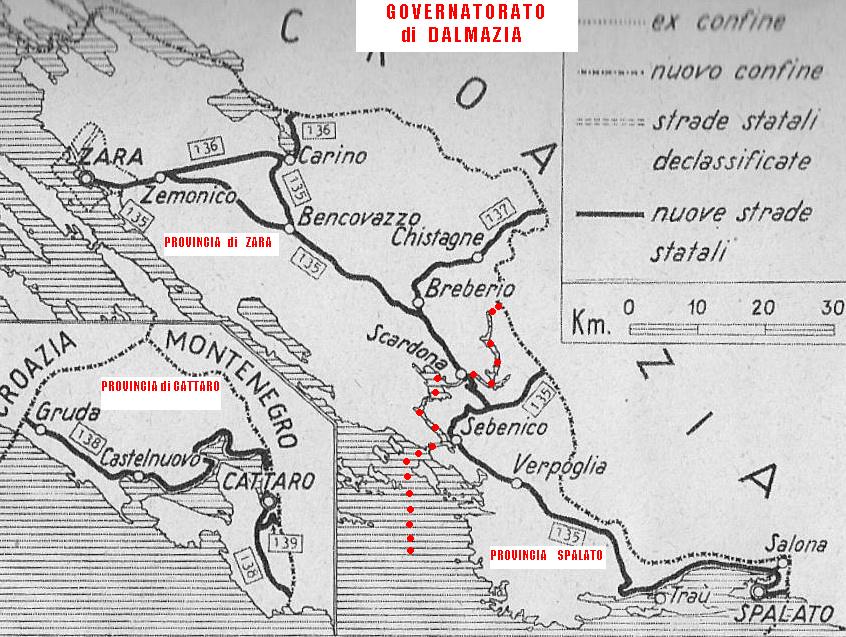
Only during the Second World War (read https://www.ilpostalista.it/pm_file/pm_122.htm) did Italy return to Dalmatia & Spalato, creating the "Governorate of Dalmatia" (see the following map) between 1941 and 1943, while Istria was Italian after the First World War for about thirty years (1918-1947) - even though it was actually Italian until September 1943 (or for 25 years).


Map of summer 1941 with the initial borders between the provinces of Zara/Zadar and that of Spalato/Split (which included Sebenico/Sibenik). Subsequently, the boundary between the two provinces was moved south of Sebenico to the border line established in the Treaty of London of 1915 between Italy and Yugoslavia.

Because I want to research in full detail this issue, I am going to translate excerpts from the famous book of Luciano Monzali "ANTONIO TACCONI E LA COMUNITÀ ITALIANA DI SPALATO" (https://www.academia.edu/10190651/Antonio_Tacconi_e_la_Comunit%C3%A0_italiana_di_Spalato):

CHAPTER 2: THE IRREDENTIST DREAM. ANTONIO TACCONI & THE NATIONAL STRUGGLES IN SPALATO FROM THE AUSTRIA-HUNGARY CRISIS TO THE WW1 AFTERWAR (IL SOGNO IRREDENTISTA. ANTONIO TACCONIE LE LOTTE NAZIONALI A SPALATO DALLA CRISI DELL’AUSTRIA-UNGHERIA AL PRIMO DOPOGUERRA)

Antonio Tacconi spent his youth and adolescence in Spalato, where he studied in primary school in the Croatian gymnasium: thanks to these studies he acquired a perfect knowledge of Croatian and Serbian. Tacconi was a leader of the "Autonomous Italian Party" in the last years of the Habsburg domination, and then became one of the animators of the "Italian National Fascio" of Spalato, the organization that fought for the annexation of Spalato to Italy after 1918. Appointed senator of the Kingdom of Italy in 1923, Tacconi was the political leader of the Italian community of Spalato between the two world wars, becoming Mayor of the city during the fascist occupation (1941-1943) when Spalato was the capital of the italian "Governorato di Dalmazia". Like most of his compatriots, he was forced to abandon Dalmatia after the Second World War, to move to Italy, where he died in 1962.

The Tacconis were fervent Catholics, and this was an element that strongly marked Antonio, throughout his life as a practicing religious person and in close relations with the ecclesiastical circles of Split. He grew up in a Spalato which was now politically dominated by the Croatian parties. But the domination of Croatian nationalism in Spalato, as we have seen, did not coincide for many years with a real and exclusive cultural and national hegemony: the presence of a strong Italian, mostly Italian, community in the old town, the use of the Venetian dialect by the Spalato population, the love of many Spalato Croatians and Dalmatian Slavs for the Italian culture meant that the social life of all "Spalatini" were strongly impregnated by the Italian language and culture. The last part of the nineteenth century and the first The twentieth century, however, were years during which the national struggles in Spalato worsened and began to dominate the political life of the city.

It is noteworthy to pinpoint that the pro-Serbian nationalist enthusiasm of the Croatian militants was the source of numerous incidents in Spalato. The radicalization of Croatian-Yugoslav nationalism in the years of the Balkan wars, especially among the new generations, caused a growing intolerance of the most extremist militants towards the survival of culture and of an Italian minority in Spalato. This intolerance manifested itself in numerous acts of hooliganism and intimidation towards shops with Italian writings and towards homes of autonomists and Italians. The children who attended the Italian school of the Italian National League were insulted and often attacked. Every public demonstration that had an Italian or autonomist character (from funerals to musical performances) was contested and disturbed by students and young Yugoslav with Croatian nationalist militants. Between the end of 1913 and the beginning of 1914 the campaign launched by extremist groups for the boycott of shops owned by citizens of the Italian Kingdom or of Italian nationality operating in Spalato and the incidents caused by the prohibition, decided by the Spalato municipal administration, for Italian autonomist musical groups and associations to participate in the traditional parade in honor of San Doimo, caused a great stir and created strong agitation among the Italian minority.

The outbreak of war between Italy and Austria-Hungary in 1915 resulted in the crisis of Spalato's autonomist associations. The Autonomous Italian Party (of which Tacconi was a member and manager), the National League and the Society of Italian Students of Dalmatia were dissolved, and all the Italian schools in Spalato were suppressed. All Italian associations ceased to operate and be active. Some Italian Spalatini fled to Italy making an explicit irredentist choice (like Francesco Rismondo).

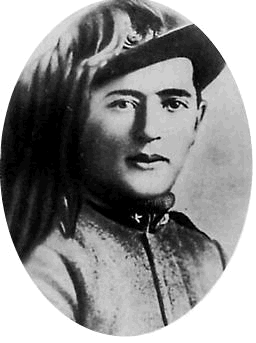
Francesco Rismondo, a "Spalatino italiano" decorated with the Italian military gold medal in WW1

In the mythology of Italian Dalmatian irredentism, Francesco Rismondo, a young man from Spalato, who fled to Italy and enlisted in the Italian army, became famous.

Rismondo fell prisoner into the hands of the Habsburg army in the Carso battles and was executed by hanging at the end of 1915.

More generally, the entire political establishment of Spalato was hit hard by the outbreak of the Austro-Serbian and then Austro-Italian war.

After the collapse of Austria-Hungary in the autumn of 1918, Italy occupied with its troops the territories that had been promised to the Italian kingdom in the London Pact: in Dalmatia the cities of Zara/Zadar and Sebenico/Šibenik, their hinterland and the islands of Cherso/Cres, Lussino/Losinj, Veglia/Krk, Lesina/Hvar, Lissa/Vis and Curzola/Korcula. But in accordance with the provisions of the armistice between the Entente, the United States and Austria, Trau/Trogir, Spalato/Split and the rest of the Dalmatian coast were excluded from the Italian occupation zone. At the end of October 1918, in the Spalato region the collapse of the Habsburg state led to the formation of a provincial government led by a (croatian) committee composed of the (fanatic) Smodlaka and (double-face) Tartaglia, which proclaimed the union of Dalmatia with the Serbo-Croatian-Slovenian state.

Antonio Tacconi, Mayor of "Spalato italiana" (28 April 1941 – 8 September 1943)
In those weeks, the leaders of the Spalato's Italian Autonomous Party decided to create a new political organization, the "Italian National Fascio", led by a Committee in which Antonio Tacconi participated: the explicit objective of this National Fascio, a political organization that had nothing to do with Mussolini's subsequent Fascism, was to fight for the union of Spalato with Italy.

-----to be continued next month of November 2023....

Friday, September 15, 2023

ITALIAN CONTRIBUTION TO ISRAEL NAVY'S CREATION IN 1930-1938

Some years ago I wrote on Wikipedia about the help given by the kingdom of Italy in the 1930s to the creation of the Israel Navy (please read https://en.wikipedia.org/wiki/Betar_Naval_Academy). I also wrote in my Researchomnia on November 2018 a simple essay about this italian help (https://researchomnia.blogspot.com/2018/11/israeli-navy-creation-civitavecchia.html).

Of course, allow me to pinpoint that this help was mainly due to the fact that Mussolini wanted to jeopardise the British control over Palestinian territories, promoting the creation of a possible jewish state's navy force. However this help also shows that -in those years before the "appearance" of Hitler and his racism inside 1938 Mussolini's Italy- within the italian fascist party was strong the influence of italian jews (like Somalia's Governor Maurizio Rava: in October 1933 there were 4920 Italian Jews who were members of the Italian Fascist Party, nearly 10% of all the Jews living in Italy -while the jews were less than 1% of the total Italian population).

But now I want to enter in full details about this help and so I add -in this September issue- some excerpts (translated in English, but also in original iIalian) from a very well documented book about the same contribution:

The ships of Zion. The Italian contribution to the birth of Israel's naval forces (of Emanuele Farruggia and Gianni Scipione Rossi)

Considering the consequences of the Piedmontese intervention in Crimea, it can be said that Italian unity itself was a geopolitical consequence of the Eastern Question. Heir to the Levantine and North African policies of the ancient states, the great Italian strategy was oriented towards obtaining full participation with the other two Mediterranean Great Powers in the exploitation of the Suez route and the geo-economic control of the Ottoman dominions: a policy marked by convergences and contrasts , with the war in Libya, the acquisition of the Dodecanese and the inclusion, among the requests granted by the Entente with the Pact of London (1915) and with the agreements of San Giovanni di Moriana (1917), of a zone of influence in Asia Minor.

In that context, with the "Imperial Note" of May 1918 to the general secretary of the Zionist Organization Nahum Sokolow, Italy recognized the aspiration to create a "Jewish national home" in Palestine, recognized by Great Britain with the Balfour Declaration of 2 November 1917. The objective of the Jewish National Home was included by the LoN among the tasks of the British Mandate, which provided for the creation of a Jewish Agency for this purpose. As Kedar and Cecini recall, Italian expectations in Asia Minor were substantially disappointed. Italy was in fact excluded from the Middle Eastern Mandates (already provisionally at the Sanremo inter-allied conference of 19-26 April 1920, then definitively by the LoN's decision of 24 July 1922), and had to settle for the simple recognition of Italian rights and of the presidency of the Commission for the Mandates of the LoN, held from 1920 to 1936 by the Marquis Alberto Theodoli. It is in this context that Italian-Zionist relations developed, starting in 1904 with the audience granted by Vittorio Emanuele III to Theodor Herzl.

The King had also shown himself open to the prospect of a Jewish settlement in Palestine, rather than in Uganda, as Chamberlain hypothesized. The small but influential Italian Jewish community and, in particular the Zionist Federation of the lawyer Felice Ravenna, facilitated contacts between the Zionists and the Italian authorities. For its part, the Italian foreign ministry made use of contact with the Movement since 1918. Levi Bianchini, already a member of the Italian delegation at the Paris and Sanremo Conferences, was sent by Minister Sforza on a mission to the Levant in 1920 where he was killed in an attack by Bedouins on the train between Damascus and Haifa.

The inuence of the Italian position in the Palestinian question was well present to the head of the World Zionist Organization (WZO), Chaim Weizmann – the promoter of the Balfour Declaration – and to Vladimir Jabotinsky, destined to become the leader of the revisionist movement (World Union of Zionists-Revisionists – Ha Zohar). Jabotinsky, a native of Odessa, had lived in Italy for three years (1898-1901). Translator of Dante into Hebrew, Jabotinsky considered Italy as his spiritual homeland and the Risorgimento as a model for the Zionist movement.

As a promoter of the Jewish Legion, in whose ranks he fought as an officer in the latter stages of Allenby's campaign, Jabotinsky had become a leading figure among Zionists, not only in the diaspora but also in Palestine, where he had been briefly imprisoned by the British as early as 1920. On the eve of the LoN Council's decision on the assignment of mandates, Jabotinsky, a member of the WZO Executive, went on a mission to Rome to meet the representatives of the main political parties. Including Mussolini, who, in an article (read: Sergio Minerbi, Levi-Bianchini and his work in the Levant 1918-1920, 1967) dated 14 July 1922 in the newspaper "Il Popolo d'Italia" («The gratitude of the Syrians ») had explicitly expressed his closeness to the aspirations of the Arab nationalists.

The meeting never took place, since Mussolini did not show up for the meeting but was preceded (16 July) by a signicant letter from Jabotinsky in Italian, in which he set out the advantages of supporting the Zionist cause - in particular for the diffusion of the Italian language - as well as the contraindications of supporting pan-Arabism, in light of the conflict in Tripolitania and Cyrenaica. The tone of the letter was decidedly marked by frankness ("Since I am told that you are violently opposed to our movement, I believe that we are enemies") and was aimed at modifying the perception of Zionism and the Jewish people, tainted by clichés then in vogue ("Mr. Mussolini, it seems to me that you don't know the Jew"; "If you want to know our level of vitality, study your fascists, just add a little more tragedy, a little more tenacity - perhaps even more experienced").

Shortly after the March on Rome, on 4 January 1923, Weizmann met Mussolini to obtain reassurances regarding the attitude that Italy would take at the Lausanne Conference on the issue of the Palestinian Mandate. Against this background lies the singular story of the relationship between fascist Italy and the Jewish Revisionist Movement which led to the holding of navigation courses for the young people of the movement at the Naval School of Civitavecchia.

It falls within the period of time, between 1932 and 1938, which will mark a turning point in the foreign policy of fascist Italy, until then characterized by substantial continuity with that of liberal Italy. The Italian ambition to undermine British dominance in the Middle East, calling into question the system of mandates, the repercussions of the Ethiopian crisis and the looming of Nazism, met with the will of the revisionists to free themselves from the British Empire ("the ethic of independence" by Jabotinsky) seeking support in Italy. If from a political-diplomatic point of view the temporary collaboration between revisionists and fascist Italy did not achieve any useful results, the training of sailors at the Civitavecchia School provided an important contribution to the birth of the naval force of the State of Israel (Hail HaYam HaYsraelyi).

A first survey at the end of 1931 - through the Consulate General of Jerusalem - with the Secretary of the PNF, Giuriati, by the young revisionist Moshe Krivoshe and a Royal Navy officer of Jewish religion, Angelo Levi Bianchini, delegate to the Commission Zionist in Palestine, it did not end well, above all due to the doubts raised by the Minister of Foreign Affairs, Dino Grandi, who did not want to alienate London's friendship.

The first ofcial contacts between the revisionists and the regime date back to 1932 through the president of the Italian grouping of revisionist Zionists, Leone Carpi, and above all through Ignazio Sciaky, a jurist originally from Thessaloniki, a disciple of Giovanni Gentile and well-connected in the capital's environments. Jabotinsky wanted to obtain authorization to open a self-defense school for "Betar", the revisionist youth organization, in Italy.

After an initial survey in Paris through the entrepreneur Angelo Donati, Sciaky obtained a meeting with the Director General for Political Affairs of Europe and the Levant, Raffaele Guariglia, one of Minister Grandi's main collaborators. Sciaky informally submitted Jabotinsky's letter for the creation of a Central School of Jewish Instructors to Guariglia. As reported by Guariglia in a note dated 30 July 1932 «to the Head of Government and Foreign Minister Mussolini», the establishment of the center in Italy would be part «of Mr. Jabotinsky's plan to begin a process of spiritual orientation of the Jewish masses in the sense of the Latin, and precisely Italian, spirit".

Guariglia underlined how France had been equally interested and therefore there could be an interest in favoring this project also to influence the revisionist movement. Undersecretary Sovich's marginal note left no doubt about Mussolini's opinion: «The Head of Government is against it. Revisionist Zionism is a fabrication of an organization with military purposes. He believes that welcoming this center into Italy could put us in difficulty with the Arabs, with the Semitic currents of neighboring states and with the moderate Israelites who live in Italy. On the other hand, Dr Weitzmann still has a notable following.»

Despite this refusal, the revisionist side continued to focus on Italy. At the Vienna Congress of the Movement, in September of the same year, the Italian delegate, Leone Carpi, spoke of the "elective affinities" (wahlverwandtschaften) between Revisionism and Fascism. The Duce, wary of the revisionists, kept channels open with Weitzmann. The 1934 meeting at Palazzo Venezia was famous, a real "tea with Mussolini", opened by the Duce with a reference to the alleged subjection of the Zionists to British imperialism and to the fact that "not all Italian Jews are Zionists", to which Weitzmann promptly retorted "and not all Italians are fascists." But then Mussolini got to the point, proposing Rome's support for the establishment of a national Jewish state with Tel Aviv as its capital, while evoking the question of Jerusalem and underlining that a possible declaration of independence would not have been sufficient without international recognition.

Including Mussolini's attempt to detach Zionism from Great Britain, Weitzmann returned to the importance of Italy aligning itself with London and Paris against Nazi Germany. In his memoirs Weitzmann reiterated his belief that having separated Rome from Berlin perhaps would not have prevented the outbreak of the Second World War but would certainly have made a difference, particularly in the Mediterranean context.

Having abandoned, for the moment, the attempt to found a «Central Jewish School for Self-Defense», through other, much more informal ways, the first course for Jewish students at the local Maritime Professional School was started in Civitavecchia. The decision to train revisionist youth in the maritime field was taken in 1931 by the Danzig Congress of the Betar. IrmiyahuHalperin, sports manager of the organization was in charge of organizing the courses. The Betar delegate in Rome, Maurizio Mendes, put Halperin in contact with Captain Nicola Fusco, director of the School.

To obtain ofcial approval of the project, on 28 October 1934 Leone Carpi wrote to Admiral Thaon de Revel, president of the Consortium of Maritime Professional Schools. Without waiting for a response, the courses began on November 28th. Only at the end of January 1935 did Carpi receive verbal authorization from the Prefecture of Milan. Once it had been ascertained, in fact, that the costs of the courses would be borne by BETAR, the Ministry of Foreign Affairs gave a favorable opinion on the basis of various reasons (spread of the fascist idea in Palestine; of the Italian language and culture; increase in exports Italian companies; hiring of Italian fishermen by future Jewish shipowners…!). The foundation of the New Zionist Organization in Vienna in September 1935 pushed Jabotinsky to open up even more towards fascist Italy. Sciaky organized a meeting between Jabotinsky and Guariglia on October 15, in a strictly private manner. Guariglia, therefore, recommended to the Duce to support revisionist Zionism, defined as "pro-Italian", as opposed to ofcial Zionism, considered an "instrument of British imperialism". Hence the approval of the Betar courses in Civitavecchia as well as the authorization to open a "Central Self-Defense School", which however never saw the light. Corrado Tedeschi's propaganda mission in Palestine on behalf of the CAUR (Action Committees for the Universality of Rome) is framed in this context. This change can also be attributed to the pro-Italian position taken by Jabotinsky regarding the Ethiopian crisis, which distinguished him from the pro-British attitudes of the official Zionists.

During 1936, Sciaky's meetings with Theodoli intensified, in Rome and Geneva, with the aim of obtaining Italian support for a petition from the revisionists to the Commission on Mandates. This was done in the belief that Italy could be considered an Ersatz of Great Britain as a proxy power or in any case a useful side in the Palestinian question, in particular after the start of the Arab revolt. Likewise, through the Consulate General in Jerusalem, various offers of collaboration with Italy arrived from revisionist exponents, such as Scheschkin, however without Jabotinsky's approval. Having overcome the bureaucratic obstacles, at the instigation of Jabotinsky, the entrepreneur Efraim Kirschner financed the purchase, for 150,000 lire, of a 700 ton 4-masted motor sailing vessel - with 2 100 HP diesel engines - the italian "Quattro Venti" which was called SARA I.

The training ship, under the Italian flag, began a cruise in the Mediterranean on 31 August 1935, with 26 students under the command of Captain Tiberio Paone of the Maritime School. Among the students there was the Lithuanian Hirsus Koliadikas who, with the new name of Zvi Kolitz, will be the author of the first (and only) biography of Mussolini in Hebrew. Halperin was also present on board, and he did not miss the opportunity to engage in politics and propaganda, in particular during the stop in Seville, where, together with his students, he met with the local Jewish community, encouraging them to boycott German goods. This was followed by a stop in Algiers, where the sight of the sailors with the "Menorah" on their blue uniform caused discontent among the Arab population. The reports of the Consuls in Seville and Algiers earned Sciaky a reprimand from Guariglia's successor, Giovan Battista Guarnaschelli, worried about the possible political repercussions. Jabotinsky himself went to Genoa in person to call Halperin and his students to order. The incident was overcome after Sciaky's clarifications and promises of good conduct and, in October 1936, with the authorization of Duce Mussolini, the SARA I set sail again from Civitavecchia, this time with a route limited to the Italian coasts except for the stopovers in Nice and Marseille.

The course saw maintenance costs increase. Joanna Jabotinsky managed to convince some supporters, including Baron Robertde Rothschild, to found a League of Friends of Jewish Shipping. Despite the increased turnout of students (more than 50 enrolled), the 1937 course began in a less favorable political context. The Tripoli incident of November 1936, with the public harassment of Jewish shopkeepers who had not respected the injunction to stay open on Saturdays and, subsequently, Mussolini's visit to Libya, with the delivery of the "sword of Islam" , were interpreted as a harshness towards the Jewish communities and a pro-Arab turn.

In February 1937 Fusco personally went to London to meet Jabotinsky and the revisionist leaders and agree on the continuation of the courses, which were increasingly linked to fishing. For this purpose, two trawlers, the Neca and the Lea, were also purchased. The 1937 training trip aimed at the Eastern Mediterranean and Palestine. In fact, to overcome the ban of the Italian Ministry of Foreign Affairs on calling at foreign ports (to avoid accidents such as those in Seville and Algiers), the SARA I was sold to a French shell company. Ciano, although not appreciating this expedient, however, did not oppose it. The SARA I, the first Jewish vessel to land in Palestine, arrived in the port of Haifa on 1 September 1937.

Despite the boycott of the representatives of the Jewish Agency and the Histadrut (the Zionist trade union organisation), Halperin and the students were received in Tel Aviv by Mayor Rokach and then also in Jerusalem, where the Italian Consul General, Quinto Mazzolini, represented by the interpreter. To the latter, Halperin expressed gratitude for fascist Italy and proposed the establishment of an "Italian-Palestinian office" with the mission, in addition to encouraging young people to dedicate themselves to fishing, to create a maritime school in Palestine. Rome rejected the proposal.

The cruise continued without incident with stops in Rhodes, Thessaloniki and Tunis, before returning to Marseille. In Tunis, Halperin's propaganda activity, although appreciated by the Italian Consul, provoked anti-Semitic demonstrations organized by the Destour movement. Although Mussolini had already focused on the Arab map to destabilize the British Empire, in particular with the Arabic broadcasts of Radio Bari and with the support of the Grand Mufti, Haji Amin Al Husseini, and the rapprochement with Nazi Germany had already begun also, he authorized the courses in 1938.

The start of the anti-Semitic campaign, with the publication of the book "The Jews in Italy" by Paolo Orano, in April 1938, and Hitler's visit to Rome, in May, further confirmed the regime's anti-Jewish turn. Despite some difficulties in returning the students to Civitavecchia, the courses ended on 31 August 1938. Curiously, on 8 May, Hitler was hosted at the Odescalchi Castle in Santa Marinella, 10 kilometers away from the School.

From 1934 to 1937, 153 Betar students attended courses at the Civitavecchia School while another 50 sailors were trained in Latvia. Among the students, those who survived the Holocaust and the war formed the cadres of the Israeli merchant and military navy. Among them Shlomo Erell, the seventh commander of the Heil HaYam HaYsraelyi (1966-1968) and Avram Blass, also an admiral.

Halperin continued during the conflict, with the help of the Rothschilde of the Royal Navy, to train Jewish sailors and divers. After the birth of the State of Israel he settled in Eilat to carry out oceanographic studies in the Red Sea. The Naval Museum in Eilat is dedicated to him. The Halperin Foundation has financed scholarships from the University of Haifa as well as the construction of a vessel, the RV Halperin, for oceanographic research activities. The experience of the Civitavecchia School was narrated by Halperin in his "History of Hebrew Seamanship".


Jewish Cadets of the Civitavecchia Maritime School near the "Sarah I" stern in 1937


============================================================

Le navi di Sion. Il contributo italiano alla nascita delle forze navali di Israele (of Emanuele Farruggia e Gianni Scipione Rossi)

Considerando le conseguenze dell’intervento piemontese in Crimea, si può dire che la stessa unità italiana sia stata una conseguenza geopoliticadella Questione d’Oriente. Erede della politica levantina e nordafricanadegli antichi stati, la grande strategia italiana fu orientata ad ottenere una piena compartecipazione con le altre due Grandi Potenze mediterranee allo sfruttamento della rotta di Suez ed al controllo geo-economico dei domini ottomani: una politica segnata da convergenze e contrasti, con la guerra di Libia, l’acquisizionedel Dodecaneso e l’inclusione, tra le richieste concesse dall’Intesa col Patto di Londra (1915) e con gli accordi di San Giovanni di Moriana (1917), di una zona di influenza in Asia Minore.

In quel quadro, con la "Nota Imperiali" del maggio 1918 al segretario generale dell’Organizzazione Sionista Nahum Sokolow, l'Italia riconobbe l’aspirazione alla creazione di un «focolare nazionale ebraico» in Palestina, riconosciuto dalla Gran Bretagna con la Dichiarazione Balfour del 2novembre 1917. L’obiettivo della Jewish National Home fu incluso dalla SdN tra i compiti del Mandato britannico, che prevedeva a tal fine la creazione di un’Agenzia Ebraica. Come ricordano Kedar e Cecini, le aspettative italiane in Asia Minore furono sostanzialmente deluse. L’Italia fu infatti esclusa dai Mandati medio-orientali (già in via provvisoria alla conferenza interalleata di Sanremo del 19-26 aprile 1920, poi in via definitiva dalla decisione 24 luglio 1922 della SdN), e dovette accontentarsi del semplice riconoscimento dei diritti italiani e della presidenza della Commissione per i Mandati della SdN, ricoperta dal 1920 al 1936 dal marchese Alberto Theodoli. E’in tale contesto che si svilupparono i rapporti italo-sionisti, avviati nel 1904 con l’udienza concessa da Vittorio Emanuele III a Theodor Herzl.

Il Re si era mostrato aperto anche alla prospettiva di un insediamento ebraico in Palestina, piuttosto che in Uganda, come ipotizzava Chamberlain. La piccola ma influente comunità ebraica italiana e, in particolare la Federazione Sionista dell’Avvocato Felice Ravenna, agevolarono i contatti trasionisti e autorità italiane. Dal canto suo, il ministero degli esteri italiano sin dal 1918, si avvalse di un contatto col Movimento. Levi Bianchini, già membro della delegazione italiana alla Conferenza di Parigi ed a quella di Sanremo, nel 1920 fu inviato dal Ministro Sforza in missione nel Levante dove trovò la morte in un attacco di beduini al treno tra Damasco e Haifa.

L’inuenza della posizione italiana nella questione palestinese era ben presente al capo dell’Organizzazione Mondiale Sionista (WZO), Chaim Weizmann – il promotore della Dichiarazione Balfour – e a Vladimir Jabotinsky, destinato a diventare il leader del movimento revisionista (World Union of Zionists-Revisionists – Ha Zohar). Jabotinsky, nativo di Odessa, aveva vissuto in Italia per tre anni (1898-1901). Traduttore di Dante in ebraico, Jabotinsky considerava l’Italia come la sua patria spirituale e il Risorgimento modello per il movimento sionista.

Come promotore della Legione Ebraica, nei cui ranghi combatté come ufficiale nelle ultime fasi della c ampagna di Allenby, Jabotinsky era diventato una figuradi spicco tra i sionisti, non solo nella diaspora ma anche in Palestina, dove erastato brevemente incarcerato dagli inglesi già nel 1920. Alla vigilia della decisione del Consiglio della SdN sull’assegnazione dei Mandati, Jabotinsky, membro dell’Esecutivo della WZO, si recò in missione a Roma per incontrare gli esponenti dei principali partiti politici. Tra cui Mussolini, il quale, in un articolo (leggasi: Sergio Minerbi, Levi-Bianchini e la sua opera nel Levante 1918-1920, 1967) del 14 luglio 1922 sul quotidiano "Il Popolo d’Italia" («La gratitudine dei Siriani») aveva espresso inmaniera esplicita la sua vicinanza alle aspirazioni dei nazionalisti arabi.

L’incontro non ebbe mai luogo, poiché Mussolini non si presentò all’appuntamento ma fu preceduto (16 luglio) da una signicativa lettera di Jabotinsky in italiano, in cui esponeva i vantaggi di un appoggio alla causa sionista – in particolare per ladiffusione della lingua italiana – nonché le controindicazioni del sostegno al panarabismo, alla luce del confklitto in Tripolitania e Cirenaica. Il tono della lettera era decisamente improntato alla franchezza («Siccome mi si dice ch’Ella è violentemente avverso al movimento nostro, credo che siamo nemici») ed era volta a modicare la percezione del sionismo e del popolo ebraico, viziata dai clichés allora in voga («Signor Mussolini mi pare ch’Ella non conosca l’ebreo»; «Se vuol conoscere il grado di vitalità nostro, studi i suoi fascisti, soltanto vi aggiunga un po’ più di tragedia, un po’ più di tenacità - forse anche più di esperienza»).

Poco dopo la Marcia su Roma, il 4 gennaio 1923, Weizmann incontrò Mussolini per ottenere rassicurazioni circa l’atteggiamento che l’Italia avrebbe tenuto alla Conferenza di Losanna sulla questione del Mandato palestinese. Su questo sfondo si colloca la singolare vicenda dei rapporti tra l’Italia fascista ed il Movimento Revisionista ebraico che portò allo svolgimento di corsi di navigazione per i giovani del movimento presso la Scuola Navale di Civitavecchia.

Essa si colloca nell’arco di tempo, tra il 1932 ed il 1938 che segnerà un punto di volta della politica estera dell’Italia fascista, sino ad allora caratterizzata da una sostanziale continuità con quella dell’Italia liberale. L’ambizione italiana di insidiare il predominio britannico in Medio Oriente, rimettendo in discussione il sistema dei mandati, le ripercussioni della crisi etiopica ed il profilarsi del nazismo, si incontrarono con la volontà dei revisionisti di affrancarsi dall’Impero britannico («l’etica dell’indipendenza» di Jabotinsky) cercando una sponda nell’Italia. Se sotto l’aspetto politico-diplomatico la collaborazione temporanea tra revisionisti ed Italia fascista non conseguì alcun risultato utile, la formazionedi marinai presso la Scuola di Civitavecchia, fornì un contributo importante alla nascita della forza navale dello Stato di Israele (Hail HaYam HaYsraelyi).

Un primo sondaggio sul finire del 1931 - attraverso il Consolato Generale di Gerusalemme – col Segretario del PNF, Giuriati, da parte del giovane revisionista Moshe Krivoshe e di un ufciale della Regia Marina di religione ebraica, Angelo Levi Bianchini, delegato presso la Commissione Sionista in Palestina, non andò a buon ne, soprattutto per le perplessità avanzate dal Ministro degli Affari Esteri, Dino Grandi, che non voleva alienarsi l’amiciziadi Londra.

I primi contatti ufciali tra i revisionisti ed il regime risalgono al 1932 per il tramite del presidente del raggruppamento d’Italia dei sionisti revisionisti, Leone Carpi, e soprattutto di Ignazio Sciaky, giurista originario di Salonicco, discepolo di Giovanni Gentile e bene introdotto negli ambienti della capitale. Jabotinsky voleva ottenere l’autorizzazione all’apertura in Italia di un scuola di autodifesa del «Betar», l’organizzazione giovanile revisionista.

Dopo un primosondaggio a Parigi per il tramite dell’imprenditore Angelo Donati, Sciaky ottenne un incontro col Direttore Generale per gli Affari Politici dell’Europa e delLevante, Raffaele Guariglia, uno dei principali collaboratori del Ministro Grandi. Sciaky sottopose informalmente a Guariglia la lettera di Jabotinsky per la creazione di una Scuola Centrale di Istruttori Ebrei. Come riportato da Guariglia in un Appunto del 30 luglio 1932 «al Capo del Governo e Ministro degli Esteri Mussolini», l’istituzione del centro in Italia sarebbe rientrata «nel piano del Signor Jabotinsky di iniziare un processo di orientamento spirituale delle masse ebraiche nel senso dello spirito latino, e precisamente italiano».

Guariglia sottolineava come la Francia fosse stata egualmente interessata e quindi poteva esserci un interesse nel favorire tale progetto anche per influenzare il movimento revisionista. L’annotazione a margine del Sottosegretario Suvich non lasciava dubbi sull’opinione di Mussolini: «Il Capo del Governo è contrario. Il sionismo revisionista è una montatura di un’organizzazione con fini militari. Ritiene che accogliere in Italia questo centro potrebbe metterci in difficoltà con gli Arabi, con le correntianti semitiche degli Stati vicini e con gli israeliti di tendenza moderata che stanno in Italia. D’altra parte il Dr Weitzmann ha ancora sempre un seguito notevole.»

Nonostante tale rifiuto, da parte revisionista si continuò a puntare sull’Italia. Al Congresso di Vienna del Movimento, a settembre dello stesso anno, il delegato italiano, Leone Carpi, parlò delle «affinità elettive» (wahlverwandtschaften) tra Revisionismo e Fascismo. Il Duce, diffidente nei confronti dei revisionisti, manteneva aperti i canali con Weitzmann. Celebre l’incontro del 1934 a Palazzo Venezia, un vero e proprio «tè con Mussolini», aperto dal Duce con un accenno alla presunta sudditanza dei sionisti all’imperialismo britannico e al fatto che «non tutti gli ebrei italiani sono sionisti», cui Weitzmann ribatté prontamente «e non tutti gli italiani sono fascisti». Ma poi Mussolini andò al sodo, proponendo l’appoggio di Roma alla costituzione di uno Stato nazionale ebraico con capitale Tel Aviv, evocando però la questione di Gerusalemme e sottolineando che un’eventuale dichiarazione d’indipendenza non sarebbe stata sufficiente senza il riconoscimento internazionale.

Compreso il tentativo di Mussolini di staccare il sionismo dalla Gran Bretagna, Weitzmann ritornò sull’importanza di un allineamento dell’Italia con Londra e Parigi contro la Germania nazista. Nelle sue memorie Weitzmann ribadì la convinzione secondo cui l’avere staccato Roma da Berlino forse non avrebbe prevenuto lo scoppio della seconda guerra mondiale ma avrebbe certamente fatto la differenza, in particolare nello scacchiere mediterraneo.

Tramontato, per il momento, il tentativo di fondare una «Scuola Centrale Ebraica per l’Autodifesa», per altre vie, molto più informali, si giunse all’avvio a Civitavecchia del primo corso per allievi ebrei presso la locale Scuola Professionale Marittima. La decisione di formare la gioventù revisionista in campo marittimo era stata presa nel 1931 dal Congresso di Danzica della Betar. IrmiyahuHalperin, responsabile sportivo dell’organizzazione fu incaricato dell’organizzazione dei corsi. Il delegato della Betar a Roma, Maurizio Mendes, mise in contatto Halperin col Capitano Nicola Fusco, direttore della Scuola.

Per ottenereun’approvazione ufciale del progetto, il 28 ottobre 1934 Leone Carpi scrisse all’Ammiraglio Thaon de Revel, presidente del Consorzio delle Scuole Professionali Marittime. Senza attendere una risposta i corsi iniziarono il 28 novembre. Soltanto a fine gennaio 1935 Carpi ricevette un’autorizzazione verbale dalla Prefettura di Milano. Una volta accertato, infatti, che le spese dei corsi sarebbero state a carico della BETAR, il Ministero degli Esteri aveva dato parere favorevole sulla base di diverse motivazioni (diffusione dell’idea fascista in Palestina; della lingua e della cultura italiana; aumento delle esportazioni italiane; assunzione di pescatori italiani da parte dei futuri armatori ebrei…!). La fondazione, a Vienna, nel settembre 1935, della Nuova Organizzazione Sionista spinse Jabotinsky ad aprire ancora di più verso l’Italia fascista. Sciaky organizzò il 15 ottobre un incontro tra Jabotinsky e Guariglia, in forma strettamente privata. Guariglia, quindi, raccomandò al Duce di sostenere il sionismo revisionista, definito «pro-italiano», in contrapposizione al sionismo ufciale, considerato «strumento dell’imperialismo britannico». Di qui il beneplacito ai corsi della Betar a Civitavecchia nonché l’autorizzazione ad aprire una «Scuola Centrale di Autodifesa», che però non vide mai la luce. In tale contesto si inquadra la missione propagandistica di Corrado Tedeschi in Palestina per conto dei CAUR (Comitati d’Azione per l’Universalità di Roma). Tale cambiamento può attribuirsianche alla posizione pro-italiana assunta da Jabotinsky rispetto alla crisi etiopica,che lo distingueva dagli atteggiamenti lo-britannici dei sionisti ufciali.

Nel corso del 1936 si intensificarono gli incontri di Sciaky con Theodoli, a Roma eda Ginevra, al ne di ottenere l’appoggio italiano ad una petizione dei revisionistialla Commissione sui Mandati. Ciò nella convinzione che l’Italia potesse essere considerata un Ersatz della Gran Bretagna come potenza mandataria o comunque un’utile sponda nella questione palestinese, in particolare dopo l’inizio della rivolta araba. Allo stesso modo, attraverso il Consolato Generale di Gerusalemme, giunsero varie offerte di collaborazione con l’Italia da parte di esponenti revisionisti, come Scheschkin, peraltro senza l’approvazione di Jabotinsky. Superati gli ostacoli burocratici, su impulso di Jabotinsky, l’imprenditore Efraim Kirschner \finanziò l’acquisto, per 150.000 lire, di un motoveliero a 4 alberi di 700 tonnellate – con 2 motori diesel da 100 CV – il Quattro Venti che venne denominato SARA I.

La nave scuola, sotto bandiera italiana, iniziò, il 31 agosto 1935, con 26 allievi al comando del Capitano Tiberio Paone della Scuola Marittima, una crociera nel Mediterraneo. Tra gli allievi vi era il lituano Hirsus Koliadikas che, col nuovo nome di Zvi Kolitz sarà l’autore della prima (e unica) biograa di Mussolini in lingua ebraica. A bordo era presente anche Halperin, il quale non perdette l’occasione per fare politica e propaganda, in particolare durante la tappa a Siviglia, dove, assieme agli allievi si incontrò con la locale comunità ebraica, spronandola al boicottaggio delle merci tedesche. Seguì la tappa ad Algeri, dove la vista dei marinai con la «Menorah» sull’uniforme azzurra causò malumori tra la popolazione araba. I rapporti dei Consoli a Siviglia a ad Algeri fruttarono a Sciaky una reprimenda da parte del successore di Guariglia, Giovan Battista Guarnaschelli, preoccupato delle possibili ripercussioni politiche. Lo stesso Jabotinsky si recò di persona a Genova per richiamare all’ordine Halperin e gli allievi. L’incidente venne superato dopo i chiarimenti di Sciaky e le promesse di buona condotta e, ad ottobre del 1936, con l’autorizzazione del Duce Mussolini, la SARA I salpò nuovamente da Civitavecchia, questa volta con una rotta limitata alle coste italiane eccettuati gli scali a Nizza e a Marsiglia.

Il corso vide aumentare i costi di mantenimento. Joanna Jabotinsky riuscì a convincere alcuni sostenitori, tra cui il barone Robertde Rotschild, a fondare una Lega degli Amici della Navigazione Ebraica. Nonostante l’aumentata afuenza degli allievi (più di 50 iscritti), il corso del 1937 si avviò in un contesto politico meno propizio. L’incidente di Tripoli del novembre 1936, con la pubblica agellazione di negozianti ebrei che non avevano rispettato l’ingiunzione di restare aperti il sabato e, successivamente, la visita di Mussolini in Libia, con la consegna della “spada dell’Islam”, furono interpretati come un inasprimento verso le comunità ebraiche e una svolta filo-araba.

Nel febbraio del 1937 Fusco si recò personalmente a Londra per incontrare Jabotinsky ed i dirigenti revisionisti e concordare la prosecuzione dei corsi, sempre più legati alla pesca. A tal fine furono anche acquistati due motopescherecci, il Neca ed il Lea, Il viaggio di istruzione del 1937 puntava sul Mediterraneo Orientale e sulla Palestina. Per superare, infatti, il divieto del Ministero degli Esteri italiano di far scalo in porti esteri (per evitare incidenti come quelli di Siviglia e di Algeri ), la SARA I era stata venduta ad una società di comodo francese. Ciano, pur non apprezzando tale espediente, tuttavia, non si oppose. La SARA I, primo battello ebraico ad approdare in Palestina, giunse nel porto di Haifa il 1° settembre 1937.

Nonostante il boicottaggio dei rappresentanti dell’Agenzia Ebraica e dell’Histadrut (l’organizzazione sindacale sionista), Halperin e gli allievi vennero ricevuti a Tel Aviv dal sindaco Rokach e poi anche a Gerusalemme, dove il Console Generale italiano, Quinto Mazzolini, si fece rappresentare dall’interprete. A quest’ultimo Halperin espresse riconoscenza per l’Italia fascista e propose la costituzione di un “ufficio italo- palestinese” con la missione, oltre che di incoraggiare i giovani a dedicarsi alla pesca, di creare una scuola marittima in Palestina. Roma respinse la proposta.

La crociera proseguì senza incidenti con scali a Rodi, Salonicco e Tunisi, prima del rientro a Marsiglia. A Tunisi, l’attività propagandistica di Halperin, per quanto apprezzata dal Console italiano, provocò manifestazioni antisemite organizzate dal movimento Destour. Nonostante Mussolini avesse già puntato, per destabilizzare l’Impero britannico, sulla carta araba, in particolare con le trasmissioni in arabo di Radio Bari e con l’appoggio al Gran Muftì, Haji Amin Al Husseini, e fosse già iniziato l’avvicinamento alla Germania nazista anche nel 1938 i corsi furono autorizzati.
L’avvio della campagna antisemita, con la pubblicazione del libro "Gli Ebrei in Italia" di Paolo Orano, nell’aprile 1938, e la visita di Hitler a Roma, a maggio, giunsero ad ulteriore conferma della svolta antiebraica del regime. Nonostante alcune difcoltà nel far rientrare gli allievi a Civitavecchia, i corsi si conclusero il 31 agosto 1938. Curiosamente, l’8 maggio, Hitler venne ospitato presso il Castello Odescalchi di Santa Marinella, a 10 chilometri di distanza dalla Scuola.

Dal 1934 al 1937, 153 allievi della Betar frequentarono i corsi della Scuola di Civitavecchia mentre altri 50 marinai furono addestrati in Lettonia. Tra gli allievi, quelli che sopravvissero all’Olocausto ed alla guerra, formarono i quadri della marina mercantile e militare israeliana. Tra di essi Shlomo Erell, il settimo comandante della Heil HaYam HaYsraelyi (1966-1968) ed Avram Blass, anch’egli ammiraglio.

Halperin durante il conflitto continuò, con l’aiuto dei Rothschilde della Royal Navy, ad addestrare marinai e sommozzatori ebrei. Dopo la nascita dello Stato di Israele si stabilì ad Eilat per compiere studi oceanograci nel Mar Rosso. Il Museo Navale di Eilat è a lui dedicato. La Fondazione Halperin ha finanziato borse di studio dell’Università di Haifa nonché la costruzione di un battello, la RV Halperin, per attività di ricerca oceanograca. L’esperienza della Scuola di Civitavecchia è stata narrata da Halperin nella sua "History of Hebrew Seamanship".

Tuesday, August 1, 2023

THE EXTERMINATION OF ITALIANS IN THE DALMATIA ISLANDS (STARTED BY THE HABSBURG & FULLY COMPLETED BY THE CROATS) - PART 2

This august 2023 -as a follow up of the "Part 1"- I want to research about the responsabilities of the Croats in the complete extermination of the romance speaking autochtonous population of the Dalmatian islands. Of course we have to remember that some dozen Italians "survive" in Cherso/Chres and Lussino/Lusinj, because these northen dalmatian islands were officially part of the kingdom of Italy from 1918 until 1947. But -let's pinpoint it- in all the other dalmatian islands there are no more Italians in 2023! The two most "italian" islands of Dalmatia in the first half of the XIX century, Veglia/Krk in the north and Lissa/Vis in the center-south, have no italians at all in 2023!!!!

Since the early 1800s started to appear the Croatian nationalism, soon in fight with the Italian nationalism: in one century and half of wars and political battles of every kind the Dalmatian Italians disappeared (being reduced in the Croatian census of 2011 to a few hundreds in an area that has nearly one million inhabitants!). This fact has originated the suspicion that the disappearance of the Dalmatian Italians could be related to an "ethnocide" (read in Italian: http://www.mlhistria.altervista.org/storiaecultura/testiedocumenti/tesiscaglioni/tesi.htm).

The cities on the Adriatic's coast (mainly Zara/Zadar & Spalato/Split) were populated by the most educated and instructed Dalmatia's Italians and so are the only that still have Italians residents living there in 2023. But the islands were populated by poor sailors and farmers and now have no more Italians living there, because all have been reduced to emigrate or to be "assimilated" by the croatian majority (let's remember that it is very difficult to force a "graduated" to change ethnicity for him/her and/or for his/her descendants!). This is the case -for example- of Lissa/Vis, a central dalmatian island that -according to the Lieutenant Colonel George Duncan Robertson, who occupied Lissa in 1812 for the British empire- was "populated by very friendly but also extremely poor venetian speaking people" (please read https://www.jstor.org/stable/44229394): now the island has no more romance speaking inhabitants.

The natural borders of Italy include the Dalmatia islands, according to the italian irredentism (to the map should be added the islands of Saseno and Corfu in front of Albania)


First of all, allow me to dedicate this issue to a Croat named "Neno", who -as he wrote, but I am not 100% sure- has some roots in the dalmatian Italians who lived in Lissa (actually called "Vis" in croatian language). He is very well informed about the Lissa history during the XIX & XX century and writes in a perfect italian language (to the point that sometimes I think he "is" italian!)

So, let's start remembering that, as we all know, the full Dalmatia was romanised when started the first barbarian invasions around the VII century, according to Theodore Mommsen (in his masterpiece "The Provinces of the Roman Empire"). The dalmatian islands were the main refuge (from these early Slav attacks) of many romance speaking inhabitants during these early Middle Ages centuries. However the first Croats who settled in the Dalmatian islands were a minority that was "assimilated" by the majority of the neolatin population (called "Dalmatian latins") before the X century. Only in the south dalmatian islands there was a huge presence of Croats (who were only partially assimilated): the "Narentane pirats", mainly in the Brazza/Brac, Lesina/Hvar and Curzola/Korcula islands.

It is indicative - in order to reject the many lies and exagerations written by the croatian propaganda, mainly during the Tito years- what wrote the arab Al Idrisi about the ethnic composition of the Dalmatian islands in the late Medioeval years:

The population of Dalmatia in the XII century

(The following is a description of Dalmatia from the famous “Book of Roger” (Tabula Rogeriana), written by the Arab geographer Muhammad al-Idrisi at the court of King Roger II of Sicily in 1154)

In his descriptions Al Idrisi made a clear distinction between the Slavs and the Dalmatians – the term ‘Dalmatian’ refers to the autochthonous Latin-speaking population who descended from the original Roman inhabitants.

Al-Idrisi wrote which towns and cities were inhabited by Slavs and which were inhabited by Dalmatians. The Dalmatians predominated in almost all the major towns and cities of Dalmatia (Zara, Spalato, Traù, Lissa, Ragusa, Cattaro), while the Slavs inhabited only one city (Antivari) and a couple of minor towns.

According to Al Idrisi, this was the ethnic composition (of autochthonous Dalmatian latins and immigrated Croats) of the Dalmatia islands in the XII century:

Castelmuschio (Veglia/Krk) - Populated by Dalmatians
Lussino/Lusinj - Populated by Dalmatians and a few Croats
Cherso/Chres - Populated by Dalmatians
Arbe/Rab - Populated by Dalmatians
Zaton-Aenona/Nin - Populated by Dalmatians
Spalato/Split - Populated by Dalmatians and a few Croats
Traù Vecchia/Trogir old - Populated by Dalmatians
Traù/Trogir - Populated by Dalmatians
Lissa/Vis - Populated by Dalmatians
Brazza/Brac - Populated by Croats and a few Dalmatians
Lesina/Hvar - Populated by Croats and Dalmatians
Curzola/Korcula - Populated by Dalmatians and a few Croats

Additionally, his contemporary William of Tyre, in his chronicle Historia, described Dalmatia this way: “Dalmatia is inhabited by a very fierce people, given over to plunder and murder. ...with the exception of those who live on the coast and who differ from the rest in customs and language. Those on the coast use the Latin language, while the others (in the hinterland) use the Slavonic tongue and have the habits of barbarians.”

Furthermore, in these centuries after the year 1000 AD, the Dalmatian language started to disappear, assimilated by the Venetian dialect. Dalmatian was spoken on the Dalmatian coast from Fiume (now Rijeka) as far south as Cottorum (Kotor) in Montenegro. Speakers lived mainly in the coastal towns of Jadera (Zadar), Tragurium (Trogir), Spalatum (Split), Ragusium (Dubrovnik), and also on the islands of Curicta-Veglia (Krk), Crepsa-Cherso (Cres), and Arba-Arbe (Rab). Almost every city developed its own dialect, but the most important dialects now known were "Vegliot", a northern dialect spoken on the island of Curicta-Veglia KrK), and "Ragusan", a southern dialect spoken in and around Ragusa (Dubrovnik). The last speaker of this romance language -Tuone Udaina- died in Veglia/Krk in 1898, after being interviewed by yhe italian linguist Matteo Bartoli.

It is noteworthy to remember that in those centuries there was a huge influence in all Dalmatia from southern Italy (mainly because of commerce): if interested , please read: http://istria-fiume-dalmatia.blogspot.com/2018/06/the-cultural-ties-between-dalmatia-and.html .

After the XII century the terrible epidemies ("Black death". etc..) that hit Europe depopulated the Dalmatian islands and with the Ottoman invasion of the Balkans many Slavs settled in these depopulated Dalmatian islands, changing forever the local ethnic composition that has been always with a romance speaking majority.

When the Republic of Venice ended in 1797 there were only a few dalmatian islands with a majority of romance speaking inhabitants: Cherso (Chres), Veglia (Krk) and Lussino (Lusinj) in the north with Lissa (Vis) in the center of Dalmatia. But a huge minority was still present in the islands of Arbe (Rab), Ugliano (Uglian) and Pago (Pag) in the north & Lesina (Hvar) in the south, while Trau (Trogir), Brazza (Brac) Curzola (Korcula) and Lagosta (Lastovo) had some small minorities. The french occupied the region and united all Dalmatia to their kingdom of Italy. In all Dalmatia nearly one third was italian speaking in those years of the Napoleon's kingdom of Italy, according to the famous linguist Bartoli (Bartoli, Matteo. "Le parlate italiane della Venezia Giulia e della Dalmazia". p.46).

The XIX century and the beginning of the disappearance

The croatian historian Pericic (Š.Peričić, "O broju Talijana/talijanaša u Dalmaciji XIX". stoljeća, in Radovi Zavoda za povijesne znanosti HAZU u Zadru, n. 45/2003, p. 342) wrote that in 1809 there were 75000 native speakers of italian in Dalmatia, a region that had 250000 inhabitants: that means that in the region nearly 30% were italians and 70% croatians.

In the middle of the XIX century the historian F. Pagliacco wrote that "A.Schmidl in «Koenigreich DalmatienJJ (Stuttgart, 1842) su una popolazione della Dalmazia di 375.000 anime dà 320.000 slavi e oltre 45.000 italiani.........Schmidtl in 1842 published in his Koenigreich Dalmatien that the population of Dalmatia was 375000 with 320000 Slavs and more than 45000 italians". That means that the romance speaking population was only about 20% after some decades of austrian rule. Indeed, he also wrote that since the Dalmatian islands were occupied by the Austrian empire with the Napoleon defeat, the romance population started to be harassed, with a reduction that started in great percentages mainly after 1861 when was created the kingom of Italy.

The reason of this initial reduction of the romance speaking population in the dalmatian islands during the first seven decades of the XIX century: the higher fertility rate (and immigration from the poor Dinaric Alps) of the Croats, the emigration of the Italians to the more rich northern Italy (and to the Americas), but also the beginning of the nationalism in the croatian society. Nationalism that was initially promoted by the croatian clergy (as can be understood in the following excerpts)

The following are sections from a book written by Nino Bracco about Lussino island (and his town Neresine/Nerezine):

In Cherso and Lussino, the first political problems began to arise after the annexation of Istria and Dalmazia by Austria, after the fall of Napoleon, but especially after the outbreak of Italian revolutionary independence movements, (and other parts of Europe) in the first half of 1800. In this period the central government of Vienna began to fear the spread of the legitimate national aspirations of the various subjected peoples, especially fearing the extension of irredentism in their Italian territorial possessions, where the Italian language, and prevailing culture was Italian as in the territories of Trento, Trieste, Istria, and Dalmatia. In these regions, then began an intense policy of "deitalianization", with the intensification of police controls, and strong political restrictions with discrimination against Italioan speaking people, to which was added, in areas of lower Italian cultural prevalence (like in the Dalmatian islands), even a strong policy of Slavenisation, based on the ancient teaching of the Romans "divide et impera", and on the supposed easier subjugation of Slavic peoples, less acculturated, and less contaminated with "germs" of the French Revolution.
......Drastic measures in Istria, and Dalmatia: The first drastic action given by this anti-italian policy was the decision of the Government of Vienna, taken in 1825, to separate administratively and politically the three islands of Quarnero (Cherso, Lussino and Veglia) from the rest of Dalmatia, which was already at an advanced stage Slsvenisation. This was done also for natural reasons and territorial ethnicity, by passing the new northern boundary of Dalmatia between the islands of Veglia (Krk), and that of Arbe (Rab), and between the islands of Cherso and Lussino with the island of Pago. Simultaneously, in 1825 was formed the Captaincy of Lussino which joined the Mangraviato of Istria, from which depended these three main islands of Quarnero: Veglia, Cherso and Lussino. This separation was dictated by the will of the government of Habsburg: croatize the stubbornly "Italian" Dalmatian possessions. Not by chance was chosen as the focus of this policy the most Italian of the three islands, namely that of Veglia, where was also established the new bishopry for the region, removed from Ossero, with the clergy pertaining to it assuming the role of a bridgehead for deitalianizzation of the region by introducing the ancient religious rites in the Old Slavonic language, the "Glagolitic", and removing the Latin.
.......To better understand these events, it is useful to report the data on the population of the island of Veglia taken from a census conducted in the early nineteenth century: the entire island population was 11,500, including 3,393 in the capital city, including 3,215 Italian speaking only Italians, 100 of Serb Croatian speaking also Italian and 78 foreign (Slovenians, Fiume/Rijeka people, Italians, Austrians, and others). The Croatian-Serbs were virtually all members of the clergy, and employees of the Bishop's seat. A subsequent survey in December 1900 gave the following result: residents of the city of Veglia 1,598, of which 1,450 Italians, 132 Croatian-Serbs and 31 foreigners. In the census of 1925, i.e. after the passage of the island under the sovereignty of the newly formed Kingdom of Yugoslavia, the inhabitants turned out 3,600 including 1,200 in the town of Veglia. As you can see these political changes have resulted in the exodus from the island's most ancient inhabitants, a dramatic change if you put in the account the number of new immigrants from the Slavic regions of the hinterland. In essence, in the hundred years of Austrian rule, the inhabitants of the island of Veglia decreased by more than one third, while in other islands of the Quarnero Bay, and surrounding areas, the population continued to grow regularly: this was the first great exodus, and political ethnic cleansing of the Quarnero region.
......The December 1 of 1866, should be considered as the official date for the beginning of "Dalmatia croatisation", when the Imperial Royal Government of Vienna issued the decree, which ordered the replacement of the Italian language in all public administrations, a legacy of more than four centuries of Venetian administration, with the Serbo-Croat. The decree provided that no State official should be hired unless he can demonstrate in front of a committee, that he knows, besides Italian the Serbian-Croatian language. This important policy shift was considered as the consequence of the disastrous defeat of the Italian fleet at the Battle of Lissa (July 20, 1866). The first alleged presence of Croatian population in Neresine has begun to materialize, not coincidentally, during this period, despite the total absence of Croatian culture in town. The Croatian language was completely unknown from the same population as it spoke a language predominantly Slavic-romanised, this did not contain significant elements of language similar to the SerbCroatian, from the personal names of the inhabitants. The first operational Istrian territory change, and therefore also in newly annexed islands of Quarnero, of the new policy was the closure of the Italian schools, and the establishment of Croatian schools wherever possible (in Neresine this attempt, as we have seen, created serious problems, and disorders), and the promotion, and support, including financial, of Slavic nationalism (Slovenian in Trieste, and Croatian in the rest of the region).
......In Neresine the croatisation policy was promoted by the Franciscan Catholic clergy dependent on the new Diocese of Veglia, by the Franciscan friars of the convent of San Francesco, gradually replaced by other more ideologically oriented, with the task of awakening, or even create from scratch in the country, Croatian nationalist sentiments, but also instill in the population feelings against Italians. The croatian friars, who were also "Franciscans", simply bring in a few slavic prayers in their church, and started to promote Croatian nationalism, in view of the fact that the local native language of Neresine was of partial Slavic origin. The political problems were furthermore accentuated around 1870, when, after the end of the Italian wars of independence, the Austrians were driven out from Italy, that was unified under the Savoyard monarchy, who incorporated also Rome, and the States of the Church.
.......The commitment of nationalistic friars: but in the main centers of the islands of Cherso and Lussino (i.e. Cherso, Lussinpiccolo, Lussingrande) and in the same Ossero, this policy had not borne fruit, because there were no vehicles suitable for the purpose, since the population of these towns was native Italian speakers...... As already mentioned, one of the tools used was sending in the Franciscan friars committed to spreading the Croatian nationalism. The culmination of this policy was reached in 1894, when in Neresine arrived as a catholic guardian Father Francis Smolje. This croatian Smolje, impregnated more with nationalistic fanaticism that charitable Franciscanism, began an intensive political indoctrination by relying on women's religiosity and abolishing the Latin and Italian in religious ceremonies, such as baptisms, weddings, and funerals (while introducing in their place the Croatian language).


There were numerous public denunciations against the actions of the Slavic clergy, who were carrying out their work with the open support of the Habsburg authorities. In 1877 Francesco Sbisà, an Istrian deputy of the Parliament in Vienna, presented a query denouncing the Slavicization of Italian names and surnames. In 1897 the Istrian linguist Matteo Bartoli mentioned that 20,000 names were changed by croatian & austrian authorities, especially on the islands of Cherso, Lussino and Veglia (later officially called in croatian language Chres, Losinj and Krk), which were almost entirely inhabited by Italians. In 1905, during a meeting of the Istrian Diet, the Istrian deputy and attorney Pietro Ghersa, using extensive documentation derived from extensive research, denounced the government's conniving work of Slavicizing approximately 20,000 Italian names in the Istrian Province.

It should be noted that the research of Bartoli and Ghersa took place independently of each other: the former dealt primarily with the islands of the Quarnaro (now called "Kvarner"), while the latter instead dealt with the Istrian peninsula. Moreover, these findings took place in two different periods. The figure of 20,000 Slavicized Italian surnames, reported by both men, must therefore be referring to two different areas and therefore represents only a fraction of the total amount of names that were Slavicized in the regions of Istria and the Quarnaro.

Probably the number was over 50000 in these two areas, according to historian Della Volpe. It should be noted that the data indicated above, regarding Italian surnames forcibly Slavicized in Istria, are largely incomplete for this region itself, since many others in Istria were modified without being restored to their original form. Additionally, these practices also occurred in other parts of Julian Venetia, in all Dalmatia (mostly in the Dalmatia islands), and in the Trentino and Alto Adige (where they engaged in Germanization).

The Dalmatia's full croatisation

As written above by Nino Bracco, the Dalmatia's croatisation started officially in 1866, after the austrian emperor made a shameful decree against the "survival" of the italians in Julian Venetia and Dalmatia: he ordered that the romance speaking population had to be replaced by the Croats (and possibly by the Germans in some northern areas)!

The welcome given by the italian population to the Italian sailors that landed in Lissa/Vis in October 1866 (just before the italian disaster at the navy-battle of Lissa) pushed the austrian authorities to behave harshly with those Lissa's Italians, promoting huge harassment against them while also using the croatian fanatics in the island for this "vengeance". As a consequence the italians in Lissa diminished drastically in the next years: in the 1880 austrian census they were in Lissa city 3292 but in the 1890 census they were only 300, according to Federico Pagnacco ("Italiani di Dalmazia", p. 174).

The Lissa population welcomed the Italian sailors in 1866, when they started to land in the island and brought food (as in the above image)

It is interesting to note that the italian academic Bartoli in the last decades of the nineteenth century calculated that the Italians were nearly 12.5% of the Dalmatian population (according to Austro-hungarian census) and he even did a classification of the Dalmatian cities based on an index of 3 groups related to the "italian language spoken": first group of fully italian (Zara, Veglia, Ossero, Arbe, Lussinpiccolo, Lesina); second group of partially italian with a minority of slavs (Cherso, Pago, Lussingrande, Cittavecchia di Lesina, Curzola, Sebenico, Traù, Spalato, Almissa, Cattaro); third group of italian minority (Nona, Scardona, Macarsca, Stagno Grande, Ragusa, Lissa, Castelnuovo di Cattaro, Perasto, Budua). So, without doubts this index showed that Zara, Veglia and Arbe were the only original "Neolatin city states" (read my https://researchomnia.blogspot.com/2013/09/dalmatias-neolatin-city-states.html) where the neolatin society had totally survived centuries of "attacks" from the croatian assimilation in Dalmatia.

But during the XX century, with the two world wars, even these cities lost their neolatin characteristics! Please read for complete info: "A tragedy revealed" of Arrigo Petacco https://books.google.com/books?id=hhD0R8DBr_UC&pg=PA3&source=gbs_toc_r&hl=en#v=onepage&q&f=true

Furthermore -in order to understand this process of full croatisation - please read the following excerpts from "Esodi di Italiani dalla Dalmazia" of Carlo Cipriani:

"A decree of the Austrian Government of 8• November 1866 transforms numerous Dalmatian schools from Italian into Croatian. Another Austrian decree, dated 1st December 1866, obliges the employees of the province to the knowledge of the Slavic language. Then begins the collapse of the Municipalities: that of Gelsa falls into the hands of the Croatians in l868. In 1873 the Municipality of Sebenico/Šibenik was demolished which, amid violence and abuses of all kinds, it falls into the hands of the Slavs. In the 1875 the Municipality of Curzola/Korčula falls; in 1876 the Municipality of Sìgna (Sinj) was taken away from the Italians; Ragusa'Dubrovnik fell in 1878; in 1881 fell Trau/Trogir; in 1882, amid unheard-of violence and with the menacing predominance of Austrian warships in the port, the glorious Municipality of Spalato/Split, fiercely defended, fell, says Antonio Bajamonti; Lissa/Vis falls in the hands of the Croats in 1886 and 1887 ca, de Cittavecchia. In the round less than twenty years nine municipalities - the main ones in Dalmatia - they pass from an Italian administration to an administration of Croatians. Only Zara resists."

"1865. Kingdom of Dalmatia/ Province of the Austrian Empire: Mostly Italian diet. The ten main municipalities are Italian: Zara, Spalato, Sebenico, Ragusa, Traù, Lissa, Korčula, Signa, Cittavecchia, Gelsa. Language used by the offices,: Italian. Middle schools, all Italian. Primary schools, 9 Italian, 125 Italian-Slavic, 23 Slavic. Population: Slavs 384,180 and Italians 55,020 (12.5% of the total)...........1910. Kingdom of Dalmatia/Province ofthe Austrian empire: Eleven deputies, all Slavs. Provincial Diet, 39. Slavs and 6 Italians. All Communes to the Slavs, except Zara. All the schools of the Province, and of the State, Slavic. Official language, Slavic. Population 610,669 Slavs and 18,028 Italians (2.8% of the total)."

On 14 June 1867 another austrian decree ordered the croatisation of the gymnasium-lyceum of Zara/Zadar; in the same year the first anti-Italian street riots caused by masses of croatian peasants; italian speaking citizens were forbidden to enter the countryside; the Italian landowners had their vines cut down, their trees felled, their crops stolen; at Signa/Sign the Croatian friars refused to administer the holy sacraments to the Italian population.

This austrian policy against the Italian component found particular application in Dalmatia, especially after the announcement of the 1896 marriage of the Prince hereditary Vittorio Emanuele III with Princess Elena of Montenegro who, according to Vienna's suspicions, she would have brought the Italian nationalities even closer and closer to Serbia in the region, in an anti-Croat and consequently anti-empire key (please read http://www.assdiplar.it/documentprogr/costantinonigraambasciatoreavienna.pdf).

Indeed in Sebenico on July 31, 1869, the Croatian mob attacked and seriously injured 14 sailors of the royal Italian ship Monzambano at anchor in the port of the Dalmatian city. On February 15, 1870, an attempt was made to set fire to the Teatro Verdi in Zara, the temple of Italian art. All these episodes led to a first beginning of the exodus of the Dalmatian populations towards Zara, Istria and the motherland. The Croatian Slavic irredentism which claimed to annex Dalmatia to Croatia thus managed to destroy in a short time centuries of peaceful coexistence guaranteed by the good governance of the Republic of St. Mark.

Hundreds of attacks on the italians and their properties were done before and during WW1 by croatian nationalist in all Dalmatia.....and the austrian government never tried to block all these harassments! As a consequence more and more dalmatian Italians emigrated, mainly from the dalmatian islands (where they were a small community without any defense)

The attacks and harassments by the croats continued in all Dalmatia in the next years after the end of the first world war. And there was also "the war of numbers", linked to the falsification of the number of Italians still living in Dalmatia. Furthermore, in 1919 the Spalatini (native neolatin citizens of Spalato/Split) had affixed 8,000 signatures - authenticated - to a petition sent to the Italian Delegation to the Peace Conference to demand the annexation of the city to Italy. That is, in the city of Spàlato/Split alone there were at least 8,000 Italians able to sign., but the Croats never admitted this amount.

The Italian Ministry of Foreign Affairs, in order to have more precise data, had to ask the Consular Representatives for information on the spot that they answered with a series of notes between February and April 1921.The Italian Vice Consul in Cùrzola reported the "huge number of citizens of Cùrzola/Korcula - 118 families with 564 members - who announced themselves to this civil commissioner with the intention of leaving the city and moving to the Kingdom". And he added: "Excluding the regnicoli here domiciled and the officials of the ceased Austrian regime entered our service [who are almost all Italians] and not even calculated the Italians of fresh date, declared such after our occupation, still remain between Cùrzola and the neighbor Petrara Village as many as 189 families with 835 members ". Overall, therefore, the Italians were more than a thousand.

From Sebenìco"Sebenik, that Consul informed that in the city lived 190 Italian families with 650 people and, with the surrounding territory, they would have been at least 800. Data for defect, since when the so-called "second zone" (Sebenìco) was evicted - as far as we know - 20 families left on 20 April 1921. A week after 300 people, and on June 13 another 653.

In Lissa/Vis, April 17, 1921, the Italian flag was lowered. The minutes of the handover were countersigned by the mayor Lorenzo Doimi of de Lupis and 30 Italian family leaders.

In relation to Ragusa/Dubrovnik, the Consul General of Spàlato, reported on the existence of about 100 families of "Regnicoli" (Italians born in the Italian Peninsula), and added: "Italian Dalmatian families who will opt will be fifty".

In this search for data, the list of names of the Dalmatian magistrates and chancellors who were displaced in the Peninsula can be of some interest. These are 74 former Austrian employees placed in the roles of the Italian judiciary in Dalmatia since 1919.The Consul General Umilta, in his book of memories, would have written that, "Including Zara, remained annexed to Italy, the Italians were certainly not inferior to 50/60 thousand." And he added: "Then we must mention those who, isolated in the countryside and in small villages, were to be called Slavs not to be slaughtered by the "Croatian energumens", then the indifferent who, while they wished that their country was annexed to Italy, did not dare to demonstrate openly their aspiration, so as not to see any possibility of life precluded ". Finally, a more political than statistical consideration: "In short, among Italians proper and sympathizers, there were no less than one hundred thousand people in Dalmatia, who did not expect anything good from the union of Dalmatia to Yugoslavia.

This first slow and constant ethnic cleansing created the premises for that policy of re-Italianisation which in the years following the First World War affected those few lands of Dalmatia, which passed to the Italian state after the fall of the Austro-Hungarian Empire. The croatisation of Dalmatia and the gradual expulsion of the Italian element were now accomplished facts in 1918-1920. All of this took place before the advent of the fascist regime, before the attempt by the Italians to re-Italianise those lands (1921-1941).

Indeed the disappearance of the Italians of Dalmatia was nearly complete in 1930, when Federico Pagnacco ( https://www.openstarts.units.it/server/api/core/bitstreams/83f515c0-b586-4f2f-9eea-5747dbc4f2ee/content) wrote in his "Italiani di Dalmazia" that: << According to the position of June 1, 1929 there are all over the Jugoslavia shores of Dalmatia 5,609 Italians and according to the position of 1st June 1930, only 4,900, because 709 people emigrated in the last year. In front of the total population of our shores that count 764,699 inhabitants, Italians represent 0.64%>>. Of course there were the nearly 20000 italians living in the enclave of Zara and those in Cherso, Lussino and Lagosta, but soon they were exterminated during WW2.

Finally, here it is the ethnic extermination in percentages for the two dalmatian islands that were the most "italian", according to the french Marmont in 1810:
* Veglia/Krk: 1790:98% Italians-02% Croats; 1890: 71% Italians-29% Croats; 1990: 0.01% Italians-99.9% Croats
* Lissa/Vis: 1790:80% Italians-20% Croats; 1890: 3% Italians-97% Croats; 1990: 0% Italians-100% Croats


N.B.: For further info about the extermination totally completed by the Croats (mainly during the Tito years), please read my issues:1)https://researchomnia.blogspot.com/2022/12/julian-dalmatian-exodus-diaspora-1944.html; and 2)https://researchomnia.blogspot.com/2018/10/the-disappearance-of-dalmatian-italians.html

Bibliography

1) Neresine:Cherso & Lussino. ([http://www.neresine.it/Neresine%20last.pdf])

2) Il primo esodo dei Dalmati (https://secolo-trentino.com/2020/02/11/primo-esodo-dalmati-1870-1880-1920/)

3) Banca d'Italia in Jugoslavia tra il 1941 ed il 1945 https://www.academia.edu/20551087/Prima_e_dopo_l8_settembre_Lamministrazione_della_Banca_dItalia_in_Jugoslavia_1941_1944_?email_work_card=view-paper

4) Capris- Croatia is stealing our history and heritage in Dalmatia ( https://researchomnia.blogspot.com/2014/01/croatia-is-erasing-falsificating-and.html )

Friday, July 14, 2023

THE EXTERMINATION OF ITALIANS IN THE DALMATIA ISLANDS (STARTED BY THE HABSBURG & FULLY COMPLETED BY THE CROATS) - PART 1

During the second half of this July month I want to continue my article written 3 months ago and research in detail the extermination of the Italians in the Dalmatian islands (Lissa, Lagosta, etc...), an ethnocide started by the Habsburg and completed by the Croats.

Historically the disappearance started with the barbarian invasions (of the Avars and Slavs) of the eight century, that forced the autochthonous population of the Roman Dalmatians to take refuge in the Dalmatian islands and in some city-islands near the coast (like Ragusa, Trau and Zara, now called Dubrovnik, Trogir and Zadar). These "Adriatic" areas were nearly all romance-speaking until the "Duecento" (XIII century), when started the Ottoman invasion of the Balkan peninsula. Since then the Republic of Venice -that ruled the region until the Dinaric Alps for many centuries- was forced to accept many refugees (mostly Slavs, but also a lot of Slavicized Vlachs called "Morlachs") from the Muslim conquered regions of the western Balkans and soon the newly arrived become majority in the coastal region. When Napoleon conquered the Republic of Venice in 1797, the Italian linguist Bartoli calculated that in the "Dalmatian Venetia" more than two thirds of the population was Croatian speaking (with pockets of Serbian speaking areas): the Dalmatian Italians were a minority of less than 33% of the total Dalmatian population and were concentrated in the main cities. Because of higher fertility rate and further emigration toward the relatively rich and developed Dalmatian coast from the poor inland mountain regions, the Slavs in the first half of the XIX century become more than 80% of the Dalmatian population. The Austrian census done in 1857 registered -south of the Quarnero islands (Cherso, Lussino, Veglia and Arbe, now called Chres, Losinj, Krk and Rab)- 45,000 Dalmatian Italians (nearly all in the islands and in the main cities, where they were the majority in some towns like Zara and Veglia) and 369,310 Slavs: the romance speaking population of coastal Dalmatia & its islands was reduced to less than 20%! ((https://books.google.cl/books?id=r60EAAAAQAAJ&pg=PA38&dq=%C3%96sterreichisches+K%C3%BCstenland&as_brr=1&hl=de#v=onepage&q&f=false ) Since then started to appear the Croatian nationalism, soon in fight with the Italian nationalism: in one century and half of wars and political battles of every kind the Dalmatian Italians disappeared (being reduced in the Croatian census of 2011 to a few hundreds in an area that has nearly one million inhabitants!). This fact has originated the suspicion that the disappearance of the Dalmatian Italians could be related to an "ethnocide" (read in Italian: http://www.mlhistria.altervista.org/storiaecultura/testiedocumenti/tesiscaglioni/tesi.htm).

The exodus of Dalmatian Italians during WW2: the photo shows Dalmatian Italian families from the outskirts of Spalato going toward the ship that will bring them to Venice in September 1943.


The cities on the coast (mainly Zara/Zadar & Spalato/Split) were populated by the most educated and instructed Dalmatian Italians and so are the only that still have Italians residents living there in 2023.

But the islands were populated by poor sailors and farmers and now have no more Italians living there, because all have been reduced to emigrate or to be "assimilated" by the croatian majority (let's remember that it is very difficult to force a "graduated" to change ethnicity for him and/or his descendants!). This is the case -for example- of Lissa/Vis, a central dalmatian island that -according to the Lieutenant Colonel George Duncan Robertson, who occupied Lissa in 1812 for the British empire- was "populated by very friendly but also extremely poor venetian speaking people" (please read https://www.jstor.org/stable/44229394): now the island has no more romance speaking inhabitants

The only exceptions are the northern dalmatian islands that were inside the Kingdom of Italy from 1918 until 1947: Cherso/Kres & Lussino/Lusinj (where there are -still now- a few dozen Italians). For example, from Lissa/Vis (please read my https://researchomnia.blogspot.com/2014/09/lissa-perfect-ethnic-cleansing-of-local.html) to Lagosta/Lastovo (https://researchomnia.blogspot.com/2013/08/lagosta-perfect-ethnic-cleansing.html) all the italian speaking population of these islands has TOTALLY disappeared!

Excerpts from the book "Esodi diItaliani dalla Dalmazia" of Carlo Cipriani:

.... In 1880 with the support of austrian military force it fell the Italian administration of Spalato/Split. And in the elections held only in 1882, the frauds and a menacing military presence ensured that the Croatian party won; in this city -that was becoming the largest Dalmatian city- all Italian-language schools were closed. The same happened later in all the other cities: little by little the Italians came excluded from all administrations: italian young people had to study in schools with croatian language whereas previously there were schools in Croatian and in Italian. Dalmatians Italians had, where they succeeded for economic reasons, to open private language schools in Italian for their children.
.....In 1909, the Italian language was banned in all dalmatians offices. Only the city of Zara/Zadar managed to maintain a city administration and schools in Italian until 1916. A series of activities completed the Italian presence with societies and clubs, especially sports, which cemented the citizens' italian national spirit. But as these events developed, more and more emigration began for large number of Italian Dalmatians.
.......In the second half of the 19th century started a migration towards the north of the western Adriatic: Trieste, Fiume, Venice and towards the Americas. In part it had the same economic reasons which, in those decades, drove the emigrations from all of Europe, but for the Italian Dalmatians, especially after 1870, perhaps it was added unknowingly a national aspect for the impossibility of educating their children in Italian language, which was possible to do in other places of the Empire. In some cases the abandonment of Dalmatia was motivated by explicit national reasons, as happened to the journalist Arturo Colautti, who in 1880 was attacked by a group of soldiers and had to flee to the Kingdom of Italy. Many Italian Dalmatians declared themselves to live in peace as Croatians, while continuing to speak Italian at home and in public; the evident sign of this emigration and of not publicly declaring oneself Italian, is the progressive decrease of Italians in censuses: from nearly 55,000 (12.5% of the population) in 1865 to 18,000 (2.7% of the population) in 1910.
......At the end of world war 1, the hostility of the president of the USA and the rivalry of the French meant that Italy saw its rights to the Italian territories of the northern and eastern Adriatic contested. The Kingdom of Italy had to confront itself with the newborn Kingdom of Serbs, Croats, Slovenes - SHS- (the citizens of this kingdom up to a few weeks before had previously fought against Italy), for the territories of the eastern Adriatic, which also in large part had been occupied by Italian troops after 4 November 1918. The incapacity of the Italian rulers of the time meant that with the Treaty of Rapallo of 1920, Dalmatia was left to the SHS Kingdom, except for the city of Zara and the islet of Làgosta. The Dalmatian Italians were faced with a triple choice: move to Italy, remain in Dalmatia with Italian citizenship, remain in Dalmatia becoming yugoslavs. This choice divided the families and everyone made a different decision, however we cannot establish with certainty how many Italians remained and how many emigrated; summary calculations speak of at least 3,500 emigrants in Italy and about 7,000 Dalmatians who remained with Italian citizenship in Dalmatia which passed to Yugoslavia until 1920. There was then a certain amount of Italian Dalmatians who hadn't had the courage to leave houses, relatives, interests and who took Yugoslav citizenship to live in peace: it was estimated 300 on the island of Veglia/Krk and about 3,000 in Spalato/Split, but there is no indication for the other locations (obviously the 15,000 and more Dalmatians of Zara are not calculated).
.......One of the problems of the emigrants was the imminent departure organized in a very short time time on the impetus of the Foreign Minister, who showed himself sensitive to requests of yugoslav people. The Italian government of the pro-Yugoslavs, Giolitti and Sforza, in February 1921 established that the cession of Dalmatia occupied by Italy to Yugoslavia would take place in three phases: outermost areas on April 1, 1921, Sebenico/Šibenik district and southern islands on April 21, the Zara/Zadar district successively. The people had to give in in a few days the properties, pack up the household goods and leave for unknown destinations in search of work and a new accommodation. In some cases, such as the abandonment of Sebenico/Šibenik, of the islands of Arbe/Rab, Veglia/Krk and Cursola/Korcula, the dates were suddenly brought forward by a few days throwing the Italians who were leaving into panic and chaos. As far as the Royal Italian Government implemented some support measures, life as refugees was not easy and for years many found themselves moving from one place to another in Italy in search of an accommodation. Life was no easier for the remaining Italian Dalmatians. Those that had Italian citizenship they encountered difficulties in their work, especially the free professionals, in dealings with local authorities and had problems with schools children in smaller towns. The same difficulty also faced those who had accepted to become Yugoslav citizens; the ban was added to the lack of Italian schools for young people of Yugoslav citizenship even if of Italian nationality, when they wanted to attend the few Italian schools left in operation. Then, there was the moral aspect of being culturally Italian, but forced to renounce it in order to survive.
.......Some dalmatian italian families were forced to split up in 1920: it is noteworthy to remember the Tartaglia with Ivo Slavic mayor of Split and his brother Renato who moved to Trieste; the Bettizas with Marino who opted for Yugoslavia while Vincenzo and John chose Italy. Little by little things stabilized even if, gradually, in a quiet flow, many Italian Dalmatians left Dalmatia, until the outbreak of World War II. The Italian Dalmatians living in Yugoslavia indeed had many work and life difficulties. Meanwhile in the city of Zara annexed to the Kingdom of Italy lived a compact Italian community of about 20,000 people and another thousand were on the island of Lagosta (that was also officially part of the Kingdom of Italy until 1947).
.......The terrible violences that happened during WW2 (Foibe, Zara bombing, etc...) caused a new strong wave of refugees. In 1955–1956 of the more than twenty thousand Italians who lived in Zara before the war world 2, there were only a few dozen left.........."


....to be continued the next month "PART 2" with sections (translated in english) of the book written after WW1 in italian by Federico Pagnacco and titled "Italiani di Dalmazia"....

Bibliography:

1- "Italiani di Dalmazia" of Federico Pagnacco ( https://www.openstarts.units.it/server/api/core/bitstreams/83f515c0-b586-4f2f-9eea-5747dbc4f2ee/content)

2- "Esodi di Italiani dalla Dalmazia" of Carlo Cipriani (file:///C:/Temp/Esodi_di_Italiani_dalla_Dalmazia_e_.pdf)

3- "LUSSINO, DICEMBRE 1944: OPERAZIONE "ANTAGONISE" of William Klinger (https://hrcak.srce.hr/file/369584)

4- "Gli internati militari italiani: dai Balcani, in Germania e nell’Urss.1943-1945" of Maria Teresa Giusti https://ricerca.unich.it/retrieve/handle/11564/702656/159303/Gli%20internati%20militari%20italiani%3A%20dai%20Balcani%2C%20in%20Germania%20e%20nell%27Urss.%201943-1945.pdf

5- "La Gran Bretagna e la questione Jugoslava (1941-1947", of Rosario Milano (https://www.academia.edu/18588898/La_Gran_Bretagna_e_la_questione_jugoslava_1941_1947_?email_work_card=title)