Saturday, March 1, 2025

SUB-ROMAN BRITAIN (410-610 AD)

This month I am going to research info about "Sub-Roman" Britain, that was the name for the British history years between 410 AD (when the Roman legions went away from the British isles) and 610 AD (when the last area of Romanized Britain was conquered by the Anglo-Saxons invaders).

The collapse of the former Western Roman Empire during the so called 'Dark Ages' (that started in Roman Britannia in 410 AD) was gradual. Out of this vacuum arose regional tribes and leaders determined to take back kingdoms that were theirs and oust any Roman presence for good. However, the Roman guard was tenacious and survived in small pockets that emerged in both Gaul and Britain. These areas of Romano-Celtic resistance held out against the Anglo-Saxons until at least the beginning of 7th century in Britain and against the Visigoths and the Merovingian Franks until the late 8th century in France. However some scholars (like John Morris in The Age of Arthur: A History of the British Isles 350-650. London, 1973) think there are remains of semi-romanised Britons until the start of the eight century.

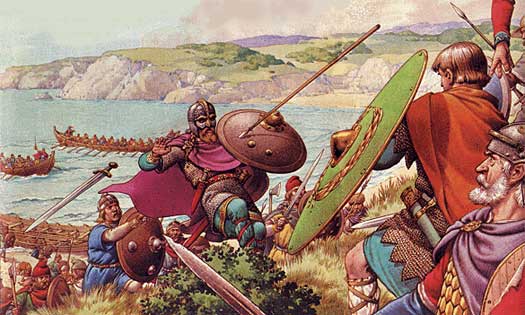
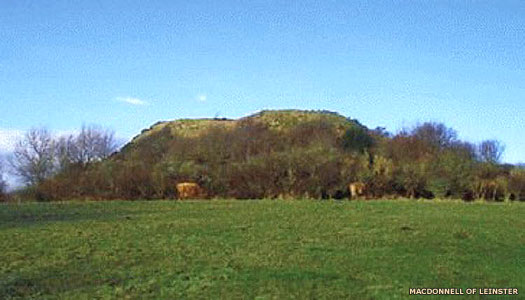
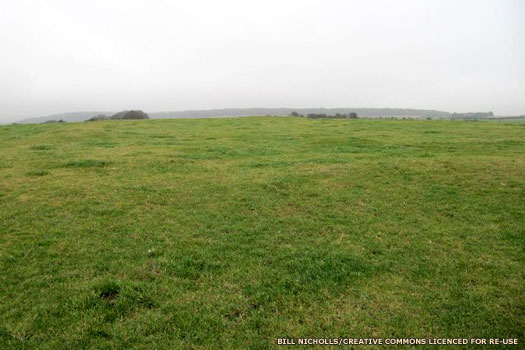
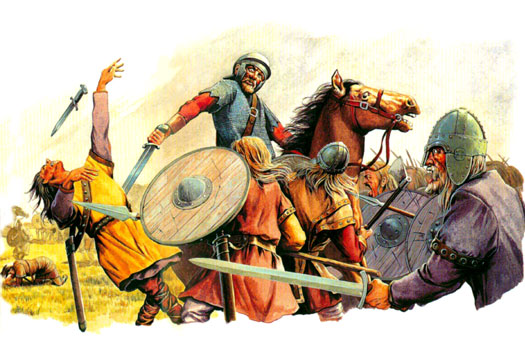
In Britain this two centuries period is usually called "Sub-Roman Britain" and is centered on the "mytical" figure of  King Arthur, a Romanised leader (some historians think  Ambrosius Aurelianus was the "real" king Arthur) of the Romano-Britons who was able to defeat the Germanic invasors with his victory at the battle of Mount Badon around 500 AD ( https://www.historyfiles.co.uk/FeaturesBritain/BritishMountBadon.htm ).


The R1b-U152 presence in Roman Britannia

Furthermore, we have to remember that the Romans established over 70 cities or towns in Britain, including important cities like London, St Albans, Colchester, Winchester, Gloucester, Exeter, Leicester, Lincoln, Manchester and York. But they "genetically" left only a minimal presence in the actual population of these cities. Only the area around Lincoln and York has maintained a relatively huge amount of people with the R1b-U152, the so called "Haplogroup of ancient Romans" (see the following related map). 

Indeed Maciamo Hay wrote in this interesting essay (read the complete article here:https://www.eupedia.com/genetics/britain_ireland_dna.shtml) that "genetically and cromosomically....
......it is very difficult to assess the genetic impact of Romanization on the British population as the Roman citizens, soldiers and slaves who settled in Britannia were not merely people from the Latium or Italy, but could have come from anywhere in the empire. "


Even if we assume that Britain was fully Celtic before the Roman conquest, similar to Ireland or the Scottish Highland once Germanic DNA has been removed, it is still very hard at present to clearly differentiate Brythonic Celts from other Celts from the continent, notably Gaul, who might have settled in Roman Britain. Even the Romans from Italy appear to have belonged predominantly to the same R1b-U152 as Hallstatt and La Tène Celts, also accompanied by significant minorities of G2a-U1 and J2b. Deeper subclade analysis may soon allow population geneticists to distinguish between Roman/Italic and Celtic subclades within these haplogroups. At present it seems that the L2 and Z36 subclades of R1b-U152 are more Celtic/Gaulish, while Z56 and Z192 are more Italic/Roman.

Map of the R1b-U152 in western Europe 

So, experts think that the Romans are in a maximum roughly 15% of male lineages of "Roman" origin for England, 10% for Wales, and 7% for Scotland. However, it would be reasonable to assume that at least half of these come from Alpine Celts and Normans, and probably more in Scotland's case. It is hard to explain the discrepancy with the 30-35% of autosomal genes of Mediterranean origin that are now present in the modern population of England. One explanation is that a substantial share of Romano-British male population was killed by the invading Anglo-Saxons, and that autosomal genes were passed on through Roman-British mothers who bore the children of the Germanic invaders....."

Some researchers (like D'Ambrosio of the University of Genova) wonder why the farm area around Lincoln (read also https://www.reading.ac.uk/web/files/archaeology/Reading_April_14_talk_AS.pdf )  is the only one in modern Great Britain with actual population showing genetically a 15/20% of R1b-U152, the so called "haplogroup of Ancient Romans" (a percentage that is similar to the one in Mediterranean Spain around Valencia!). One possible explanation is that the Roman villas population of the area survived the onslaught remembered by Gildas in his "De excidio Britanniae" getting refuge in the nearby southern Pennines  mountains and later-when better times arrived during the last Sub-Roman Britain decades- these Romanized populations came back to where they used to live.

Probably this is what happened near Lincoln in the small city of Southwell, that was called "Tiovulginacester" in Sub-roman times, where there also are huge percentages of the Haplogroup J2 (typically originated in Anatolia & southern Italy).

Additionally we must pinpoint that in the city of Southwell (near Lincoln) the remains of an opulent Roman villa were excavated in 1959. Part of a mural from the excavation is displayed in the Minster. It is one of three of its type found in the territories of the Corieltauvi (or Coritani) tribes – along with Scampton in Lincolnshire and Norfolk Street in Leicestershire. A stretch of the Fosse Way runs on the far bank of the River Trent, with evidence of Roman settlement at Ad Pontem ("to the bridge" or "at the bridge"), north-west of the village of East Stoke. Other evidence of Roman settlement includes the use of Roman bricks in prebendary buildings around the Minster, remains of a ditch or fosse discovered at Burgage Hill in the 19th century, and possible Roman remains beneath the Church Street site of the recently vacated Minster School...The Venerable Bede records a multiple baptism in the "flood of the Trent" near "Tiovulginacester" by Paulinus in the presence of Edwin of Northumbria, whom he had converted to Christianity in 627. There is disagreement on the location of Tiovulginacester, but Paulinus certainly visited it and may have founded the first church in Southwell: the existence of this place called Tiovulginacester clearly shows that a partially romanised population was still living there in the early seventh century...BD


British Latin

 The Latin spoken in the British Isles after the Roman occupation left numerous traces in loanwords into British Celtic (spoken by the indigenous Celtic population of England and ancestral to Welsh, Cornish, and Breton) and early Anglo-Saxon (Old English). It is probable that "British Latin" over time developed differently from the Latin spoken on the Continent, but scholars do not agree on what its distinctive features were. This is in spite of the dramatic discoveries starting in the late 20th century (e.g., the Vindolanda tablets) that have greatly augmented the documentation of British Latin.

 So, a British variety of Late Latin, a nascent ‘British Romance’ called "British Latin", was probably rather widely spoken, not only in bilingual situations if not as a preferred and only vernacular, across the fifth century and into the sixth. in the area fully romanised. If interested read "The Romance of early Britain: Latin, British,and English, c.400-600" ( https://academic.oup.com/book/55329/chapter/434347840.)
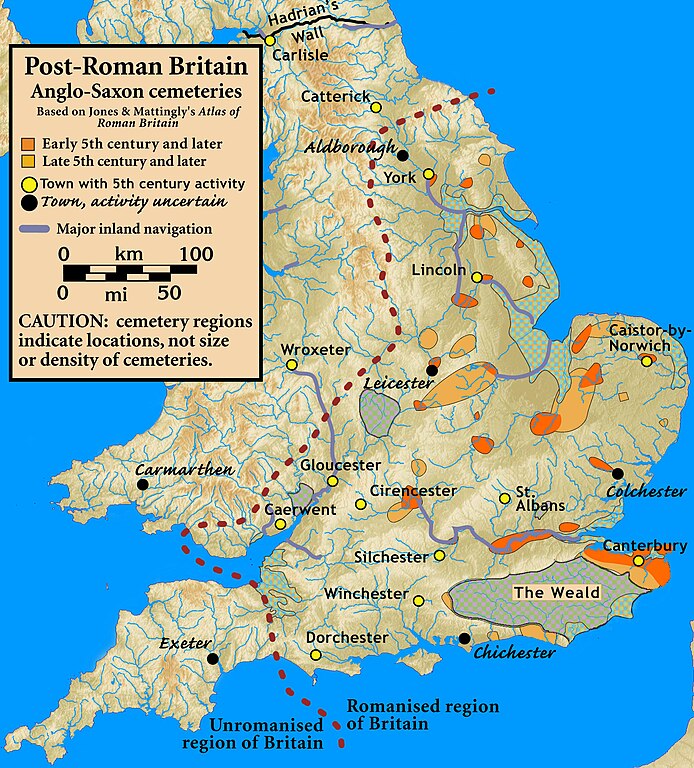


Map showing the fully romanised region of Britain around 450 AD and a few decades later.  In these arreas the remaining romanised Britons developed the "British latin", a romance language. The remaining areas of former Roman Britannia were "semi-romanised" (from Cornwall to the Hadrian wall).


Chronology of sub-Roman Britannia

The following are excerpts from an interesting essay about the years between 410 and 610 AD, taken from "History Files" ( in " https://www.historyfiles.co.uk/MainFeaturesIndex.htm ):

The history of the British Isles from the end of the most recent ice age to the formation of the united Anglo-Saxon kingdom forms several stages and covers a good deal of conflict. It starts with the Early Cultures which appear prior to the Iron Age. Then the Celtic occupation of Prydein leads up to the Roman incursions and the creation of Roman Britain.

Subsequent decline generated the Post-Roman period in which all stories of Arthur are contained, but this also covers the gradual loss of Celtic power in the land and its marginalisation on the western and northern fringes. With the expulsion of Roman officials in AD 409 (see feature link), Britain again became independent of Rome and was not re-occupied.

The fragmentation which had begun to emerge towards the end of the fourth century now appears to have accelerated, with minor princes, newly declared kings, and Roman-style magistrates all vying for power and influence while also facing the threat of extinction at the hands of the various barbarian tribes which were encroaching on the borders from all sides. A British Church was in evidence, with practices which would become increasingly isolated from those of the Roman Church.

Various units of laeti and foederati had been settled in the country from the mid-fourth century onwards (probably following the sudden visit to Britain by Emperor Constans in 343). Often Germanic in origin, by 409 they had been settled for up to sixty years and more, and may not have retained much of their 'Germanness' except that they often lived in self-sustaining communities outside city walls. The country was probably filled with similar immigrants from all over the former empire: Danubians, Gauls, Iberians, Italians, and others, many of them the descendants of legionnaires and all settled for some time. By now they were part of the very fabric of the country.

However, as Edward Dawson confirms when backing up the 'Germanness' point above, later units of laeti may not have been so settled. There appears to have been large numbers of them around many towns in the south-east of Britain. Amongst all the empire's immigrants, it was Germanic groups who best retained their cultural identity, sometimes for generations, continuing to teach their children German when others were learning Latin, or perhaps native British. When fresh waves of Germans arrived, conquering all in their path, it was probably not hard for the settled. Germans to experience a tactical change of loyalty.


DETAILED CHRONOLOGY:

409 - c.425

FeatureThis is a period in which central administration apparently breaks down to an extent, with local administrative centres and then rulers beginning to appear. The climb to power of Vortigern of the Paganes seems to reverse this trend (see feature link), although in some regions he probably has to administer what are in effect kingdoms rather than provinces. Even his own territory seems to have been divided into sub-kingdoms, such as Buellt and Guorthegirnain.

Quite possibly, in true Roman fashion, he acquires the title of emperor, perhaps proclaiming himself 'Emperor of Britannia' in order to cement his hold on power. It seems that he and Aurelius Ambrosius of Caer Gloui form the figureheads for opposing parties, but for the moment it is he who has dominance.

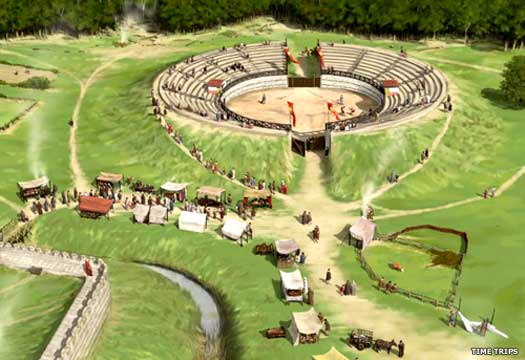
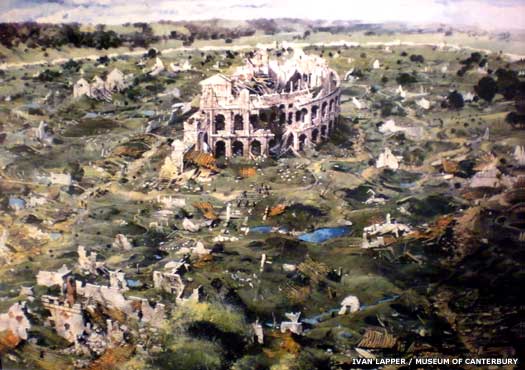
Roman amphitheatre at Silchester
This artistic reconstruction shows the amphitheatre at Caer Celemion (Calleva Atrebatum, modern Silchester), which was built outside the walls, to the north-east of the town itself

During this period, mercenaries, or laeti, are settled in some regions of the country, possibly to bolster populations of foederati and laeti which may already have been in place for some generations.

Groups are known to exist along the Thames Valley, in the north of Caer Celemion, and along the Saxon Shore from Caer Gwinntguic to Ceint and Caer Went.

There is a strong economic reason for placing them in the Thames Valley and other lowland areas. Northern coastal Germans (Angles, Jutes, Frisians, and Saxons) are accustomed to employing a farm economy set in lowlands, not uplands. They know how to work marshes and river valleys, so these settlement areas suit them entirely.

416

FeatureA synod is held in Carthage (the 'Council of Carthage') in the Roman province of Africa which takes a firm line against the Pelagian 'heresy'. Pelagius (circa 354-420 or 440) is a British ascetic who has allegedly denied the doctrine of original sin. He finds many supporters in Britain and the British Church, especially amongst the educated classes (see feature link).

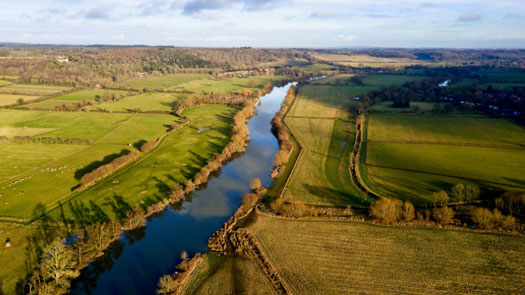
Thames Valley
The Thames Valley forms an east-west passage through the hills between London and Surrey and also through the hills of Wiltshire, providing easy access for river users to the River Avon around Bath

420

The use of coinage (usually silver coins) as the means of substantial payment seems to die out within ten years of this date. However, a high level of self-sufficiency in both civil service and the army has already become the established norm in Britain for the best part of a century, so this in itself is far from being a sign of the collapse of civilisation.

fl c.420s?

Anblaud / Amlawdd Wledig

Ruler of Ercing. First emperor of independent Britain?

c.421

Triphun is the Irish leader of the Déisi in Demetia in the west of Britain. As the fourth generation of Déisi to have been raised in Britain, the tribe now has roots in the country and has clearly developed a certain degree of reliability and trustworthiness.

By taking a Roman name, Triphun has become part of the British ruling elite, so much so that he is able to marry Gweldyr, the Romano-British heiress of Demetia, and become king himself of what becomes known as Dyfed.

fl c.425 - c.455

Wortigernos / Vitalinus / Vortigern

Ruler of Paganes. Second emperor of Britain? Died by fire.

429

St Germanus, bishop of Auxerre, and Lupus, bishop of Troyes, visit Britain to fight the Pelagian 'heresy' which is running rampant through the British Church. They meet with a still extant Romano-British aristocracy (the principle proponents of the heresy), probably at Caer Mincip. The following year, in line with standard Roman imperial policy in Gaul, Vortigern brings in Saxon allies to help restore order along the borders.

St Germanus of Auxerre
The Alleluia Victory saw St Germanus lead the Britons to a bloodless victory over marauding Saxons, perhaps demonstrating that the country was finally managing its own defence

c.432 - 436

Aurelius Ambrosius of Caer Gloui is apparently a leader of a British council, which presumably answers to Vortigern. It is his decision to confirm the Irish Déisi as commanders of the Demetia area of the west coast in order to counter the threat of Irish raiders.

Vortigern acquiesces and assigns to Ambrosius 'Dinas Emrys and all the western lands', suggesting that Ambrosius becomes the architect for the defence of these western areas.

This is motivated by the council's reluctance to depend entirely upon Saxon mercenaries, with their constant demands for increased provisions, especially in an area in which they will be lightly supervised. The Déisi have already been settled for some time and are already self-supporting.

c.437/438

FeatureAccording to Gildas (see feature link) and Nennius when referring either to Aurelianus Ambrosius (Ambrosius 'the Elder') or his son, this family represents the Romanised nobility in Britain. As already mentioned, they appear to be based in the city of Caer Gloui and its surrounding territories.

They are the main opposition to Vortigern's pro-Celtic faction, and it is at this time that the increasing animosity between the two groups erupts into internecine warfare. The factions fight the Battle of Guolloppum (Cat Guolph, Wallop in Hampshire). The result is uncertain, but it is probably followed by a period of civil strife in eastern and southern Britain.

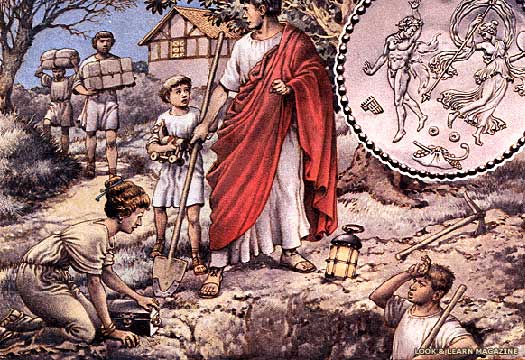
Romano-Britons burying treasure
With discord building in the country between about 420-450, many Romano-Britons left in a hurry, burying their wealth in the hope that they could return in better times to collect it

fl c.437 - c.446

Ambrosius 'the Elder'

Leader of Romanised opposition in Britain. Killed by plague.

c.440 - 441

Saxon foederati and laeti (settled largely on the east coast and Thames Valley, and probably increased in number since the barbarian raids on Britain of 409) take advantage of the unrest and openly revolt. As a cause they cite the failure of the British to supply them with provisions which may have been reduced to zero as a consequence of the civil war.

By 441, the Gallic Chronicles report large sections of Britain under Germanic control following the Saxon revolt: 'Britain, abandoned by the Romans, passed into the power of the Saxons'.

FeatureCommunications between Britain and Gaul are disrupted, vacated towns and cities are in ruin. The migration of Romano-Britons towards the west and to Armorica turns into a torrent (see feature link), with emigrants coming especially from Dumnonia and Cornubia. The country begins to be divided geographically, along factional lines.

c.446

St Germanus' second visit to Britain rids the country of the last of the Pelagian heresy when he visits Elafius' subjects. Elafius seems likely to be the leader of the territory of Caer Gwinntguic. Severe plague hits southern Britain in the same year, and unburied bodies are to be found in the streets of cities such as Caer Ceri.

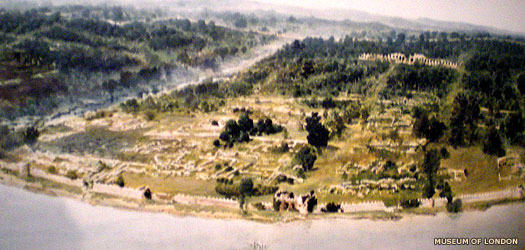
Post-Roman Londinium
By the mid-fifth century Londinium had been largely abandoned following at least half a century of slow decay and a steadily dwindling population, but with trade virtually ceased the city's purpose was temporarily ended

450

Former Celtic tribal associations continue to re-emerge as independent territories and kingdoms develop over the course of the fifth century. There is evidence of the reuse and refortification of Iron Age hill forts, while the newly-created kingdom of Brycheiniog creates a capital on a crannog. Cadbury Congresbury in Somerset is producing substantial quantities of Mediterranean pottery, with smaller amounts also coming from South Cadbury as local leaders move their residences to more protected locations.

It is attacks by the Picts (under Drust mac Erp) and Irish Scotti which prompts Vortigern to hire Jutish and Angle mercenaries to fight them off. Hengist and Horsa are invited into Britain and land at Ypwines fleot (Ebbsfleet).

Traditionally, they fulfil the terms of their contract by fighting back the invaders and receive territory on which to settle on the island of Ynys Tanatus (Thanet) in Ceint (although according to British oral tradition, they are first given territory around the Wash and only gain Tanatus after their numbers are swelled by a massive influx of their countrymen).

c.455

According to later British tradition, Vortigern is removed from office by the council after trying to settle yet more foreign laeti in Britain, this time in the north-east, within the territory of the 'Kingdom of Northern Britain'. The high kingship is given to his eldest son, the able and popular Vortimer. Hengist, seeing that he no longer has a malleable ally, revolts and the territory or kingdom of Ceint is quickly overrun.

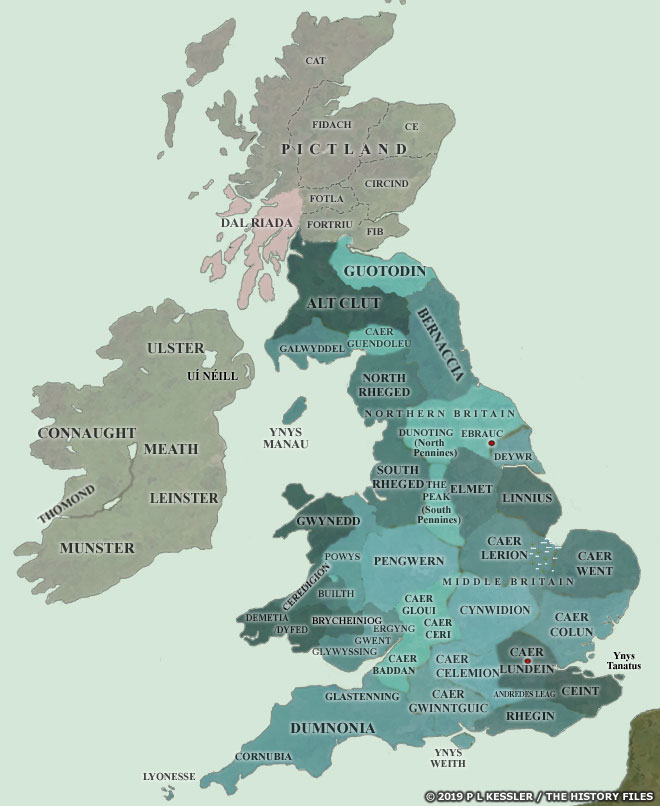
Map of Britain AD 450-600
This map of Britain concentrates on British territories and kingdoms which were established during the fourth and fifth centuries AD, as the Saxons and Angles began their settlement of the east coast (click or tap on map to view full sized)

fl c.455 - 457

Vortimer / Britu

Son of Vortigern. King of Gwent. Elevated by the council.

c.455

In the east of the island, the new and more serious foederati revolt sees a loss of territory to Jutes and Angles which is never regained by the Britons. The new arrivals have seen how weak are the British defences and begin a takeover of the kingdom of Ceint, aided by the many foederati settlements in key areas of the land, especially along the Saxon Shore forts and at Canterbury.

They are probably further encouraged by the chaos in Roman Gaul following the murder of the magister militum Aetius. Hengist's polyglot army fights British forces (traditionally commanded by Vortimer) at a place they name Ægelesthrep or Ægelsthrep (probably Aylesford or, less likely, Epsford, both in Kent). Vortimer's brother, Cadeyrn Fendigaid, ruler of the Paganes, is killed, as is Hengist's brother, Horsa.

Again according to later tradition, Vortimer is poisoned and his death allows Vortigern temporarily to reclaim the high kingship before he is faced by Ambrosius Aurelianus. Vortigern flees to his ancestral lands, 'at the fortified camp of Genoreu, on the hill called Cloartius', in Ercing, by the River Wye.

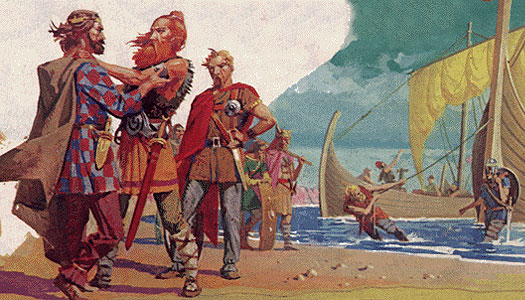
Vortigern meets Hengist and Horsa
Vortigern's policy of hiring mercenaries to help with Britain's defences was entirely in line with those of the late Roman period, but the chaos in the country - plague, mercenary revolt, civil war, frequent pirate raids - probably convinced Hengist and Horsa (shown here being greeted by Vortigern) that land was ripe for the taking

FeatureThere he meets his end when Ambrosius sets fire to his fortress with him inside it. Historically speaking, as much as extremely limited historical knowledge will allow, Aurelianus and his probable successor, Artorius (see feature link), seem to lead the fight to preserve the remaining British territory.

If Vortigern had titled himself 'Emperor of Britannia', then it seems reasonable to assume that his successors copy this, but after Artorius even the grounds for this supposition become reduced.

As if all that isn't enough, in the region of Deywr within the 'Kingdom of Northern Britain', Soemel is noted by the later royal pedigree as someone who 'separated Deira from Bernicia'. It seems to be Soemel who establishes negotiated terms of service, perhaps on a semi-independent basis.

FeatureThis time of chaos and confusion would be an ideal date for this event. At the same time, it would seem likely that Angles from Deywr are settling in Lindsey, which may still be under Romano-British control (see feature link).

fl c.457 - c.480

Ambrosius Aurelianus (Riothamus?)

Magistrate of Caer Gloui. Possible emperor of Britain.

FeatureGeoffrey of Monmouth proposes an almost entirely mythical account of the life of Ambrosius Aurelianus (see feature link). It ends with him being poisoned by Saxons, and his brother, Uther Pendragon, succeeds him.

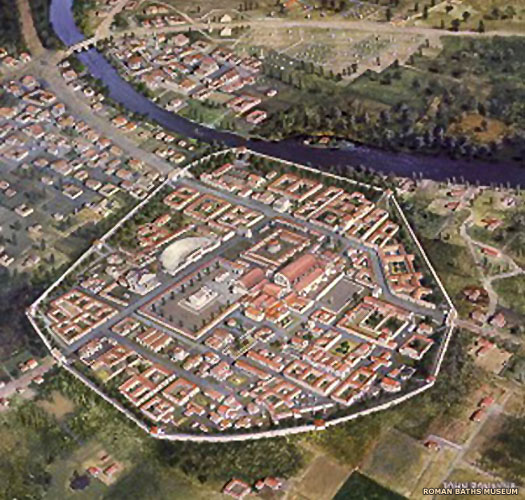
Roman Aquae Sulis
An artist's impression of Roman Aquae Sulis, later known as Caer Baddan to the Romano-British and which retains that name in an altered fashion today (Bath)

Uther immediately sets out to attack those Saxons who are involved in his brother's death, after they have teamed up with Paschent (Pascent of Buellt), son of Vortigern, and a young nobleman of Ireland named Gillomanius (could this individual be the contemporaneous High King Lóeguire macNéill?).

FeatureUther defeats them all, killing Paschent and Gillomanius. Then Uther has to defeat a resurgent Octa (which scholars think might actually be the real name of Hengist of Kent) before enjoying a largely peaceful reign which leads up to the well-known death of Gorlois of Cornwall and the birth of Arthur Pendragon (with this event, according to legend, taking place in Tintagel, possibly a Dumnonian royal court at this time - see feature link).

457

After much hard fighting at a place called Crecganford (Crayford in Kent), and apparently heavy losses, the British abandon Ceint. Those Saxons who had joined Hengist in 455 also settle in what is becoming Kent, but they have little impact on the Jutish nature of the kingdom and leave few traces. Some of them instead push farther west to form early elements of the Middel Seaxe.

c.460

Occupation of Cadbury Castle is re-established, perhaps selected for its defensive capabilities in these troubled times. Its reoccupation is not in the form of a city or an established seat of government for successive rulers. Instead it seems to be somewhere which a British leader of stature, perhaps Ambrosius Aurelianus, or Riothamus (if they are not one and the same person), makes his personal headquarters.

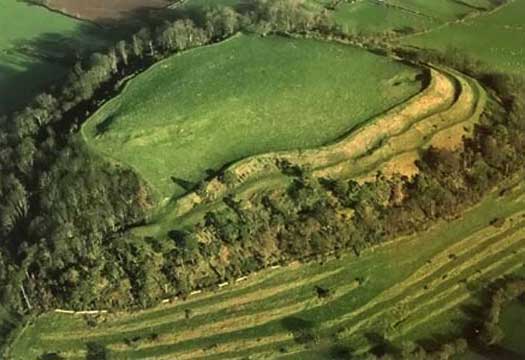
Cadbury Castle
Even today, Cadbury Castle presents the image of a powerful and defensible location, with views across the whole of Somerset giving it a level of strategic importance

468 - 469

FeatureRiothamus, 'King of the Britons', crosses the English Channel to Gaul, bringing 12,000 ship-borne troops. 'Riothamus' is a title rather than a name, apparently meaning 'supreme king', which raises the possibility that he is Ambrosius Aurelianus (see feature link).

Riothamus remains in the country for a year or more (perhaps reinforced by Armorican Bretons), and advances to Bourges and even farther. Gaul's imperial prefect, the deputy of the Western Roman emperor, treacherously undermines him by apparently dealing with the Visigoths.

Caught by surprise by the Visigoths, Riothamus fights a drawn-out battle near Bourges but is eventually defeated when no imperial forces come to his assistance. He escapes with the remnants of his army into the nearby territory of the Burgundians, never to be heard of again.

A second battle soon follows which involves a combined army consisting of units of Romans, troops from Soissons under Comes Paulus, and Burgundian foederati, but they are also defeated, and Soissons and Armorica are cut off from Rome. The disappearance from history of Riothamus does not rule out the possibility of him successfully returning to Britain, but this would also be a reasonable date for Arthur to take command of Britain's defence as his successor.

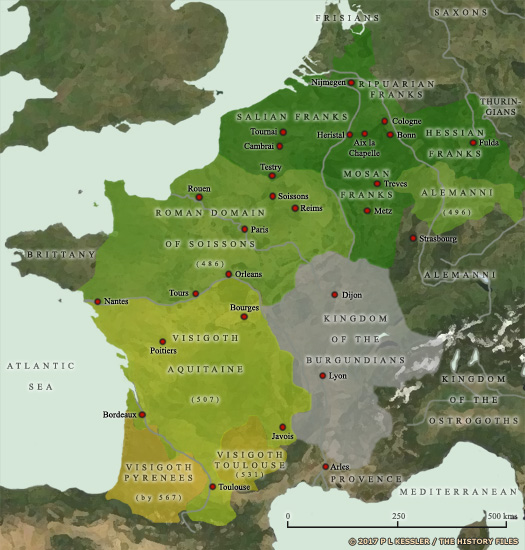
Map of Western Europe between AD 481-511
This map shows the expansion of the Frankish kingdom between AD 481-511 and the presence of the Roman domain of Soissons (click or tap on map to view full sized)

477

Newly arrived Saxons under Ælle and his sons land at Cymens ora and beat off the Britons who oppose their landing (part of the proposed British kingdom of Rhegin), driving them to take refuge in the great forest called Andredesleag (The Weald). These Saxons quickly become known as the Suth Seaxe.

fl c.480 - 511

Artorius / Arthur Pendragon

Son of Uthyr/Uther & Eigr. Possible emperor of Britain.

There is a great deal of material which has been written about Arthur, or more properly Artorius, but there is little direct proof of his existence. For that reason several scholars have chosen to disbelieve entirely in his existence.

FeatureHowever, it seems impossible that an individual who makes such an impact on history that a swathe of later generations of kings name their sons after him, and who is included in a vast body of literature, could not exist. In an historical sense, it seems logical to place him in the last few decades of the fifth century, governing, or at least protecting, the country after Ambrosius Aurelianus and before his traditional date of death in 511 (or 537 by some sources), and perhaps claiming Cadbury Castle as his military headquarters (see feature link).

Traditionally, again, he is the son of Eigr (Ygerna), the daughter of Anblaud 'the Imperator', who has a connection to Ercing. He marries Guinevere, a medieval form of a Cornish name which is probably Veneva (and which descends as the modern Jennifer). She is a princess of Dumnonia, and possibly a sister to King Gerren.

Text
Sir Cligés is one of the less well-known knights of the round table, a poor knight because of his generosity who is rewarded by Uther Pendragon for his kindly ways and selflessness

Artorius himself is primarily a leader of cavalry, the best weapon of the British against the foot-slogging Saxons for as long as they can maintain their breeding stock of large warhorses. This is the force he leads against Geoffrey of Monmouth's Saxon leaders, Colgrin, Badulf, and Chelderic (the first of whom is sometimes linked to Deywr), while being supported by King Hoel of Brittany. This is also how he enters into legend.

486

Clovis of the Franks defeats, captures and executes Syagrius, the last Roman commander of Soissons. The Franks are now completely dominant in northern Gaul and Roman control has been thrown off. The death of Syagrius may also sends a signal to Saxons and other Germanic peoples that attempting to settle in Gaul is now hopeless, although the situation regarding migrants is hard to determine.

488

This is the last recorded entry for the Jutes of Kent in the Anglo-Saxon Chronicle until 565. Fighting against the Britons move further westwards as they lose the south coast to the Suth Seaxe, Londinium to the Middel Seaxe and their Suther-ge, and the Upper Thames to the Thames Valley Saxons and Ciltern Saetan (despite the long resistance in the latter area which is offered by Cynwidion and Caer Mincip).

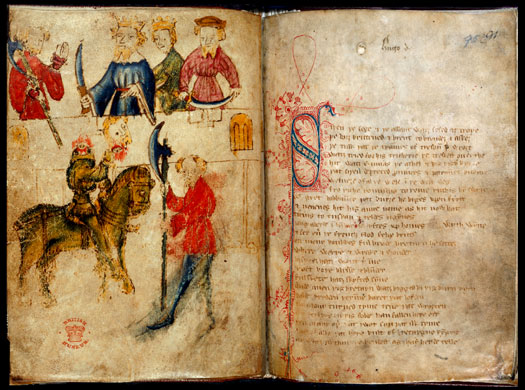
Sir Gawain and the Green Knight
Gawain of the Guotodin is perhaps one of the most famous of Arthur's 'Knights of the Round Table', but his origins seem to lay in the Lothian region, although his actual presence there seems to have been extremely limited

However, the influx of Saxon fighters may have slackened since 460, when the prospects for soldiers of fortune may have seemed better in the remnants of Roman Gaul, coupled with the fact that the Britons are apparently starting to gain the upper hand (especially in the traditional twelve victorious battles of Arthur in locations such as Lind Colun).

Despite this apparent improvement in fortunes, the sense of profound shock which has been dealt to British society by events since the first major Saxon revolt around 441 has triggered changes which will see the rapid mutation of the British language into 'Early Welsh' in the space of about a century.

Young people in this period who grow up with British and Latin languages may be hearing their grandchildren speaking a different tongue. Even the bardic tradition begins to break down, with the sounds and patterns of their words destroyed by the changes. Much of the Iron Age tradition is lost, although fragments do survive.

495

FeatureAccording to tradition, Cerdic lands in five ships on the south coast at Cerdices ora, together with Saxon and possibly some Jutish companions, and begins a takeover of the local Jutish, Saxon, and sub-Roman territories. Those Jutes and Saxons who are already settled there are apparently already referring to themselves as West Seaxe (possibly separate from the earlier Meonware settlers to their east).

Remains of Roman Canterbury
The Roman city of Canterbury was, by the sixth century, in ruins, with small Jutish houses built in between. The remains of the city wall can be seen all around them

The fighting begins on the same day as Cerdic 'arrives', suggesting that his potential power play begins in violence or immediate resistance. If Cerdic is in fact a Briton who rebels against the remaining central authority (which seems to be a distinct possibility), then given his location he could be serving as a magistrate of the former Belgae territory of Caer Gwinntguic until he seizes part of the territory in order to found his own little empire. It is another blow to British unity and defence.

c.496

FeatureArthur seemingly commands the defence of Mons Badonicus against a confederation of Saxon and Jutish warriors which is most likely led by Ælle of the Suth Saxe (see feature link). The British victory grants them a generation of relative peace and consigns the South Saxons to subsequent obscurity. All building and repair work on major new defensive works probably comes to an end with the victory.

There is now a gap in Germanic Bretwaldas for the next half century. This is probably due to the Mons Badonicus defeat and the long peace between the Britons and the Germanic coastal settlements. As there is no significant warfare, there can be no significantly superior war leader to push forward the Germanic advance.

FeatureQuite the opposite, in fact, as there seems to be a reverse migration of Angles and Saxons into continental Europe during the first half of the sixth century. Those who remain are firmly in control of the east (see feature link, right).

Aelle of the South Saxons
The coming of Ælle and his apparently pre-established status as bretwalda spelled eventual defeat and death for the Britons of modern Sussex, and quite possibly led to the siege of Mons Badonicus

Geoffrey of Monmouth has Arthur handing over the kingship to Constantine, but that would presume that the dating shown here is wrong. An alternative date (also given by Geoffrey) for Arthur's retreat to Avalon (Glastonbury in Dumnonia) is 542, which would provide an overlap between Arthur and Constantine, but would displace Arthur's fifth century activity against the Saxons. This revision may only work if his father, Uther Pendragon, actually does exist and has enjoyed the long reign given to him by Geoffrey.

fl c.530 - c.540

Constantine / Custennin ab Cado

King of Dumnonia. Successor to Arthur?

531

On the other side of the English Channel, the Franks of Austrasia conquer the Thuringians. Portions of territory are lost to Saxons, probably to the Continental Saxons, but there also seems to be a reverse migration of Germanics from the east coast of Britain, where the recent British victory at Mons Badonicus has cut them off from the acquisition of new lands.

These returning Angles and Saxons appear to be given land in Thuringia by King Theuderich. However, it is also at this time, in this century, that the migration of Britons from the mainland to Brittany is at its heaviest, weakening the British defensive position for the future.

fl 540

Aurelius Conanus

King of Caer Gloui.

? - 540

Vortiporus / Vortiporius

King of the formerly client Déisi of Dyfed.

c.540

Vortipor(us) of the Déisi of Dyfed is clearly a powerful figure in British history, as noted by his being included in the list of high kings of Britain. His name has been recorded in various ways, from the Latinised Vortipor itself, to the Gaulish Voteporix, and the (perhaps) more genuinely original Vortepor mac Aricol. Even this has been recorded in later Gaelic as Gartbuir mac Alchoil.

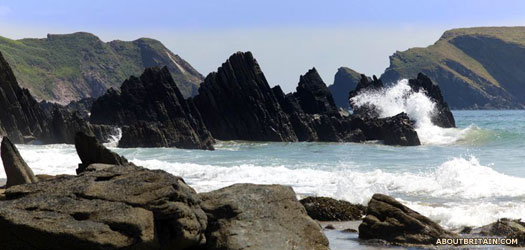
Marloes Sands
The coast of Pembrokeshire, part of the territory of the Demetae and the later kingdom of Dyfed, is a mixture of sandy beaches and daunting rocks (as at Marloes Sands, shown here), but there would have been many places for the Déisi to land and seize some territory

fl c.540 - 549

Malgo / Maglocun / Maelgwyn Gwynedd

King of Venedotia.

547

In the north, the British kingdom of Bernaccia is seized by Angles who have been serving as laeti. The ruling king, Morgan Bulc is forced out. He takes refuge with the Guotodin, shifting his power base there, but the loss leaves a gaping hole in the defences of the eastern coastline. It is the first such breach in the defences of the north, despite a century of such chaos to the south of Britain, and suddenly the defensive strength of the 'Men of the North' looks shaky.

549 - c.600

Following the death of the powerful Maelgwyn of Venedotia, and given the dearth of information about the northern British kings at this time, it is entirely plausible to place first the 'three unnamed tyrants' and then Keretic - see below - as kings in the north.

The Yellow Plague which sweeps through the country hits the Britons far harder than it does the invaders, finally shifting the balance of power in favour of the latter. Even the Picts seem to be affected by the plague, with the possible loss of at least one of their kings, Drust mac Munaith, in 552.

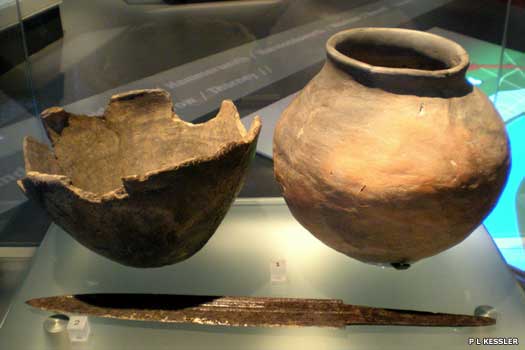
Saxon cremation urns from the area around London
By the mid-sixth century, Saxons were settling around Londinium, and using pots such as these for their cremation burials, while the seax blade is generally more Frankish than Saxon, but the city itself remained overgrown and in ruins for another half a century

It is odd to have such a gap so late in the list, but not if the next four rulers are from the poorly documented north. The Saxon advance in the south also lends weight to this hypothesis (which is proposed by Mick Baker).

Their westwards advance becomes much more rapid, with them soon swallowing much of Somerset and Dorset from Dumnonia. The Angles also advance, taking large swathes of central and northern Britain, and ending any realistic claim by the high kings of Britain to rule over the whole island.

Three unnamed tyrants now claim the high kingship. The names below are accepted as high kings in other references, and their dates fall conveniently into the gap left between the reigns of Malgo and Keretic, but they are not in the list formed by Geoffrey of Monmouth. To differentiate them, they are shown here in red text.

549 - 560?

Morgan Bulc

King of Bernaccia (to 547), and Guotodin (c.560 onwards).

552

The West Seaxe conquest of Caer Gwinntguic proves that the southern Saxons have recovered from their massive Mons Badonicus defeat. From this point onwards, the Britons continually lose territory until the modern borders of Wales are decided.

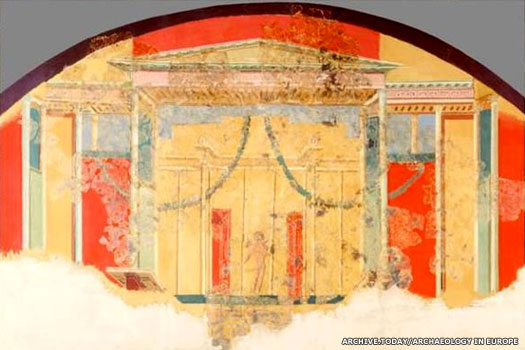
Frescoe in Venta Belgarum
A wall painting in the Roman palace of Venta Belgarum as reconstructed by Sean A MacKenna (1932-2012), an expert in excavation, conservation, structure, and restoration

560? - 579

Rhydderch Hen

King of Alt Clut.

579 - 590

Urien

King of North Rheged.

577

Caer Gloui, together with Caer Baddan and Caer Ceri, falls to the West Seaxe. With this collapse, the territory of Caer Celemion to the east is now totally isolated, and Dumnonia is cut off from any overland contact with other surviving British territories (and largely disappears from the overall story as far as the rest of the Britons are concerned).

Gwent and Pengwern now form the western frontier against further Saxon advances. The Hwicce take over the territory and eventually push its borders north into Worcestershire, at the expense of Pengwern.

580

Ebrauc (York) falls to the Angles of Deira. It is a major blow to British hopes of regaining control of the country and blots out at least two and-a-half centuries of Christian worship in one of the British Church's key bishoprics. It seems likely that, if he exists, Geoffrey of Monmouth's Archbishop Tadioceus of York flees the city with the rest of the nobility, holding his title as an exile, perhaps from Elmet.

590 - 613

Keretic / Keredic / Ceredig

Probably the same Ceretic as in Elmet.

595

FeatureThe Annales Cambriae (see feature link) records the death of Dynod of Dunoting in battle against the Bernicians. He is probably the last British ruler of the Pennines (unless the remnants of the territory are absorbed into North Rheged).

Gloucester's Roman walls
Despite the focus of settlement now being away from the old fort, Glevum's Roman walls were still very much in use in the sixth century, at least until the city's fall to the West Seaxe

His family are forced to flee to Powys, including his second son, the famous bard, Aneirin, while another son, Deiniol, is already in Gwynedd as the British Church's first bishop of Bangor.

By this time the Deiran and Bernician Angles are pushing far into British territory, and the Iclingas are expanding to the south with only Elmet and the probable Cynwidion and Caer Mincip alliance holding out in this region as enclaves until 616-617, and South Rheged until about 613.

c.597

The Gododdin is a long series of elegies composed from the early seventh century onwards which commemorates a force of Britons who assemble in Guotodin at this time. This force marches south to fight the Angles at Catreath and seemingly attacks the Roman fort near the strategic road junction now called Scotch Corner.

Ultimately, the battle is a disaster for the Britons. The flower of the northern British warrior class is decimated by the superior numbers of the Bernicians. Guotodin, as well as the other kingdoms of the north, probably including Elmet, are all fatally weakened by the defeat.

The Mote of Mark
The Mote of Mark is an early hill fort at Rockcliffe, overlooking Rough Firth, which was occupied in the sixth century, presumably by Rheged's nobility

603

The first meeting takes place between the Roman Church in the form of St Augustine of Canterbury, and the Celtic Church (the descendant of the former British Church of the Roman period). It is arranged when Æthelbert of the Cantware uses the Hwicce as intermediaries, and the meeting goes favourably for Augustine.

A second meeting is quickly arranged, although perhaps not in the same year. This takes place at Abberley in Worcestershire, probably close to the border between the Hwicce and Pengwern. It is attended by seven bishops of the Celtic church, along with many learned monks, mainly from Bangor-is-Coed (in Pengwern).

The meeting ends in disappointment for the Roman envoy, with no agreements of cooperation or unity being reached between the two churches, especially in regard to the important question of the calculations for Easter and evangelising the pagan English.

c.600 - 610

The territory of Caer Celemion is destroyed, probably by Ceawlin of the West Seaxe. It is the last British-held territory south of London and east of Dorset to fall. The town of Calleva Atrebatum is abandoned and its wells are filled in to prevent its citizens from returning.

Lowbury Hill in Berkshire
Caer Celemion's re-use of a former Roman temple at the top of Lowbury Hill (near Compton in west Berkshire) in the mid-500s as a look-out point ended with the territory's fall, but it did see further use as an Anglo-Saxon cemetery


c.597

Y Gododdin is a long series of elegies composed in Old Welsh from the early seventh century onwards, principally by Aneirin, son of Dunaut of Dunoting. It commemorates a force of Britons who assemble near Din Eidyn at this time in preparation for facing their powerful foe.

It includes not only the still-wealthy and aggressively strong Guotodin themselves, but warriors from all over the country, including 'three chiefs of Novant', clearly the nearby Novantae in post-Roman form (and also an unknown number of peasant militia who are not worthy of mention in a grand poem).

After attending 'churches for shriving, true is the tale, death confronted them' - clearly the British Church exists here - this force marches south to fight the Angles at Catreath (generally accepted as being modern Catterick, approximately eighty kilometres north of Ebrauc). It seems strange that they should march past Bamburgh on their way, the capital of the early Bernician kingdom, but perhaps not if they are making an attempt to reclaim the lost capital of the North, Ebrauc.

Britons versus Angles
The attack against the Angles at the end of the sixth century appears to have been a last-ditch attempt by the semi-Romanised Britons to rid the land of these invaders - and it failed, albeit gloriously

The battle seems to take place during an attack against the Roman fort near the strategic road junction now called Scotch Corner, by the south bank of the Swale at Catterick Bridge. Gwawrddur is praised for 'glutting black ravens on the wall of the fort, though he was not Arthur' (a term used to denote great slaughter of the enemy, but even so this warrior is still not a match for Britain's heroic battle leader of the previous century).

Ultimately, the battle is a disaster for the Britons. The flower of the northern British warrior class is decimated by the superior numbers of the Bernicians or Deirans. Guotodin, as well as the other kingdoms of the north, probably including Elmet, are all fatally weakened by the defeat.

?

?

Unknown survivor of Catreath. Ruled (truncated?) kingdom.

638

The events of around 597, as chronicled in the Gododdin, sound the death knell for the kingdom. Unable to recover from this, the Annals of Ulster note pithily 'the battle of Glenn Muiresan and the besieging of Eten' - Din Eidyn.

No more is mentioned, not even the outcome of the battle or subsequent siege. The monks on Iona record that the attacker is Domnal Brecc of Dál Riata, and defeat for the Britons is clearly implied as the battle leads to the siege. Din Eidyn apparently falls to Oswald of Bernicia (soon afterwards, it seems), and notably the Irish annals use a variant of its name - Eten - to help the case against 'Din Eidyn' being an invention of the Angles.


Roman Viroconium
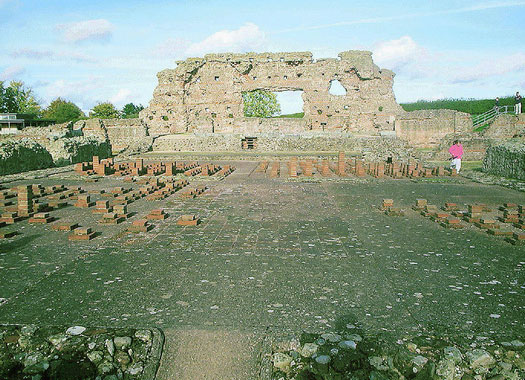
The old Roman fort at Viroconium, one of their largest settlements, was substantially and skilfully rebuilt in timber between about 530-570, and then mostly dismantled by 600, during the period in which Pengwern may have achieved a semblance of independent Romano-British rule


LINKS:


Wednesday, February 5, 2025

NORMAN SICILY (1061-1194)

The following are excerpts from the interesting essay "Study of the Norman State in Sicily, 1061-1194" (written by Jonathan Hoffman & others). It is a follow-up of the essay I have written about "Longobard Salerno" last month.

THE NORMANS IN SICILY & SOUTHERN ITALY

Map in italian language showing the years when happened the Norman conquest of all southern Italy, completed in 1091 AD
The Worlds the Normans Found

Southern Italy in the centuries leading up to the Norman invasion was a polarizing place. Throughout Southern Italy were a number of communities with distinct identities. We are going to be taking a closer look at three of the more important communities in Southern Italy in the time leading up to the Norman conquest of the region (after the yer 1000 AD). They are Lombards (called also "Longobards"), Byzantines, and Muslims, all of whom played a significant role in shaping the Southern Italy that the Normans would invade and unify.

We will be looking at Southern Italy and its autonomous nature from 6th century AD to when the Normans imposed their authority on the region at the end of the 11th century. Many believed that this region was underdeveloped and not being used, which just is not the case. In Southern Italy after the invasion of the Lombards, power would be divided by areas belonging to the Byzantine and the Southern Lombards. The Muslim conquest of Sicily in the 9th century would have a large and similar impact to the roles of the Byzantine and Lombards in shaping the Italy that the Normans would go on to conquer.

Longobards and Southern Italy

The Lombards were a Germanic people who found a home in Southern Italy by the 6th century. Their invasion of the region began in 568 and within decades they established a strong kingdom in the territories north of the River Po, Tuscany, and in the two duchies of Spoleto and Benevento. The biggest rival to the Lombards in Southern Italy at the time of their invasion was the Byzantines who already had a lot invested in the region. There would be some tension between the two autonomous regions but by 680 AD the Byzantine empire had concluded a treaty with the Lombards, which seems to have involved a formal recognition of their presence in the region.

Throughout the 8th and 9th centuries, the Lombards would keep their eyes set on maintaining control of territory in Southern Italy. Internal conflicts would pose a threat to their power and a civil war occurred in the 9^th^ century between factions in Benevento and Salerno. The conflict would go on to shape Southern Italy as it had a direct link to an increase in the number of Muslims in the region during the 9th century. Both sides employed Arab mercenaries and hired them to fight on their side during the civil war. Word spread of work in southern Italy because of the conflict and a rise in Arab population ensued. This was one of the most significant consequences of the open hostilities.

Louis II, king of Italy and Holy Roman Emperor, took great interest in the conflict because of its attraction to Arab mercenaries. He most likely would have never paid any attention to this conflict otherwise. In the year 849, Louis helped bring an end to the conflict by dividing the Lombard duchy between the two sides while establishing some degree of stability.2 The end of the conflict meant that Arab mercenaries would no longer be in demand.

The end of civil war suggested a brighter future for the region. The Byzantines had been losing interest in Southern Italy and the two factions that were previously at war were satisfied. For a short period of time, the Lombards were seemingly in control of most of southern Italy. Unfortunately for the Lombards in Benevento, however, the Byzantines had rediscovered interest in territories that had once controlled in Southern Italy. From the end of the 9th century into the 10^th^ century, conflicts ensued and the Lombards began to lose territory to the Byzantines.

By the early 10th century, Benevento would become Capua-Benevento and would be ruled as a single entity. The newly formed unit of Capua-Benevento found it difficult to resist the Byzantines. Salerno, on the other hand, seemed to benefit from the conflict. As the Byzantines were by their campaigns to regain their former territories in Capua-Benevento, Salerno flourished. Interestingly, both Salerno and Capua-Benevento managed to maintain stable governments throughout this period, even if many elections were rigged to ensure that the Lombards would retain power.

From the 6th century until the start of the 11th century, the Lombards exercised significant power in Southern Italy and strongly influenced the region the Normans would ultimately take over. Salerno was a town that was well-bonded with traditional structures and it remained prosperous during Southern Italy’s feud with Emperor Otto I. The Lombards had their own system of law; in fact, in Southern Italy it was one of the two major legal systems – the other being Roman Law. In short, the lands the Lombards ruled were politically sound and represented one of the strongest of the autonomous regions in Southern Italy on the eve of the Normans’ arrival.

The end of Lombard rule in Southern Italy signified the end of autonomous rule in the region. By the 11th century, the Normans had arrived and began taking over Southern Italy. When the Normans captured the principality of Salerno, they brought an end to the last Lombard stronghold and an end to area’s autonomous regions.

Byzantine Sicily and Southern Italy

Byzantium's grip on Italy grew stronger during the seventh, eighth, and ninth centuries. The Byzantines had to restructure their control over the remaining holdings in the Italian peninsula after the Lombard invasion of the region. The years from 876-1000 were turbulent due to succession problems and Muslim raids, which aggravated internal divisions. This led to the fall of Byzantine Sicily as the island became dominated by Muslim rulers with ties to North Africa. The chaos that persisted in much of Italy culminated with the arrival of the Normans. The effect of the Norman Conquest on Byzantine Italy resulted in its separation from the Byzantine heartland. This led to the eventual decline of Byzantine culture and influence in Italy.

By the end of the seventh century, the Byzantine regions of Italy had been through an entire century of turmoil. Following the Lombard invasions, the Byzantines militarized their remaining territories, concentrating land in the military and handing it to the Exarch of Ravenna and his dukes. This was accomplished at the local and regional levels, with the final phase being the establishment of military strongholds.3 With the inclusion of eastern clerics and artists throughout the kingdom of Italy, rather than just in Rome, Byzantine influence grew after the Lombards were formally recognized in 680. Eight of the nine pontiffs who sat in St. Peter between 676 and 715 were Greek, Syrian, or Sicilian. The emperor sought the assistance of the pope because political and religious stability depended on it. Since that meant imperial authority in Rome, Rome enjoyed further prestige from this association. Resistance against the Lombards was successful and was accomplished by placing power in the hands of local elites from imperial garrison units. Threats from the Arabs, Bulgars, and Slavs weakened the empire, making the role of the eastern exarch less important. The conversion of the Lombards from barbarians to Romanized Catholics weakened the loyalty given to the empire.

The Duchy of Naples included the Bay of Naples' coasts and islands, as well as the inland Terra di Lavoro and the towns of Sorrento, Amalfi, and Gaeta. Its institutions followed the traditional Italian model, with power and wealth concentrated in a military-based elite. Naples' allegiance to the empire was greater than that of the northern provinces. The need for imperial help was due to its maritime relations with the east and the need for imperial protection against the ever-present threat of Lombard Benevento. The fall of Ravenna in 751 had little impact on the duchy since it had fallen under the authority of the strategos of the theme of Sicily. The Arab invasion of Sicily in 827 was the turning point in the detachment of Naples from the empire. In 835, Duke Andrew employed Muslim mercenaries to battle Prince Sicard of Benevento (833-839), and in 842 and 843, he assisted the Muslims in capturing Messina from the empire. This alliance strengthened Naples, allowing them to sign a crucial treaty with the Lombards in 836. Later, in order to prevent attacks from Muslim strongholds such as Taranto, the Neapolitans strengthened their relations with the Saracens. Byzantium's cultural and economic presence was enormous, according to evidence, and included imports of eastern pottery. Gaeta grew in importance as a communication hub in the north. Gaeta occasionally operated independently of Naples and was forced to change its policies toward Muslims. To the south was the non-Roman city of Amalfi, which was populated by Lombard refugees. It was a naval base by the eighth century, and it was used in wars with the Lombards, Franks, and Arabs. Following a raid by Prince Sicard of Benevento in 839, Amalfi gained independence from Naples under its own leaders. Despite the fact that the Greek aspect was not as strong as Naples' and that its foreign policy was independent of the empire, its trade relations with the east became increasingly important.

Calabria was the name given to a late Roman civilian province that bordered on the Terra d'Otranto. The imperial territory faced a crisis in the middle of the seventh century, with the civilian government dispersing and breaking down as the Lombard dukes of Benevento seized vast regions. This resulted in a late seventh-century institutional reorganization. Due to immigration from Greece and Sicily, this time marked a turning point in both areas' Hellenization. From written history, little is known about the duchy during this time period. The position of the duchy became clearer only after Nikeophoros Phokas conquered Lombard Calabria in 885-886.

In contrast to the upheaval evident in most Byzantine areas on the Italian peninsula, Sicily occupied a more prominent position within the imperial plans beginning in the seventh century. The island of Sicily rose to prominence as a naval base for countering Muslim advances from North Africa. In the early 690s, Justinian III turned it into a theme. Its strategos came to rule over imperial territories in southern Italy, and after the exarchal government fell in 751, he became a key figure in negotiations with the Franks, Lombards, and the papacy. The influx of officials and soldiers from the east quickened the Hellenization process. Emperor Leo III was able to realize the island's economic, political, and military importance. Sicily was one of the regions that was transferred to the patriarchal authority of Constantinople. Due to this, the Latin element disappeared and the process of Hellenization was reinforced. Nonetheless, by the eighth century, unrest was on the rise. One reason for this was the downturn in the economy. The increasing number of Arab raids had a detrimental impact on the island’s prosperity.

Sicily, unlike its mainland counterparts such as Ravenna, Rome, and Naples, lacked a central power base and an independent military elite. As a result, the populace's response to the upheavals of the 820s was varied and, in some respects, passive. A largely Arab army landed in the western port of Mazara in June 827 and defeated the Byzantine strategos Plato soon after. After defeating Palermo in 831, Cefalù in 857, and Enna in 859, the Arabs gradually expanded their influence over the island. The critical misfortune occurred when the capital Syracuse collapsed after a nine-month siege, and the city's population was massacred.

Byzantium's status in Italy had shifted dramatically over two centuries, from a precarious position in 680 to the verge of a new era of power and influence in the late ninth century. Traditional imperial rule only worked with the aid of a coherent Hellenization mechanism in the theme of Sicily and associated duchies of Calabria and Otranto. However, in every region, developments were shaped by the decentralization that began in the seventh century, and distinguishing practices and institutions that were more often Roman than strictly Byzantine remained influential. The destruction caused by Arab raids, as well as Frankish political and military failures, bolstered Byzantium's status. The reconquest of most of the Lombard territory in Apulia, Calabria, and Lucania, including Bari and Taranto, retaken in 876 and 880, began a new period of Byzantine dominance in southern Italy.

Around the year 900, there was a significant shift in terms of southern Italy's security and independence from external powers. This transition was brought about for three main reasons. The resurgence of Byzantine influence in the late ninth century, under the governorship of Nikephoros Phokas in the 880s, was the most notable. The Byzantines had retaken most of northern Calabria and consolidated their control over southern Apulia. The second reason was that the areas of southern Italy not under Byzantium's rule were more stable. Third, following the Arab capture of Taormina, the last major Byzantine stronghold in Sicily, in 902, Arab leader Ibrahim ‘Abd-Allah died the same year, effectively ending any Arab advance from Sicily. The system of southern Italy remained largely in a state of equilibrium from 900 onwards. The main problem for the Byzantine government in Calabria and Apulia following 915 was local disillusionment.10 While there was some back-and-forth between the Byzantines and the Lombards, the Byzantines were able to keep much of the territory they had reclaimed in the 880s. Unlike the autonomous factions in southern Italy, Byzantium was the dominant power. They had more pressing concerns in Asia Minor, so the protection of their Italian possessions was left to the locals. Since neither the Lombards nor the Byzantines were able to make permanent encroachments, the south was mostly at a standstill.

Amalfi, Naples, and Gaeta, the three duchies off the west coast, were quite different from the Lombard territories. These three duchies' economies were based on trade. Amalfi was the most affluent of the three coastal cities in southern Italy. In the ninth and early tenth centuries, they refrained from military confrontations with the Arabs because trade was so important to them. In certain cases, they even helped the Arabs. Due to their proximity to the Lombard territories, these three territories were almost always under the patronage of the Byzantine Empire.12 In the 980s and 990s, the Arab attacks resumed. These Muslim raids reached all the way to Apulia. According to legend, Prince Guiamar III welcomed a party of pilgrims from Normandy after this series of raids. He allowed them to stay because he was impressed by their military prowess, and this marked the beginning of the Norman presence in southern Italy.

The Normans left much of the Byzantine infrastructure in place when they first conquered southern Italy. The religious activities of Greek churches were permitted to continue. In the territories, the Normans encountered a Byzantine Italy with a combination of Latin and Byzantine influences. The influx of newcomers from the north into Calabria and Sicily had a major effect on southern Italy, as Hellenic influences were gradually choked. The loss of relations between Byzantine Italy and the Byzantine heartland harmed Byzantine culture. This occurred gradually because the Normans didn't have a strategy of eradicating Byzantine influence; rather, it happened as a result of their invasion.

The "Cappella Palatina" was built in 1143 by the Normans in Palermo, the capital of their "Kingdom of Sicily".It is the most wonderful of the Norman Roger's churches, with Norman doors, Saracenic arches, Byzantine dome, and roof adorned with Arabic scripts; and it is perhaps the most striking product of the brilliant and mixed civilization over which the grandson of the Norman Trancred ruled. 1911 British Encyclopedia.


Islamic Sicily

After the prophet Muhammad passed away in 632, the Muslim umma began their campaign to spread both the message of Islam and to conquer land. By 731, the Arabs had successfully reached the Iberian Peninsula by moving westward from Egypt through the Maghreb and conquering much of the land. By this point, the Arabs controlled most, if not all of, North Africa. Towards the beginning of the ninth century (third Islamic century), all of the conquered lands had united and become one empire underneath one universally accepted authority. While each land was still ruled by its individual rulers, they had all agreed upon serving the caliph and every major decision including war had to receive his blessing before they entered or started a war. However, the Islamic nation or umma was both politically and religiously divided with many viewing the caliph in Baghdad as no longer the legitimate ruler.15 This caused the umma to divide and separate based on their own inner religious issues. Ultimately, this led to many of these territories appointing their own caliphs and pledging allegiance to them instead of the one in Baghdad.

Leading Up to the Invasion

In the Middle Ages, during the 8th to 12th centuries, Sicily was viewed as a coveted possession of Islam and was no stranger to invasions and conquests. Its position in the Mediterranean Sea was seen as a strategic one and it was sought after by many civilizations during the classical period and the Middle Ages. During the ninth century, the Aghlabids (a dynasty of Arab princes ruling the Ifriqiya province) had set their sights on Sicily. During this time, the province ruled by the Aghlabids faced a series of domestic problems including a violent insurrection.16 While this insurrection was put down by the princes, it created a feeling of residual resentment towards the royals among the army factions. With this feeling of resentment growing, many took advantage of it including the Berbers who felt as though there were clear social and economic inequalities between the governors and the governed.

In 827, Ziyat Allah had been contacted by Euphemius, a rogue admiral in the Byzantine empire, who told him that Byzantine forces were holding some Arab soldiers hostage. If this were true, it would break the peace treaty the Aghlabids and Byzantines had signed together. The only catch was that Ziyat Allah had to help Euphemius overthrow his enemies within the Byzantine forces. When presented with this idea, he had to keep in mind the host of domestic issues happening around it, especially the feeling of resentment towards the elite in society. But he understood that engaging in war with the Byzantines would help shift the focus away from the slew of domestic problems he had going on. Ziyat Allah also understood that Sicily would bring some exciting new prospects including a renewed commercial success as well as military ventures. By invading Sicily, it would give the army some work to do and keep them away from the rebellion that was growing. Keeping all of this in mind, Ziyat Allah decided to invade the island.

The Invasion

Sicily was heavily guarded and considered a prized possession by its current rulers, so it was understandable that the invasion met with strong resistance. In fact, in the beginning, Muslim forces lost the majority of the battles that they had fought in. However, when they did enter battle, they were able to patch up lingering differences which led to Constantinople sending reinforcements to help the Arabs invade Sicily. Without these reinforcements, their conquest wouldn’t have been as successful as it was. In short, internal dissention in the Byzantine Empire played an important role in the Arab conquest of Sicily.

During the invasion, there were definitely visible differences in both independence and leadership within the armies. These differences would lead to a strained relationship between the Muslims in Sicily versus the ones in North Africa. Death was often common in these conquests and many military leaders would die in battle. When these leaders died, the army selected their successors, which the leaders in North Africa didn’t like. This practice became a point of contention between the two groups. If a military leader was chosen and sent by the leaders in North Africa, there was a chance that the new leader would be rejected, which speaks to the growing independent thinking among the troops.

During the invasion of Sicily, the Muslim troops were able to capture territories that were key to the Byzantine Empire, which led to their ultimate victory. The first key city the Muslims were able to capture was Palermo. The capture of Palermo led to the establishment of a Muslim capital in Sicily and its vicinity to the ocean helped it gradually develop into an urban center along with the other already established Muslim centers. Another key city the Muslims were able to capture was Castrogiovanni. This city was where Byzantine headquarters were located. Once it had been captured, Muslim armies had pressed on eastward, a path that eventually led to the downfall of Byzantine Sicily.

Muslim Sicily

There was a growing divide between the Muslims living in Sicily and the rulers in the Ifriqiyan province. Many groups tried to take advantage of this, including the Fatimids. The Fatimids were a group of Shiites who claimed to be descendants of Fatima and Ali. The Fatimids called for economic, social, and religious reform and addressed concerns regarding Aghalbid rule.17 Understanding the current political climate they were in, they were able to use the Aghlabids’ corruption and abuse of power to their advantage and succeeded in stifling the Aghlabids’ last attempt at reform.

Once they were thrust into power, the Fatimids were able to maintain the Aghalbid-Sicilian jihad conquest and used this to their advantage. They were also able to manipulate the use of jihad in order to serve their own interests. They were able to accomplish this in three ways. Since the Fatimids were ruling a majority Sunni area, they were conscious enough to give credit to the Sunni caliph whenever there was a Muslim victory in Sicily.

They had also praised the Sicilian Muslims and promised to continue supporting their campaign in Sicily. This made sure that they kept the Sicilian Muslims happy, which allowed the Fatimids to stay in power. Finally, they appealed to the Sicilians due to their anti-Aghlabid campaign. By doing so, it allowed the Sicilian Muslims to see that the Fatimids were the opposite of their previous rulers, which helped the Fatimids establish a Shi’ite caliph. While their rule was not illegitimate, it had an impact on Sicily’s Muslim community, who in response held elections to select their own rulers.

In 912, Sicilian Muslims did just that when they elected Ibn Qurhub as their ruler. Ibn Qurhab was initially hesitant to accept the position to rule and only did so when he received the full support of both the Fatimids and the Aghlabids. During his rule, he raided Christian towns and even created tensions between the Fatimids and the Aghlabids by swearing allegiance to the caliph in Baghdad. This conflict resulted in his death in 914.

During the Kalbid period in Sicily (948-1053), Muslims succeeded in completing a jihad campaign and this provided some political and social stability. During this period, there was evidence of a shift in focus from a jihadist campaign to active support for culture and learning. This is evident from the Sicilian works of Islamic jurisprudence which helped confirm the island’s connection to North Africa. There were also works focusing on the Arabic language and its subfields, opening up the possibility for language studies. It also led to the field of poetry coming in at a rapid pace.

After this growth and stability came a decline with the rule of Jafar Ibn Yusuf in 1014. During his rule, his own brother rebelled with the help of slaves and Berbers, which led to the expulsion of all Berbers from the island. There were rumors of misconduct surrounding Ibn Yusuf and, seeing the chaos that ensued during this rule, the Zirid princes decided that it was an opportunity to rip control away from the Fatimids.18 Under their rule, Sicily was able to thrive once again. The Zirid princes helped bring military and political prestige both in Sicily and their own court. They also allowed for co-existence and interdependence between the province and the motherland which was not an option with other rules. By ruling Sicily, they were also given ample opportunity of wealth in terms of both land and resources it provided. It also opened up new trading avenues and routes to gain more capital.

Final Days of Arab Sicily

The Arabs contributed much to the formation of Sicily and, thanks to them, Sicily became powerful in that era. The Arabs came to Sicily and, in the beginning, there was a great deal of prosperity and a relatively peaceful coexistence with other religions and ethnic groups. The Normans initiated campaigns of destabilization and took advantage of political fissures that had appeared in the Muslim world. These strategies had a destabilizing effect and enabled them to conquer the island during thirty years of brutal campaigns.

The Arabs brought their innovations and knowledge to Sicily and it shaped it to be a prosperous peaceful era. The island of Sicily was fully conquered by Arabs in the 9^th^century and, with the notable exception of the Orthodox Christian population in the northeast of the island, many Sicilians converted to Islam. Just like the Moors - the Arabs who conquered Spain - they brought an intellectual tradition to Sicily.

Sicily under the Arabs witnessed a growing influence of Islamic culture that emanated from Qayrawān (a town in modern-day Tunisia). The Arabs who became the majority in Sicily wanted to expand their religion into the people and their government. Their control of seaports was critical to communication and trade. They played a vital role in Sicily’s economic prosperity.

The division and resentments between Christians and the Muslim authorities would resume. First the Byzantines failed many times to take back Sicily with many Arab military victories over them. Ultimately, however, the Christians again became the majority and the Muslims community declined. The hostilities with the Byzantine Empire were costly and this helps explain why the island was able to be conquered again in the eleventh century, this time by western European Christians.

The Arab Muslims who ruled Sicily for two centuries would lose control of the island to a group of warlords from Normandy. The Normans were skilled soldiers who were Christians and they would promote the spread of their religion while taking control of the trade routes and communications that had been under Muslim control. As the Normans came to dominate the island, however, an Arabic-speaking Muslim population would continue to exist on the island until 1220, when Emperor Frederick II exiled them to a colony at Lucera, located on the mainland in what today is Puglia.

Statue of Roger II, creator of the "Kingdom of Sicily". This famous norman warrior was King of Sicily and Africa, son of Roger I of Sicily and successor to his brother Simon. He began his rule as Prince of Salerno & Count of Sicily in 1105, became Duke of Apulia and Calabria in 1127, then King of Sicily in 1130 and King of Africa in 1148.
Conclusion

Each of the three societies discussed in this essay had a significant impact on Sicily and Southern Italy well before the Normans’ arrival.

The Lombards were able to create a stronghold on the island and were also able to overcome a civil war that, at least temporarily, resulted in a larger Arab population in the region. The Lombards also enabled certain areas under their control to flourish.

The Byzantines, on the other hand, had a huge impact Sicilian culture, which should not surprise us since they ruled the area for a long period of time. One of the most important relationships created at this time was the one between the Byzantine Empire and the papacy. This relationship helped the Byzantines with the invasions from other empires while the pope was able to gain greater influence. The Byzantines also militarized their territories - including Sicily - creating a much stronger island.

The Arabs, too, left an important legacy to Sicily by bringing with them, among other things, a rich cultural and intellectual heritage - a tradition that included art, architecture, poetry, language and even farming techniques. the Muslim population but also growing poetry and language studies at a rapid pace.

To conclude, when the Normans arrived in Sicily and Southern Italy, they were fortunate to be able to draw on the experience and knowledge of accomplished societies that had come before them as they created a new state in a diverse, multicultural landscape.

Thursday, January 2, 2025

LONGOBARD SALERNO

History of Salerno (in southern Italy) when was under the Longobards during the Middle Ages

The "Longobard Salerno" was the historical period of Lombards (or Longobards) domination in the city of San Matteo (as is often called Salerno), which lasted from the seventh century to a few years before the thirteenth century.

Image showing the longobard castle "Terracena" of Salerno. The palace (destroyed by a very strong earthquake in the thirteenth century) is shown as it appears in a miniature of the Canon of Avicenna. The image represents the story (perhaps legendary) of Robert, Duke of Normandy. Mortally wounded by an arrow, he was heroically saved by his Lombard wife (Sichelgaita of Salerno) who sucked the poison as prescribed by the doctors of the "Schola Medica Salernitana"


INTRODUCTION

«"It is known that the city of Salerno was, in this era, the Athens of Italy."...a phrase written by the famous numismatist Giulio Cordero di San Quintino (1778-1857) way back in 1841, but which still retains all its relevance today: "On sait que la ville de Salerne étoit, à cette époque, l’Athènes de l’Italie" Raffaele Lula»


Salerno was conquered for the first time by the Longobards of Prince Arechi I in 620 AD and from then for five centuries until 1077 the city of San Matteo was dominated by a minority of Germanic origin, which left an indelible mark on it. With the Principality of Salerno of Guaimario IV, Salerno became "de facto"[3] the capital of the entire southern Italian continent, unified for the first time since the end of the Roman Empire.

Furthermore, Longobard Salerno had the first "university" of medicine in Europe, the famous "Salerno Medical School", where for the first time women participated as the Mulieres Salernitanae: among the prominent personalities of the mulieres Salernitanae are handed down the names of the Lombards Trotula de Ruggiero, Rebecca Guarna and Abella Salernitana.

Salerno was also the only Longobard territory in Italy to develop a fleet for trade in the Mediterranean: in 1058 a "privilegium mercaturae" granted by Prince Gisulfo II of Salerno also attests to the birth of a free market connected with maritime activities. It should also be remembered that ships from Salerno took part in the capture of Mahdia, in present-day Tunisia: in the second half of the year 1000, Mahdia, then governed by the Zirid vassals of the Fatimids, was repeatedly attacked, and briefly conquered, by Genoa and Pisa with the help of Salerno, Amalfi and Gaeta, but the attack did not have lasting effects

The longobard prince of Salerno Guaimario IV (1027-1047) in his 20 years of rule was able to dominate all continental southern Italy

HISTORY

Salerno - despite being in the coastal center of the Campania region - has always had northern "origins" in its History: it was founded by the Romans in an Etruscan territory

Unlike nearby Naples which was founded by the Greeks and then dominated by the Byzantines, "Roman" Salerno became "Longobard" in the seventh century, having a Romanized population with a large Germanic minority when Arechi II founded the Principality of Salerno in 774 AD.

Scholars such as Ajello estimate that in the eighth century in Salerno over a third of the population still spoke the Longobard language mixed considerably with neo-Latin words and phrases. Professor Ajello states that in Salerno in that century out of a population of about 6,000 inhabitants, over 2,500 were Lombards. And they were concentrated in the upper district of the historic center of Salerno, on the hill where the Castle of Arechi was located.

It should also be remembered that many Lombard refugees took refuge in Salerno and its surroundings - perhaps a thousand, according to Ajello, but other scholars (such as D'Ambrosio) believe there were double - who, with their families, fled from northern Italy conquered by Charlemagne's Franks.

«Arechi II welcomed the Lombard refugees coming from the north (conquered by the Franks) giving them lands in these two areas (around his castrum of Salerno). In these territories there are rural churches dedicated to Saints whose cult was very widespread in Langobardia Maior and foreign to the southern regions: in the Giffoni countryside, about ten km from Salerno, we find Sant’Ambrogio, San Vittore and Santa Tecla; in Nocera another church of Sant’Ambrogio and a small chapel dedicated to Saints Nazario and Celso in Bracigliano near Rota (Mercato San Severino), probable evidence of the colonizing activity developed in these areas G.L>>


After a long struggle between the Byzantines and the Lombards that began around 620 AD, in 646 the city finally fell into the hands of the latter as part of the Duchy of Benevento, although the evidence of Lombard presence, already starting from the 6th century, is confirmed by the discovery of a tomb, in the archaeological complex of San Pietro a Corte, of a little girl named Teodonanda, who died on 27 September 566.
With the advent of Lombard domination, the city experienced the richest and most famous period of its history, which lasted more than five centuries.

In 774 the prince of Benevento Arechi II decided to move his court to Salerno, which was populated by many Lombard families. The city gained importance and numerous works were built, including the sumptuous palace, of which traces remain scattered throughout the historic center. This palace (now almost completely disappeared) was a building next to the "Palatine Chapel" (Church of San Pietro a Corte).

A few decades later, in 849, the Principality of Salerno became independent from Benevento, acquiring the territories of the Principality of Capua, northern Calabria and Puglia up to Taranto.

«Ludovico II, Emperor of the Holy Roman Empire, sponsored the agreement to divide the Lombard Mezzogiorno into two distinct principalities, with Benevento and Salerno as capitals. The text of the agreement, dated between 12 May 848 and December 849, recalls the imperial authority......Siconolfo obtained a series of "loca et gastaldata", which outline an area coinciding with the Tyrrhenian and southern strip of the ancient Benevento duchy, from Cosenza, Cassano and Taranto in the South to Sora in the North Treccani»


Furthermore, the mint of Salerno began minting coins around 851, the year of the foundation of the principality following the struggles for succession to the throne of Benevento between Siconolfo and Radelchi[11]. The minting of coins in the city continued uninterruptedly even in the Norman era until the mint was suppressed in 1198 by order of Constance of Altavilla.

DOMINION OF THE CONTINENTAL SOUTH OF ITALY

Starting with Prince Siconolfo, who titled himself "Langobardorum gentis princeps", Salerno became the capital of a principality that came to control with Guaimatio III and Guaimario IV all of continental southern Italy.

In fact, with Prince Guaimario III (who ruled from 994 to 1027), Salerno entered a phase of great splendor, as evidenced by the inscription Opulenta Salernum engraved on the coins of the time. He was responsible for reducing the cities of Amalfi, Gaeta and Sorrento to vassals of the Principality of Salerno and for the annexation of many of the Byzantine possessions in Puglia and Calabria.

But it was his successor, Guaimar IV, who achieved the greatest dominion by occupying the Aspromonte of southern Calabria and building a Lombard fort at Squillace, thus driving the Byzantines from the Italian peninsula for the first time since the Gothic Wars.

He also became Duke of Puglia and Calabria in 1042, but in 1047 Emperor Henry III officially disauthorized him, starting the crisis that would lead to his death and the end of the Principality of Salerno a few decades later.

However, Guaimar's legacy included dominions over Salerno, Amalfi, Gaeta, Melfi, Puglia, Calabria and alternately over Capua. Furthermore, John V, Duke of Naples, declared himself a "vassal" of Prince Guaimar in 1039 and remained faithful to him throughout his reign.

Map showing the Principate of Salerno under Guaimario IV, when reached the biggest extention
He was undoubtedly the last great Lombard prince of southern Italy and according to some historians the best ever.

What earned him so much favour was above all his character, which the historian John Julius Norwich sums up by writing that "throughout his life he had to fight against the unscrupulous ambitions [of his rivals], and he did so without ever breaking his word or failing in his commitments. Until his death, his honour and his good faith were never tarnished". Other reasons were his political intelligence, the papal favour and initially the imperial favour of the West, but especially the sword of his faithful Norman mercenaries.

In 1077 the last Lombard prince, Gisulfo II son of Guaimar IV, was forced to surrender Salerno to the Normans of Robert Guiscard and with his death in 1091 (after having been "Duke of Amalfi" for only one year in 1089) the Lombard era in Italy definitively ended.

THE LONGOBARD - NORMAN SALERNO

The population of Salerno - which had about 35,000 inhabitants at the end of the 11th century, according to De Simone - remained under the dominion of the large Lombard-Salerno minority even after 1077. In fact, Guiscard's wife was the Lombard Sichelgaita, who had a lot of influence on her husband.

«Between 1058 and 1072 Sichelgaita accompanied her husband (Robert Guiscard) on his repeated trips to Calabria, Puglia and Sicily, where she accompanied him during the capture of Palermo, torn from the Arabs. On January 14, 1072, after entering the city, she attended the mass celebrated in the church of S. Maria. In the winter of 1076-77, after breaking the alliance with Gisulfo, Guiscard laid siege to Salerno, which was finally conquered. In this situation, which saw her husband opposing his brother, Sichelgaita found herself in a situation of evident tension and perhaps played, at least according to the sources, a role of mediator between the contenders.... She wrested from her husband the promise - later revealed to be impossible to keep - to leave Salerno to Gisulfo, entrusting Amalfi to their firstborn son Ruggero. During the siege - again according to Amato's account - Sichelgaita received requests for help from her fellow citizens of Salerno and from her own relatives, making sure that food and drink reached them.... Sichelgaita also participated in the battle of Durazzo (in Albania) on 18 October 1081 and in the victorious siege of the city of Treccani»


It should also be noted that the Normans were not a people like the Lombards, but a group of mercenary warriors from Northern Europe, who on a few occasions moved to southern Italy with their respective families. And in many cases they married Lombard girls in Salerno (as in the case of Guiscardo with Sichelgaita): for this reason many scholars affirm that from 1077 there was still a "Lombard" Salerno, at least partially and for another century until the thirteenth century.

After the end of the Principality of Salerno, many Salernitans of Lombard origin joined the Normans in their conquests: Salerno became the capital of the unified southern Italy under the Normans, who also conquered Muslim Sicily.

Siege of the Salernitans to the Empress Costanza in the Castel Terracena. Note that all the civilians have brown-blond hair, a sign that those in favor of the Norman Tancred were of Lombard descent<>br/>
Salerno grew in importance in the 12th century thanks to the construction of its cathedral and the growth in international fame of its "Medical School", which also had the Garden of Minerva considered the forerunner of European botanical gardens by UNESCO.

In the years 1105-1110 the English philosopher-scientist Adelard of Bath, author of the "Quaestiones naturales", visited the school, where we have the greatest flowering of treatises and authors. The physician Constantine the African (born in the Arab Ifrīqiya) also arrived in Salerno and lived in the city for several years and translated many texts from Arabic such as the Aphorisma and the Prognostica of Hippocrates

«There are four cities that excel above the others: Paris in the sciences, Salerno in medicine, Bologna in law and Orleans in the acting arts. Thomas Aquinas in "De virtutibus et vitiis"»


The Regimen Sanitatis Salernitanum is internationally considered the most famous treatise produced by the School; the work, in Latin verse, is a collection of hygienic rules, placed at the foundation of its doctrine elaborated entirely in Lombard Salerno

Although it is commonly dated around the 12th century, some sources claim that the "Regimen" dates back to 1050. The work, dedicated to an unidentified Rex Anglorum (probably Robert II, Duke of Normandy and pretender to the throne of England, who was in Salerno in 1099, returning from the first crusade), sets out the indications of the School for everything concerning hygiene rules, food, herbs and their therapeutic indications. The author is unknown and it is probably a collective work even if some attribute it to the Lombard John of Milan, who was a disciple of Constantine the African.

But in 1130 the Normans of the son of Guiscard (Roger II) founded the "Kingdom of Sicily" and moved the capital of their dominions from Salerno to Palermo. This fact was much criticized by the Lombards of Salerno, by now assimilated into the population of the city. Consequently many citizens of Salerno moved to Palermo, determining the first beginning of the decline in importance of Salerno, which in a few decades completely collapsed and was even destroyed by the German emperor Henry VI in May 1194.

In fact, in 1191, Emperor Henry VI descended into Italy to block the attempt of the Norman Tancred to emancipate himself from the Holy Roman Empire. While besieging Naples, he fell ill (probably from malaria) along with his wife Constance of Hauteville whom he sent to Salerno (until then faithful to him) to be treated by the famous doctors of the "Schola medica". Henry himself fell seriously ill; then Henry of Welf, who was also participating in the siege of Naples, deserted to Germany, and falsely claimed that the emperor was dead and passed himself off as a possible successor. Although Henry VI recovered, the imperial army was forced to withdraw entirely from Italy. Constance remained in Salerno with a small garrison as a sign that Henry VI would soon return

Once Henry had withdrawn with most of the imperial army, the cities that had fallen to the Empire immediately declared their allegiance to Tancred, most now fearing his retribution. The Salernitan Nicholas of Ajello, former archbishop of Salerno, who was helping to defend Naples, wrote letters about the events to his friends and relatives in Salerno. So the people of Salerno saw an opportunity to gain some favors from Tancred (possibly even making Salerno the "capital" again) by taunting and besieging the defenseless Constance at Castel Terracena. Constance appeared on a balcony and spoke to them in a tone of mild remonstrance and admonition, trying to tell them that the situation could improve and that Henry VI's defeat could be exaggerated by Nicholas, but the people of Salerno were determined to capture her for Tancred, and so they continued the siege. Constance locked herself in her room, locked the windows, and prayed to God for help and vengeance. After a quick negotiation with Elia di Gesualdo, a distant relative of Tancred, Constance voluntarily left on the condition that her German guards were allowed to leave unharmed. She was then arrested by Elia (and some barons of Puglia who were related to her) and handed over to Tancred in Messina

But the revenge of Henry VI, when he returned to Salerno in the spring of 1194, was terrible and cruel: he destroyed the city without mercy for all the citizens, especially massacring the supporters of the Norman Tancred who were almost all of Lombard origin in Salerno.

«the real beginning of the decline of Salerno can be traced back to a precise date: May 17, 1194, when the emperor Henry VI, to take revenge on the inhabitants of the city who had imprisoned and handed over to his rival Tancredi, two years earlier, his wife, the empress Constance of Sicily, besieged it: the attempts of the archdeacon Aldrico[19] to convince the inhabitants to ask for the emperor's forgiveness were useless, the people of Salerno resisted. At that point, the fate of the city was sealed: Henry had it stormed by his troops, had it sacked and its inhabitants massacred. Pietro da Eboli described the scene in dramatic tones: "the women were raped and the men were shot, the survivors were exiled and all their goods confiscated".....The emperor had the Lombard walls razed to the ground, and a good part of the city was destroyed. The consequences of those devastations will continue for a long time, as the documents show: in the deeds of sale and purchase of houses owned in the first half of the thirteenth century, the word “dirutum“, “in ruins”, is often found. The palace of Sichelgaita>>


Furthermore, it should be remembered that Salerno in the 11th and 12th centuries had a notable Jewish community in the area called "Giudecca" around the current Church of Santa Lucia de Judaica, which was the largest in southern Italy (having over six hundred members around 1167, according to Benjamin of Tudela and which was badly hit on this occasion. This presence had grown during the years of the "Opulenta Salernum" but practically disappeared in the decades following the attack of Henry VI, even if some Jews remained in the Ghetto of Salerno until 1541 when Charles V ordered the end of the Jewish presence in southern Italy dominated by the Spanish of the Inquisition).

LEGACY IN TODAY'S SALERNO

Something remains of the Lombard centuries in today's Salerno, from simple geographical terms such as "Lama", the name of a stream that runs through the historic center and which takes its name from the Lombard word "lama" which means "stream" in Italian to architectural structures of great importance such as the original Cathedrale and the Castle of Arechi (which takes its name from the Lombard prince of the same name

Moreover, there are more than a dozen churches in Salerno of Lombard origin, the most famous being those of San Massimo and Sant'Andrea de Lavina. And there are the best (and fragmentary) testimonies of Lombard painting present in Salerno in the church of Santa Maria de Lama.

The remains of Castel Terracena and the Lombard archaeological complex of San Pietro a Corte are, in absolute terms, the only archaeological testimony of palatial architecture from the Lombard era remaining in central-southern Italy.

Panel of the Salerno Ivories -preserved at the Diocesan Museum of Salerno- depicting "The Nativity" and "The Flight into Egypt"
In Salerno there are currently two masterpieces of art of international level, according to Professor Ajello: the "Crypt" of San Matteo of the Cathedral and the Salerno Ivories. These ivories were most likely commissioned by the Lombard archbishop Alfano during the consecration of the Cathedral of Salerno in 1084. Due to their almost completeness and excellent state of preservation, they represent the most important ivory decorative cycle in the world. And they are exhibited for the most part in the local Diocesan Museum, but unfortunately some are scattered around the world (in the Louvre in Paris, the Metropolitan Museum in New York, the Victoria and Albert Museum in London, the State Museums of Berlin (Staatlichen Museen zu Berlin) and the Hermitage in St. Petersburg

Finally, it should be remembered that the current Salernitans (especially those living in the historic center) are known for their somewhat "northern" mentality - being orderly and entrepreneurial, which differentiates them from the rest of the inhabitants of Campania. When there was the Covid 19 epidemic, for example, Salerno was the only southern city not to have problems with urban cleanliness.

Thursday, December 5, 2024

ITALIAN TRIPOLI (LIBYA)

This month I am going to research the "Italian Tripoli", capital of Italian Libya from 1911 to 1947. Italian Tripoli was the capital of "Italian Libya". During the early XX century the city of Tripoli was under Italian control for 3 decades, that lasted from 1911 until January 1943. Italians conquered the town of less than 20,000 inhabitants from the Ottoman empire and enlarged it in 1943 to a big city of nearly 120,000 "Tripolini" (more than half Italians), creating a vibrant and modern capital in north Africa.

The census of 1939 showed this population in Tripoli:
Town...... Italians....... Arabs........ Jews........ Total
Tripoli... 47,442......... 47,123...... 18,467......113,212

Italian Tripoli was at the center of Italian NorthAfrica in the "Greater Italy" during WW2 (borders in orange color).With Decree of 9 January 1939 the four provinces of Tripoli, Misurata, Benghazi and Derna were aggregated to the Kingdom of Italy, becoming an integral part of the Italian metropolitan territory.

History

During the Italo-Turkish War of 1911 Tripoli was conquered by the Italian Kingdom. The Italian fleet appeared off Ottoman Tripoli in the evening of September 28, 1911: the city was quickly conquered by 1,500 Italian sailors, welcomed by the population (https://archive.org/details/tripoliitalianal00mart/page/36/mode/2upTripoli inhabitants welcomed the Italians; p. 36-40). The huge jewish community of Tripoli was very supportived of the Italian occupation (http://archive.diarna.org/site/detail/public/1784/).

TRIPOLI ITALIANA: The Grand Hotel, built in the early 1930

With the 1912 treaty signed in Ouchy, Italian sovereignty was acknowledged by the Ottomans, although the local Caliph was permitted to exercise religious authority. Italy officially granted autonomy after the war, but gradually occupied the region of Tripolitania. Originally administered as part of a single colony, Tripoli and its surrounding province were a separate colony from 26 June 1927 to 3 December 1934, when all Italian possessions in North Africa were merged into one colony called ''Libia''.

Since 1937 the governor Italo Balbo started a policy of immigration of Italians (mainly farmers) who were called the Ventimilli and some of them settled in the area of Italian Tripoli (https://www.youtube.com/watch?v=N_jA9rzM1MsVideo of Italian settlers arriving in the port of Tripoli).

Fiat train "Littorina" at Tripoli station

So, by the end of 1937, the city had 108,240 inhabitants, including 39,096 Italians (according to The Statesman's Yearbook 1948. Palgrave Macmillan. p. 1040). At the start of WWII Italian Tripoli had 111,124 inhabitants of which the Italians were 41,304: 37% of the city's inhabitants. Additionally there were nearly 18,000 Jews in the Tripoli area. Indeed after the Italian occupation of Libya in 1911, the Jews made great strides in education and economic conditions: at that time, there were about 21,000 Jews in the country, the majority in Tripoli. In the late 1930s, Fascist anti-Jewish laws were gradually enforced, and Jews were subject to moderate repression: still, by late 1940 -due even to the partial rejection of those laws by governor Italo Balbo- the Jews accounted for a fifth of the population of Tripoli and maintained 44 synagogues.

In 1942 Tripoli -according to estimates of the Italian government (Istituto Agricolo Coloniale (Firenze); Ministero degli Esteri, 1946)- reached a temporary population of nearly 150,000 inhabitants, due to the arrival of many Italians from Benghazi and Cyrenaica who took refuge from the British army attacks during WWII. As a consequence Tripoli was in that year -for the first time since the Arab conquest in 643 AD- a city mostly Christian.

Fiera internazionale di Tripoli ("Tripoli International Fair") in 1939

Architectural and Urbanistic improvement of Italian Tripoli

Tripoli underwent a huge architectural and urbanistic improvement under Italian rule (http://www.fedoa.unina.it/1881/1/Santoianni_Progettazione_Architettonica.pdf Tripoli section: p. 54-59). The first thing the Italians did was to create in the early 1920s a sewage system (that until then lacked) with water & electrical facilities to all the city and a modern hospital. Also was started the creation of the modern port.

Furthermore, in the western section of Tripoli was created an industrial area in the 1930s, around a huge tobacco factory (called "Manufattura Tabacchi di Tripoli"), with railway workshops, Fiat Motor works, various food processing plants, electrical engineering workshops, ironworks, water plants, agricultural machinery factories, breweries, distilleries, biscuit factories, tanneries, bakeries, lime, brick and cement works.

Governor Balbo used to say that "We Italians found in 1911 a big village of approximately 20,000 inhabitants called Tripoli and now we have in 1940 a modern capital nearly ten times bigger and one of the most developed and vibrant cities of Africa". (photos of Tripoli: http://www.paolocason.eu/Viaggio%20a%20Tripoli.htm ).

In the coast of the province was built in 1937-1938 a section of the Litoranea Balbia, a road that went from Tripoli and Tunisia's frontier to the border of Egypt. The car tag for the Italian province of Tripoli was "TL" (Berionne, Michele. "Libia (1937-1943)" Italian car tags )

Furthermore the Italians - in order to promote Tripoli's economy - founded in 1927 the "Tripoli International Fair", which is considered to be the oldest Trade Fair in Africa (http://tripolifair.com/tripoli-international-fair/ Tripoli International Fair brief history). The so-called Fiera internazionale di Tripoli was one of the main international "Fairs" in the colonial world in the 1930s, and was internationally promoted together with the Tripoli Grand Prix as a showcase of Italian Libya(http://cronologia.leonardo.it/storia/a1937f.htm Filippo Giannini: Colonial Italy and Islam (in Italian).


Italian Tripoli's Via Generale De Bono in 1933

Indeed the Italians even created the "Tripoli Grand Prix", an international motor racing event first held in 1925 on a racing circuit outside Tripoli that lasted until 1940 (https://www.youtube.com/watch?v=KEtz-wzbs9YVideo of Tripoli Grand Prix).Tripoli during the Grand Prix was visited by the elite tourism of the world and had even some "fashion" shops (https://www.pinterest.com/pin/187040190754209597/ Italian women walking near the Tripoli Castle in 1939).

The first airport in Libya, the "Mellaha Air Base" was built by the Italian Air Force in 1923 near the Tripoli racing circuit (actually is called "Mitiga International Airport"). The regular air services (with postal services) in Libya began in November 1928 with the first Rome-Syracuse-Tripoli air route, three times a week in winter, daily in summer, of the "Societa Anonima Navigazione Aerea (SANA)" airplanes. In the December of 1931 the "Società Nord Africa Aviazione (NAA)" inaugurated the Benghazi-Agedabia-Sirte-Tripoli line, which followed the coast line. With the absorption of the two companies from the ''Ala Littoria'' in 1935 the service continued on the same routes. From 4 April 1937 the Rome-Tunis line of Ala Littoria was extended to Tripoli; in 1938 the Air France opened a Marseilles-Tripoli line, then extended to Benghazi and Damascus. (www.academia.edu/2326842/ Le Poste italiane fuori dI'talia).

Tripoli had even a modern railway station with some small railway connections to nearby cities, when in August 1941 the Italians started to build a new 1,040 kilometres (646 miles) railway (with a 1,435 mm (56.5 in) gauge, like the one used in Egypt and Tunisia) between Tripoli and Benghazi. But the war -with the defeat of the Italian Army- stopped the construction the next year: only one hundred miles were created, but it was done also the project to connect this new railway with the borders of Tunisia & Egypt.


Banca d'Italia in 1932

Tripoli was controlled by Italy until 1943 when the provinces of Tripolitania and Cyrenaica were captured by Allied forces. The city fell to troops of the British Eighth Army on 23 January 1943 and the Italian colonists since then started to diminish (the following photo shows a family of farm colonists with British soldiers).

Tripoli was then governed by the British until independence in 1951. Under the terms of the 1947 peace treaty with the Allies, Italy relinquished all claims to Libya.

After WWII the era of international decolonization fostered a huge exodus of Italians from Tripoli (http://intranet.istoreto.it/esodo/parola.asp?id_parola=25https://books.google.com/books?id=ax0EpcZqeMkC&pg=PA12&lpg=PA12&dq=gheddafi+expulsion+of+italians&source=bl&ots=OYfkJX6Gd-&sig=7jgJ5We-toLe59m-eIyoYaBjjik&hl=en&sa=X&ei=PMEyVJnpE9C8ggSbzYGIBg#v=onepage&q=gheddafi%20expulsion%20of%20italians&f=false. Gaddafi expulsion of the Italians in 1970).

At present, the Libyan Italians are organized in the Associazione Italiani Rimpatriati dalla Libia (. http://www.airl.it Associazione Italiani Rimpatriati dalla Libia). The remaining "Tripolini" struggle to get their confiscated properties (http://www.airl.it/la-nostra-storia#eventistorici History of the Italian refugees from Gheddafi Libya) and even to maintain their Italian cemetery (www.corriere.it/esteri/16_aprile_10/cimitero-italiano-tripoli-sterpaglie-croci-divelte-devastazioni-70e3480c-ff61-11e5-a032-8e8dfe3b8a86.shtml Attacks on the Tripoli Italian Cemetery)

Infrastructures

Since the first years in Italian Tripoli were made many infrastructures by the Italians, even with the participation of the local arab "elite" (Journal of Libyan Studies 3, 1 (2002) p. 59-68: "Local Elites and Italian Town Planning Procedures in Early Colonial Tripoli (1911-1912)" by Denis Bocquet and Nora Lafi). The most important were the coastal road (called "Via Balbia" in honor of Italo Balbo after his death in 1940) between Tripoli and Benghazi and the railways Tripoli-Zuara, Tripoli-Garian and Tripoli-Tagiura.


The Cathedral of Tripoli (in the 1960s.

Other important infrastructures were the enlargement of the port of Tripoli with the addition of a seaplane facility and the creation of the Tripoli airport (later in the 1930s was added another "international" airport in nearby Castel Benito).

The first modern hospital in Tripoli was created by the Italians: the "Tripoli Central Hospital" main buildings that are standing now were built during the Italian administration of Libya in the 1910s. It was known then as L'Ospedale Coloniale di Vittorio Emanuele III (or Vittorio Emanuele III Colonial Hospital). The service during those days used to be headed by Italian doctors: notable among them was Tomaso Casoni (1880–1933) who practiced there from 1912 to 1932. He described there a test for diagnosing hydatid disease based on "dermal hypersensitivity", known internationally after him as the Casoni test. The original building is still standing and is occupied by the hospital's surgery department.

Since 1912 the Italian authorities started creating a "city plan", that was one of the first in the world to respect the ancient medieval city called "medina" (without demolitions of old buildings): it was decided to create a new modern city outside the Ottoman walls (http://www.fedoa.unina.it/1881/1/Santoianni_Progettazione_Architettonica.pdf Section: Tripoli, un centro di sperimentazione urbanistica e architettonica, p. 104). Tripoli city plan and architectural development by Italy). The city of Tripoli underwent a huge transformation in those years, with the creation of new avenues, squares, sea promenades and modern buildings like -to name a few worldwide famous- the modern "Palazzo delle Poste" and the "Palazzo Previdenza Sociale".

Lungomare Badoglio in 1940

From the central square "Piazza Italia", located just south of the old castle and medina, were created huge boulevards, like Corso Sicilia and Lungomare Badoglio (above is the photo of Lungomarfe Baxoglio in 1940), Corso Vittorio Emanuele III, Via Roma, Via Lazio, Via Piemonte and Via Lombardia around which new Italian-style modern buildings were developed. The buildings of the "Cassa di risparmio della Tripolitania" and of the "Banca d'Italia" were created as masterpieces of rationalist style (and are still used by the Central Bank of Libya).

In Tripoli was built in 1928 the biggest catholic cathedral of north Africa: the "Tripoli Cathedral". Italian government even restructured the ancient "Arch of Marcus Aurelius".

Indeed immediately after the Italian conquest, this Roman monument (related to M. Aurelius) received conservation and restoration work from the Italian administration, while the zone around the arch was reorganized by the Italian architect Florestano Di Fausto in the early 1930s. Governor Balbo gave Di Fausto in 1938 the task of designing the city plan of Italian Tripoli, and Di Fausto, nominated by Balbo chef of the "Commission for Urban Protection and Esthetics", with the main task of designing Tripoli's city plan, started to produce a stream of projects for Libya's capital: there the architect outlined the plan of Piazza Castello (the area around the Red Castle) and of the square around the Arch of Marcus Aurelius, in the Medina. Moreover, he erected public buildings, churches, markets, hotels, totaling fifteen works in few years(http://www.artefascista.it/tripoli__fascismo__architettu.htm Architecture in Tripoli created during Fascism Architecture in Tripoli created during Fascism).

"Piazza Italia" with Italian Renaissance style fountain and buildings

His masterpiece in Tripoli was the multifunctional center "Al Waddan" (hotel, swimming pools, casino, theater), characterized by a long row of arches parallel to today's Sharia al Fatah promenade: it was one of the predecessors of "modern malls". Indeed the actual Al Waddan opened in 1936 as the "Uaddan Hotel & Casino", just east of the Grand Hotel Tripoli (now destroyed as it was when originally built in 1925). Historically it was the grandest hotel in Tripoli and was referenced by an American journalist as being "the Waldorf Astoria of Tripoli" and was also named "a jewel of modern African architecture" (Segrè, Claudio G. Italo Balbo: A Fascist Life. University of California Press. p. 303. ISBN 978-0-520-07199-5). It contained a casino and a 500 seat theatre. Di Fausto also created the famous "Hotel Del Mehari", built in 1935 at the same time as the nearby Hotel Casinò Uaddan. According to Brian McLaren in his book Architecture and tourism in Italian colonial Libya (https://books.google.com/books?id=_lrYlxdX7DIC&pg=PA194#v=onepage&q&f=false), the (destroyed after WW2) Mehari hotel "provided a fusion of the indigenous architecture of Tripoli with a modern aesthetic that responded to the demand for a metropolitan standard of comfort, typical to colonial tourism" In all these works, the architect Di Fausto resumed his Romano-Greek experience, mixing with great virtuosity arabisant and novecento elements.

Even the modern futuristic "Church of Saint Francis" in downtown Tripoli was another work of art of him. The same residence of Governor Balbo was to become after WWII the "Royal Palace" of the Libya's king. Balbo even promoted the creation of an international airport at "Castel Benito" (now called Tripoli International Airport), connected by the first international flights in Africa to Italy and to Ethiopia's Addis Abeba. The Red Castle Museum was established in 1919, when the colonial Italians in Libya converted a section of the Tripoli's ancient castle to a museum to house many of the archaeological artifacts scattered across the country since prehistoric times. The square around the castle was designed in the thirties by architect Di Fausto as "Piazza Castello" and was integrated with nearby "Piazza Italia" and the disappeared "Lungomare Conte Volpi".

In 1939 was created the '7 October Stadium', a grass football stadium called initially "Stadio Comunale di Tripoli" and based in the center of the city. The stadium was initially made for 5,000 people and was used even for athletism and cyclism sports. It was the only football stadium in Tripoli before the June 11 Stadium was built in the 1970s.

The "Palazzo del Governatore" of Balbo, remodeled as Royal Palace in the 1950s

The Piazza Italia (now called Martyr's Square) featured on one side a wide avenue leading towards the seafront with two tall pillars. On top of the pillars still there are an iron-cast, miniature wooden ship on the norther corner, while the other one features a horseback rider. On the Piazza's other side there was the Teatro Miramare, called later Royal Miramare Theatre: it used to be located across from the Red Castle Museum, but it was demolished by Gaddafi's government after the 1960s to create space for large demonstrations. Another important building demolished by dictator Gheddafi was the Tripoli railway station, built in 1937. It was the only railway station in Africa served by the state-of-the-art "Littorina" (an Italian passenger train that obtained the world record of speed in 1939 with the model FS Class ETR 200).

Additionally, a group of villages for Italians and Libyans were created on the coastal tripolitania around Italian Tripoli during the 1930s. They were like satellite towns and interacted with Tripoli (http://www.qattara.it/balbia_files/Opere%20italiane%20in%20Africa.pdf Photos of Italian works in Libya and of the new villages created for Italians and Libyans). In 1939 the most important created and populated only by native arabs and berbers (who received by governor Italo Balbo the Italian citizenship in the newly created "Quarta Sponda" or "Fourth Shore of Italy") were: "El Fager" (al-Fajr, Alba in Italian language), "Nahima" (Deliziosa), "Azizia" (‘Aziziyya, Meravigliosa), "Nahiba" (Risorta), "Mansura" (Vittoriosa), "Chadra" (khadra, Verde), "Zahara" (Zahra, Fiorita), "Gedida" (Jadida, Nuova), "Mamhura" (Fiorente).

All the villages in the outskirts of Tripoli since 1939 were connected daily by bus service to the "Stazione centrale autobus" (one of the first central bus stations in north Africa), located in the square of the Tripoli Railway Station.


Corso Vittorio Emanuele in 1936

LINKS

1)"Atlante delle colonie italiane". Detailed Atlas of Italian colonies, written by Baratta Mario and Visintin Luigi in 1928 (https://historica.unibo.it/explore?bitstream_id=767002&handle=20.500.14008/78925&provider=iiif-image&viewer=mirador)
2)Italian senate photo archive: Tripoli (https://patrimonio.archivioluce.com/luce-web/search/result.html?query=&jsonVal=%7B%22jsonVal%22%3A%7B%22query%22%3A%5B%22tripoli+%22%5D%2C%22fieldDate%22%3A%22dataNormal%22%2C%22_perPage%22%3A20%7D%7D&activeFilter=temi&luoghi=%22Tripoli%22&activeFilter=luoghi)
3)Italo Balbo: LA COLONIZZAZIONE DEMOGRAFICA IN LIBIA (1939) ( http://epa.oszk.hu/02500/02510/00033/pdf/EPA02510_corvina_1939_04_281-291.pdfhttp://epa.oszk.hu/02500/02510/00033/pdf/EPA02510_corvina_1939_04_281-291.pdf )
4)Video of Tripoli in 1936 (https://www.youtube.com/watch?v=7kU8WsW2Eiw)
5)Video of "Fiera di Tripoli" in 1939 (https://www.youtube.com/watch?v=RTFIvuUb9eo)