Friday, March 3, 2023

ADDIS ABEBA ITALIANA (1936-1941)

ITALIAN ADDIS ABEBA (1936-1941)

The following is an essay about Addis Abeba (the capital of Ethiopia) when was under Italian rule from 1936 until 1941. The essay was written by Bruno D'Ambrosio of the University of Genova (Universita' Statale di Genova - Italia):

ADDIS ABEBA ITALIANA

Map of Italian Plan for Addis Abeba marketplace site: (1) Italian City; (2) Natives' City. Original in "Gli Annali Dell'Africa Italiana". Anno II -Numero 4 -1939 -XVIII

On 5 May 1936, Italian troops occupied Addis Ababa (usually called Addis Abeba) during the Second Italo-Abyssinian War, making it the capital of "Italian East Africa". Addis Ababa was governed by the Italian Governors of Addis Abeba from 1936 to 1941 (https://www.worldstatesmen.org/Ethiopia.html#Italian-East-Africa). In those five years the Italian government made many improvements to the city, from the construction of Hospitals and roads to the creation of stadiums like the Addis Abeba stadium (www.artefascista.it/adis_abeba__fascismo__architettur.htm).

Indeed in less than three years (1938/1940) -after the arrival of the Viceroy Amedeo D'Aosta and the first successes against the Ethiopian guerrilla (called "arbegnocs") with the complete "pacification" of the region (called "Scioa" and sometimes "Shewa") around Addis Abeba- there was in the city & surroundings:

1) a rapid increase in public works, 2 the construction of an extensive road network with six thousand kilometers of paved roads, 3) a visible improvement of agriculture and veterinary services, 4) the construction of clinics and (previously non-existent) health care places located every thirty kilometers, 5) an appreciable spread of education and various forms of assistance and 6) a generalized development of Italian entrepreneurship and work.

The first radio broadcasts in Addis Abeba & Ethiopia were created in 1937, when many radio-programs were done in Italian language for the Italian colonists

The Ansaldo Corporation of Italy in 1935 created a one-kilowatt station in the outskirts of Addis Abeba, inaugurated with a speech of emperor Selassie. The Italians took over the station in early 1936 and planned to develop it into a communications center for their new empire, joining those already established in Somalia and in Asmara (Radio Marina). A more powerful radio station of seven kilowatts was started by the Italians in 1937 (broadcasting the first radio-programs of Ethiopia, as can be seen in the above photo).

The Bank of Italy issued the loan "City of Addis Ababa" for 200 million lire, and in the spring of 1940 the city appeared to be a huge construction site with big investments done by the italian government. When Italy entered the war in 1940, the attack on British Somalia in the summer of 1940 and the British counter-offensive in early 1941 blocked all the works of Addis Ababa.

The news of the construction of the new capital disappeared from the Italian press after the end of WW2, as nearly all the traces of the Italian occupation were later canceled from the current city.

Aerial view of the Addis Abeba center in the urban masterplan of 1939 Italian Ethiopia

Mussolini promoted the development of Addis Abeba: he spent 53 billion current lire for the war and civilian building projects in Ethiopia. This remarkable sum (no other colonial power had spent so much money on the colonies, and in such a short time) reached over 10 % of Italy's GNP in 1936, the year of greatest expenditure.

Total State expenditure for civilian works in Italian East Africa between 1937 and 1941 amounted to about 10 billion current lire, of which over 8 were spent on roads and about 2 for other building works. The road building plan, directly conceived by Mussolini, met with several of the regime’s aims: a political aim, because the new roads would represent, vis-à-vis the rest of the world, the unmistakable sign of fascism’s new imperial civilisation; a military aim, because roads would open up the whole of the Ethiopian territory to the Italian army; moreover, road-building would also have great social relevance, by facilitating the migration and settlement of Italian colonists; finally, roads would also be economically important, because they would help develop a wider market for both Italian and local wares, and would involve thousands of building and transport firms in the actual construction works, as well as about 200 000 Italian and 100 000 African workers.G. Podesta'


It is noteworthy to pinpoint that in 1940 there was a satisfactory management -by the Italian government- of relations with different religious cults and that in Addis Abeba (and Ethiopia) there was the construction of churches and mosques without problems.

The Italians favored the development of catholicism in Addis Abeba, also between the ethiopian natives. They enlarged and improved the Cathedral of Addis Abeba.

BRIEF HISTORYbr/>
Map showing the Italian conquest of Addis Abeba and Ethiopia in 1935-1936

The city of Addis Abeba was conquered by Italian troops in 1936 and soon was declared the capital of the new Italian empire.

Addis Abeba grew from 45,000 inhabitants in spring 1936 (when the Italians won the Italo-Ethiopian war) to nearly 150,000 in spring 1941, when the Italians were defeated and the Allies (with emperor Selassie) returned to the city.

The city, that looked in 1935 like a medieval town (also because of thousands of slaves living in dire conditions) in just five years was transformed in a modern capital where more than 40,000 Italians lived in a city with a typical XX century society, free of slavery and full of developments & improvements.

Indeed during Italian rule, the Italians abolished slavery in all Ethiopia, issuing two laws in October 1935 and in April 1936 by which they declared to have freed 420,000 people. After Italian defeat in Second World War, Emperor Haile Selassie, who returned to power, abandoned his previous ideas about a slow and gradual abolition of slavery in favor of one that mirrored Italy’s civilized abrogation (abolition-of-slavery-in-ethiopia)

Italian propaganda postcard showing the freedom from slavery of Ethiopians by the Italian troops of the "Divisione Sabauda" in 1935

So, the first thing the Italians did in the just conquered city was to proclaim the end of slavery and to make free nearly 10,000 slaves in the Scioa region.

The british Lady Kathleen Simon of the "Anti-Slavery Protection Society" was one of the first to appreciate this action and the definitive end of slavery in Ethiopia.

Indeed in Addis Ababa the situation was full of expectatives after the Mussolini proclamation of the "Italian Empire" in May 9, 1936. The capital of the empire was due to become, in Mussolini’s opinion, the most beautiful and futuristic city in Africa, the beacon of the new fascist civilization. The preparation of the new town planning scheme was very long and problematic, involving top professional people like Giò Ponti, Enrico Del Debbio, Giuseppe Vaccaro and even Le Corbusier, who personally asked Mussolini to be allowed to design the plan for the new city (Le-corbusiers-visions-for-fascist-addis-ababa/).

However the city in May 1936 had no major infrastructures: there was no electricity in many areas, there were no sewers at all, only a few roads were asphalted and the city lacked a road network connecting with other Ethiopian urban centers. But there was an aqueduct in operation, which supplied only some areas, while fast transport was provided only by the Gibuti-Addis Ababa railway line, built by the French and inaugurated in 1917. The Italians solved all these infrastructure problems in a few years of hard work!

The famous "Villa Italia" in the outskirts of the city was improved in late 1936, as a residence of the main Italian authorities ( https://baldi.diplomacy.edu/diplo/texts/Del_Papa_VillaItalia.pdf).

In autumn 1937, the result of the initial works managed by the Governorate of Addis Ababa in a year and a half of activity was, all in all, positive: the repaving of the main roads, the restoration of existing health facilities, the expansion of some hotels and the restructuring of the natives market. Moreover six buildings of the I.N.C.I.S ( housing institution for government employees) were built. And also the "Casa del Fascio", both inaugurated on 28 October; while the Regulatory Plan Office had expropriated property in the industrial zone and some areas had been given in concession to institutions and private individuals.

Video of initial Italian constructions in 1936 Addis Abeba:


However work started on a full scale only in 1939. The fourth and last definitive Addis Abeba urban plan -approved by Mussolini- provided for a clear separation between the European and indigenous areas. This would have meant transferring the African population and building tens of thousands of new homes.

Indeed the definitive Urban Plan for Addis Abeba was approved by Mussolini in late 1938 (with the "green" separation of the native southern quarters from the Italian northern quarters), but was never fully created, because of WW2.

After the conquest of the city, some Ethiopians started a guerrilla war with terrorism in all Ethiopia and many italian and eritrean soldiers were attacked and sometimes murdered even in Addis Abeba. In February 1937 -after nearly 200 Italians and Eritreans (including women) have been attacked & murdered by the "arbergnocs" in the city's area- happened the attempted assassination of Marshal Rodolfo Graziani, Marquis of Negele, Viceroy of Italian East Africa. As a consequence the Italians did a massacre of suspected Ethiopians and since then the city was fully "pacified" until the british conquest in 1941.

Because of the complete lack of terrorism in Addis Abeba, many Italian colonists settled in the city after 1937 and the city flourished in an astonishing way: Italian settlers had increased from a few thousands in early 1937 (with 150 families) to over 40,000 in March 1940 (33,059 men, 6,998 women and about 4,000 families) whilst the African population had practically doubled and was estimated at about 100,000 people.

When started WW2 Addis Abeba was a capital with nearly 150000 inhabitants and looked more like a busy european city with a booming development than a lazy african colonial city.

Furthermore ut is noteworthy to pinpoint that the "Health Corps" of Italian Africa was created only in 1936, and it was made up of about 200 doctors and health inspectors, by organising a special public competition which took place between 1937 and 1938. Three centres were gradually built in Addis Ababa, Asmara and Mogadishu, specialised in the cure of malaria, as well as numerous hospitals and clinics. Following direct orders by Mussolini, since 1936 special attention was naturally given to the prevention and cure of venereal diseases (since the authorities could not prevent contact between Italian men and African women), by rounding up and imposing forced hospitalisation on thousand of native women in special “syphilis homes”.

As a consequence towards the end of 1938 the incidence of sexual diseases had dropped: the percentage of Italian soldiers suffering from venereal diseases was about 5 % compared to 10 % in 1937, whilst that of civilians, which was much lower, had decreased from 1.4 to 0.9 %. An improvement was also registered among indigenous military personnel, from 3.7 % to 2 %. These data of course reinforced Mussolini’s will to increase the number of whole families emigrating from Italy to AOI. A remarkable effort was made to improve healthcare: beside the doctors belonging to the Italian Africa Health Corps, flanked by 450 military doctors, there were about 500 civilian doctors (232 specialists, among whom 30 paediatricians, and 262 general practicioners). Special maternity wards were built in the hospitals situated in the main locations.


The new Italian hospital in Addis Ababa had a delivery room and a pediatric clinic for Italians, with a capacity of over 100 beds in its various sections: expectant mothers, postpartum mothers, babies’ room, gynaecological ward, infectious diseases, visitors’ room, etc. The children’s hospital was subdivided into separate wards for babies and older children, for infectious, gastro-intestinal or pulmonary diseases, etc. Moreover, a university-type faculty was founded in early 1940 in Asmara to train nurses and the same was planned for Addis Abeba.

In Addis Ababa the number of new-born Italian babies was continually growing, rising from 50 in 1937 to 570 in 1939 and the number of weddings being celebrated shot up too, despite the dramatic housing shortage. Italians lived in all possible ways: many continued to live in temporary shelters (tents, huts and prefabricated houses), whilst a lot of families used indigenous homes that had been expropriated or rented.

Mussolini found this situation intolerable, and he constantly urged the Italian East Africa’s government to ensure a more vigorous policy of racial separation (on his orders the African market had been forbidden to Europeans, but the measure was later withdrawn, because indigenous trade was indispensable for the provision of food by whites).

As Amedeo d’Aosta (the new Viceroy of AOI since 1938) once remarked, the solution of the problem of racial prestige was incompatible with the housing situation: firstly, there was not enough money to build houses for Italians or tukuls in the new indigenous town, then there were huge difficulties in sourcing water and building materials; that is why most Ethiopians, after cashing in their expropriation indemnity, went back to the old quarters.

The 1938 arrival to Addis Abeba of Viceroy Amedeo D'Aosta

To confront the situation, given that, as the Viceroy Amedeo repeated, it was impossible to separate the two races “by evicting one hundred thousand natives”, and whilst waiting for the implementation of a low-cost building programme for the colonists, it was necessary to stop new family units emigrating to Italian East Africa.

To house the families of AOI government employees, who had been forced by Mussolini to take their wives and children to Africa, the national housing body for civil servants (INCIS - "Istituto Nazionale Case degli Impiegati dello Stato") financed the construction of 42 buildings with 119 flats, largely insufficient to satisfy all requests. Private individuals did not have any incentives to invest in residential building save for exceptional cases. Notwithstanding the “winds of war”, only in July 1939 a law was emanated which authorised banks operating in AOI to grant loans and mortgages to institutions, societies or private citizens who wished to build civilian houses (including cheap homes), and the planning schemes of the most important towns were completed only on the eve of WWII.

The war definitely put an end to all works in progress, and today there are just a few traces of the five years of Italian occupation .

But if the new imperial cities had trouble in taking shape, social life in Addis Ababa and Asmara was pulsating just like that of any other European town. At the heart of the city were the markets: in the Ethiopia capital in 1939 over 75,000 heads of cattle had been slaughtered and thousands of tons of foodstuffs had been sold. Dozens of shops and even department stores were opened in the Scioa cities. Leisure activities also boomed: in Addis Ababa four cinemas had been built for Europeans and one for Africans.

New dancehalls, restaurants and bars were being opened everywhere. The working men’s clubs and numerous sports and recreational societies, supported by local government and by the PNF, organised the colonists’ free time. In the Scioa governorate, near the strategic hubs where companies and the army had located their logistic bases, new urban agglomerates rose from scratch, with plenty of restaurants and clubs.

The Italians were the first to promote the football in Ethiopia, after 1937. No overall Ethiopian championship was played in 1938 and 1939, but there were regional leagues in the provinces of Amhara (capital Gondar), Harar (capital Harar), Scioa (capital Addis Abeba) and Galla e Sidama (capital Jimma).

In the Scioa governorate the team participants were made of amateur Italian players -playing mostly in the newly created "Campo Sportivo "Littorio" (video of Littorio's inauguration: http://senato.archivioluce.it/senato-luce/scheda/video/IL5000027374/2/Impero-Italiano-Addis-Abeba.html ), the first football stadium of Addis Abeba. Successively it was enlarged in 1940 (with tribune and athletic lanes). These teams included: Ala Littoria; A.S.A. Citao; Littorio; M.V.S.N.; S.S.Pastrengo ; Piave ; A.S. Roma d'Etiopia-Addis Abeba. However the war stopped these amateur Championships in 1940.

In 1944 the first Ethiopian Championship was held in Addis Abeba, with 5 teams representing the various communities in the capital conquered by the Allies. In the final match the BMME of the British Army won the Fortitudo of the remaining Italian colonists. Participants: St. George (Ethiopian); BMME (British); Fortitudo (Italian); Ararat (Armenian); Olympiakos (Greek).

Italian soldiers paving-asphalting roads in 1937 Addis Abeba center

The Italian Fascist Party (PNF) was a crucial instrument in moulding colonial society in a fascist sense and also in the involvement and training of those Africans destined to fill some inferior role in the civil administration or in the army, through school education and the Gioventù Indigena del Littorio (GIL – the fascist indigenous youth organisation).

Italian colonists’ degree of adhesion to the fascist party was massive, well above the percentage of party members back in Italy, especially among women: at the end of 1939 the PNF had 51,146 members in the colonies, whilst pending applications for membership amounted to 24,397 and those transferred from Italy were 9,950: nearly one third were in Ethiopia (mainly in the capital area). There were 3,308 women enrolled in the fascist organisations (12.8 % of the female population). There also were 237 fascist working men’s clubs with 38,235 members and 106 sports societies with 19,822 members.

Colonisation represented a major turning point in the life of thousands of settlers. The regime conceived a new social plan for the empire, consisting of a society made up by brave and hard-working Italian colonists.

1938 map of the Scioa governorate around Addis Abeba, South of the capital can be seen the "Azienda Agricola Biscioftu" (a huge farm development, with Italian colonists)

Furthermore, since 1937 the peripheral lands around Addis Abeba were improved with colonization projects: the full "pacification" of the Ethiopian guerrilla in the Scioa region allowed in 1938 to start farm projects with Italian colonists.

So, in the same year the O.N.C. ("Opera Nazionale Combattenti") created two modern farms in Olettà, a center about 40 kilometers from Addis Ababa and in Biscioftù, at the same distance from the capital but on the route to Djibouti.

For the valorization of the country around Addis Abeba, other development models were taken into consideration, such as the "capitalist-type colonization" guided by the large private capital (for example, in Addis Alem a factory for the production of slaked lime was established under the Italian management, and in its first year of production it turned out 30,000 hundredweights of the material).

It was considered also the so called "industrial-type colonization", in which the concessionary companies would manage the transformation of agricultural and mining products. Belonging to the latter type was the "Villaggio Torino", designed by Giorgio Rigotti and built about 35 kilometers from Addis Ababa. This was an industrial plant linked to agriculture with a high-rise mill, a pasta factory and a biscuit factory, annexed to which there was a small Italian workers' settlement and an indigenous neighborhood

In 1940 an Italian government study found that there were nearly half a million native Ethiopians (mainly living in the Scioa governorate, where the capital was Addis Abeba) who were receiving salaries from the Italians (in the Army, in the civilian administration, in many private companies and also inside Italian families as maids/nurses/housekeepers): the living standards of the autochthonous Etiopians in these areas increased to levels never historically reached before (G. Podesta, "Emigrazione in Africa Orientale" emigrazione italiana nelle colonie africane ).

After their conquest of Ethiopia, the Italians acted quickly to reorganize the educational system in Ethiopia, that was in a very low level of development (in a country of nearly 6 millions there were only 8,000 students enrolled in twenty public schools in 1935).

A remarkable effort was made to establish a school system in AOI, both for Italians and for Africans. Schools for Italian students were built in thirty locations. Some secondary schools of all kinds were also created in Addis Abeba and in the main Ethiopian towns.

The two most important Italian schools in Addis Abeba were the Liceo-Ginnasio Vittorio Emanuele III and the Istituto Tecnico Benito Mussolini, both reserved for Italian children, while the prewar Empress Menen School for girls was converted into the Regina Elena military hospital. In the city some elementary schools were established for the Italians ( educazione italiana nelle colonie africane ), while also a few new schools were created for the native population: the Italian government pinpointed in 1939 that there were thirteen primary schools in the Scioa governorate, staffed by over sixty teachers and having an enrollment of 1481 Italians & native Ethiopians.

Additionally it is noteworthy to pinpoint that the 512 young Italians enrolled in the "Gioventu Universitaria Fascista" (GUF) in Addis Abeba requested the creation of a university institution in the capital of Ethiopia. In 1939 the GUF asked the government to study this possibility (or at least to allow exams to be done directly in Addis Abeba), but the start of WW2 stopped all this process and the first university in Ethiopia was created only in the 1950s by the French Jesuit Lucien Matte.

Video showing the 1938 welcome to the "Vicere" (Viceroy) Amedeo Savoia-Aosta of Italian Ethiopia in Addis Abeba:


However Ethiopia -and Africa Orientale Italiana (AOI)- proved to be extremely expensive to maintain, as the budget for the fiscal year 1936-37 had been set at 19.136 billion lire to create the necessary infrastructure for the colony. At the time, Italy's entire yearly revenue was only 18.581 billion lire (https://storicamente.org/gagliardi_colonie_italiane_africa_fascismo ).

WW2 put an end to the Italian empire: in April 1941 Addis Abeba was occupied by the British. After signing the surrender, his last italian governor, Agenore Frangipani, committed suicide because was forced to surrender the city to them without fighting - in order to save the lives of the Italian civilians living in Addis Abeba (mainly women and children) from the vengeance of the ethiopian nationalists (the "Arbegnocs", who already had done a massacre with the Italian civilians in the city of Harar, defended harshly by italian troops some days before). Frangipane considered "a lack of honor" for himself the surrender without fighting.

It is noteworthy to pinpoint that after the Italian surrender in Addis abeba, some Italians started a guerrilla war against the Allies, in the hope of a possible Rommel victory in Egypt and with the return of the Axis troops in Ethiopia later.

One of them was Rosa Dainelli, a doctor. She -in August 1942- succeeded in entering the main ammunition depot of the British army in Addis Abeba, and blowing it up, miraculously surviving the huge explosion. Her sabotage destroyed the ammunition for the new British Sten submachine gun, delaying the use of the newly created piece of equipment for many months. Doctor Dainelli was proposed for the Italian iron medal of honor (croce di ferro). Some sources claim the date of attack was actually in September 1941 (https://www.mentaerosmarino.it/wp-content//uploads/2017/10/Rosa-Costanza-Danielli.pdf).

HERITAGE

The main heritage is the construction of an extensive network with nearly six thousand kilometers of paved roads in all Ethiopia, as recognised by the same emperor Haile Selassie. The main road created by the Italians was the fully asphalted Addis Abeba-Asmara/Massaua, that broke the historical road "isolation" of the Ethiopian capital.

Additionally it is noteworthy to remember that actually (2023) there are only a few Italian-ethiopians descendants -may be nearly one thousand- of the 40000 colonists (who settled in the city in the fascist years). But there it is still a good Italian heritage from them in contemporary Addis Abeba (from constructions to food, etc..). There it is also an area in actual Addis Abeba called "Old Italian district" around the historical "piassa" (https://ethiopianbusinessreview.net/piassa/).

Photo of a typical ethiopian food: "injera" with italian spaghetti -heritage from the "Etiopia italiana" years- and now called "pasta saltata" in Addis Abeba (https://www.kqed.org/bayareabites/138982/how-colonialism-brought-a-new-evolution-of-pasta-to-east-africa).


Visiting places, speaking to people, going into a restaurant or bar, you discover a huge Italian heritage. Places like "Piassa", which means square in Italian, or "Merkato" which means market in Italian, or "Casainchis" which is taken from Casa INCIS, the former Italian Institute which built the compound for Italian civil servants during the thirties, obviously are Italian names. Also in the architecture the Italian heritage in Addis is relevant. Some prestigious buildings in the Piassa area as well as the monumental Cathedral of Saint George were all built by Italian architects. However, most of the Italian ties can be retrieved in Ethiopian food; and not only in the famous macchiato coffee, (Caffe' macchiato) you can find it in many coffees made with traditional Italian espresso machines. The population largely eats pasta and you can find lasagne, pasta al forno, penne, spaghetti (all perfect Italian names for different kinds of pastas) in many Ethiopian restaurants and homes, together with the famous pizza. To highlight the special relationship between Ethiopia and Italy is one common dish made by mixing "injera" with spaghetti, called locally, "pasta saltata". Finally, you can find other Italian ties in names like "makina", which means car. Markos Berhanus


In 2020 the small community of the Italians and Italo-ethiopians of Addis Abeba lived around this famous "piazza" (square) - called locally "piassa" (https://salamboinaddis.com/2012/12/19/the-italians-of-addis/) and located in the oldest area of the city.

INFRASTRUCTURES
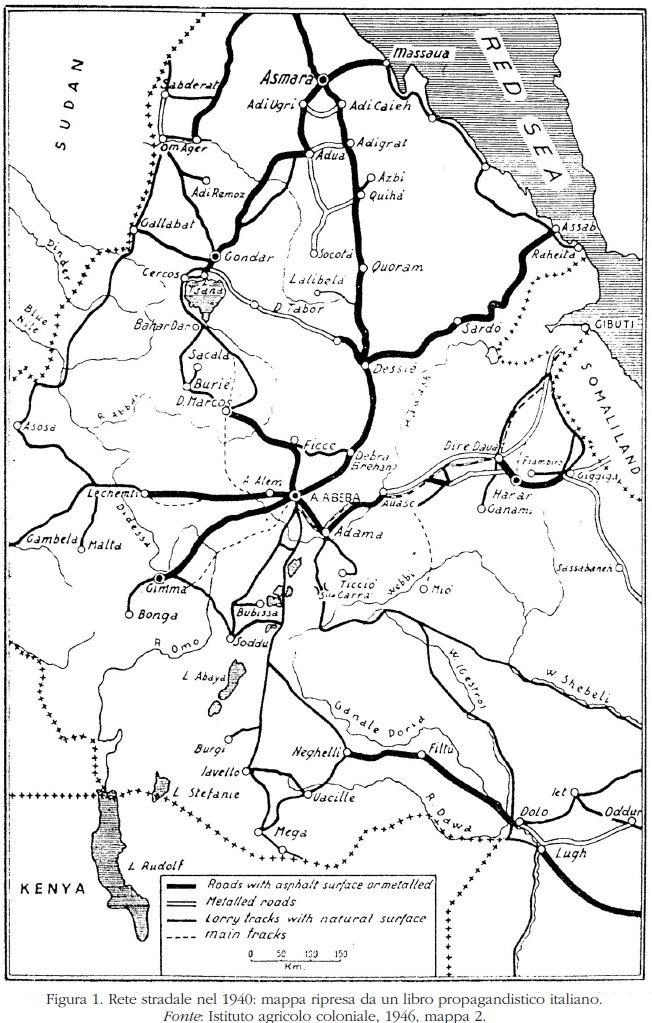
Map showing the roads created by the Italians in 1937-1940 (in dark black the fully asphalted)

The Italians invested a lot in Ethiopian infrastructure development, mainly in the capital region. They created the "imperial road" between Addis Abeba and Asmara/Massaua, the Addis Abeba - Mogadishu and the Addis Abeba - Assab. Also, the Addis Abeba-Berbera/Hargeisa was nearly completed when WW2 blocked all the road constructions.

Indeed in the few years of Italian rule in Ethiopia were done two important improvements: the complete abolishment of slavery and the road construction of a communication system in a mountainous country.

"No paved roads existed in Ethiopia before the Italian conquest of 1936. Historian Bertazzini wrote that "...At the outset of the Italian-Ethiopian war, few roads were completed and none had modern asphalt surface. Only two major -but unpaved- tracks for lorries existed in 1935, the Jimma-Addis Ababa and the Addis Ababa-Dessié'...The simple list of the projected roads gives an idea of the magnitude of the investments undertaken (by the Italians). The vast majority of the works were managed by the AASS(Azienda Autonoma Statale della Strada), a public company purposely created by the Minister of the public works. The AASS obtained an incredibly large budget from Rome: not only did the six-year development plan destine more than 7.7bn Italian Lire (out of the total 12bn!) for road construction, but the AASS even received additional 3.1bn Lire, for the financial year 1936-7. In 1939, the newly built colonial transportation network totaled roughly 4,625 km of paved roads and 4,877 km of unpaved tracks. The total development of the new roads by the end of 1940 in Ethiopia and "Africa Orientale Italiana" (AOI) was almost 6,000 km"


Furthermore, 900 km of railways were reconstructed or initiated (like the railway between Addis Abeba and Assab), dams and hydroelectric plants were built and many public and private companies were established in the underdeveloped country.

The most important -with their headquarters in Addis Abeba- were: "Compagnie per il cotone d'Etiopia" (Cotton industry); "Cementerie d'Etiopia" (Cement industry); "Compagnia etiopica mineraria" (Minerals industry); "Imprese elettriche d'Etiopia" (Electricity industry); "Compagnia etiopica degli esplosivi" (Armament industry); "Trasporti automobilistici (Citao)" (Mechanic & Transport industry).

Actual photo of the Italian-era building of the Ethiopian Electricity company, built in the early 1940s in typical modern Italian style.

Italians even enlarged and created new airports (like the "Ivo Olivetti aeroporto", that actually is called "Lideta airport" in the outskirts of Addis Abeba) and in 1936 started the worldwide famous "Linea dell'Impero", a flight connecting Addis Abeba to Rome.

Addis Ababa was incorporated into the imperial italian network of fligths, being served four times a week with the Savoia Marchetti, SM-73 airplanes: in two days (and no more in a week) Italy was connected with Ethiopia, also with a new daily postal service.


ALA LITTORIA: "Orario estivo del 1938" (Timetable of the "Linea dell'Impero")

The line was opened after the Italian conquest of Ethiopia and was followed by the first air links with the Italian colonies in Africa Orientale Italiana (Italian East Africa), which began in a pioneering way since 1934. The route was enlarged to 6,379 km and initially joined Rome with Addis Ababa via Syracuse, Benghazi, Cairo, Wadi Halfa, Khartoum, Kassala, Asmara, Dire Dawa .

There was a change of aircraft in Benghazi (or sometimes in Tripoli). The route was carried out in two and a half days of daytime flight and the frequency was four flights per week in both directions. Later from Addis Ababa there were three flights a week that continued to Mogadishu, capital of Italian Somalia.

The most important railway line in the African colonies of the Kingdom of Italy as the Djibouti-Addis Ababa. It was long 784 km and was acquired following the conquest of the Ethiopian Empire by the Italians in 1936.

The route of the railway was protected by special Italian military units since 1936 and until 1938, when the Ethiopian guerrilla finished and all the regions crossed by the trains were fully "pacified".


The railway Addis Abeba-Djibouti was officially declared safe and "pacified" from summer 1938

The route was served until 1935 by steam trains that took about 36 hours to do the total trip between the capital of Ethiopia and the port of Djibouti. Following the Italian conquest was obtained in 1938 the increase of speed for the trains with the introduction of four railcars high capacity "type 038" derived from the model Fiat ALn56 (http://www.train-franco-ethiopien.com/photos_cfe/autorails_fiat_cfe/pages/image/imagepage15.html ). These diesel trains were able to reach 70 km/h and so the time travel was cut in half to just 18 hours: they were used until the mid 1960s (http://www.train-franco-ethiopien.com/photos_cfe/autorails_fiat_cfe/pages/image/imagepage30.html). At the main stations there were some bus connections to the other cities of Italian Ethiopia not served by the railway (http://www.train-franco-ethiopien.com/photos_cfe/gare_diredawa_cfe/pages/image/imagepage15.html).

Additionally, near the Addis Ababa station was created a special unit against fire, that was the only one in all Africa (Railways map -enlarge to world map!: [https://openrailwaymap.org/?style=standard&lat=45.37626702418105&lon=6.249847412109375&zoom=9 ]).

ARCHITECTURE

Cinemas & Theaters


The first Italian cinema in Addis Abeba was the "Romano", opened in October 1936 , followed by the "Marconi" in via Tripoli. The "Cinque Maggio" and the "Italia" cine-theater of the 'House of the Fascist Hospitality' were inaugurated both in 1937.

The "Italia" was a super cinema with 1200 seats. It was used also as a theater and for opera activities.

The "Impero" in via Massaia and the "Roma" were built later, just before WW2 started.


Late 1939 photo of the cinema "Impero"

In 1939, the new "Marconi" cinema-theater was designed by Ippolito Battaglia.

The cinema showed the same morphology of the elements used in the project of the building for the government offices (prepared in the same years by architect Plinio Marconi for the monumental area of the city).

Hospitals

In Addis Ababa, at the time of taking possession of the city, were recovered and restructured by the Italian government some of the existing health facilities: the Ospedale Italiano/Italian Hospital "Principessa di Piemonte" (built by the "Italica Gens" - A.N.M.I.), the Hospital "Duca degli Abruzzi" (only for Italians) and the Hospital "Vittorio Emanuele III" (only for indigenous Ethiopians).

The Italian hospital, showed a "classicism" shape with clad in light yellow trachyte stone and decorated by red brick; it was built from 1931 to 1934 on a project by engineer Piero Molli from Turin and it was among the first three-story buildings of the city, built with reinforced concrete frames. The engineer of the works was Mario Bayon, while the structural calculations were performed by the engineer Giberti. In October 1939, an additional expansion was studied.

INSTITUTIONS

Schools

*Scuola elementare mista Vittorio Emanuele III of Addis Abéba.
*Ginnasio-Liceo Vittorio Emanuele III
*Istituto tecnico Benito Mussolini
*Missione della consolata (asilo d infanzia e scuola elementare parificata mista).
*Scuola parificata mista del Littorio. Missione delle suore canossiane (scuola parificata, a Cabanà). Missione San Vincenzo da Paola (scuola governativa per tracomatosi).
*Missione della Consolata (scuola parificata, brefotrofio per bambine, orfanotrofio).
*Missione della Consolata (college for the sons of Ethiopian authorities, under the "Direzione superiore affari politici").
*School for muslims
Photo of Italian colonists in a 1939 folklorist meeting in the Addis Abeba outskirts, celebrating with Italian regional dances

Viceroy Amedeo D'Aosta planned to bring 20,000 Italian colonists in 1942 to live in the Scioa region, imitating what was done in Libya with the 20,000 colonists who successfully settled there in 1938. Mussolini by 1956 (in order to commemorate twenty years of the Italian empire existence) wanted to move half a million Italians to live in the Ethiopian Highlands, but WW2 blocked all these projects

Associations

* Sopraintendenza scolastica. *Casa del fascio. *Istituto di cultura fascista. Opera nazionale dopolavoro.
*Gioventù italiana del littorio.
*Fascist university group. The Gioventu Universitaria Fascista (GUF) of Addis Ababa, made up of volunteers from the Ethiopian war and directed by Fabio Roversi Monaco, played an important role in the promotion of cultural activities in the empire. The preparation of prelates and assistance to graduates for enrollment in Italian faculties were also fundamental. In 1939 the GUF asked the government to evaluate the possible creation of a university of the empire or, at least, to allow the exams to take place directly in Addis Abeba.
*Ufficio stampa e propaganda AOI.
*Casa dei giornalisti.
*Ufficio superiore cartografico.
*Museo dell impero.
*Opera nazionale combattenti.
*Regio automobile club d Italia.
*Consociazione turistica italiana; Compagnia italiana turismo cinema, teatri, radio.
* Istituto luce Impero Italiano
*Cinema teatro Italia (Casa dell ospitalità fascista)
*Cinema Impero
*Cinema Romano
*Cinema Cinque maggio (for native ethiopians)
* Stazione radiofonica Eiar (with auditorium) of the Istituto Luce (Ethiopia).

Newspapers and magazines

*«Corriere dell Impero» newspaper (called "Quotidiano di Addis Abeba" from March 1938 until February 1938 as journal of the "Federazione dei fasci di combattimento"; from May to December 1936 called «Il Giornale di Addis Abeba»)
*«Il Lunedì dell Impero» (magazine of the «Corriere dell Impero»)
*«Marciare» («Magazine of "Goliardia fascista dell Impero". Giornale mensile di avanguardia del Guf»)
*«Ye Chessar Menghist Melchtegnà» («Corriere dell Impero» in Ethiopian language). Weekly magazine published by the «Barid al-imbiraturiyyah»
*«Il messaggero dell Impero»; weekly newspaper in arab language published by the " Ufficio stampa e propaganda"; from March to December1938 «Kuriri di Imbiru»( inside the «Corriere dell Impero])
*«Ye Roma Berhan» («Luce di Roma»).Monthly magazine in Aramaic language.
*«Addis Abeba» (monthly magazine of the Addis Abeba city hall)
*«Etiopia Latina» (monthly magazine)
*«L Impero illustrato» (weekly magazine); «Notiziario mensile della MVSN nell AOI»; «L Impero del Lavoro» (magazine of the "Ispettorato fascista del lavoro")
*«Rassegna sanitaria dell AOI» (weekly magazine published by the "Società di medicina dell impero")
*«La Consolata in AOI» (monthly magazine of the "Missione della Consolata editori"
*Tipografia del Governo; Generale Stamperia del Littorio
*Tipografia della missione della Consolata
*Bulletins/Journals: Giornale ufficiale del governo Generale dell Africa Orientale Italiana e Bollettino ufficiale del Governo dello Scioa» (weekly); «Foglio d ordini e di comunicazioni del Governo Generale dell Africa Orientale Italiana» (monthly) ; «Foglio d ordini dello Stato Maggiore del Governo Generale dell Africa Orientale Italiana» (monthly) ; «Foglio d ordini e di comunicazioni del Governo dello Scioa» (monthly) ; «Bollettino dell Ufficio dell Economia Corporativa dello Scioa» (monthly); «Bollettino dell Economia Corporativa dello Scioa» (monthly) «Scioa» (monthly published by the "Ufficio della produzione e del lavoro"); «Bollettino di idrobiologia, caccia e pesca dell Africa Orientale Italiana» (news from the "Servizio di idrobiologia e pesca e della Sovrintendenza alla caccia"

LINKS

* PHOTOS of Italian Addis Abeba: http://senato.archivioluce.it/senato-luce/ricerca/libera/esito.html?query=addis+abeba Photos of Italian Addis Abeba
* VIDEOS of "ISTITUTO LUCE" related to Addis Abeba:https://patrimonio.archivioluce.com/luce-web/search
/result.html?luoghi=%22Addis%20Abeba%22&activeFilter=luoghi

Friday, February 3, 2023

DAY OF REMEMBRANCE (FEBRUARY TEN)

February 10: National Memorial Day of the Exiles and Foibe

In a few days more is going to be the "National Memorial Day of the Exiles and Foibe" , called GIORNO DEL RICORDO in italian or "Day of Remembrance" in english.

We all know that at the end of WW2 there has been an ethnic cleansing of the authocthonous italian population in Dalmatia and a tentative to do the same in Istria and Venezia Giula. Historian Guido Rumici wrote that more than 11000 Italians in those years were killed in the "Foibe" (please read: Guido Rumici, "Infoibati (1943-1945). I Nomi, I Luoghi, I Testimoni, I Documenti". Mursia, 2002. ISBN 978-88-425-2999-6), while some thousands were killed in different ways and more than 350000 were forced to exile. In a few words: nearly 400000 italians suffered the "ethnic cleansing" of Tito, the Yugoslavia's communist dictator!

As happened in other "cleansing" in History -like in Armenia- those who shamefully did this uncivilised act usually deny it. That is why I am adding to my february essay the translation in english of an italian book, related to the evidences and proof about the yugoslavian ethnic cleansing of Italians in the eastern Adriatic coast.

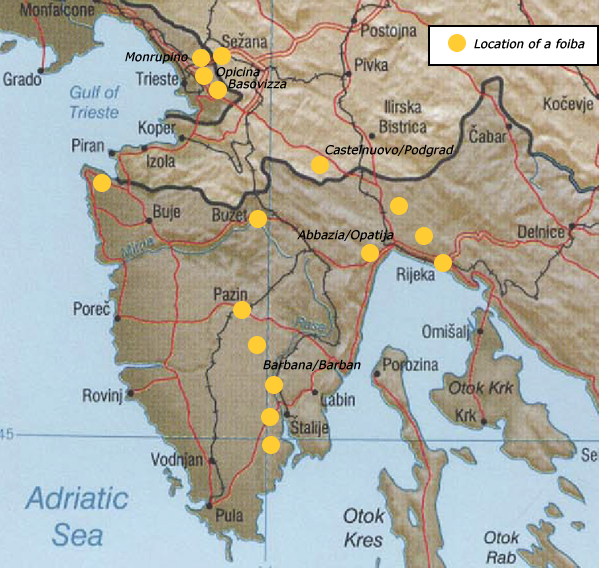
Map showing the most famous "Foibe" in Istria and surroundings

The following excerpts from a book published in 2019 by the "Nova Rivista Storica" of the editrice Dante Alighieri deal with post-war population movements, expulsion, and ethnic massacres affecting Yugoslavia, during the years 1943-1947, with a focus on the Italian Eastern Border.

The author Eugenio Di Rienzo argued that Yugoslav political and military leaders considered the aftermath of the Second World War, in their neighbourhood, a convenient window of opportunity for "adjusting" the ethnic structure in specific regions according to their ideological visions and nationalistic ideals. Such an “ethnic cleansing” combined with Bolshevik social engineering occurred in Istria-Venezia Giulia, Dalmatia and partially also in the city of Trieste.

QUANDO LA STORIA DIVENTA SMEMORATA ("When History forgets"), of E. Di Rienzo

Indeed, there was no doubt that on the eastern coasts of the ancient «Venetian sea» there was a planned depopulation action (compulsory, forced and forced exodus/physical elimination) aimed at the Italian-speaking populations, for two reasons:

1 ) The killing of our (Italian) compatriots was not only a form of political struggle because it was not limited to the fascist militiamen and soldiers of the Royal Army, who had participated in counter-guerrilla actions and forced de-Slavization programs, but concerned the Italian population as a whole and even militants of the Liberation Committee who had fought shoulder to shoulder with the IX Korpus of Tito's Yugoslavia. On the Slavic-communist side, an attempt was made to dominate and subordinate the Italian units to its own directives and, in case of failure, it passed, as in the case of the "Osoppo-Friuli Brigade" (composed of volunteers of secular, liberal, Catholic, monarchist inspiration) to the ferocious and treasonous violence against them. Even the communist partisans, naturally more inclined to comply with the Tito directives, were put in a position not to offer resistance to the violent and sudden progress of the "Slawisierung" (slavisation) carried out with the arms policy. Most of them were forced by the Slavic commands to operate far from Italian territory in order to weaken the military presence of our compatriots in Venezia Giulia, on the Dalmatian coast and in Trieste in particular.

2) Those massacres were not even only the result of a war of class unleashed by the Slavic peasant masses against the elites Italians from the coast, because the "infoibati" were Italians of every social stratum, without distinction of wealth, class, affiliation or political conviction (except for the militants of democratic anti-fascism), age or sex. As we read, in fact, in the mournful diary of the Tito occupation of Trieste (1 May - 12 June 1945), written by Pier Antonio Quarantotti Gambini, one of the most important figures of Italian and Trieste culture of the twentieth century:
"It is almost impossible to know if an arrested person is still here in Trieste, or if he hasn't already been led away towards a foiba, his hands tied with wire behind his back, in those columns of deported or dying people who cross the city every night. What is surprising is that there is no news of any capture of large exponents of Nazi-fascism or of policemen. Only continuous arrests and mysterious disappearances of petite people, and moreover obscure: young dilettantes, enlisted in the Civic Guard to escape the calls of the German republics and who took up arms against the Nazis alongside the Volunteers in the insurrection; Finance policemen, Carabinieri, commoners who have disputed with the citizens of Tito these days, or who had long since been noted for their national sentiments, Italians from the old provinces of the humblest classes, boys stopped in some group on the street, and also women and girls. To vanish into thin air it is enough to be Italian. Having been Fascists or Republicans has nothing to do with all these arrests; on the contrary, it would seem that the Titos have almost a preference in targeting those who have never given proof of fascism and even above all those who have been anti-fascists. And, to those who point out to them how they have already persecuted and even killed many anti-fascists in 1943, and are now doing the same, they respond with the formula that they have created for these cases, because Tito's movement, even more than Mussolini's and of Hitler, always moves within the tracks of some formulas, which most of the time are nothing more than sentences. But, for every situation, for every case, for every circumstance his sentence is ready. And then, they say “we must hit the fascists even without a card and without a badge"
.

It is noteworthy to pinpoint that in the Balkan appendix of the "socialist paradise" the ethnic reclamation -perpetrated with military hands- was current practice from 1945 to 1948 and beyond. Indeed until 1950, about 57,000 ethnic Germans in Yugoslavia territories fell to the blows of Slavic-Bolshevik violence and a much higher number of German prisoners of war died by lynching, summary executions, "infoibamenti", or died of starvation in the so-called "expiation marches", organized by the Yugoslav Communists, which stretched for about 1,300 km, from the southern border of Austria to the northern border of Greece. Even more numerous were, then, those reduced to the condition of "worker-slaves" by the armed forces of Tito and by their willing collaborators who did not wear any uniform.

And this enormous number of deaths must not be forgotten in order to understand the meaning of what happened on the Italian Adriatic coast between 1943 and 1947. An event that cannot be described except with the term "democide" (created by Rudolph Rummel), i.e. mass murder planned by part of a government against the members of an ethnic community to which it was decided to deny not only the right of citizenship but also that of existence.


Photo of Norma Cossetto, an istrian girl killed in a Foiba in 1943 only because she was italian. After the Second World War, Norma Cossetto's death has been considered emblematic of Foibe massacres and ethnic cleansings of Italians by Yugoslavs in Istria. In 1949, the University of Padova conferred to her the laurea "honorary" and in 2005 the Italian President Ciampi awarded her the "Medaglia d'oro al merito civile".

In order to close (with complete information) this february essay, allow me to pinpoint the full statistics of this "democide": Rummel calculated that -in addition to 24,000 italian deaths because of foibe, lynching, hanging, drowning, summary executions by firing squads, etc...- between May 1945 and the end of 1947, more than 190,000 Italians crossed the border. There were also 160,000 people, including ex-partisans and anti-fascists, who left after Stalin’s break with Tito (1948-49) or as a result of the "Trieste crisis" in 1954.

Finally, we must remember that in the territories of former Yugoslavia now (2023) there are only about 40,000 Italians (nearly all in north-west Istria and in Fiume-actual Rijeka). This fact means that in the territories lost to Jugoslavia by Italy because of defeat in WW2 and that had more than 430,000 italian inhabitants in 1945, only 8% of them remain: a nearly perfect ethnic cleansing!

And in Dalmatia this democide is complete: for example, in Zara (actual Zadar) there are only a dozen italians, while the city in 1940 was fully italian and with 21,372 inhabitants!

Sunday, January 1, 2023

THE AROMANIANS OF GREECE

The neolatin Aromanians of northern Greece

The Aromanians (called often "Vlachs" in the Balkans) speak a language that evolved from Latin. Latin was transmitted by Romans to many peoples and was used as an international language for centuries. Most Vlach populations live in and around the borders of modern Greece.

The word „Vlachs‟ appears in the Byzantine documents at about the 10th century, but few details are connected with it and it is unclear what it means for various authors. It has been variously hypothesized that Vlachs are descendants of Roman soldiers, Thracians, diaspora Romanians, or Latinized Greeks. However, the ethnic makeup of the empires that ruled the Balkans and the use of the language as a lingua franca suggest that the Vlachs probably do not have one single origin. DNA studies might clarify relationships, but these have not yet been done.

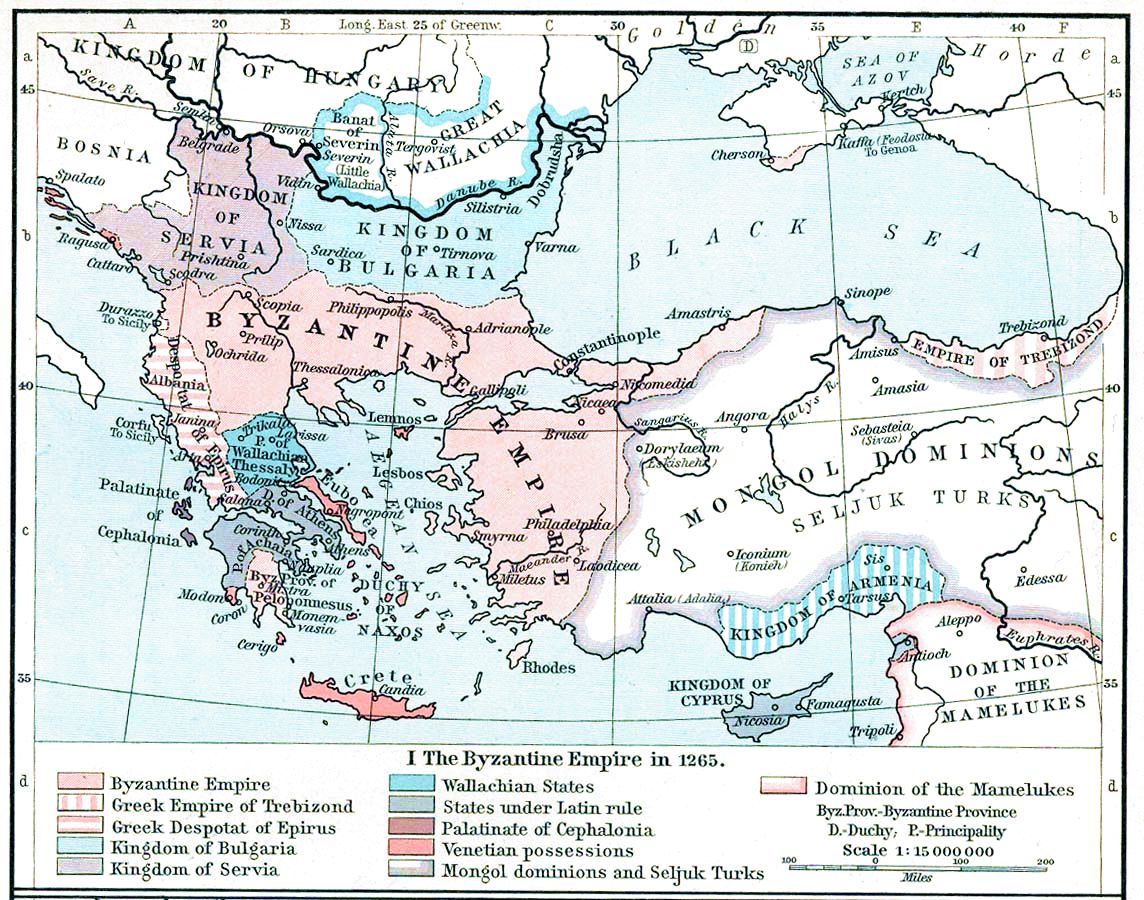
After the year 1000 AD the Vlachs grew in importance in the Greek area: The Aromanians had control of most of actual Thessaly (called "Great Vlachia" during the Middle Ages) in the XIII, XIV and early XV centuries.
Map of 1265 "Great Vlachia" (in dark blue): this was a province and region in southeastern Thessaly used to denote the entire region of Thessaly in the 13th, 14th and early 15th centuries

The chronicles of Nicetas Choniates, Benjamin of Tudela, Geoffroy de Villehardouin, Henri de Valenciennes, Robert de Clary, and other sources account for the existence of this state, comprising Thessaly, as opposed to other two "Wallachias", "Little Wallachia" in Acarnania and Aetolia, and an "Upper Wallachia" in Epirus. But actually the Aromanians have been nearly fully assimilated in these regions of Greece. However they actually remain in relatively huge numbers in the Pindus region, in villages located on the mountains just south of Albania.

In the 19th century Vlach was spoken by shepherds in Albania who had practically no relationship with Hellenism as well as by urban Macedonians who had Greek education dating back to at least the 17th century and who considered themselves Greek. The latter gave rise to many politicians, literary figures, and national benefactors in Greece. Because of the language, various religious and political special interests tried to attract the Vlachs in the 19th and early 20th centuries. At the same time, the Greek church and government were hostile to their language. The disputes of the era culminated in emigrations, alienation of thousands of people, and near-disappearance of the language. Nevertheless, due to assimilation and marriages with Greek speakers, a significant segment of the Greek population (may be a third) in Macedonia and elsewhere nearby descends from Vlachs

Traditionally, Aromanians lived in the southern Balkans. Areas with considerable Vlach population exist in central and southern Albania (e.g. the destroyed Moschopolis) and the area that was earlier called Pelagonia and is now in FYROM, with cities such as Krusovo and Monastir (Vitolia).

However, most Vlach habitations appear to be in Greece. The mountain villages form a line that goes from Rome (Italy) to Istanbul (Turkey). At the sides of Pindus, from Grammosta to Pertouli there are about 80 mountain villages, despite the extensive demographic changes of the 20th century. Traditional groups in the plains still exist from Xanthi to Corfu and from the mouth of the river Acheloos to the mouth of Sperchios and also in Evoia.

At the end of the 19th century, there were about 150,000 Aromanians in the southern Balkans, and about half the Greek population of Thessaloniki in fact consisted of Vlachs. After 1912-13 about 100,000 (2/3 of them) became Greek citizens. Since then, they have been much reduced due to emigration and assimilation. The 1951 census,the last time that minorities were counted in Greece, recorded 39,385 Vlachs. Around 2003, there may be 20,000 people in Greece who consider themselves Vlach. Now (in 2023) for greek authorities they are the same amount more or less.

However, these estimates are difficult due to a lack of census information and political bias: it is noteworthy to remember that there are some estimates of as high as 600 000 Aromanians now living in Greece (like the one of Thede Kahl). If one takes into account all potential speakers who consider themselves belonging to the Vlach/Aromanian nation, we should perhaps speak of a maximum of 300 000 Aromanians in Greece and a number of fluent Aromanian speakers as around 100 000.

Historically Weigand (in 1895) concluded that there were about 100,000 in Greece and another 500.000 in the Balkans, and Winnifrith (in 2002) agrees with a larger number (that approached the million in all the Balkans until up to Italy and Chekoslovakia). The Romanian propaganda mentioned 1,200,000. Indeed after the union of northern Greece, of the approximately 160,000 Macedonian Vlachs, 102,000 ended up in Greece, 30,000 in FYROM, 13,500 in Albania and about 10,000 in Bulgaria, Kosovo, Serbia, and Bosnia (Koukoudis, 2000, vol. 3, p. 40).

Furthermore, much has been written about the educated urban elites of Moschopolis and Pelagonia, who were often Vlach traders traveling as far as Hungary, Romania and India. At least as far back as the 17th century, urban Vlachs cultivated the Greek language and literature during the darkest periods of the Ottoman empire with translations and printing presses. Records show that they considered themselves Greek, usually had Greek names, and several became greek-national benefactors. Evidence includes 24 letters of Moschopolis merchants, the printing press of Moschopolis and the records of commercial fraternities of Transylvania.

Examples of Aromanians who were Greek scholars are Rigas Velestinlis (Feraios) and Konstantinos Mertzios. The latter was a rich merchant of the 18th century, who discovered and rescued the Greek archive of Venice and later became a Greek Academy member. The archive of the Greek high school in Monastir during the 19th and 20th century shows that almost all the students and teachers were Vlachs, often from poor families.

Several people maintained the Greek conscience in modern FYROM, despite the passage of 90 years since Pelagonia became Serbian. These families maintained a simultaneous use of Greek and Vlach languages for centuries.

Indeed in Greece the Aromanians had a huge influence in the society.

Historically the members of this „minority‟ have acted as the backbone of Hellenism: fighters against Ottoman occupation, like Rigas Feraios, Giorgakis Olympios, and possibly Theodoros Kolokotronis; leaders of leftist resistance against the Germans (EAM), such as Alexandros Svolos and Andreas Tzimas. Distinguished writers like Kostas Krystallis and Christos Zalokostas were Vlach, as were contemporary composers like Apostolos Kaldaras, Kostas Virvos, Babis Bakalis, and Mitropanos. Many became rich Balkan merchants during the 18th and 19th centuries and many Greek national benefactors were Aromanias, such as Nikolaos Stournaris, Georgios Arsakis, Michael and Georgios Tositsas, Georgios Sinas. Simon Sinas financed the construction of the Academy of Athens, while Georgios Averoff contributed to the first Olympic games.

There was at least one Vlach prime minister, Ioannis Kolettis (1773-1847), ministers (like Evangelos Averoff), and countless senators. Without the majority realizing it, the government of Greece was many times under the control of this „minority‟.

The Aromanian Ioannis Kolettis (centre), then ambassador of Greece to France, in Paris in 1842 (he -born in a village of Pindus mountains- was Prime Minister of Greece twice: in 1834-1835 and in 1844-1847)

Aromanian history in Greece during the last two centuries

The emergence of a consciousness which can be characterised as "national" probably did not occur among the Aromanians before the beginning of national movements of the peoples of Southeastern Europe at the beginning of the 19th century. In the Byzantine and Ottoman period, orthodox Christians defined themselves, regardless of language and culture, as Romans: in Greek Romaioi, later Romioi, in Latin Romani, later Români and Armâńi.

Before Aromanians began to develop their own consciousness or to orient themselves in respect to other peoples and their national movements, the most important aspect of self-identification was mainly as belonging to an Ottoman millet (orthodox Christians) and secondarily to a professional group (shepherds, craftsmen, merchants etc.). Due to traditional work as nomadic herders and due to persecution (especially by Turkish-Albanian troops), Aromanians were dispersed all over the Balkans. When at the beginning of the 19th century an Aromanian movement could be observed especially in the Aromanian diaspora in Buda and Vienna, large numbers of Aromanians were already assimilated into the societies of many regions or were in the state of being assimilated.

Thus we have to distinguish between the "national Aromanian movement" as such on the one hand, and their participation in other national movements on the other hand. Most common streams of national orientation among Aromanians were (and are) pro-Greek and pro-Romanian. The Greek-Romanian conflict on the so called "Aromanian question" split the Aromanians into different factions, i.e. those who consider themselves as being Romanian, those who consider themselves as being Greek and those who consider themselves as being Aromanian.

Since the Aromanians belonged to the Greek Patriarchate and their cultural and economic activities were bound to the Greek church, especially the wealthy urbanised Aromanians have been active promoters of the Greek language and Greek culture for a long time in the former centuries before the French Revolution.. Greek was already in the 17th and 18th century a lingua franca in large parts of Southeastern Europe.

The knowledge of Greek was the key to education and to a higher social status and in this process it did not play any role if Greek was spoken as a mother or as a foreign language. The first written documents in Aromanian were written with the Greek alphabet and did not have the intention to teach Aromanian, but to spread the Greek language. The success of the Greek language among the Aromanians was not only caused by a few individuals promoting Greek culture, but mostly by increasing contacts with Greek neighbours and the Greek language as the most important commercial language.

A lot of settlements in central Greece became hellenised without the influence of political or church activists in the early XIX century. The development of a specifically Aromanian identity can be observed in the early Aromanian diaspora. Especially Aromanian grammars and language booklets document a clear consciousness of latinity/romanity; in 1815 the Aromanians of Buda and Pest asked to have their language used for orthodox liturgy. Peyfuss emphasises that "this Aromanian movement cannot be reduced to activity of Romanian propaganda in Turkey", but has characteristics of a "typical national movement for the 19th century".

In the 1860s, soon after the establishment of independent Romania, the Romanian national movement and its extensive educational policy in Macedonia, Thessaly and Epirus began to influence Aromanian activities. Since then, Aromanian activities were automatically bound to Romania.

The recognition of the "Ullah millet" (meaning: a "Vlach province" in the Ottoman empire) the influence of different national movements, especially those of Greece and Romania, and the influence of foreign powers in the southern Balkans (like France and Italy) , led to further division and clashes. The Greek-Romanian conflict achieved its climax in the last and most violent phases (please read https://researchomnia.blogspot.com/2019/09/the-aromanian-national-rebirth.html) of the Macedonian Struggle (1903-1908), when most Aromanian groups fought on the pro-patriarchate side, while others took sides with the pro-Bulgarian exarchists. Confrontation between differently oriented Aromanians led to bloodshed. The increased tension between the different groups in 1906 led to the breaking-off of diplomatic relations between Romania and Greece.

Since then, the "Ullah millet" has been called a "Romanian minority" and the Aromanians were no longer divided into pro-Greeks and pro-Romanians, but into Greeks (Neo-Hellenes) and Romanians.

.......A different orientation began in 1917, when Italian troops advanced via Albania into Epirus and founded, with the help of Alkiviadis Diamantis, the "Principate of Pindos" in the area of Aromanian settlement. Italy undertook attempts to convert the pro-Romanian Aromanians into pro-Italian, which succeeded to a small degree. In the summer of 1917, when the Italian troops suddenly extended their occupation from Albanian territory to Epirus , the infamous adventurer Alcibiades Diamantis, a Romanian teacher and sometimes an agent of Italian and sometimes Romanian propaganda, first appeared in the Wallachian villages. The idea he was promoting at the time in collaboration with the Italian authorities and a core of Romanian Vlachs centered on Vovousa, was to make the areas where the ethnically diverse Kutsovlachs ("Aromanians") lived autonomous in a canton under the auspices of Italy. Italy, then fishing in murky anti-Hellenic waters, helped Diamantis play his game - supplying food to the would-be liberators of Kutsovlachs, appointing consuls to many Kutsovlach villages, strengthening rumors that Italy and Romania wanted to cooperate in the Balkans with a Latin Italo-Romanian state. The result was, in the fall of 1918, a group of Vlachs from Pindos proclaimed in Kortsa the Republic of Pindos, which lived for one day! The group of Romanians even resisted armed the Greek military detachment that had gone to Vovousa to take over the village from the withdrawing Italians.Divani Lena ((https://vlahoi.net/istories-gegonota/to-thnisigenes-prigkipato-tis-pindou )


Similar attempts were undertaken during the Second World War, when the Aromanian members of the "Roman Legion" fought on the side of the Italian troops. On the other hand, a large number of Aromanian villages were destroyed by German & Axis troops in 1943-1944. Indeed in May 1941, Diamantis demanded a Vlach state with the support of the Italians and suggested putting the Romanian schools under Italian authority. During the terrible greek famine of the winter 1941-1942 the area ruled by the Roman legion was practically not affected, mainly because of huge italian help (please readhttps://researchomnia.blogspot.com/2021/09/vlachs-during-italian-occupation-of.html).

With the sympathy for the Italians grew the number of philocatholics among the Aromanians, but the traditional identification with the Orthodox Church kept the majority of the Aromanians closer to modern Hellenism.

On 25 September 1941, Alcibiades Diamandi sent a memorandum to the first collaborationist Greece's Prime Minister (Georgios Tsolakoglou), as a representative of the Vlachs of Pindus and of the South Balkan Vlachs. The memorandum of Diamandi initially contained few requirements: a) The appointment of prefects, mayors and local leaders, would be done by him. b) The dismissal of permanent employees and the transfer of those who are not in favor of that movement. c) To compensate the injured individuals during the Italian-Greek war and Vlachs who had offered animals, fur and other items for the care of the soldiers. d) To punish those who during the Greek-Italian war had transfered Aromanians with anti-"greek national" behavior.

In autumn 1941, the Prince of Pindus Diamandi moved to Larissa and -with the support of Italians who controlled that territory- founded the "Roman Legions Army". The commandant of those Vlach troops was appointed Nikolaos Matusi who was born in Samaria and lived in Larissa.

The number of Vlachs who wore the uniform of the Roman Legion was about 2000 (please read for more information: https://researchomnia.blogspot.com/2021/09/vlachs-during-italian-occupation-of.html).

Map showing the territorial requests, at the 1919 Peace Conderence of Paris, for the creation of an Aromanian state in the Pindus region of northern Greece. This territory was approximately the same of the Diamandi's "Principate of Pindus" during WW2
After WW2 the remaining Aromanians of Greece started to be fully "assimilated". In the 1960s and 1970s ntimidation and repression of Aromanians by local Greek politicians, teachers, priests as well as the nationalist press in the period between the civil war and the military dictatorship has led to a tabooing of minority topics in Greece.

In Greece there is no newspaper using the Aromanian language. Contemporary Aromanian periodicals can be divided into those few (5% of the total) that deal with Aromanian topics and occasionally print texts written in Aromanian and all those local newspapers (95% of the total) that hardly write about Aromanian subjects and are only published in Greek language.

Finally, we have to remember that in 2023 the survival of the Aromanians in Greece is in a very difficult situation, while in Albania and Macedonia (FYROM) it is improving (with official recognition of their neolatin language and other ethnic topics: please read https://researchomnia.blogspot.com/2018/02/aromanians-are-official-minority-in.html).

Thursday, December 1, 2022

JULIAN-DALMATIAN EXODUS & DIASPORA (1944-1954)

The following is a translation in english of some excerpts of a research done by Michele Pigliucci, about the nearly complete disappearance of the italian community in the "Venezia Giulia" and "Dalmazia" regions of Italy during the ten years after the end of World War 2. This disappearance has been defined by some historians (like Sabbatucci) with the word "ethnocide" (mainly in Dalmatia, where the italians of Dalmatia are now reduced to only a few dozens!).

The Italians of "Piemonte d'Istria" exiled in 1954 in Trieste. Photo done in 1959

"La diaspora dei giuliani e dei dalmati: una ferita ancora da sanare" (The diaspora of Julians and Dalmatians: a wound still to be healed), by Michele Pigliucci

The Julian-Dalmatian exodus refers to the mass migratory phenomenon that occurred between 1944 and 1954 which involved a substantial percentage of the inhabitants of the Italian region Venezia Giulia, a geographical region enclosed between the Julian Alps, the Isonzo river and the sea, and including the Gorizia karst , the Trieste karst and the Istrian peninsula up to the Gulf of Quarnaro.

The phenomenon largely occurred after the cessation of hostilities during the Second World War, at the end of which almost all of the Venezia Giulia region had passed under the sovereignty of the Federal Republic of Yugoslavia; it was a phenomenon that involved the majority of the Italian population of the region, who decided to abandon their homes to flee to Italy, often in a daring way, taking with them what was possible to close in a chest or pile up on a cart and often even the coffins containing the remains of their own deads.

The figures referring to the extent of the phenomenon have often been manipulated for political interests, oscillating between the three hundred and fifty thousand mentioned by Father Flaminio Rocchi and the two hundred thousand reported by the Slovenian scholar Zerjavic.

But the most reliable figure is that of the "Opera Profughi" (Opera Refugees), who took a census of 201,440 people to which the historian Raoul Pupo believes it is necessary to add the number of those who for various reasons escaped the count, thus arriving at a reliable total of just over three hundred thousand people.

This is almost all of the Italian population in the area, an exodus of dimensions indeed impressive, unprecedented in the history of Italy.

When Italy signed the armistice in september 1943, the Yugoslav partisans of the Popular Committee for the Liberation of Istria proclaimed from Pisino (actual Pazin in central Istria), with a nationalistic language, the return of Istria to the Croatian motherland, and occupied the whole region left without any political and military authority; established people's courts with which they began a ferocious liquidation of Italians (but also of some fascist Slovenians and Croatians) accused of being enemies of the people.

Several hundred people disappeared in those few months when drowned in the sea or shot on the edge of a foiba, often thrown alive and after being tortured; the victims were both military and civilians with positions during the regime, but also people completely unrelated to fascism such as Norma Cossetto, a university student who was arrested and raped by several men before being thrown alive into a foiba.

The region (after a few weeks of partizan occupation) remained under German administration up to spring of 1945, when the last Allied advance got the better of the exhausted Nazi-fascist troops: the 4th Yugoslav Army also took part in the offensive -which was ordered by Marshal Tito- to give the absolute precedence to the full occupation of Trieste. The city was reached on May 1 even earlier than Lubliana, just one day earlier than upon the arrival of New Zealand soldiers. It was the so-called «race for Trieste», which Tito knew was strategic for the purposes of the future structure geopolitics of the area.

With the withdrawal of the German troops and the definitive disbandment of the departments of the Italian Social Republic, all of Venezia Giulia was also occupied by the Yugoslavs who resumed arrests, summary trials and eliminations of those who for various reasons were denounced as enemies of the people by the many informants in the area. After forty-two days of occupation the Yugoslavs left Trieste, Gorizia and Pola while the rest of the istrian territory became de jure Yugoslav territory (with the exception of the north-western coastal area up to the Mirna river which will constitute the "Free Territory of Trieste" until 1954).

It was then when began the "exodus" of the Italian population, whose origin can be traced back to three reasons: one linked to security, one political and one national.

The flight of the Italians was above all a reaction to the liquidations and the violence implemented by the Yugoslav regime and in particular by the secret police, the OZNA. The large number of people disappeared and killed in sinkholes (called "foibe" in italian) throughout the territory greatly frightened the Italian population, so much so that historian Sabbatucci does not hesitate to speak of "ethnic cleansing" towards the Italians, convinced that there was precisely behind these liquidations the will of modify the ethnic structure of the territory by eliminating the Italians especially before the Peace Conference defined sovereignty over the area.

The political motivation, consisting in the desire not to submit to a communist regime, then played a fundamental role both in the Italians of the exodus and in the "remained" italian community (confident in the nascent regime) and both for the Italian workers who decided to cross the border in the opposite direction in order to do adherence to the ideal of socialism. Many of those workers, however, will be persecuted as "cominformists" after the break between Tito and Stalin.

Finally, it affected the choice to flee also the national identity, on which the exile memoir insists a lot, which often tells of a voluntary exile, motivated by the desire to continue living in an Italian land. The strong national sense of these populations, on which they had Irredentism and Fascism, and the millenary rivalry with the Slavs, found fertile ground and certainly contributed to this choice. In the first post-war years, together wjth the violence, the regime titino undertook a work of Slavicisation of the region similar to that of Italianization conceived by fascism: the Italian shop signs, the use of the Italian language was substantially prohibited, many Italian schools were closed and it was banned enrollment in the same to all children whose surname ended in «-ch», automatically considered Italianized Slavs.

The five exodus waves

The exodus materialized in five main waves corresponding to as many historical events:

1) A first wave followed the fierce Anglo-American bombing of Zara, whose inhabitants had already sought refuge in Italy in 1944: the abandoned city would later be occupied by Tito's partisans and the Italians would never return.
2) The second wave followed the definitive annexation of the vast majority of the Istrian region, Fiume and the Dalmatian lands in June 1945.
3) A third wave took place in the winter of 1947, when also Pola passed under Yugoslav control following the signing of the Peace Treaty: in the city there were tens of thousands of inhabitants (nearly all the "Polani") who decided to embark to reach Italy.
4) In 1948 a new wave affected the communists who had wanted to stay or who had moved to Tito Yugoslavia and who, after the Tito's expulsion from the Cominform in 1948, had ended up as enemies of the yugoslav regime because loyals to the Partito Comunista Italiano.
5) The last big wave finally occurred in October 1954, no less than nine years after the end of the war, when the London Memorandum established the passage of Trieste to Italy but handed over to Yugoslavia the coastal area from Capodistria (now called Koper) up to the river Quieto (now called Mirna).
.
The arrival of the exiles on the national territory in 1945 and 1946 was the cause of harsh political disputes: the docks of the ports of Venice and Ancona they hosted, upon the arrival of the steamers, protest demonstrations from the side of dock workers who accused the Giuliani of fascism as fugitives from a communist regime. Disembarked on land, the exiles were then sorted onto the various trains that would take them to the 120 refugee camps scattered throughout Italy to host them as best they could: during the passage of one of these trains to the Bologna station, the workers even threatened to strike if the authorities had allowed the convoy to stop to receive the comfort of the Red Cross.

The Communist Party helped to spread hostility towards the exiles even in the final destinations of the journey, favoring the identification of the Giulians with war criminals forced to flee from Venezia Giulia to escape the reaction of their victims. This distrust spread significantly in Italy, also fueled by the precarious living conditions in which the exiles found themselves in the refugee camps.

In accordance with this attitude of mistrust the historiography official has ignored for decades the extent and sometimes the very existence of this tragedy. Still in the 90s of the twentieth century the manuals only marginally reported this page of history, which survived relegated to neo-fascist political propaganda and the memoirs of exiles. The bad reception given to refugees on the docks of the ports and in the stations was the prodrome of a more general removal not only of the story of the exodus, but also of much of the history of the Italian presence in Venezia Giulia and Dalmatia.

But among the causes that had led to the collective removal of this story of Italy it is impossible to deny how contributed the "shame" (promoted mainly by the Italian communists) due to the presence of the Italian element in Venezia Giulia & Dalmatia, considered alien and of colonial origin by the Yugoslavia of Tito. This belief results completely unfounded as the Latin element in Istria and in Dalmatia is autochthonous, historically documented without solution continuity from the Roman imperial age up to national Italian unification (called "Risorgimento") to which provided an important blood contribution.

Historical evidence does not permit misunderstandings: Italy, defeated in the Second World War, had to give away as a "repair" an entire region of its metropolitan territory (Venetia Giulia, Istria and areas of coastal Dalmatia), as large as Tuscany, whose population for the most part chose the path of exile both to escape the terror of the new communist regime Yugoslavian and to preserve its national identity.

Wednesday, November 2, 2022

ROMANS IN EQUATORIAL COAST OF WEST AFRICA

Romans in the Gulf of Guinea

We know that Romans went to the north areas of subsaharan Africa from the Mediterranean coast of northern Africa, but some academics think that they probably reached also the Gulf of Guinea by sea and/or by crossing the Sahara. I am going to research this possibility.

HISTORY

When Romans conquered Carthage in the second century BC, they also obtained their huge commerce in the Atlantic coast of west Africa.

Indeed a sea-borne merchant people like the parent Phoenicians, the Carthaginians ranged far beyond the Straits of Gibraltar to trade with the Britons and with the Berbers of western Morocco. Sometime before 400 BC Hanno, a Carthaginian admiral, embarked with a fleet of sixty vessels on a famous voyage of exploration down the Atlantic coast of Africa.

He certainly reached the Gulf of Guinea and, from his report of gorillas, probably he arrived to the shores of modern Gabon, but he did not circumnavigate the continent as some have claimed. Furthermore the discovery, two centuries ago, of a cache of Carthaginian coins of the fourth century BC in the Azores—a third of the way across the Atlantic from Portugal—raises the question whether some stray Punic navigator may not even have discovered the New World.

It is noteworthy to pinpoint that the earliest recorded contact with the island of Mogador (near the coast of actual Western Sahara in southern Morocco) was by the Carthaginian navigator Hanno, who visited and established a trading post in the area in the fifth century BC. In the first century BC roman merchants settled in the island and established a small fortified settlement, which may have been the starting point for Roman merchants sailing to the Cape Verde islands and the Gulf of Guinea.

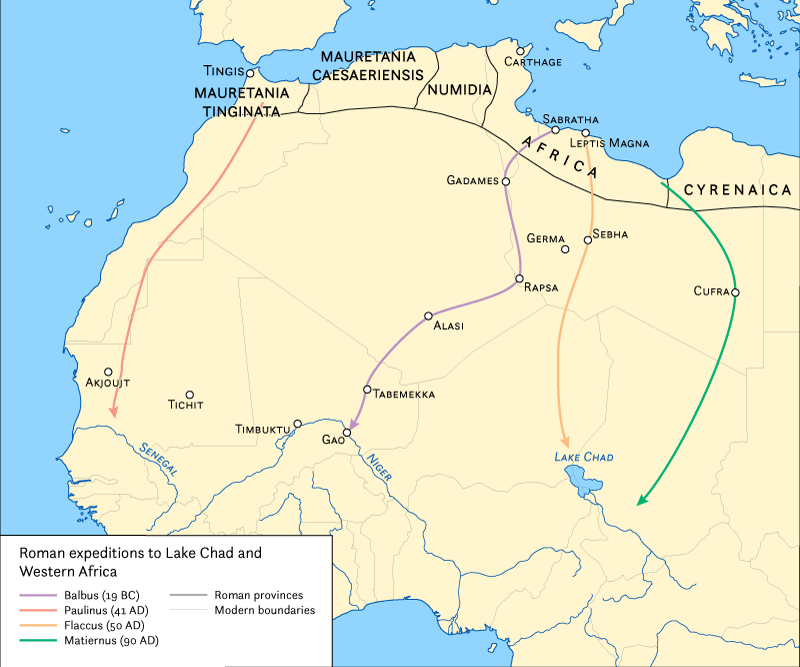
However Romans later conquered Carthago and maintained all trade done across the Sahara after the second century BC and until the fifth century AD. Indeed one roman named Iulius Maternus travelled the most south from the Mediterranean shores inside central Africa.

According to Marinus of Tyre (Ptol. 1,8,5), the roman Iulius Maternus together with the king of the Garamantes set off from Garama (near the Tibesti mountains in the south of actual Libya) to the south and, after four months and 14 days (Ptol. 1,11,5), reached the Ethiopian land of Agysimba, where they saw a great number of rhinoceros (cf. also Ptol. 1,7,2; 8,2; 6 f.; 9,8; 10,1; 11,4; 12,2; 4,8,5; 7,5,2). Maternus seems to have travelled as a trader between AD 83 and 92 AD. To our knowledge, he penetrated further than any other Roman into the African interior and probably reached the gulf of Guinea.

The landscape Agisymba embraced a vast area south of the Sahara from Lake Chad to the west to the Niger bend (and perhaps the delta) and belonged politically to the reign of the king of the Garamantes.This king had his headquarters in the city of Garama in today's Fezzan (western Libya). Agisymba is first time mentioned in the geographical work of the Alexandrian scholar Claudius Ptolemy (2nd century A. D.). An accurate localization of the landscape of Agisymba is still expected, but it is also believed in modern research to be an antecedent kingdom of Kanem. In the second half of the 1st century A D, Iulius Maternus who was probably a native of Roman North Africa, traveled from Leptis Magna to Garama.

There he joined the entourage of the king of the Garamantes and traveled further four months a southerly direction until the landscape Agisymba. There are various considerations, what role Iulius Maternus had played during this expedition: he was seen as a Roman general, as a businessman or as a diplomat. Raffael Joorde -a german historian- wrote that Maternus was a diplomat who received the unique opportunity to make the extensive territory south of the Sahara accessible for the geographers in the Roman world probably reaching the Atlantic ocean in actual Nigeria. The cause of this long journey is assumed by many researchers to be a military campaign of the king of the Garamantes against rebellious subjects.

However some historians (like Susan Raven) believe that there was even another Roman expedition to sub-saharan central Africa: the one of Valerius Festus, that could have reached the equatorial Africa thanks to the Niger river.

Indeed Pliny wrote that in 70 AD a legatus of the Legio III Augusta named Festus repeated the Balbus expedition toward the Niger river. He went to the eastern Hoggar Mountains and the entered the Air Mountains as far as the Gadoufaoua plain. Gadoufaoua (Touareg for “the place where camels fear to go”) is a site in the Tenere desert of Niger known for its extensive fossil graveyard, where remains of Sarcosuchus imperator, popularly known as SuperCroc, have been found). Festus finally arrived in the area in which Timbuktu is now located.

Some academics, such as Fage, think that he only reached the Ghat region in southern Libya, near the border with southern Algeria and Niger. However, it is possible that a few of his legionaries reached as far as the Niger river and went down to the equatorial forests navigating the river to the delta estuary in what is now southern Nigeria. Something similar may have occurred in the exploration of the Nile done under Emperor Nero in Uganda.

After the third/fourth century the roman contacts with sub-saharan Africa started to disappear, because of the final crisis in the roman empire

Maritime travels

Even maritime contacts happened in the western coast of Africa: there are some academic discussions about the possibility of further Roman travels toward Guinea and Nigeria and even the equatorial areas of the Gulf of Guinea.

XIX century map showing the Fernando Po island in the Gulf of Guinea. This island was known to the Romans as one of the "Hesperides": they knew that it was located at 40 days of navigation from the Cape Verde islands (called in roman times "Gorgades")

Indeed according to Pliny the Elder and his citation by Gaius Julius Solinus, the sea voyaging time crossing from the Gorgades (Cape Verde islands) to the islands of the Ladies of the West ("Hesperides") now known as São Tomé and Príncipe and Fernando Po was around 40 days (meaning that Romans knew the exact time needed to reach these equatorial islands -located in front of Camerun/Niger delta- and only with their direct exploration/navigation they could have know this precise time).

Furthermore, a Roman coin -in a good condition- of the emperor Trajan has been found in Congo (http://www.strangehistory.net/2015/02/10/roman-coin-congo/).

Roman coins have been also found in Nigeria and Niger; and in Guinea, Togo and Ghana too. However, it is much more likely that all these coins were introduced at a much later date than that when there was direct Roman intercourse so far down the western coast. But it is possible -even if with a possibility of a very minimal percentage of only 5%, according to researchers- that Roman merchants left there those coins doing their trade when reached the gulf of Guinea.

Finally it is important to remember that Augustus, based on the discovery of a sunken roman merchant ship from southern Hispania in the Djibouti area (in the horn of eastern Africa), wanted to organize around Africa a roman maritime expedition (to be done initially by his adoptive son Gaius Caesar when he sailed from Egypt's Berenice toward Aden).

It was going to be done -around 2 AD- from southern Egypt to Mogador and Sala (in actual Morocco). But it seems that it never took place.

Saturday, October 1, 2022

MONTENEGRO BETRAYED AFTER WW1 (& UNITED TO YUGOSLAVIA)

Only a few books have been written about how the independent kingdom of Montenegro was united to Yugoslavia after WW1 against the wish of many Montenegrins (who made the famous "Christmass Uprising" in 1919). One very well written is the one by Alberto Becherelli with the title "Montenegro Betrayed: The Yugoslav Unification and the Controversial Inter-Allied Occupation".

It is noteworthy to pinpoint that the Italian government (initially also with France) tried to stop this unification, but with no results: France at the Peace Coneference of Paris accepted the unification in 1919, while Italy choose to get an agreement with the Treaty of Rapallo in november 1920 (when Yugoslavia accepted the borders in Venezia Giulia and Dalmatia in exchange of Italy's no more intervention against the Montenegro unification)

Later in the twentieth century, the "Christmas Uprising" was subject to ideological emphasis in Montenegrin nationalism. In World War II, one of the earliest leaders of the Greens, Sekula Drljević, invited the Italian occupation of Montenegro and collaborated with Italy in order to break away from Yugoslavia with the "Italian Governorate of Montenegro"(1941-1943). With him there was also Krsto Popović, the leader of the "Christmas uprising", who organized his collaboration militia called the "Lovćen Brigade". This militia was under the control or influence of the fascist Italian occupation force (if interested, please read: https://www.academia.edu/42722637/L_occupazione_italiana_in_Montenegro_Forme_di_guerriglia_e_dinamiche_politiche_del_collaborazionismo_%C4%8Detnico_1941_1943_Qualestoria_anno_XLIII_n_2_dicembre_2015_pp_65_80?email_work_card=view-paper).

The following are some excerpts from this very interesting book:

Montenegro Betrayed: The Yugoslav Unification

A Tradition of Independence

During WWI, the Kingdom of Montenegro experienced its last troubled period of independence at the end of a process that in the 19 th century had brought the country almost continuously in a stateof war against the Ottomans with important political and military successes, despite the fact that Sultan Selim III, already in 1799, had formally recognized that Montenegrins “had never been subjects of the High Porte.”

Under the Ottoman domination, the mountains of Montenegro preserved a de facto autonomy from the authority of the sultan due to a peculiar tribal structure and on the basis of the payment of a tribute, which frequently had been unpaid. A particulartheocracy headed by the prince bishop of Cetinje – vladika elected by a local assembly– had existed from the beginning of the 16th cen-tury until 1851, when Montenegro, after the death of Petar II Petrović-Njegoš (author of a literary work that became a symbol of the Montenegrin and more generally of the South Slavic nation-building process: Gorski Vijenac [The Mountain Wreath]) also became a secular principality with a definitive separation between temporal and spiritual power.

Over the centuries, the Ottoman army repeatedly attempted to subjugate without success the Montenegrin tribes from the mountains, while the Montenegrin cities on the coast remained for a long time linked to the "Serenissima" Venazia: if Bar (Antivari) and Ulcinj were conquered by the Ottomans in 1571, Kotor and the territory of oka (since 1420), and Budva (since 1442) remained Venetian until 1797 (and after the Napoleonic period under Austria until 1918).

From this historical legacy, the widespread belief among the 18th century Montenegrin vladikas was that Montenegro, whose independence was recognized at the Congress of Berlin of 1878, had never been fully conquered by the Turks.

Still at the beginning of the 20th century Montenegro, also due to the constantly increasing influence of Russia on the country in the previous two centuries, was at the forefront in the fight against “the oppressors of the Slavic peoples,” and the first among the Balkan allies to proclaim war on Turkey in October 1912. If in 1911, before the Balkan Wars, the territory of the kingdom had less than 10,000km with a population of 284,000 inhabitants, in 1914 the country’s surface reached 15,000 km and the population rose to 470,000 inhabitants.

Since 1860, King Nikola was the seventh sovereign from the Petrović-Njegoš dynasty (founded in 1697 by Vladika Danilo IPetrović) and during his fiftieth year (1910) of reign –with half a century of territorial expansion, modernization and socio-economic progress– the principality of Montenegro was elevated to a kingdom andBar declared a free port. Moreover, since December 1905 King Nikola had introduced in the country a constitution based on the Serbian one from 1869.Relations between Montenegrins and Serbs, in the years beforeand during WWI, were controversial.

On the one hand, the Yugo-slav idea had gradually unified the two peoples and, after the parti-tion of the Sandžak of Novi Pazar, proposals for a political, customsand military union of the two countries were advanced – despite the persistent divergences between the Petrović-Njegoš and Karađor-đević dynasties, both eager to make their own kingdoms the central pillar of the Yugoslav unification. On the other hand, the tradition ofindependence of Montenegro was still strong and solidified by therecent wars, which had contributed to strengthen the brotherhood between the Yugoslav peoples, but had not helped in improving therelations between the governments of Cetinje and Belgrade.

In this sense, the Montenegrins continued to reproach the Serbian attitudetowards their aspirations over Shkodër: both the Serbian abandon-ment of the siege during the Balkan Wars and the Serbian attemptduring the retreat at the end of 1915 to assume the control of the cityeven though it had been previously occupied by the Montenegrins.

The Shkodër area was one of the main territorial objectives for the expansion of Montenegro, together with Herzegovina, the south-eastern part of Bosnia, and the Adriatic coast from the spring of the Neretva River to the Bay of Kotor (former Cattaro), including Dubrovnik (former Ragusa).
In addition to this, during WWI, the Montenegrin Army was subject to the Serbian Army General Staff; for this reason the Montenegrins accused the Serbian officers in command for being responsible for the defeat. In October 1915, indeed, the resistance of the Montenegrin army against the offensive of the Austro-Hungarians was ineffective. As aconsequence, in January 1916, the latter had conquered Mount Lovćen and then had invaded the entire country. King Nikola fled to France and Montenegro fell under the Austro-Hungarian domination until the defeat and collapse of the Dual Monarchy in 1918.

Photo of Krsto Popovic, the leader of the Christmas Uprising:
The Controversial Union with Serbia

Far from becoming an independent state again, Montenegro at the end of the war was occupied by the Serbian troops. With the Corfu Declaration of July 20, 1917, the head of the Serbian government Nikola Pašić and the leader of the Yugoslav Committee Ante Trumbić had already laid the basis of the Yugoslav union. The unification of the South Slavic territories with the Kingdom of Serbia was agreed by Pašić, some members of the Skupština, the representatives of the National Council of Zagreb and those of the Yugoslav Committee with the Geneva Convention of November 9, 1918.

With the occupation of Montenegro by the Allied troops –French, British, American and Italian– in the autumn of 1918 most of the country went under the control of the Serbian troops of Colonel Dragutin Milutinović, that presented themselves as the redeemers of the “oppressed brothers” and were actively engaged in propagating the union between Montenegro and Serbia. The unification was supported by relevant Montenegrin personalities such as Andrija Radović, head of the government in exile until January 1917. The split between Radović and King Nikola had lasted since August 1916, when the prime minister of Montenegro started supporting the union of Serbia and Montenegro through the unification of the Petrović-Njegoš and Karađorđević dynasties, firstly with the abdication of the former in favor of Alexander of Serbia, and then with a following rotation tothe throne between the two families.

Since February 1917, Radović was leading the Montenegrin Committee for the National Unifica-tion, founded in Geneva and in close contact with the Serbian governmental circles that worked to de-legitimize the sovereignty of King Nikola over Montenegro.At this point, the Montenegrin sovereign, mainly due to the marriage of his daughter Elena with the King of Italy Vittorio Emanuele III, hoped that the Italian occupation of Kotor and Bar could counterbalance the Serbian one and in some way be useful for the preservation of his dynasty on the throne of Montenegro. The Italian ambitions on the other side of the Adriatic Sea, a mix of political, strategic and economic aspirations, at least were the best guarantee for the maintenance of Montenegrin independence. At a political level, however, the Serbian Prime Minister Pašić worked to legalize the Serbian hegemony over the territory of Montenegro, preventing the return of King Nikola to the country, dissuaded also by the Italian and French governments.

At the same time, the committee led byRadović began the campaign for the election of the deputies to theGreat National Assembly in Podgorica, which would decide on the future status of Montenegro. On November 19, 1918, the Montenegrin elections held under the military pressure of the Serbian troops were done by acclamation rather than secret vote. Cetinje was the center of political propaganda: here the supporters of the unconditioned union with Serbia presented a list of candidates on a white colored paper, while their opponents, more cautious and with the aim to preserve the political integrity of Montenegro, presented a green colored list.

The two colors became the terms used to identify the two factions: the “whites”(bjelaši) were favorable to the union with Serbia, and the “greens”(zelenaši) were the supporters of independence. If the latter were pri-marily an expression of the rural society, the former had among theirranks more urban exponents: merchants, artisans, and intellectuals.

The Inter-Allied Occupation and the "Christmas Uprising"

According to the Italian military authorities in Montenegro, from the end of December 1918 there were rumors that in order to provide for the shortage of armament the Italian garrisons of Virpazar and Bar could be attacked both by pro-Serbian armed movements and Montenegrin independence supporters. This was the premise of the anti-Serb uprising that began in the surroundings of Cetinje on January 3, 1919. Jovan Simonov Plamenac and the other “green” leaders sent emissaries to the Inter-Allied command of Cattaro, led by the French General Venel, to demand the occupation of Cetinje and Montenegro by the Inter-Allied troops with the exclusion of the Serbian-Yugoslav ones.

Even in Bar the goal of the insurgents was to throwout the pro-Serbian local authorities. For Venel, however, any kind of Inter-Allied intervention against the Serbian-Yugoslav troops wasout of discussion. As in the previous days, the French general in charge did not even consult the commanders of the other Alliedcontingents. The French seemed deliberately favoring the Serbian occupation, openly supporting Radović and the “white” faction inthe area between Virpazar and Shkodër and facilitating the arrival rom Dubrovnik of a pro-Serbian Montenegrin legion trained and supported by the French.

The Italian military command in Montenegro openly denounced the pro-Serbian attitude of the French, an accusation that was considered reliable also by the American Ambassador in Rome Nelson Page, who on January 9 reported to the Commission to Negotiate Peace in Paris the text of a telegram from Kotor which stated:

........"January 6: French General is making a French-Serbian penetration into Montenegro admitting no other than Serbian authority. The intervention of his troops has a counterrevolutionary character. There are about 3,000 of which 500 were landed at Ragusa, 400 of the latter having already arrived at Cattaro [Kotor] have gone into Montenegro in French uniforms and with Serbo-French officers. Immediate help and energetic diplomatic steps indispensable since the enemy is energetically stirring up sedition.".......

Even the Montenegrin government in exile condemned how the French authorities facilitated the arrival in Montenegro of the followers of Radović, at the same time hindering the arrival of King Nikola’s supporters to whom had been denied the permission to enter the country with trivial excuses.

The Italians suspected that even the health precautions taken by the French in Kotor against typhoid cases in late December –communication between the city and the rest of Montenegro was limited with a release of a safe-conduct forleaving the country– were a pretext in order to allow to the Serbian commands to isolate the Montenegrin population. Pero Šoć denounced this attempt by the Serbian authorities to the American chargè d’affaires in France Bliss. According to Šoć only Serbian conspirators and agents had open access to Montenegro, while Montenegrin statesmen and politicians had to appeal to the Allies in order to have the permission to leave the country and reach Rome or Paris.

For this reason, the Italian general accused the French command of complicity in the subjugation of the Montenegrin population perpetrated by the Serbian authorities. Even without the support of the Inter-Allied authorities, Montenegrin insurgents under the command of Krsto Popovic (around 15,000-20,000 persons in the whole country) marched on Cetinje and other cities (Nikšić, Virpazar, Podgorica) facing Serbian-Yugoslav troops (January 6), which had a smaller number of men but were better equipped. Lacking food and ammunition, military preparation, skills and resolute leaders, around 3,500 “greens,” of which only a third were armed, were soon forced to desist from taking Cetinje, the only city where for a few days the insurgents could engage into a real battle against the Serbian-Yugoslav soldiers (400 men) and the “white” militias (300 men) under the command of the Serbian general Martinović.

Although they had the support of the population who were opposed to the violence of the “whites” and to the unconditional union of Montenegro with Serbia carried out in terms of a simple annexation, the “greens” did not prove to be as organized and cohesive as their opponents and the Serbian-Yugoslav soldiers were. The goal of the “green” armed insurrection was mainly to provoke an Allied intervention, and in particular an Italian one also if they had never explicitly affirmed it; it was not a real movement of resistance. The neutral position of the Italian troops, from which the insurgents expected a more or less direct support, diminished the hope of the “greens” for a success.

After the failed rebellion, despite the assurances given by Venel, the Serbs launched retaliation. Only in Podgorica they arrested 164 persons, including three cousins of King Nikola, eighty officers and numerous dignitaries of the court, confiscating properties.

The conflict between the “greens” and “whites,” however, did not end with the uprising of January 1919 and continued in the following years. The Italian military authorities, in the areas under their occupation, recorded incidents and violence between the “whites” and the Serbian-Yugoslav troops on the one side and Montenegrin nationalist gangs on the other. In early June, for example, the Italian High Command and the Italian Ministry of Foreign Affairs received reports about clashes in the mountainous region of the Shkodër frontier (Skadarska Krajina, Krajë for the Albanians) between the Serbian-Yugoslav troops and the Montenegrin "Komiti" headed by the well-known Savo Raspopović, on whose head the Serbian authorities placed a bounty of 20,000 dinars. Only in the evening of May 27, the assault of the bands of Raspopović caused to the Serbian-Yugoslavs several causalities. During the month, Raspopović continued his attacks in the area around Bar, a fact that brought the Serbian-Yugo-slav troops to accuse the Italians of having reached an agreement with the Montenegrin leader.

At the same time, Italian soldiers had to face frequent clashes with the Serbian-Yugoslav units and militias, which often ended in gun-fight for not entirely clear reasons.

The head of the Italian Army General Staff also insinuated that the French command in Albania and Montenegro could be responsible for many of the increasingly frequent anti-Italian demonstrations in the country. The Italian Foreign Minister Tommaso Tittoni promised to bring to the attention ofthe Allied governments the attitude of the Serbian-Yugoslavs, who claimed at all costs that Italian troops should abandon Montenegro.

The garrisons in the country, including the Italian detachments, were abandoned by the Allied troops at the end of April 1919. The Allied occupation was reduced to the coastal area (Bar, Kotor, Ulcinj and Virpazar) withthe aim of securing the supplies for Shkodër, while the inner part of the country was garrisoned exclusively by the Serbian-Yugoslav troops. The English also left Virpazar and Bar between April 27 and 30. The Italians remained in Bar (at the railways and the port), Ko\tor and Virpazar and were categorically ordered not to be meddle inthe clashes between Serbian and Montenegrin “dissident” bands.

From the summer of 1919 indeed the “greens” again took up the arms, this time with the Italian support. In April, in fact, the government in Rome with the Montenegrin government in exile signed a military convention for the formation of a Montenegrin legion in Italy. The Italian ships landed in Montenegro with new forces ready to incite the population against the Serbian authorities without reaching the desired results. The regions of Bar and Virpazar became theaters of new conflicts between Serbian-Yugoslavs, Montenegrin rebels and Italian troops.

The Yugoslav delegation at the Paris Peace Conference, indeed, once again explicitly asked for the evacuation of the Italian troops from Montenegro to definitely complete the unification of the Kingdom of Yugoslavia. In the summer of 1919, Radović (July 26-29) and then Pašić (August 14, 29 and 31) sent notes to the french Clemenceau calling for the withdrawal of the Italian troops that were accused of intentionally encouraging “the elements of disorder” in Montenegro.

Flags of the Green montenegrins while in exile in Gaeta (Italy):
Conclusions

At the end of 1919, at the Paris Peace Conference, the Yugoslav delegation –as during the summer the Italian counterpart had already done– officially denounced a series of violence that the Italian command in Montenegro committed against the Yugoslav soldiers and civilians and for which a special committee was appointed by the government of Belgrade for investigation. On the other hand, the Allies communicated to the Montenegrin government in exile that they no longer would anticipate the monthly credit hitherto paid to King Nikola (the subsidies ceased at the end of October).

In this way, King Nikola was forced to leave Paris and to reach Prince anilo, while the Montenegrin government in exile had to reduce its personnel, leaving in Neuilly sur Seine only Plamenac and other few persons. In this situation, despite the hostility of the Montenegrin population to the Serbian annexation, which, as it had already been said, did not mean an opposition to a real Yugoslav federalist union, or the Montenegrin establishment in exile it was impossible to continue to support the historical rights of Montenegro for independence.

Among other things, Plamenac tried a series of desperate and unsuccessful initiatives, such as the agreement concluded on May 12, 1920, with Gabriele D’Annunzio, who was still in Fiume with his legionaries, hoping to keep some kind of Italian support for the Montenegrin issue. At that time, in fact, the Italian government for the resolution of the Adriatic question had already abandoned the previous political radicalism and was now ready to reach an agreement with the government of Belgrade. The agreement of Plamenac and D’Annunzio, with the latter that was keeping contacts with the representatives of the Yugoslav nationalities that opposed Belgrade centralism in the Kingdom of Yugoslavia, provided for the restoration of the independence of the Montenegrin kingdom as a first step towards the liberation of the Yugoslav populations from the Serbian rule.

The Supreme Council of the Allies briefly examined only a Mon-tenegrin note sent on November 26, 1919, with which Plamenac threatened that if the Montenegrin delegate was not immediately invited to the Peace Conference for the signing of the peace treaties with Germany, Austria and Bulgaria, the Montenegrin government in exile would conclude a separate peace with these countries.

On December 1, 1919, the Supreme Council decided not to give any response to the threats of Plamenac, simply ignoring his letter. The Italian delegate De Martino agreed with the decision, but also asked if the Supreme Council before or later would take into consideration the Montenegrin issue, which still needed a solution. For Clemenceau the Montenegrin issue did not exist, the problem –he replied to De Martino– was more over different: For how long did the Italian government still have the intention to pursue this matter? Clemenceau, without explicitly stating it, was reaffirming that for the Allies the Montenegrin issue had been resolved long time ago with the proclamation of the Kingdom of Yugoslavia.

he Montenegrin issue, from the diplomatic point of view, was officially over at the end of 1920, when also the appeals of the Montenegrin government in exile to the League of Nations did not find an answer (November 1920).

Italy, which had been the main supporter of the Montenegrin cause in order to defend its interests on the other coast of the Adriatic Sea against the Yugoslav aspirations, finally interrupted the political and military support to the Montenegrin refugees preferring an agreement with the Kingdom of Yugoslavia for the definition of the border dispute and other controversial issues. The signing of the Treaty of Rapallo, in November 1920, meant the definitive end of the Montenegrin issue and the legitimacy of the Yugoslav state for the country that had opposed the most its recognition in the international context.

After the apparent settlement of the Adriatic issue and of the Italian-Yugoslav relations, also France took the moment to resolve itsrelations with the Montenegrin king (on December 20, 1920).

Even for Great Britain, which still during the summer of 1920 had refused to recognize the annexation of Montenegro as a fait accompli – Vesnić, head of the government in Belgrade, was insisting on this argument for the formal recognition of the union of Montenegro with the Kingdom SHS– the opportunity for the Montenegrin people to send “freely elected representatives to the Yugoslav Constituent Assembly” represented the best recognition of the legitimacy of the unification.

All this facts were followed by the interruption of diplomatic relations between the Montenegrin government in exile –that in the meantime was moved to Rome– and the United States and Great Britain respectively on January 21 and March 17, 1921: it was substantially the conclusion of the vain struggle for the independence of Montenegro against the unconditional union with Serbia and the final acceptance of its incorporation into the Kingdom of Yugoslavia.

Further readings

1-Montenegro italiano (1941-1943): https://www.academia.edu/6469238/le_nuove_province
2-Occupazione italiana dell'Adriatico dalmato nel 1918: https://www.eastjournal.net/archives/126261