Wednesday, July 3, 2019

136TH ARMOURED DIVISION "GIOVANI FASCISTI" IN MARETH BATTLE (TUNISIA)

Because British propaganda has often "forgotten" to remember the fighting sacrifice of many Italian troops during WW2, I am adding to my "Researchomnia" (that in the last years has been seen approximately one hundred thousand times by readers, mainly from the USA, Russia, Italy and Ukraine: pageviews ) a related translation from Italian of an interesting article (written by B.D.). The essay is about what did a division of young Italians -during the early months of 1943- at the Battle of Mareth in Tunisia.

Indeed one of the fiercest battles done by the Italians in North Africa was the one of the Mareth in southern Tunisia in March 1943. In the Mareth Line the 5,000 soldiers of the "136th Armoured Division Giovani Fascisti" fought bravely alongside the remaining Axis troops. The Division was nearly totally destroyed in 1943, during all the fighting in Tunisia. Even though decimated, the "Giovani Fascisti" was the last Axis military unit to surrender to the Allies in North Africa on May 13, 1943.

"Giovani Fascisti" in the battle

The following are related excerpts, translated from Benito Mussolini's so-called "Memoirs", originally written as a series of anonymous articles in the pages of newspaper "Corriere della Sera" in the summer of 1944, before being published later that year as a book under the title "Storia di un anno: Il tempo del bastone e della carota":

---------------------------------------------------------------------------------------------------

".....General Messe accepted the task (of holding the Mareth line) though realising its arduous nature; and he left by air for Tunis. Once at his post, he spent the first few weeks in getting the troops into shape both materially and morally; they were, naturally, exhausted, either by their interminable retreat or by their long stay in African territory, a stay which for thousands of soldiers could be reckoned in terms of years. The fate of Tunisia was bound up with supplies. No fewer than three hundred thousand men were concentrated in a small space. The problem of organisation and supplies assumed disquieting dimensions. Naval losses were increasingly heavy. In April alone 120,000 tons of Italian shipping was sunk and a further 50,000 tons was damaged. While the enemy troops were more than well supplied, the Italo-German forces were threatened with mortal anemia.

When the first efforts of the German thrust were spent, having achieved nothing except an extension of the bridgehead, the English went over to the attack along the Mareth line.

In Rome the date of the attack was discussed, and it was thought that Montgomery would delay it in order to profit by the full moon as had been the case at El Alamein. Instead, the English general launched the attack on a pitch dark night. To prevent the artillery mowing down the infantry ahead of them, each soldier wore a white cloth on his back. The Mareth line was strong for some fifteen miles — from the sea to about half its length. The rest was weaker and the last sector almost non-existent; moreover, it was entrusted to the Saharan formations which had reached these positions after a highly exhausting march across the most remote desert trails. These formations, besides, had little artillery and lacked the necessary preparation for meeting the shock of mobile and armoured columns. The Italian troops entrenched on the Mareth line and protected by a broad anti-tank ditch resisted bravely and counter-attacked

Montgomery did not succeed in breaking through. Let us say frankly, too, because it is true, that in that sector the English were beaten.

Then the enemy switched his attack over to the weakest side, on the extreme right of Messe’s position, and there, profiting by an extensive use of armour, he had no difficulty in overcoming the Libyan forces and outflanking them. This forced General Messe to retreat some sixty-odd miles on a line running roughly halfway between the Mareth line and Tunis, Meanwhile, the Germans to the north-west were being hard-pressed by the Americans — here, also, with infinitely greater resources. Thus the circle contracted to the point of making further resistance impossible....Benito Mussolini
"

Giovani Fascisti firing an antitank gun
I sent a letter in my own hand to Messe on April 14th, 1943, couched in these terms:

Dear Messe,
Your report on the first victorious battle on the Mareth line is so vivid, thrilling and exhaustive that I have decided to make it known to the Italian people by having it printed. I have introduced merely a few alterations for comprehensible reasons. By this, and not only by this, I intend to give full recognition to your work as Commander and to the courage shown by your soldiers. Between the end of March and today the situation has changed, that is, has become more difficult. I wish to tell you that I count on you to protract resistance to the uttermost and thus upset the enemy plans, at least with regard to their time-table, which aim at a landing on the mainland, after a landing on the islands. Once again: we are doing and will continue to do the impossible to supply you with what you need.
My hearty good wishes and regards, as always,
MUSSOLINI.


After the battle of the Mareth line, the second delaying battle in Tunisia took place, the battle of the so-called Shotts, a sort of salt marshes. Of this battle, too, Messe sent me a report accompanied by this note:
Duce,

I take the liberty of sending you, after the preceding report on the Mareth-El Hamma battle, the report of the battle of the Shotts, and the beginning of the difficult retreat on to the Enfidaville line. The report relates with perfect frankness the course of the bloody and violent struggle undergone and the extremely grave circumstances in which there occurred the disengagement of the large forces on the Shotts line and their retreat; also our very heavy losses, in virtue, chiefly, of the enemy superiority in the matter of armour and of artillery and, more particularly, in the air, where they had complete and unopposed mastery. But I can say that once again officers and men fought desperately and by their sacrifices did honour to our country’s flag.

The troops are physically very tired, and seriously diminished in numbers. The men fighting are, almost all of them, the same who retreated from Libya. But all my energy and all the energy of the various Commanders is being directed to helping and sup- porting these fine and heroic soldiers of ours, who are really working miracles. There has not been a single point at which the enemy has set foot inside our positions without our launching a fierce and violent counter-attack. ……. And I should like to tell you one thing more — that our troops at this time, compared with our allies (always first-class soldiers), have demonstrated greater willingness and momentum.

Owing to the very serious exhaustion of the troops, the inadequacy of artillery and ammunition and the almost complete lack of armoured vehicles, compared with the enemy’s crushing superiority in material, the situation is growing steadily graver. Our air force — and our ally’s as well — may be called non-existent, compared with the really overwhelming and intensively active enemy air force. In spite of all, you may be sure that the order to resist to the last will be faithfully carried out.


General MESSE.


--------------------------------------------------------------------------------------------------

HISTORICAL BACKGROUND

The Battle of the Mareth Line was done by the British Eighth Army of General Montgomery in Tunisia, against the Mareth Line held by the Italo-German First Italian Army of General Giovanni Messe. It was the first big operation by the Eighth Army since the Second Battle of El Alameint, that happened in Egypt ​nearly 5 months previously.

British tank destroyed by the sacrifice of the "Giovane Fascista" Ippolito Niccolini (who received the 'gold medal to military valor'). His body can be seen to the bottom back side of the tank
The "36th Armoured Division Giovani Fascisti" division was created in 1942, when fought bravely in Libya (Bir el Gobi) and Egypt (Siwa): the division was in Tunisia -with other Italian & German divisions- in early 1943, after occupying the old Mareth defenses created by the French.

On late March 19, 1943, "Operation Pugilist" -the first British attack- established a bridgehead in the Mareth line but a break-out attempt was defeated on March 21/24 by Axis counter-attacks done mainly the 136th Armoured Division Giovani Fascisti and the XV Panzer Division of the German Wehrmacht.

As a consequente Montgomery did a few days later the "Operation Supercharge II", an outflanking manoeuvre via the Tebaga Gap on March 21 - 26: it was successfully and Messe was forced to writhdraw 64 km back in the Shott area of southern Tunisia.

The Battle of Mareth was preceded a few days before by the "Battle of Medenine", a small counterattack by the famous Rommel.

This battle was unsuccessful and was the last done by the "desert fox" before returning to Germany.

After a full day of fighting, Rommel accepted a suggestion from Messe to end the attack, since it could not be continued without risking losses which would compromise the defence of the Mareth line

On March 19, 1943, XXX Corps (Lieutenant-General Oliver Leese) of the Eighth Army commenced "Operation Pugilist" (the British code name for the Mareth battle).

The First Italian Army had at its immediate disposal 56 tanks: 29 German and 27 Italian. The German Africa Korps, with the 10th and 21st Panzer Divisions, and a total of 94 tanks, was in army group reserve. The 21st Panzer Division, which had been moved toward Mareth on 17-18 March to counterattack if necessary in conjunction with the 15th Panzer Division, was not expected to arrive in its assembly area before the morning of the 19th. On the coastal plain of Mareth, Messe had from northeast to southwest--the Italian XX Corps under Generale di Divisione Taddeo Orlando, including the 136th (Young Fascists) Division, commanded by Generale di Divisione Nino Sozzani and the 101st (Trieste) Division under Generale di Brigata Francesco La Ferla (the latter's sector embracing the village of Mareth).

Some 50,000 Germans and 35,000 Italians were in the First Italian Army, according to the highest Allied estimate. Montgomery had 125,000 soldiers -according to Major-General W. Stevens, with 1,481 guns to the Axis's 680, with 623 tanks to the Axis's 139 and with air strength of at least two to one.

According to historian George Howe- the Eighth Army of Montgomery entered the battle for the Mareth Line organized into two regular and one provisional corps: the main attack was to be delivered on a 1,200-yard front close to the seacoast (defended by the "Giovani Fascisti" division) by 30 Corps under General Leese. It would include the British 50th (Northumberland) and 51st (Highland) Divisions, 4th Indian Division, and British 201st Guards Brigade. The third major element of the army, 10 Corps, commanded by General Horrocks, consisted of the 1st and 7th Armoured Divisions and 4th Light Armoured Brigade. It was to be held in reserve.

The British opened the main attack on the Mareth Line with an extremely heavy artillery preparation by over 300 guns in the evening of March 19. Howe estimated that 20,000 rounds fell in the Young Fascists sector, nearest the coast, and about 16,000 rounds in the 90th Light Africa Division's area farther west.

The 50th (Northumbrian) Infantry Division (Major-General John Nichols) managed to penetrate the Italian-held line near Zarat (a coastal city), strongly defended by the Giovani Fascisti. The terrain and heavy rain prevented deployment of tanks and anti-tank guns, which left the British infantry partially isolated and a counterattack by the 15th Panzer Division and the Giovani Fascisti division on 22 March, recaptured nearly all of the bridgehead.

It was a clear defeat for Montgomery but his armament superiority soon changed the temporary tactical defeat in a victory, thanks to a flanking maneuver on the Tebaga Gap.

THE BATTLE

Map of the Mareth battle (click to enlarge it)
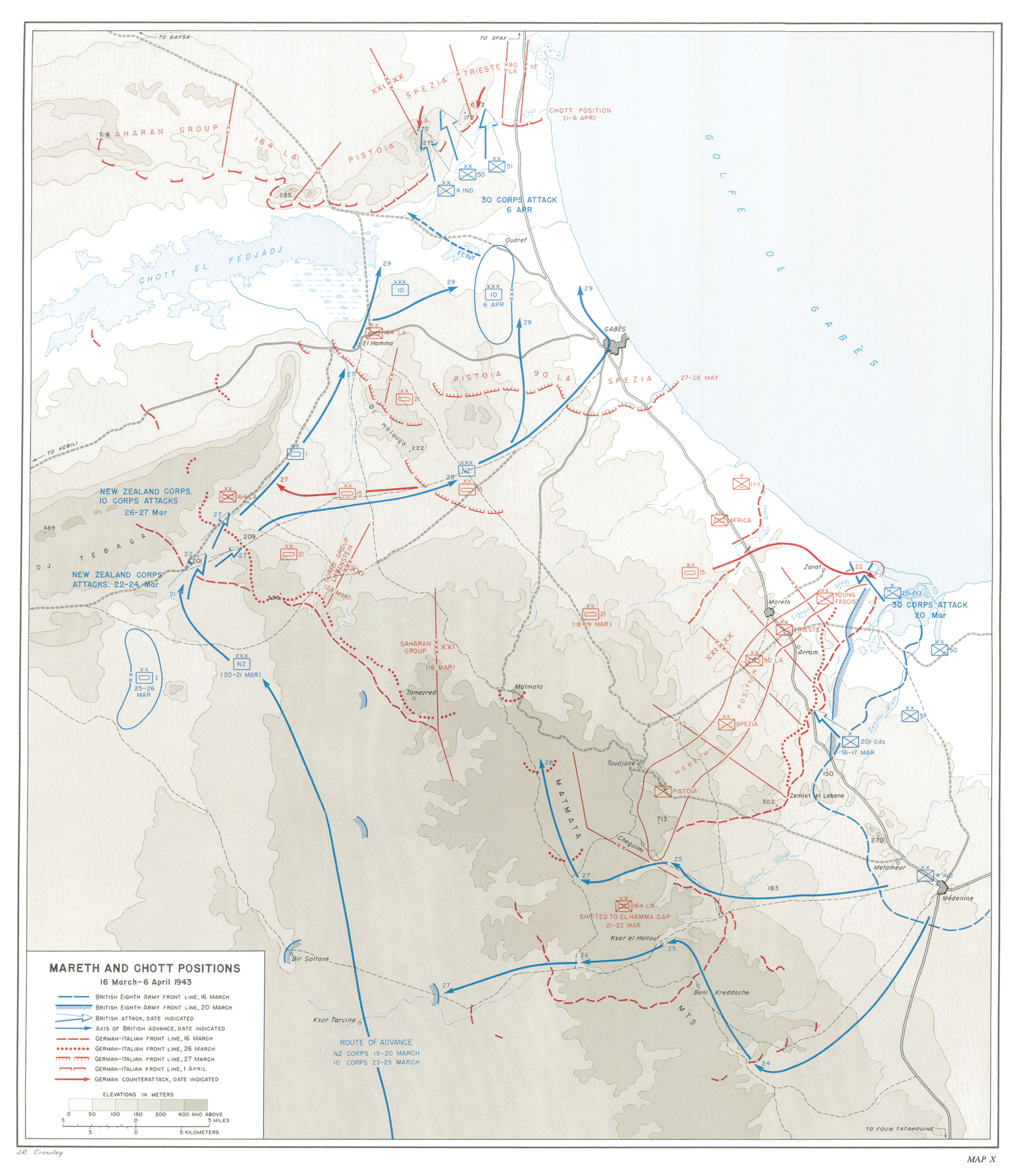

At 8.30 pm on March 19th, hell broke loose on the front with an initial terrible artillery bombing, like a replica of El Alamein. General Montgomery was aiming to close the conflict in north Africa by the end of the month. But in the next days he was forced to change his opinion, because of the desperate -and often suicidal- fightings done by Italian and German troops like the infantry division "Giovani fascisti" at the Mareth line.

Suggestive names were chosen by general Messe for the Axis defense lines of the Mareth line (that has been created initially by the French in the late 1930s, against possible Italian attacks from Italian Tripolitania): "Biancospino", "Betulla"., "Tiglio", "Timo", etc... The "P2" stronghold was entrusted to the Xth/8th brigate; "Larice" ("P1") and "Tiglio" ("P1 bis") to the 11th/8th. While the LVIIth/8th brigate presided over the strongholds of "A1" and "A2".

When the Montgomery attack started the bersaglieri of the 8th Regiment resisted, but two adjacent positions, "Betulla" and "Biancospino", held by 5 Companies of the German "Grenadiers of Africa" collapsed. So the British attackers could take the backside of the "Trifoglio" stronghold manned by the Xth, who was conquered after a furious struggle.

The British then threw themselves on the stronghold of the 11th/8th, but the attempt was defeated.

In the early dawn, the former Brigates of the 8th and 7th are given the task of attacking the "Betulla" stronghold, occupied by the British. Under the orders of Captain Givone, the fusiliers of the 1st and 2nd Companies, although subjected to three hours of intense artillery fire and mortars, launch themselves into the enemy trenches. Actors of heroic episodes are also two fusilier platoons of the 3rd Company, dragged to harsh combat by Lieutenant Guineani.

On the late morning of the 22nd, after having overwhelmed the stronghold "Timo 2", the British attackers tried against the "Timo 1" defended by the "Giovani Fascisti". But t was rejected.

On the same day the 15th German Armored Division counterattacked and the British were driven back from the strongholds "Betulla", "Trifoglio", "Tamarindo" and "Timo 2", while the "Biancospino" was reoccupied by the "Arditi" and "Young Fascists" soldiers on the day 24.

On this important coastal sector, the reaction of Italian weapons -mainly from the Young Fascists" -opened up frightening voids in the British ranks, destroying numerous tanks and killing many British soldiers. It is noteworthy to pinpoint that Montgomery had 620 tanks attacking the Mareth line on the March 21, defended by only the remaining 94 tanks of Messe: even so the British were initially defeated in the northern coastal section of the Mareth line.

Indeed the Eighth Army assigned the attempt to punch through the final line to British 30 Corps. The 30 Corps assigned it to the British 50th Division, which gave the mission to the 151st Brigade and 50th Royal Tank Regiment (fifty-one tanks, of which eight had 6-pounder guns). The British 69th Brigade and a detachment of the 9th Field Squadron, Royal Engineers, were expected to clear a path to the Zigzaou wadi (defended by the "Giovani Fascisti") and to set up protection on the southwestern flank for the crossing of that barrier at three points--one for each of two infantry battalions and one for the tanks.

Giovani Fascisti at Mareth line
Following closely an artillery barrage, and led by "Scorpions" (tanks equipped with flailing chains on revolving drums to detonate enemy mines), the tanks of the armored column would carry fascines, ten feet long and eight feet in diameter, to make the wadi crossing and that of the steep-sided antitank ditch beyond it passable for the heavy vehicles. The infantry and tanks were to fan out on the far side in a bridgehead from which the enemy was to be cleared by battles at numerous strongpoints.

Severe difficulties impeded the first night's operations. The British force opened the path to the wadi and established the flank protection, but the Scorpions failed and the mines had to be more slowly removed by engineers using detectors. The British infantry crossed successfully but the tanks were delayed. Some of their fascines were ignited and had to be replaced from a stock farther to the rear. The Giovani Fascisti's fire was heavy and continuous and, near the wadi's edge, knocked out several tanks (see photo at bottom of article's comments).

For 3 days - 21, 22, 23 March - the hammering of the artillery and the impact of the armored vehicles were incessant against the Bersaglieri of the 8th brigade and the other "Young Fascists". However, repeated counterattacks of the LVII brigate (Mayor Bassi) succeeded in breaking every British attempt even at the strongholds “A1" and " A2", that were isolated & surrounded.

Like in El Alamein the vain initial efforts of Montgomery were increased tenfold from March 21st, while the New Zealanders were conquering the Tebaga Pass and there was the risk for the Italians & Germans of being circumvented.

Montgomery suffered serious losses; so much so that he was forced to erase his initial comments of easy victory, with the new messages he sent to London: these were very dramatic messages pinpointing a "firm, desperate resistance". (especially from the Germans of the V Army of Von Arnim, which still had efficient vehicles and was not on foot like the Italians of Messe).

ORDER OF BATTLE

Armoured Division Giovani Fascisti (Division GGFF):
(Data from website "Comando Supremo" & data, but in Italian language, from historian A.Cioci)

Reggimento fanteria "Giovani Fascisti" (136th GGFF REGIMENT)
I Battaglione "Mi scaglio a ruina" (1st GGFF Battalion)
II Battaglione "Abbi fede"(2nd GGFF Battalion)
8º Reggimento bersaglieri (8th Bersaglieri Regiment)
V Battaglione bersaglieri motorizzato
XII Battaglione bersaglieri motorizzato
III Battaglione armi accompagnamento
IX Battaglione fanteria autonomo
136º Reggimento artiglieria (136th ARTILLERY REGIMENT)
XIV Gruppo artiglieria su autocannoni da 65/17 su Morris CS8
XV Gruppo artiglieria su autocannoni da 65/17 su Morris CS8
XVI Gruppo artiglieria su autocannoni da 75/27 su Fiat-SPA TL37
XVII Gruppo artiglieria su autocannoni da 100/17 su Lancia 3Ro
88ª Batteria artiglieria contraerea da 20/65 Mod. 35
III Gruppo squadroni corazzato "Cavalleggeri di Monferrato" su AB41
IV Battaglione controcarro autocarrato "Granatieri di Sardegna"
XXV Battaglione misto genio

Comandanti/Commanders (1942-1943)

General D. Ismaele Di Nisio
General D. Nino Sozzani

British photos of the Mareth battle. The first photo shows one of the British tanks destroyed by the "Giovani Fascisti", while crossing the wadi ZigZoau


COMMENTS

The sacrifice of the Giovani Fascisti division in Tunisia has been forgotten.

In two months of desperate & hopeless combat (from mid March to mid May 1943) the 5000 men of their Division suffered terrible losses and only 50 men remained when they surrendered in the area of Cape Bon/Enfidaville (they were the last soldiers of Messe to lower the Italian flag in north Africa in "Quota 141" -http://www.italia-rsi.it/primadell8sett/birelgobi/birelgobi0.htm). All the others were killed, missed in combat or wounded & made prisoners of war (POW) mainly in the battles of Mareth, Enfidaville and Cape Bon. The "damnatio memoriae" (the old roman way to erase the memory of those defeated) fell over their fightings: the Italian government never did a monument or ceremony to them and their British enemies simply gave all the merits to the Germans.

For example, we all know that Montgomery's memoirs are not accurate and are completely biased when minimising Italians efforts. In his memories, usually everytime something goes wrong for him, it’s always because of “Rommel” intervention or for Germans resistance. Italians for him were nearly always "losers".

Even at the Mareth line he wrote the same opinion– despite the fact it was Messe who engineered the resistance and directly commanded the counterattack of the German panzers, which were the only panzers left the 1st Italian had. Moreover, he seems to ignore that were the strongholds held by the Germans the ones that crashed down after the first punch given by the 50th English division: strongholds "Biancospino", "Bosso" & "Betulla” held by the Germans were overrun, while the strongholds “Larice" and "Trifoglio” held by Italians (Giovani Fascisti, X and XI Bersaglieri) resisted the strong initial attack.

Indeed the 21, after assessing that this was effectively the main attach, and after also the stronghold "Trifoglio" was overrun, Messe decided to commit the 15 Panzer Division as well as Italian infantry (Bersaglieri, Giovani Fascisti, Black Skirt and some German infantry – but minority in numbers) for a counterattack. Borowietz, commader of the 15 Panzer, was informed of the plan the 21. The successful counterattack was carried out effectively by Messe without any help by Rommel.

Furthermore, Churchill at the House of Commons and the House of Lords declared on March 24: "The bridgehead constituted at the price of blood by the British 8th Army on enemy positions, has been eliminated by the Germanic counterattack".

For the wounded English pride it was necessary to tell the world that the great British Army of Montgomery has not been defeated by the "weak" Italian soldiers but from the "Fox of the desert" (who no longer was in North Africa since March 8 and who they will continue to "materialize" in the battlefield). Indeed Rommel's army, renamed "1 Italian Army" , in early March 1943 was under General Messe. (He was not promoted Marshal until the last day of fighting in North Africa in May 1943).

This was the first time German divisions has come to be under orders of an Italian general.

Rommel's last act was to appoint a German general to be liaison officer with the "1 Italian Army"", the appointment being effective as from 8 March, which was a day or so before Rommel left North africa. His appointee was Major-General Bayerlein.

Finally, its is important to pinpoint that the division "Giovani Fascisti" was made only by "voluntaries", in many cases university students (just 18/19 years old). They fought for their ideal of an Italian empire that could give to the Italians the prosperity enjoyed by the Italian peninsula during the centuries of the Roman empire. But History was not on their side, because one of the consequences of WW2 was the end of the colonial era.

Indeed, their sacrifice was not totally worthless: they honored their country, even if British "propaganda" (like the one of Montgomery) was too much aggressive and unjust.

VALOR MEDALS

Military Valor Medals given to the "Giovani Fascisti" Division during WW2 (http://www.qattara.it/piccolacaprera_files/ggff.pdf):

2 Gold Medal of Military Valor
38 Silver Medal of Military Valor
61 Bronze Medal of Military Valor
116 War Cross of Military Valor

COMBAT STRENGHT

On the March 19, 1943 the Division was holding the Northern (Coastal) section of the Mareth Line and had a combat strength of 5000 men.

Two months later, when surrendering -on May 13- as the last Axis troops still fighting in Tunisia, what remained of the Division was just 50 men (without food and ammunitions) of the II battalion under captain Baldassari. Only one percent of the original combat force.

Finally it is noteworthy to pinpoint that less than one thousand of the original 5000 were made POWs and survived WW2 and this fact means that more than 80% of the division soldiers and officers died in combat or from wounds received in battle. But sadly general Montgomery (and many British military historians) never wrote one single word about this astonishing ultimate sacrifice.

Giovani fascisti in battle

Wednesday, June 5, 2019

THE TRUTH ABOUT TOLOMEI AND ALTO ADIGE

In the last decades there have been continuous critics (mostly from Austrian & Tyrolean people) of what did Ettore Tolomei in Alto Adige, an alpine region in northern Italy that was united to the Kingdom of Italy after WW1. I am going to try to be the most honestly impartial about this Italian politician and writer, researching information from those who support him and his "Italian irredentism" and from the many who critic his involvements in the process of the Italianization (or re-Italianization as he wrote) of the Alto Adige.

Alto Adige areas with Tolomei's names
Indeed in 1923, three years after Alto Adige had been formally united to Italy, Italian place names, almost entirely based on his "Prontuario dei nomi locali dell'Alto Adige", were made official by means of a decree (read the original version in Italian, with introduction written by Ettore Tolomei, here: http://www.mori.bz.it/toponomastica/index.htm.

Since then the Austrian propaganda has attacked Tolomei saying that Fascism ordered his "Prontuario", but the truth is that it was started to be created in 1906 -according to Eduardo Mori- when Fascism did not exist and officially authorized since 1921 by the liberal governments of Giovanni Giolitti and Ivanoe Bonomi.

This is the translation of historian Mori comments about these complaints against Tolomei and his 'Prontuario':

"....The 'Prontuario' has been the victim of a continuous and lively cultural defamation on the part of a certain South Tyrolean world, but it has always resisted these criticisms, which were interested and uncultivated because, as anyone can see, it is superficially the product of in-depth etymological studies, of vast archival research, of vast linguistic culture and has always tried to give the various localities absolutely reasonable names, always drawing, whenever possible, on prebarbaric substrates, or by adhering to the etymological meaning of surely Germanic names, or by devising assonances that correspond well to spirit with which the people assign names to places. The Prontuario was always presented as a product of the fascist era which is completely false. The handbook is the fruit of the Italian irredentist spirit and had been started in 1906 well before the Great War; it was then continued during the war because it was considered logical that our soldiers conquered lands with Italian and not Austrian names; it was accomplished long before Fascism came to power. Fascism did nothing but the last formal act of its formalization. The Prontuario has always been presented as an instrument of Italianisation of Alto Adige/South Tyrol; nothing more false because, well before the South Tyrolean claims, it already officially established the principle of "bilinguality with the precedence of the Italian name”. And it really takes a huge dose of intellectual dishonesty to argue that a Nation, on its territory, does not have the full right to baptize places in its official language, to have maps with names that its citizens can understand, to attribute to each place the name that best believes, even if completely disconnected from what the linguistic minority continues to freely use....."

Another mistake is the Austrian & SouthTyrolean usual declaration that the Italianization of Alto Adige was only promoted & made by Tolomei and the Italians: Hitler, for example, made harsh critics to the SouthTyroleans and always despised the possibility of German fighting for the South Tyrol. Here there are some of his declarations about this problem:

THE CONTEMPT OF THE FUHRER
1922. - "We must not for a sentiment of brotherhood to 200,000 Germans treated well, forget that elsewhere there are millions of truly oppressed Germans (...) We must openly and sincerely declare to Italy that for us the question Alto Adige does not exist and will never exist again. And these declarations honestly maintain and prove true with facts " (From a speech of November 17, 1922 pronounced in Bad Ems and reported in a report by the Italian delegate of the Inter-allied Commission for Rhineland Tedaldi, for which see also Ingram Beikircher. - Such statements alienated Hitler's sympathetic conservative right-wing sympathies to Hitler also from the fact that, at least then, the NSDAP - National Socialist Workers' Party sought proselytes of preference in the sectors of the traditional left).

. 1923. - "Our eyes must be on the Rhine: Strasbourg is a sacred city for German sentiment far more than Bolzano and Merano" (Objection to a letter by Kurt G. W. Ludecke, published by the "Corriere Italiano" on October 16, 1923. These sentiments were confirmed ten days later by Leo Negrelli, journalist of the said sheet, which was published in Rome in 1923-24).

1925. - «Yes, South Tyrol. If I am dealing with this problem here, it is also to call that shameless rogue on the bill, which relies on the stupidity and forgetfulness of our large strata, dares to simulate a national indignation that is more foreign to our parliamentary cheaters than it is to foreigners a magpie the concept of ownership. I note that I am one of those who took their places from August 1914 to November 1918 where this territory was also defended: that is, in the army. In those years I fought too, not because the South Tyrol was lost, but because it was, like every other German country, preserved at home. Those who did not then fight were the marauders of parliament, all the rogue politician of the parties (...) Who today believes he can solve the problem of Alto Adige with protests, declarations, marches etc. or is a rascal, or is a petty bourgeois German. It is easier to chat today for the recovery of South Tyrol than it was one day to fight for its conservation. Everyone does what he can then we shed our blood: today they let their beaks go (...). If one day we have to shed German blood, it would be a crime to pay it for two hundred thousand Germans when seven million Germans languish under foreign rule ".

1938. - "It is my unwavering will and it is also my political testament to the German people, to consider the frontier of the Alps erected between us by nature forever intangible". The declaration was made public in Rome at 'Palazzo Venezia' on May 7, 1938.

1939. - "Querulanten. This is the word used by Göring to define the South Tyroleans, who paw more than the others".

- Mein Kampf, Chapter XIII, Ed. Bompiani, 311 - In Chapter VI, (Bompiani 120), with his habitual aggressive attitude, Hitler had called the Alto Adige question a Jewish set-up "to support the struggle against a system that precisely we Germans must appear, in the present situation, as the only ray of light in a world that is setting ".

And finally; at the end of a meeting on the subject of the unredeemed German territories, as reported by Ingram Beikircher and Valther, the future Führer would have exclaimed, vulgarly but effectively, "Alto Adige goes on to do fuc...."


Additionally we must remember the official German proposal to settle the South Tyroleans (who "opted" for the Third Reich and did not want to remain in Italy) in Burgundy (actual "Bourgogne-Franche-Comté"), occupied by the Germans in 1940 (read in French: http://www.editions-harmattan.fr/auteurs/article_pop.asp?no=28817&no_artiste=1317): the cities of Besançon, Chalon, Dôle, Pontarlier and Auxonne would take the names of Bozen, Meran, Brixen, Bruneck and Sterzing; the French population would be expelled, while the transfer costs would have been borne by the defeated France. it was an astonishing Hitler's proposal!

Image of Andreas Hofer, the leader of the Tyroleans against Napoleon who was "Sicilian looking", according to some Nazi authorities like Goering: he pinpointed that Hofer clearly showed & represented the appearance of the local "ladins", germanized by a minority of blonde german Bavarians who settled mostly just north of Bolzano (Val Pusteria & Val Isarco) during the Middle Ages

Furthermore in all the Tyrolean & Austrian propaganda against the Italian Alto Adige there it is always a reference to the fact that this territory is considered to have been ALWAYS a German speaking area, that the Italian fascism (of Tolomei et al) wanted to Italianize after WW1. The Austrian Tyroleans always forget in their writings that only in the last four/five centuries before 1918 the romance language has become a minority language in what is now called Alto Adige.

The area around Bolzano has always been the most populated in Alto Adige with a huge romance speaking community; and in Napoleon times it was united to his Kingdom of Italy because ethnically romance speaking. Furthermore the valley "Venosta" west of Merano until the second half of the Settecento (XVIII century) was populated mostly by Ladins.

These facts -together with the existence of Ladins in Val Gardena and surroundings even now- clearly explains why Tolomei considered that the German-speaking Tyroleans were not an autoctonous population in the Alto Adige region: he promoted a "re-Italianization" of the region, starting from the names of geographical places as he wrote in his 'Prontuario'.

Tolomei looked as a reference for his "re-italianization" of Alto adige to the process of assimilation done in France after WW1 with the former mostly German speaking Alsace-Lorraine regions. He was well esteemed by the French authorities: in 1935 Tolomei -promoted to "Senator of the Kingdom of Italy"- received the "Légion d'honneur" from the "République française". The award motivation was: "In giving you this high distinction, the Government of the French Republic has taken care to recognize the outstanding services that you have rendered to the Latinity before, during and after the war (...) with your action in the Alto Adige defense outpost of the Latin block against Germanism".

Tolomei correctly pinpointed that the germanization was huge north of Merano and Bolzano, but in the val Venosta area it has only happened since the century before the French Revolution and in the Bolzano area only since the XIX century. So he indicated that there was an approximate line related to the presence of less or more than 20% of blonde hair in the population, that clearly divided in two the Alto Adige: north of the line there were people mostly German speaking since the Middle Ages, while south of the line the presence of romance population was evident in the darker hair of most people.

Curiously in recent years the genetic studies have confirmed this line, with the genetic signature of the haplogroup "R1b-U152". Indeed ancient Romans, from the original founders of Rome to the patricians of the Roman Republic, should have been essentially R1b-U152 people. See map for further understanding, showing the orange line (related to 33% of the population) of the haplogroup "R1b-U152" that is similar to the one of the 20% blonde hairs in the population (north of the line the habitants are more blonde and germanised, while south are less -because more than the 33% of the total population has this kind of haplogroup- like in northern Italy).

He initially -as a moderate fascist- wanted a slow but steady process of "assimilation" of the German speaking population, but not the expulsion (as happened -for example- in Greece and Turkey with the exchange of populations in the early 1920s).

But Hitler and Mussolini made in 1938 the "Option Agreement" (when the native German speaking people were given the option of either emigrating to neighboring Nazi Germany -of which Austria was a part after the 1938 Anschluss- or remaining in Fascist Italy and being integrated into the mainstream Italian culture, losing their language and cultural heritage and as a consequence over 80% of them opted to move to Germany). Tolomei then enjoyed this agreement (even if he was one the few fascists who opposed the alliance between Mussolini and Hitler, while promoted the creation of the "Vallo Alpino" as a defense against a possible German attack from the Brenner) and strongly supported the "disappearance" of the south Tyroleans.

Of course, this tentative of full Italianization with the "Options" enraged forever the Austrians and Tyroleans against Tolomei, who was seized by German forces and deported, first to the Dachau concentration camp and then to a sanatorium in Thuringia, after the September 1943 surrender of Italy. Tolomei miraculously survived......only to see how all his project fell after WW2.

Tolomei died in 1952 and he is still remembered with appreciation by most of the Italians (mainly of the center-right political parties), while on the other side -of course- most of the German speaking people (mainly in the "South Tyrolean People's Party") despise him.

The following are excerpts translated from the "Treccani" (the Italian encyclopedia equivalent to the British encyclopedia) about the biography of this controversial Italian "irredentist" and about his "Alto Adige":

Ettore Tolomei was born in Rovereto on 16 August 1865. After completing his higher studies, the "irredentist" Tolomei collaborated with several magazines and later founded and directed, together with his brother Arnaldo, the magazine "La Nazione Italiana"; he always dealt with economic, geographical and historical issues. He then organized the Italian gymnasium in Tunis, and spent some time in Thessaloniki, in Smyrna, in Cairo. From 1905 onwards he devoted himself exclusively to the docunmentation/illustration of the Alto Adige side, to the claim of Alto Adige to Italian culture.

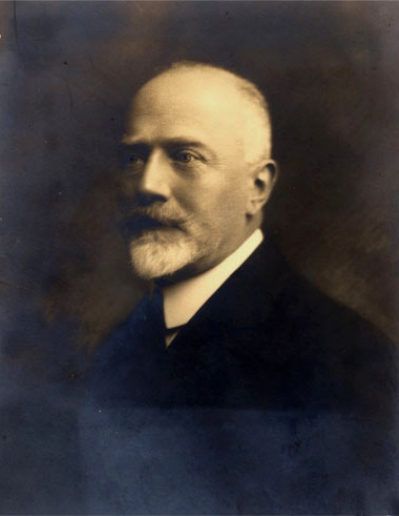
Photo of Ettore Tolomei

He succeeded in imposing his thought on the nation, in its current geographical concept, still in the period preceding the first world war, through its Archive for the Alto Adige. He always fought for the political border at the Brenner, also as a war volunteer and then, above all, in peace negotiations.

After the Italian victory in 1918 he was commissioned to govern Alto Adige as a commissioner for language and culture: and he renewed Italian toponimy in lively contrast to the post-war renunciation of many Italian politicians of leftist organizations.

His "Invettive" (Invective note) led the Black Shirts of Fascism to the occupation of the schools of Bolzano (2 October 1922), a prelude to the March on Rome. He was appointed senator on 2 March 1923. He was director of the Alto Adige Institute of Studies: he took care of the development and assimilation of culture, after having formulated the "Provvisioni" (Provisions), the basis of all the action pro-Italy that was taking place in the area of border with Austria in the late 1930s.

After Hitler rise to power in 1933, there was in Alto Adige a period of small virulence: it was when, in the spring-summer of 1934, German Nazism tried in vain, through the assassination of Chancellor Dollfuss, a coup d'état against Austria, which, if successful, would probably have paved the way even for German claims on the Alto Adige, or at least fed, with the presence of the Brenner of Nazi Germany, the irredentist ambitions of the German-speaking population, of which the intense Nazi activity of South Tyrolean exiles was a symptom.

With the development of an industrial area near Bolzano, with the new city plan, the Italian government tried to favor Alto Adige, capitalizing on companies and granting important subsidies to various local industries: with which it also aimed to increase the Italian element in the cities and to reconcile the interested sympathies of the German alloglots; but there was little success in this second purpose. With regard to his friends in Austria, Stahrenberg and Schusschnigg, Italian school policy suffered some attenuation and German private schools were reopened, under the control of the Italian school authorities; but the nationalistic tendency of some elements of the region, especially intellectuals like Ettore Tolomei, did not disarm.

The Italian war against Abyssinia came to bring some relaxation towards the border area, now that the Italian interest seemed to shift mainly towards other lands. The way was open to an agreement: and it was confirmed in the autumn of 1936, when the Italian-German alliance was established.

By bringing Italian interests to Africa and Spain, Germany was behind Italy on the continent and was able to get the latter to resign herself to giving up her influence on Austria and Central European politics, influence that was supported by Dollfuss, Stahrenberg and Suvich. The repercussions of local nature on the southern Brenner side did not fail to make themselves immediately felt in a revival of Nazi anti-Austrian propaganda and in the reawakening of irredentist dreams, which found echo and support in German press, albeit unofficial, as in the magazine "Jungvolkjahrbuch", which highlighted the right of Germany to the 220,000 inhabitants of South Tyrol.

So it is no wonder that the occupation of Austria (March 12, 1938), by bringing the German border to the Brenner Pass, gave a strong injection of enthusiasm to the more fanatical South Tyrolean elements for the third Reich and more blindly confident that the events would have led to the imminent peaceful annexation of their territory to Germany. However, subsequent events slowed down certain excesses, and the annexation of Czechoslovakia imposed some reserve. Hitler signed Italian-Germanic cultural agreements in November 1938, demonstrating his desire for agreement with Italy. However, he completed them shortly afterwards with the "Option agreements" of June 23, 1939, concerning the transfer of German allogens within the borders of the Reich, based on requests freely and individually expressed by the interested parties. For the examination of these questions and related facts, therefore, two high commissions were set up in Bolzano, one Italian (with Ettore Tolomei) and one German: this last one assisted especially by local Optants, who carried out an intense propaganda for the Options in favor of Germany, which gave an impressive result.

In fact, out of a population of 253,953 inhabitants in all Alto Adige, excluding the 42,936 belonging to the Italian ethnic group, 179,503 opted for Germany; 31.514 for Italy. However, within the maximum term set for the evacuation (December 31, 1942), only 72,749 had moved to Germany.

The events of war after June 1940 exacerbated the situation. In clear contrast with the Italian authorities, the action of the 'Streifkommandos' took place in the Alto Adige valleys in search of renouncers or deserters, some of whom were killed in skirmishes: an action that illustrates the silence of the minute population, controlled through the committees of the "Optants", through the propaganda and organization, even in times of alliance with Italy, of the infamous SOD (Sicherheits-Ordnungs-Dienst), in which all men from 15 to 60 years were militarily regimented. The treatment, sometimes inhuman, used in respect of several Optants by the various Nazi commissions, did not fail to provoke strong repercussions, which led to many requests for cancellation of the option. Requests which, in February 1943, had reached the huge figure of about 15,000!

Despite the Hitler declaration of wanting to recognize the Alps as a border between Italy and Germany, at the fall of fascism (25 July 1943) Alto Adige saw the amount of Germanic armored troops grow day by day. At the news of the armistice (8 September 1943), the members of SOD occupied all the important points and hunted down the Italian soldiers (killing 30 of them), also opposed by the treacherous and sometimes cruel demeanor of most of the German speaking population.


Ettore Tolomei, who has received the French award "Légion d'honneur" (see image to the right) and two Italian medal awards ("Ordine della Corona d'Italia" and "Stella di Grande Uffiziale dei Savoia"), during the invasion remained working at his office in Bolzano waiting to be captured without fear to face the Nazi Tyroleans who hated him.

He -nearly eighty years old- was quickly sent to the Dachau concentration camp.

He was lucky and survived.

Tolomei (who had received the noble title of "Conte della Vetta" by the king of Italy in 1938) spent his last days in Rome, where he died in 1952 at 87.

He is buried in his Trentino-Alto Adige, where every year some Italian nationalists honor his tomb (see following photo)

Tuesday, May 7, 2019

HISTORY OF ITALIAN BOLZANO

When we read or think about Bolzano, the main city in the "Alto Adige" of Italy, we usually forget that this city has always been a town inhabited by a neolatin population (in huge or small percentages, through the centuries).

Whatever ethnicity the oldest population of the Bolzano area had belonged to, it was totally "Latinized" following the Roman conquest. However, unlike what happened in the nearby valleys, the German infiltration, which probably began already with the Bavarian occupation of the VII century, was able to overwhelm the original Ladin population a little at a time until it was nearly completely extinguished and assimilated by the German (and also by the Italian population) of the growing city. The Italians started to come to Bolzano -from the Trentino, but also from Lombardy and Veneto- since Charlemagne times, because the city became a commercial trade center (with important "Fairs"), being located at the union of the valleys descending from Merano and Bressanone

Map showing "Pons Drusi" (the Roman Bolzano) in the X regio of Italy (Venetia & Istria)

Map showing that Bolzano is in the middle of the "Ladin Arch", that in the early medieval times stretched from central Switzerland to the Julian Alps

Indeed the history of Bolzano begins only with the Roman conquest in 14 BC, when Drusus built there a bridge and founded a station mentioned -in the so-called "Tabula Peutingeriana"- with the name "Pons Drusi" (Drusus bridge). Bolzano was then included in the tenth region of Italy and was fully "Latinised" after four centuries of the Roman empire. It is noteworthy to pinpoint that in 1948, excavations of the current Cathedral led to the discovery of an ancient Christian basilica from the 4th century; also discovered was a Roman cemetery, including the tomb of "Secundus Regontius" with Latin inscriptions dating to the 3rd century, making him the oldest known inhabitant of Bolzano.

The Roman city suffered greatly during the last decades of the Western Roman Empire and probably the population was reduced to a few hundred inhabitants: after the barbarian invasions the remaining population of Bolzano, some of which had settled on nearby Virgolo, returned to live permanently in the Adige hollow thus forming a preurban small village (according to recent archaeological findings in a restructured church that was rebuilt on the remains of the destroyed Christian Basilica from the 4th century).

Map showing "Pons Drusi" (the Roman Bolzano) inside the X Regio of Italy (Venetia & Histria).

Torn apart from the Lombard rule, it was part in the VII century of the Bavarian duchy with the name "Bauzanum". Paolo Diacono wrote in his "Historia Langobardorum" about a "comes Baioariorum" who in 680 AD "Bauzanum et reliqua castella regebat" (a Bavarian ruler who in 680 AD owned Bauzanum and the nearby abandoned castle: Hist. Lang., V, 36). In those years the population of Bauzanum was mostly neolatin (called "Ladins"), but there was a minority (probably around 25 %) of German settlers for the first time in this small city reduced to a village with scattered farmers around.

After some subsequent political changes, in 1027 the little city was assigned to the "Vescovato di Trento", erected by the Holy Roman Empire's emperor in dominion of the Bishops of Trento. But alongside this lordship the antagonistic power of the Counts of Tyrol was soon established, with jurisdiction all around at Gries, Dodiciville and Laives, first in condominium with the Trentino Bishops, then in complete independence.

In the late-12th century, the Trento bishops founded a "market town", along the Adige river and tributaries. The town therefore became an important trading post on the Transalpine Augsburg-Venice route over the Brenner Pass. However, in the XIII century Bolzano was officially recognized as belonging to Italy by Corradino (Conradin) of Svevia (see Regesta imperii, V, n. 4837). Indeed Dante Alighieri in his "Divina Commedia" wrote that "Tiralli" (the ladin name of the village actually called "Tirol", from which came the word "Tyrol") was the northern limit of the Italian region: "Suso in Italia bella giace un laco, a piè de l'Alpe che serra Lamagna sovra Tiralli, c'ha nome Benaco (Inferno, XX, 61-63)/In the north of Italy there it is a lake, under the Alps that close Germany just north of Tiralli, that has name Benaco". In 1268 Bolzano was declared a "city" and had around 3000 inhabitants.

The Counts of Tyrol, who first came from the Val Venosta lineage (meaning that they were originally "Ladins": the village of "Tirol" is located 25 kms northwest of Bolzano in the Val Venosta, a valley populated by Ladins until the XVIII century), then the Mainardi of Gorizia and finally from 1363 the Habsburgs, took over at the end of the thirteenth century also the rule from those "lords of Vanga" who -in the northern section of Bolzano- had a century before founded a new neighborhood, with appropriate jurisdiction. The Habsburg ended up taking possession in 1531 of all the urban territory (which was already conditionally recognized to them in 1462) that was called in German language with the name "Bozen". Only the purely ecclesiastical administration remained to the Bishops of Trent.

With the Habsburg started to grow the German population of the city and in those years probably -let's remember that there are no official statistic related to the ethnic composition of the Alps in those centuries- the city was (more or less) half German and half Neolatin. To keep numerous the presence of the Neolatin people in the city were the successive and copious Italian colonies coming from the Trentino or from the other regions of the north of the Italian peninsula since Charlemagne times. The "casane" or loan houses, founded by the Tuscan bankers in Alto Adige, appeared in Bolzano at the end of the XIII century, and thrived so numerous as to represent the whole economic life of Bolzano in the fourteenth century. Indeed corresponding with the dominant role of the notaries of these bankers until 1400, the language of the records in Bolzano up to this point was primarily Latin.

The Bolzano's "Mercantile Magistrate" building
The Coats of Arms of the Florentine family of the "Rossi" mark - a unique example - all the most famous monuments of Bolzano. Of the two convents of friars, the Dominican one depended in the fourteenth century from the province of Lombardy and even later it always maintained a chapel destined to worship for the huge Italian population of the city, while that of the Franciscans in the second half of the fifteenth century was opened to the Italian conventuals.

In that century and at the beginning of the following, Italian immigration was so conspicuous that Sigismund (Archduke of Austria) himself officially noted it on documents: in April 1487 Sigismund imprisoned 130 Venetian merchants traveling to the "Fair at Bolzano" and confiscated their goods. Furthermore, the Italian presence in Bolzano was so honored that the Italians could repeatedly provide holders of the office of city-mayor ("borgomastro") in those centuries.

From the 14th and 15th centuries onwards, a large market fair was organised four times per year to greet tradesmen and merchants en-route the Brenner Pass. The "Mercantile Magistrate" was therefore founded in 1635 by the Austrian duchess Claudia de' Medici. During every market season, two Italian and two Germanic officers, who were appointed among the local tradesmen, worked in this magistrate office. The establishment of an official trade organization strengthened Bolzano as a cultural crossroad in the Alps. Although this Mercantile Magistrate had been first designed to be a mainly Italian institution, it soon became a multilingual one, embodying one of the first cases of multilingualism applying to the public sphere in History.

Indeed in 1483 a huge fire destroyed the old "romance" city and the buildings were rebuilt in typical "gotic" style by the Hapsburgs, as can be seen today in 'downtown Bolzano' (http://gsavser.blogspot.com/2017/01/lalto-adige-e-italia-ii-le-fiere-di.html). Historian Ferruccio Bravi wrote that in the second half of the "Quattrocento" (XV century) the usual language in Bolzano was the Italian, but it started to be substituted by the German ("alla lingua usuale che a Bolzano era stata italiana fin verso la metà del quattrocento - cosi riferisce P. Felice Faber da Ulma e conferma Gian Pirro Pincio - si era sovrapposto, sguaiato e duro, il dialetto Tirolese/ to the usual language that in Bolzano has been the Italian up to the second half of the 1400s -this is what says P. Felice da Ulma and confirms Gian Pirro Pincio- it was over imposed, harsh and peasant, the Tyrol dialect").

1525 Bolzano population suffered the consequences of the "peasant war" that decimated the German lands: many peasants of Ladin (and Italian) heritage followed the leadership of Michael Gaismair and were persecuted by the Austrian Habsburgs. Since then started the full "germanization" of Bolzano and the nearly disappearance of the romance speaking population in the city, that in the following centuries reached a 91% of German speaking citizens (in the 1910 Austrian census).

However by the end of the XVIII century most of the population was romance speaking, even if by a small amount of percentage: Napoleon in the early "Ottocento" (XIX century) united to the "Department Alto Adige" a territory (with Bolzano as the main city, see following map) because mostly romance speaking; this department was a part of the Napoleonic Kingdom of Italy from 1810 to 1814. Furthermore, it was created this Department of Alto Adige with the division of the Austrian Tyrol between French Bavaria (German speaking) and the Kingdom of Italy (Italian speaking), and included the southern part of the Tyrol with the city of Bolzano with surroundings (and along with all the Trentino).

Map showing the borders of the area around Bolzano, that was united in 1810 to the Napoleon's Kingdom of Italy because mostly Italian speaking. The orange line north of Gargazzone was the border with the german speaking Tyrol, while the green line south of Salorno was the one with the Italian speaking Trentino


The boundaries were made by Austrian and German commissioners, saying that a territory would belonged to the Kingdom of Italy if it was inhabited by Italians, according to the principle: "belonging to the Kingdom of Italy because inhabited by Italians" (da appartenersi al Regno d'Italia perché paese italiano). The department included the area around Bolzano, that had a population mostly romance speaking (Italians and Ladins) while the other areas of the former South Tyrol were left united to Bavaria because mostly German speaking. (https://books.google.it/books?id=VI9IAAAAYAAJ&pg=PA429&dq=alto+adige&hl=it&ei=L_2NTtygINDUsgadrsX9Dw&sa=X&oi=book_result&ct=result&resnum=6&ved=0CE8Q6AEwBTgK#v=onepage&q=alto%20adige&f=false").

Bolzano geographical importance as a city centre set half-way between Italy and Germany/Austria had increased during the XVIII and the XIX centuries, since the first railway line between Verona and Innsbruck was completed in 1860. On that occasion, many Italian workers came to the city and to the Alto Adige region, as it is testified by the first bilingual workers’ association established in town in 1869. Although through this period the relationships between Italians and Germans (or Tyroleans) had been mostly peaceful, while being oriented to mutual advantages, the situation drastically changed before and during the I World War.

Indeed most of the region in 1815 it was put under direct Austrian administration and incorporated into the Tyrol. After the Veneto passed to Italy in 1866, the Austrians pressed for increased Germanization in Bolzano: 29,000 inhabitants of Bolzano -in the 1910 Austrian census- identified themselves as German speakers and only 1,300 as Italian speakers.

This led to irredentism among the Italian minority there: some of them were members of the "Lega Nazionale irredentistica".

Nearly one hundred Italians of Bolzano were sent to the concentration camp of Katzenau near Linz and a few also to the ones of Wagna and Mitterndorf (only 3/4 of them came back, the others died there) during WW1 (for further information, please read in Italian https://web.archive.org/web/20110213202547/http://www.trentinocultura.net/doc/radici/storia/grande_guerra/citta_baracche_h.asp).

After World War I, the Treaty of Saint-Germain (1919) gave Bolzano to Italy, which resulted in agitation by its German-speaking population.

The Italian Fascist government's program of intensive Italianization and the enforcement of Italian as the sole official language met with some strong opposition, but it was successful. In 1923, three years after Bolzano had been formally united to Italy, Italian place names, almost entirely based on the "Prontuario dei nomi locali dell'Alto Adige" of irredentist leader Ettore Tolomei, were made official by means of a decree. Bolzano was promoted to "capoluogo"(main administrative center) of its own province in 1927: the "Provincia di Bolzano".

The small Jewish community of Bolzano (that existed since the XV century) welcomed the Italian government, because often harassed by the local Germans: starting in 1932, a huge number of Jews arrived from Germany and Eastern Europe. According to the 1938 census of Jews in Italy, there were 938 Jews in the province of Bolzano (mainly in Bolzano and Merano).

Furthermore a large industrial zone in Bolzano opened in 1935: it was followed by the immigration of many workers and their families from other parts of Italy (mainly from Veneto). An improvement of Bolzano's economy -the city doubled in population and size before WW2- was created by the newly developed industrial activities: video of 1939 Bolzano (https://www.youtube.com/watch?v=oWN2oILRN3s). A huge steel mill, an aluminum mill and a magnesium mill were inaugurated in the late 1930s; also the airport (founded in October 1926 with "Regio Decreto # 1994") and a new improved railway station were created in those years. In the early 1940s was completed the "Casa littoria", a masterpiece of rationalist style; also a new modern industrial quarter was completed with large alleys & the worldwide famous "Monumento alla Vittoria" (Monument to Victory) in the former "Gries" area.

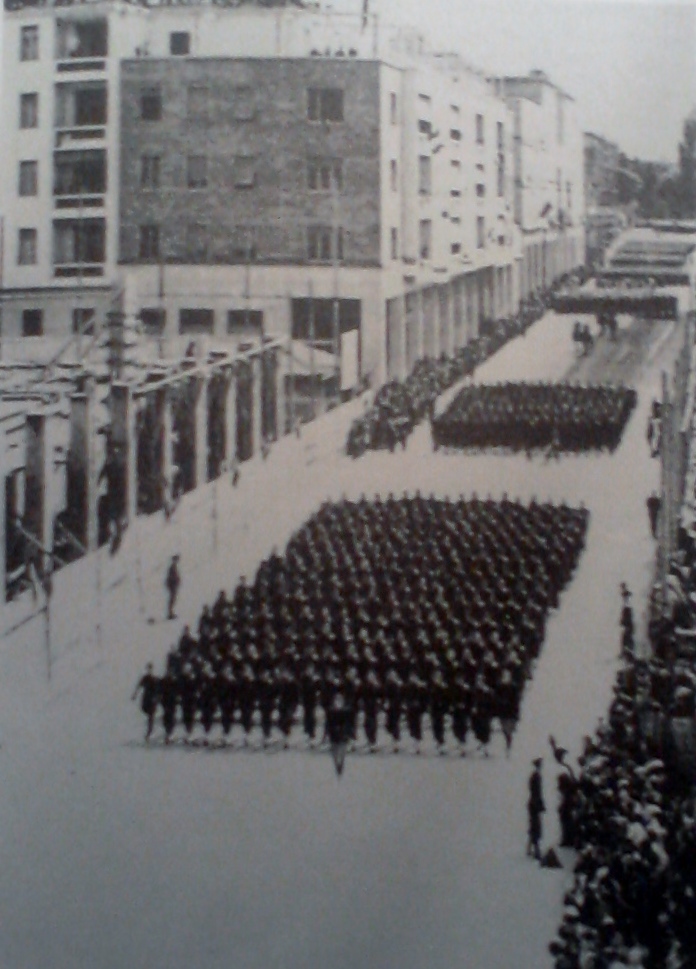
Italian troops marching in the new quarter of Bolzano in the 1930s

An agreement in 1938 between Hitler and Mussolini provided for extensive forced migration of the German-speaking population to Germany or to other parts of Italy.

Between 1939 and 1942 nearly 75,000 German speaking inhabitants of the Alto Adige (mostly from the Val Venosta and the main cities) moved to live in the Third Reich Germany (we have to remember that in the 1921 Italian census there were 190,855 German speaking inhabitants -read https://books.google.com/books?id=rwFJu_3NtXAC&pg=PA64&dq=censimento+austriaco+1910&hl=it&source=gbs_toc_r&cad=3#v=onepage&q=censimento%20austriaco%201910&f=false- in the Italian Alto Adige). And this fact means that more than 120,000 of them never moved from Alto Adige.

However, this program was extremely unpopular between the German speaking population and soon collapsed since 1943, when Hitler occupied Bolzano in September of that year beginning a process of vengeful expulsion of the Italians.

Following an agreement (1946) between the Italian and Austrian governments, the republican constitution of Italy (1947) granted the region considerable autonomy. Both German and Italian were made official languages, and German schools were permitted in Bolzano province. However, the German-speaking population in the province (called Südtirol, or South Tyrol, by the Germans) continued to demand greater autonomy. They received the backing of Austria, which charged that the German-speaking population in Bolzano had not been given the autonomy envisaged in the 1946 Austro-Italian agreement.

Serious tension developed between the two countries. In 1960 the Bolzano problem was debated, at Austria's request, at the United Nations, on whose recommendation Italy and Austria entered into direct negotiations. Their efforts were partially vitiated by acts of terror committed in the region in 1961. It was only in 1971 that a treaty was signed and ratified; this agreement stipulated that disputes in Bolzano would be submitted for settlement to the International Court of Justice in The Hague, that the province would receive increased legislative and administrative autonomy from Italy, and that Austria would not interfere in Bolzano's internal affairs. The region was granted increased autonomy in 1972.

Coat of Arms of the Italian "Provincia di Bolzano", created in 1927


A monument-sign of Italian Bolzano

The Monument to Victory ("Monumento alla Vittoria") is one of the most controversial signs of the ‘Italianisation’ of the province of Alto Adige. Built by Marcello Piacentini on the orders of Mussolini between 1926 and 1928, during the first wave of colonisation of the area, the monument immediately became the symbolic and ideological centre of the Italian town created west of the river Talvera, opposite the old ‘Austrian’ historical centre.

The project was proposed as a "tribute" for the Italian martyrs of World War One. In reality it was a triumphal arch built in the area of a pre-existing Austrian monument, that imposed a Fascist iconography and a nationalistic rhetoric on a nearly (until then) exclusively German speaking population. It was an instrument of remembrance to the historical fact that Bolzano was populated initially by romance population since Roman times and until the late Middle ages.

This symbolism and a pervasive iconography of ‘victory’ over Austria culminated in a Latin inscription that pinpoints the borders of the Italian nation: ‘Hic patriae fines signa hinc ceteros excolimus lingua legibus artibus’ (here are the borders of the Fatherland, fix the sign. From here we taught the languages, the laws and the arts’).

Piacentini reserved a central place for the monument in the new town, making it a myth of origin for the Italian presence in the area.

It reified a series of narratives dear to Fascist rhetoric: the link with Imperial Rome, the link with World War One, the cult of the veterans and their victory through the Italian irredentism's ‘Redemption’ of the Alto Adige. For example, the statue of ‘Jesus the Redeemer’ by Libero Andreotti – a reiteration of the by then established iconography of the soldier/martyr – is strategically positioned to the East, directly facing the Alto Adige/South-Tyrolean German speaking part of town. Busts of the “martyrs” of Italian irredentism Cesare Battisti, Damiano Chiesa, and Fabio Filzi, accompanied by Andreotti’s resurgent Christ, sit atop the main platform.

The Monument to Victory is in this sense not only a mythical construction in the Barthesian sense, a further sign that carries an ideological meaning beyond the literal: it is an instrument of cohesion for the newly arrived Italian speaking population. Like most myths, this extremely simplified and confrontational reduction is easily transmitted and disseminated.

The monument, fenced and closed to the public in 1978 for fear of vandalism related to the pro-Austrian terrorism, with the exception of a restoration in 1993, remained isolated for decades. Actually is being restored and promoted as an historical monument of Italian Bolzano (read for further information and photos: http://jeffreyschnapp.com/2014/07/23/about-a-monument-and-a-ring/).

-------------------------------------------------------------------------------------

Changes in Bolzano's language speaking population (approximate percentages):

YEAR -----ROMANCE-------GERMAN

600...……..100%...……………….0%
800...…….3/4%...……………….1/4%
1000...…...2/3%...……………….1/3%
1200....… ~1/2%...………….....~1/2%
1800...…….51%...………………..49%
1860...…….23%...………………..77%
1900...…...12%...………………...88%
1917...…...~5%...……………….~95%
1941...…...~80%...……………...~20%
1971...…....78%...………………...22%
2011...…....75%...………………25%
--------------------------------------------------------------------------------------

As can be read in the above data, the presence of huge romance populations (initially Ladins, then Italians) in Bolzano is continuous since Roman times. Only in the XIX century & initial XX century (precisely in the nearly one hundred years from the Congress of Vienna until 1918) the German community was the majority: after WW1 the Italian "Bolzanini" -as they are called in Italian language- were again the large majority (when the city nearly doubled the population thanks to immigration from Italy's other regions and creation of new industrial quarters).

Wednesday, April 3, 2019

THE FIRST JETS WERE ITALIAN?

There it is an interesting discussion in academic circles about the first "jet" airplanes created in the world during the XX century. Usually the Germans are judged as the first to create such a modern aircraft, but some researchers think that the Italians could have been the first. Here it is what I have found about:

The Italians created the "Campini Caproni" in the 1930s (read for further details: http://tanks45.tripod.com/Jets45/Histories/CC-2/CC-2.htm).

This creative study was the first about an airplane moved by jet propulsion. I have written in my controversial April 2017 issue (if interested in the full article, please read: https://researchomnia.blogspot.com/2017/04/the-truth-about-ufo-in-1933-italy.html) that <...we have to remember that Italian engineer Secondo Campini submitted a report on the potential of jet propulsion to the Regia Aeronautica, and demonstrated a jet-powered boat in Venice: in 1934, the Regia Aeronautica granted approval for the development of a jet aircraft to demonstrate the principle used by Campini and made a contract with him in order to receive 2 aircrafts with "propulsione a reazione" (jet propulsion) in the second half of the 1930s... >.
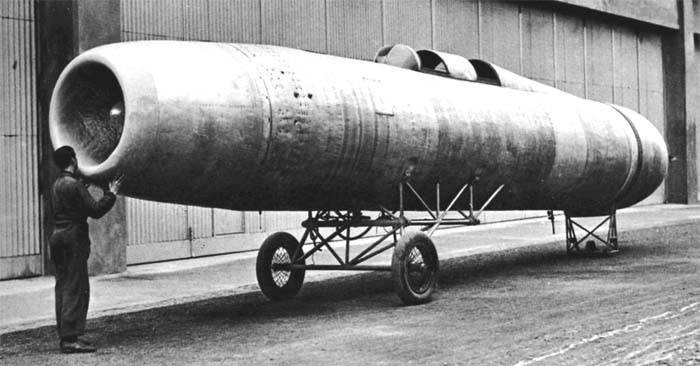
The Caproni Campini CC2 in an Italian Museum. It is the first jet airplane in History to have done a "regular" flight, because the German Heinkel He 176 & 178 were experimental jet-prototypes that did "tentative" flights of only a few minutes

Outside of Italy, the first studies for a turbojet engine date back to the 1920s thanks to the Englishman Frank Whittle and yet until the end of the 1930s no jet aircraft were built. The Italian Campini Caproni was started to be created in 1935.

Indeed on December 17, 1935, engineer Secondo Campini drafted a US patent (No. 2024274) for the construction of a jet plane, which unfortunately was not built. The deadline for the delivery of the prototypes was established on December 31, 1936, but due to some technical difficulties and mainly to increasing costs, the Undersecretary of the Italian Aeronautical government Department -General Valle- was asked to postpone to later dates.

Engineer Secondo Campini
However a fuselage was then built for static tests, preserved today at an Italian Museum, and the engine, which gave a fixed point thrust of about 700 kg and two prototypes with military serial number MM487 and MM488 called "Campini-Caproni CC2" (sometimes called "Campini Caproni N1") were then prepared. This delay allowed the Germans to "anticipate" the first flight of a jet aircraft!

So, in June 1939 the german "Heinkel He.176" rocket plane flew for a few minutes, followed in August of the same year by the Heinkel 178 driven by a jet engine with centrifugal compressor, while only in August 1940 the Campini Caproni flew.

This unique aircraft is therefore one of the first in the world to have flown with jet propulsion. The aircraft, with hybrid propulsion, was defined as a "motor-reactor" because it was driven by a reciprocating engine that operated an axial compressor and by an afterburner through which the air flow, previously accelerated, was mixed with fuel and then burned causing propulsion jet.

Certainly far from a traditional jet engine - composed of compressor, combustion chambers, turbine and exhaust nozzle - this aircraft must be counted among those that contributed to the subsequent development of aviation technology.


Indeed Campini's engine used an ordinary piston engine to compress air which was then mixed with fuel and ignited.

Modern jets are based on the turbojet principle, but Campini's jet was nevertheless a true jet, since it was the reactive force of the burning exhaust gases that pushed the plane along.

However the Italian aircraft designer Luigi Stipa (1900-1992) contended that his "Stipa-Caproni" experimental aircraft, a ducted-fan design of 1932, was the first aircraft to employ what he called an "intubed propeller" -- essentially the motorjet principle -- and that he therefore deserves the credit for the invention of the jet engine. The Caproni-Campini N.1 (or CC2) did employ many of the principles first tested in the Stipa-Caproni aircraft, albeit in a more advanced form.

Caproni built the Stipa aircraft, as per the Regia Aeronautica requirements, at their plant near Milan in 1932. The unusual design caused a number of sceptical comments and the original design intention of increasing the efficiency of the propeller by reducing the losses was generally misunderstood. The wide fuselage was practically a tunnel with a profile similar to the wings. And could have been considered to be a "circular wing". A 120 HP Gipsy III engine was mounted inside a tapered duct driving a two-blade tractor propeller, in effect utilising the Bernoulli Principle related to fluids moving in a venture duct. Stipa idea was, in fact, an important step towards the achievement of jet propulsion.

Princetown University Press published "High Speed Aerodynamics and Jet Propulsion" in 1959 and in Vol. XII stated: "The Stipa Aero plane built by Caproni in 1932 should be classified as a Jet Aircraft. 'The Stipe Aero plane can be considered as a predecessor of the Jet Aircraft of today". In this video can be seen the "tube-engine" typical of jets:https://www.youtube.com/watch?v=xYqr2h_xQRk

The Regia Aeronautica however, decided that the advantages of the duct fan were not sufficient to continue with the development and the project was dropped. Stipa was called to France in 1938 to develop his "Stipa 203" fighter, but the start of WW II ended this project. He patented the principle of the "pulsating jet engine" in 1938 in Italy, Germany and the United States and remained convinced to his death in 1992 that the Germans used his patent to develop the famous "V-1" engine (bombing London).

The "unusual design" of the Caproni-Stipa in 1932 (read: http://www.seqair.com/Hangar/Zuccoli/Legends/StipaNotes.pdf)

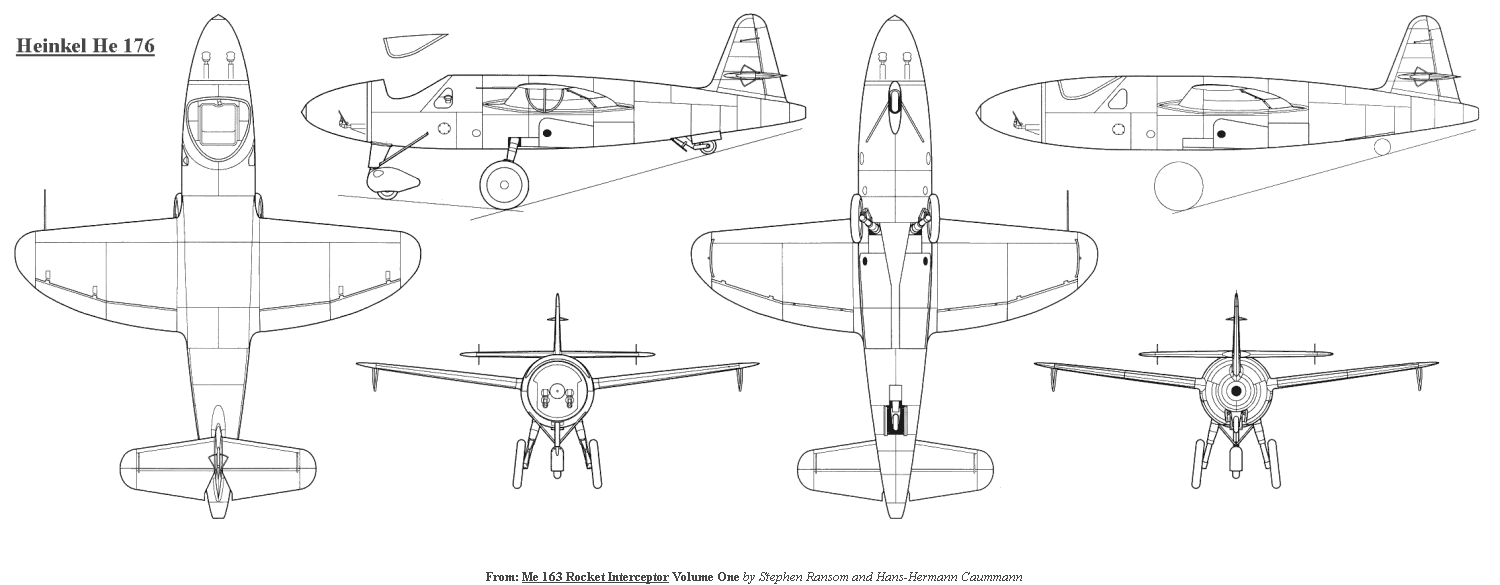
We have to pinpoint that the story of the Heinkel He 176 rocket powered aircraft has been clouded in mystery and incorrect information for many years. Only in the last few years have some of the real facts emerged. Although there had been a few german rocket powered planes earlier (Espenlaub's E 7 and the Opel-Sander Rak-1), these both used solid fuel rockets.The He 176 was to be the first aircraft in history to fly using only liquid-fueled rocket power. A proposal was first put forth in Berlin in May 1935 by Major Wolfram von Richthofen to develop a rocket-powered interceptor for the use against high flying bombers. This led to the Heinkel He 176 prototype, and eventually the Messerschmitt Me 163, the world's first rocket-powered combat interceptor.Design work was begun in late 1936, with detailed engineering drawings being completed around July 1937. Construction of the prototype began at the same time.

The first official flight of the Heinkel He 176 V1 was on June 20, 1939 flown by Erich Warsitz. On the next day, June 21, the He 176 was demonstrated in front of some german leaders (Ernst Udet, Erhard Milch). Udet was not impressed, and prohibited further tests due to the inherent dangers of rocket flight. This ban was twice lifted and twice issued again until July 3, 1939, when another demonstration was arranged at Roggentin for Adolf Hitler and more of the Third Reich leadership. An official order was issued on September 12, 1939 terminating any further work on the He 176 project.
On 27 August 1939 the Heinkel He 178 became the first aircraft to take to the skies powered entirely by a turbojet engine: the He 178 first took to the air on 24 August 1939, when it left the runway for a short time, but its first proper maiden flight came on three days later. This flight was only a partial success, as the engine was badly damaged by a bird strike soon after take-off, but the test pilot, Erich Warsitz, still had time to make a circuit of the airfield and land safely without power. The second test flight didn't come until 1 November 1939. The engine had been modified to produce the HeS 6, which produced 1,300lb of thrust, giving the aircraft a top speed of 373mph. This second flight was observed by a number of senior figures in the Luftwaffe and German Air Ministry, including Udet, Milch and Lucht, but despite the aircraft's obvious high speed there was very little official interest until the end of the year. The German Air Ministry had its own jet engine development section, and wasn't interested in private developments, at least until the then head of the department moved on.

His successor was more encouraging, but even then work on the single engined He 178 V1 soon came to a halt. Heinkel produced a design for the model V2, which would have had a retractable undercarriage and new wings, but this aircraft probably never flew. Instead work moved onto twin engined aircraft, with the Heinkel He 280 and finally with the famous Messerschmitt Me 262.

The first flight of the He 178 came almost exactly one year ahead of that of the Italian jet aircraft, the Caproni-Campini CC2, and twenty months ahead of that of the second turbojet aircraft, the British Gloster E.28/29, which took to the air on 15 May 1941.
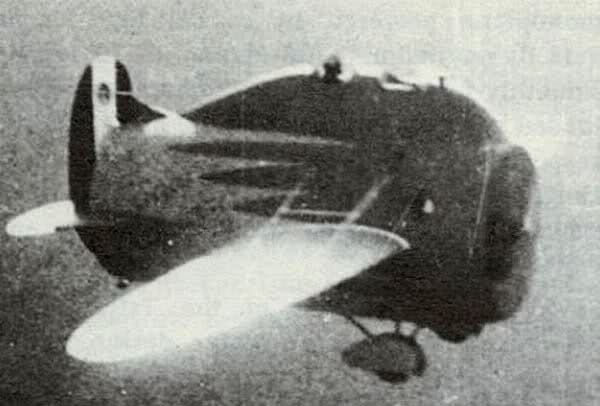
Finally we have to pinpoint that the further development of the Italian jet design was shown in the futuristic (for those years) shape of the controversial "Reggiane Re2007" (read https://aviateur01.skyrock.com/485122705-Les-avions-a-reaction-le-Reggiane-Re-2007.html ).Even if initially studied as a pre-project in 1942 (after the Caproni Campini CC2's flights), this Reggiane "caccia" (jet-fighter) was well ahead of his time. Secondo Campini, having formed a partnership with another Italian aircraft company (Reggiane) and aircraft designer Roberto Longhi, commenced work on an entirely new design: the Reggiane Re2007. This was a significant departure from the Campini Caproni N.1, including the successive decision to abandon the indigenous Italian engine it used in favour of a German-provided counterpart: the Jumo 004 reactor. At the moment of Italian armistice in September 1943, this project of engineer Roberto Longhi was ready at 70%, according to historian Piero Baroni (read: https://books.google.com/books?id=N3jPv-yONNoC&pg=PA263&lpg=PA263&dq=reggiane+re.2007&source=bl&ots=ZlwbV7SV2j&sig=ACfU3U00axqn8INfTH9zDoVP17Wh0m1Xew&hl=en&sa=X&ved=2ahUKEwjt6OrqpLnhAhVD94MKHRulBeA4PBDoATAGegQICRAB#v=onepage&q=reggiane%20re.2007&f=false).

This Reggiane project began to be built in Reggio Emilia (Emilia-Romagna) in October 1943, while the search for materials soon after. The whole project was based on the essential contribution of the Germans: the Junkers JUMO 004 reactor was necessary to propel the plane. But the project did not progress until January 1944, because of the lack of information on the performance and structure of the machine (read http://www.reggiane.info/lang1/description-7.html). The project was never completed because of the difficult relations between German and Italian authorities: the two Jumo 004 reactors requested were sent to Italy, but too late to adapt to the plane that had already been built, before the German-Italian forces did surrender in spring 1945. That said, the plane could have constituted a formidable opponent for the Allied propeller fighters: flying at more than 1000 km/h, the plane could beat all his opponents in speed; indeed the best Allied fighters did not exceed 700 km/h. By being well armed, with four 20mm cannons in his muzzle, he could have been a formidable interceptor for the huge waves of Allied bombers flying in the skies of northern Italy: difficult to strafe, from a bomber it would have been even very hard to defend from this Reggiane Re2007 effectively. The defense of such devices was ensured at the time by machine gunners shooting at the vision of the aircraft, but it was difficult for a human being to have enough reflexes to shoot on a plane flying at nearly 1000 km/h.

Models of the "Reggiane Re2007" and the "Caproni Campini CC2"

However there are some experts who argue that this jet was a fake invention. They complain that no manager of the Reggiane has ever had knowledge of this project, but other experts argue that it was a secret project and only a few were informed about this Reggiane Re2007. Additionally historians like Baroni argue that the two Jumo 004 reactors were sent without doubts to Italy for an experimental fast aircraft (he wrote: "for what reasons if the jet was fake?"). The drawings were lost during the Reggiane factory bombing by Allies, but the pictures & drawings -made after WW2- are indicative of a modern jet. Anyway, what more strikes all of us is the similar shape with some Russian "Migs" of the late 1940s (like the Mig9 with a nearly identical tail, built in 1946; see https://www.smartage.pl/mig-9-pierwszy-radziecki-mysliwiec-o-napedzie-odrzutowym/).....and Baroni surmises that probably the remaining project documents were stolen, after the factory destruction, by some members of the Italian communist party (very strong in this region) and sent to the Soviet Union!

Conclusion

The first jets were Italian? The answer -in my opinion- is yes and no.

No, because undoubtedly the first jet flight was done as a tentative experiment by the German Heinkel He 176 in June 1939, even if lasted only a few minutes. Yes, because the first "real" flight (without huge experimental "risks") was done by the Italian Campini Caproni CC2 in August 1940.....and this jet did also a first "commercial" flight when later worked as a mail transport between the two main Italian cities (Rome and Milan).

Additionally we must remember that the Campini Caproni CC2 was a complete "operative" aircraft authorized officially to operate by the Italian government and that had a not-flying prototype assembled in 1936 (there it is still the original first "experimental" fuselage in an Italian Museum: http://www.airwar.ru/image/idop/xplane/cc2/cc2-1.jpg). While the German Heinkel He 176 was a prototype that was started to be designed & created one year later, in 1937: it was quickly used in a risky flight in June 1939, rejected by the German authorities after doing only four dangerous minutes take off from the ground.


The Caproni-Stipa first flight in 1932

Furthermore we have to remember that the first airplane to fly using the "ejection air principle" (the word "jet" comes from "eJEcTion") was the Stipa Caproni in 1932....so, as the Princeton University Press stated, "The Stipa Aero plane built by Caproni in 1932 should be classified as a Jet Aircraft.The Stipe Aero plane can be considered as a predecessor of the Jet Aircraft of today". In other words, if classified as jet aircraft that means that it was the first jet aircraft! However, I personally think that this opinion is "a bit excessive". But something can be taken for true.

Friday, March 1, 2019

A ROMAN COLONY IN SOUTHERN INDIA?

For many decades there has been discussions about the possibility that there was a Roman colony in southern India. Of course this was -if really existed, because until now there are no sure proofs and evidences of the existence of a settlement of Romans in India- only a trade location created for the huge commerce between India and the Roman empire.

Indeed the Peutinger Table, a medieval copy of a 4th or early 5th century map of the world, shows a "Temple to Augustus" at Muziris, one of the main ports for trade to the Roman Empire on the southwest coast of India. This and evidence of agreements for loans between agents, one of whom most likely lived in Muziris, and a rather oblique reference in the Periplus, all seem to point to a settlement of Roman subjects living in the region.


The most famous book about the presence of Roman colonists in India is "The Periplus Maris Erythraei: Text with Introduction, Translation, and Commentary" of Lionel Casson, published in 1989 (https://books.google.com/books?id=x5I4ZkR-VB4C&pg=PA11&source=gbs_toc_r&cad=3#v=onepage&q&f=false). In page 25 and 25 can be read the following:

At Muziris/Nelkynda there are unmistakable indications of a foreign colony. The clearest evidence comes from the Tabula Peutingeriana map. Nerxt to Muziris this map shows a building identified as Temp(lum) Augusti, "temple to Augusti"; such temple could only have been put up by Roman subjects living there

Almost as clear evidence is provided by the papyrus from the Vienna collection...it contains a reference to "loans agreements at Muziris", agreements between two merchants, one of whom very probably was resident at Muziris. And there it is an indication in the "Periplus" itself that points in that direction. The author states that Muziris/Nelkynda imported grain "in sufficient amounts for those involved with shipping, because merchants do not use it". The explanation can only be that the merchants "do not use it" because they are natives of the area and hence eat the local rice, whereas "those involved with shipping" are Westerners who prefer to eat what they have been accostumed to even though it means inporting it from thousands of miles away. These Westerners, permanently established, served as middlemen between their countrymen who arrived with the cargos and the local merchants

In the east coast at Arikamedu some two miles south of Pondicherry, archaeology has brought to light convincing signs of a colony of Westerners, an abundance of Roman pottery, especially Arretine ware, which reveals that its members were active since the first years of the first century on.....In addition, a passage in a Tamil poem attests to the presence of a colony of Westerners at a port on the mouth of the Kaveri river to the south of Arikamedu. It could well be that the Westerners resident in these places were chiefly engaged in forwarding goods not all the way to Egypt but only to associates stationed in Muziris/Nelkynda, who then sold them to the merchants from Roman Egypt.

There it is evidence for the presence in eastern India not only of Western merchants but of their wives as well...a statue found at Didarganj (a little north-east of Benares) portrays a young girl whose hairdo is strikingly similar to that on busts of Roman women of the Augustan period.

RELATED STUDIES & RESEARCHES

There are some studies about the possibility of the existence of one Roman colony (or more) in India. The best researches indicate that outside the extreme borders of their empire, the Romans created some small fortifications to defend the commerce of their merchants, mainly in the "Barbaricum" (as they called the areas populated by Germans & other tribes in Europe).

But also in the commercial route toward Asia the Romans made these small "castra": for example in the Farasan islands facing Yemen recently have been discovered the remnants of a legionaries cohort castrum, that was active in the first centuries after Augustus and that probably protected the area from pirates (https://books.google.com/books?id=gzJf1KgqrWQC&pg=PA80&lpg=PA80&dq=romans+in+farasan+islands&source=bl&ots=OkYC-Ssz-s&sig=ACfU3U07z3kMSckojzFPozE1H6VgACJ2DA&hl=en&sa=X&ved=2ahUKEwieruqaveTgAhWGylkKHbz0BK84ChDoATAGegQICBAB#v=onepage&q=romans%20in%20farasan%20islands&f=false. Some researches argue that something similar was probably created in the Socotra island, but nothing has been found until now; however it is possible: Roman control of the Farasan islands area was completely unknown until the 2004 publication of an inscription attesting to the presence of a detachment of the "Legio II Traiana Fortis" and auxiliary troops on the main island in 144 AD.

Furthermore Casson hinted that in order to defend the "Temple Augusti", located in the area of Muziris, probably some Roman legionaries lived there. Indeed southern India had "pirates", according to the famous Peutinger Table, and probably the Roman colonists -who Casson supposed had settled there- were protected by some kind of small fortification or castrum.


Indeed two are the India's city areas where it was more possible the existence of a Roman colony, between the first and fourth century during the heydays of the Roman empire: Muziris and Arikamedu.

MUZIRIS

"To those who are bound for India, Ocelis (on the Red Sea) is the best place for embarkation. If the wind, called Hippalus (south-west Monsoon), happens to be blowing it is possible to arrive in forty days at the nearest market in India, Muziris by name. This, however, is not a very desirable place for disembarkation, on account of the pirates which frequent its vicinity, where they occupy a place called Nitrias; nor, in fact, is it very rich in articles of merchandise. Besides, the road stead for shipping is a considerable distance from the shore, and the cargoes have to be conveyed in boats, either for loading or discharging. At the moment that I am writing these pages, the name of the King of this place is Celebothras". Pliny the Elder: The Natural History


Muziris was the "Primum Emporium Indiae" of the ancient authors like Pliny the Elder (who wrote just after Augustus times the above excerpt). It has been initially identified with modern Kodungalur or Cranganor (though the exact location of the harbor and city is not known, because of heavy alluvial deposition) in the Kerala State of southern India.

Later, a series of excavations were conducted at the village of Pattanam near Cochin by "Kerala Council for Historical Research" (an autonomous institution outsourced by Kerala State Department of Archaeology) in 2006-07: it was announced that the lost "port" of Muziris was found (https://www.thehindu.com/todays-paper/tp-national/Pattanam-richest-Indo-Roman-site-on-Indian-Ocean-rim/article16589683.ece), but some historians and archaeologists criticised this declaration. However, the last field report on the excavations (2013) explicitly shows Pattanam as Muziris (http://kchr.ac.in/images/img/pattanam_7th_season_handbook1.pdf).

Significant is the fact that abundant Roman coinage has come to light in Muziris area. Furthermore 80 % of these pieces of metal unearthed from the whole of India have been found in the Kongu country (Coimbatore plateau). Actually, more than two thousand Roman coins have been collected in this region, most of them ranging from the first century BC to the fourth century AD, principally from the reigns of Augustus and Tiberius.

A part of the raw glass imported to Muziris followed the same route and reached the urban centers of another area where large quantitites of raw glass have been found in excavations (particularly in Arikamedu). Ceramics such as terra sigillata found at Arikamedu, now datable to the early first century AD, have also been recovered at Kodumanal, Karur and Sulur in the Kaveri valley. Recently, sherds of rouletted ware were unearthed at Vellalur, near Coimbatore, also known for a Roman coin hoard. All these discoveries indicate a possible presence of Roman merchants (and their families) in the area of Muziris (in actual Kerala).

Indeed in Pattanam Mediterranean contact is represented by readily identifiable ceramic material, including a Dressel 2-4 amphora, as well as other finds of imported Roman amphorae and related fine wares. Such artifacts date from between the late first century B.C.E. to the fourth century C.E. Remnants of Roman glass bowls, fragments of painted glass objects, and glass pendants discovered at the site are also suggestive of personal belongings rather than merchandise: this additionally confirm the possible existence of a Roman colony in Muziris.

Finally we have to pinpoint repeating that evidence further supporting the supposition that Muziris may have had a Roman ‘merchant colony’ comes from the "Tabula Peutingeriana", a medieval map depicting the Roman world as it was in the first century C.E. This map shows a building marked as "Templum Augusti" (Temple of Augustus) at Muziris. Historians like Young argue that such a structure would have been built only by subjects of the Roman Empire, likely ones who either lived in Muziris or who spent a significant portion of their time there. Young further argues that the presence of foreign merchants is supported by the Periplus, in a passage that mentions “enough grain for those concerned with shipping, because the merchants do not use it.” These merchants who do not use grain are thought to be Indians who would instead have eaten rice, whereas ‘those concerned with shipping,’ are thought to have been resident foreigners.

ARIKAMEDU

Arikamedu, one of the emporia of Roman trade on India’s Coromandel Coast, has come to be regarded as essential for the study of overseas commerce with the Mediterranean world during the so-called “Indo-Roman” trade period – a term that has prompted some controversy.

Indisputable evidence for commerce with the Mediterranean exists in fragments of transport amphorae, cups and plates of terra sigillata, ceramic lamps and unguentaria, blue glazed faience and glass bowls found at the site. Two-thirds of the amphora fragments found at Arikamedu during the 1941-1950 excavations come from wine jars, suggesting that wine was a principal commodity sent to India from the Mediterranean. Many of the fragments originated in Roman Greece, from the island of Kos, though fragments of Knidian and Rhodian amphorae have been found as well. Fragments of Koan amphorae, originating in Campania, have led to the suggestion that wine from Greece was later supplanted at Arikamedu by an Italian production.

In addition to wine jars, fragments of Spanish jars for garum sauce and olive oil have been found as well. Sherds of terra sigillata, a slipped Roman ware, found in the 1989-92 excavations at Arikamedu and dated to the first quarter of the first century C.E., are thought to represent personal possessions, novelty items, or gifts. While typically considered part of the assemblage indicating resident foreigners, a sherd found with “megalithic” writing has caused speculation that some terra sigillata pieces were sold, bartered, or gifted to the local population.

Ancient Roman pottery found in Arikamedu, India
In addition to wine jars, were also identified a few fragments each of olive oil Jars from the Istrian peninsula in the northern Adriatic, suggesting thereby that south India had either developed a taste for such products or there was a demand for them among the members of Roman trading community resident at Arikamedu.

Arikamedu was "a trading station to which goods of Roman manufacture were imported during the first half of the 1st century AD", according to Peter Francis. For him, the buildings of the northern section of ancient Arikamedu were probably inhabitated by "non-Indians" (https://books.google.com/books?id=zzZBdGQN_TIC&pg=PA30#v=onepage&q&f=false).