Showing posts sorted by date for query 1933. Sort by relevance Show all posts

Monday, February 2, 2026

THE ITALIANS OF CRIMEA

This month I want to do a research about the "Italians of Crimea". Here it is what I found:

The Italians of Crimea (Russian: Итальянцы Крыма; Ukrainian: Італійці Криму) are an ethnic minority residing in the eponymous peninsula, with the largest concentration in the city of Kerch. 

At the beginning of the 19th century, actual Italian emigration to the Crimea came from various Italian regions (mainly Liguria, Campania, Apulia), with immigrants settling mainly in the coastal cities of the Black Sea and the Sea of Azov, as well as  in Odessa, Mykolaiv, Sevastopol, Mariupol, Berdiansk and Taganrog.

But the first Italians settled there since Roman times, when there was a client state of the Roman empire in Crimea. During the early Middle Ages this link disappeared, but with the development of the  commerce of the Italian maritime republics some Italians moved there.

Indeed as a result of the Fourth Crusade in 1204, the Crusaders (leadered by the Republic of Venice) seized Constantinople. This led to the formation of the "Latin Empire" in the Byzantine lands. This is what brought the Italians again to the shores of the Black Sea. Italian trading posts, founded by Genoa, Venice, and Pisa, arose in the Black Sea and Azov Sea regions.

One of the first trading posts was "Porto Pisano" (near modern Taganrog, located one hundred miles to the east of Crimea), founded by Pisa in the first half of the 13th century.

Indeed the first Italian settlements in Southern Russia were located on the territory of modern Crimea: the most famous cities that have preserved the memory of the Italians' presence in the remains of fortresses, architectural structures, and, undoubtedly, enchanting legends, are Feodosia (Caffa); Sudak (Soldaia); Novy Svet (Paradiso). For further info, please read Another peninsula: the Italians of Crimea.

Map of Crimea during the early Renaissance, showing the Genoa colonies


FEODOSIA (CAFFA)

In the late 13th century, the Genoese settled in Caffa (called also Kaffa), modern-day Feodosia, which became the largest port and trading center of the Black Sea region. The founding of Caffa is associated with the following legend:

"Merchants from the Italian city of Genoa took a liking to a strip of coastline at the site of the former ancient Greek colony of Theodosia. But Crimea already belonged to the Tatars, and the Genoese were forced to negotiate with them. The Tatars did not object to the Latins' desire to establish a trading post on the shores of Taurida.  They agreed on the following: the Genoese would cover a bull's hide, spread on the ground, with several layers of gold coins. That was the payment. As for the territory the Genoese were hoping for, they could cut the hide into strips, tie them together, and whatever area this rope encompassed would be their possession.

The Genoese agreed and paid the money. Then they invited skilled leather craftsmen. They cut the hide into the finest threads. Tying them together, the Genoese encompassed the territory where their trading post of Caffa was later located, with a population of 70,000 people. The length of the powerful defensive wall around Caffa was about five kilometers in total. Caffa, in terms of fortified area and population, was second only to Constantinople at that time."

Genoese Caffa existed for two centuries and was destroyed by Mehmed II in 1475. Some of the surviving Italians went to Akkerman, with which the Genoese had old trade ties, but their stay there was short-lived and sad: they were robbed and expelled by the local Turkish authorities, after which they scattered in different directions.

Another group remained in Kaffa, and there, "due to the absence of divine services and Latin priests, and also because their wives were of the Greek, i.e., Orthodox faith, they converted to the Greek rite." And if not all, then most of them became Orthodox, like the Greeks.

A third group of Kaffa Italians, those who were not taken by the Turks to Constantinople (they were settled in a special quarter called Chieffe-mahalasi - "Kaffa quarter," which was located near the palace of Constantine the Great), immediately dispersed in different directions. Some went to Circassia, "thanks to their wives, many of whom they took from those lands." Some moved to the court of the Crimean Khan. A special place was allocated for their settlement, located near Bakhchisarai.

Approximately 100 years later (in 1578), after the Turks settled in Crimea, the presence of Italians was noted in the southwestern part of the peninsula "on the way from Inkerman to Chersonesus, between a narrow harbor and the Euxine Sea there is an isthmus called Little Chersonesus (now called Belbek)." This group of Italians was made knights and nobles, exempted from paying taxes, and only obligated to accompany the Khan on campaigns. They were usually used as ambassadors when it was necessary to send embassies to Christian lands. Around 1604, they were resettled in Fecciale, half a day's journey from the Khan's residence. In their new location, they continued to enjoy the same privileges and benefits as the Circassians, with whom they had much in common in their daily life and customs. By the first half of the 17th century, a so-called "Tatarization" of this Italian group had taken place.

Fechella is undoubtedly the town of Fod-Sala or Foti-Sala, located on the Belbek River on the highway from Bakhchisarai to Yalta, 25 km from Bakhchisarai.

When Christians were expelled from Crimea in 1780, no one was expelled from Foti-Sala.

Already at the beginning of the 19th century, Italian immigrants settled again in Feodosia (Genoese Kaffa), forming a small but quite old group of Feodosia Italians. There was also an Italian street in Feodosia, "one of the most lively and significant in the city; at that time, Italians constituted an influential and very noticeable element in Feodosia. At that time, the Italian language was as frequently heard in Feodosia as Italian signs were common on taverns." A significant part of the families were Genoese.

Maximilian Voloshin recounted that he knew old men who remembered the famous Garibaldi, who sailed as a cabin boy on the Black Sea.

In connection with the Genoese in Feodosia, it is necessary to mention Voloshin's report that many of his schoolmates later completed their education in Genoa.

Most of the Feodosia Italians were merchants, but there were also several people among them who were connected with land and agriculture.

The 1917 revolution forced many, or almost all, Italians to leave Feodosia forever.

In Soviet times, the Genoese Street reminded people of the city's Italian past. And now the ruins of the Genoese fortress are one of the biggest attractions of Feodosia.

SOLDAIA (SOUDAK)

The Genoese fortress of Soldaia surpasses all medieval fortifications preserved in the Northern Black Sea region.

According to ancient legend, the city was founded in 212 AD. Archaeological materials found indicate that the city was founded by the Iranian-speaking Alan tribes. The name Sudak (in Greek sources - Sugdea; in Western European sources - Soldaia; in Russian sources - Surozh; in Eastern sources - Sugdak) comes from the ancient Iranian word "sugda" - "pure", "holy".

From the 6th century, the city, like all of Eastern Crimea, was part of the Byzantine Empire.

From the second half of the 7th century, it was under the rule of the Khazar Khaganate - the largest state of that time in Eastern Europe. This lasted until the end of the 10th century, when Sugdea again passed to Byzantium.

From the end of the 11th century, the city came under the protectorate of the Polovtsians, and in 1217 it was captured by the Seljuk Turks.

In the early 13th century, Sugdea came under the rule of the Golden Horde as part of the Crimean ulus. It was at this time that a fierce struggle unfolded for possession of the ports on the Black Sea coast between the Italian city-states of Venice and Genoa.

In the 1970s, the Venetians settled in Soldaia, creating their own trading post. The city was bustling with life. At the same time, they founded the Paradiso trading post, located not far from Soldaia, a former ancient Greek colony, modern Novy Svet. In the first half of the 14th century, after the establishment of the Muslim religion as the state religion in the Golden Horde, the Christian population was expelled from the city, and its walls were destroyed. Taking advantage of the internecine struggle that began in the Golden Horde in 1359, the Genoese seized Sudak in 1365. From this moment, the restoration of the fortress walls, public and other buildings began. Thus, the Italian name of the city, Soldaia, and the rule of the Italians, now the Genoese, were re-established. And the city came to life again. It was through the port of Soldaia that the famous "Silk Road" passed.

At the end of the 15th century, the Genoese were overthrown, and the city became part of the Ottoman Empire, leaving behind a centuries-old memory of the Genoese presence – the best-preserved remains of the Genoese fortress in the entire Northern Black Sea region.

VOSPORO (KERCH)

The Kerch group of Italians existed before the 1840s, primarily consisting of merchants. After old Odessa, it was the most numerous.

The "Chiesa dell'Assunzione" (Church of the Assumption) in Kerch. It is the place of reunion of the few surviving Italians of Kerch & Crimea.

As early as the 1840s, there was a dedicated Sardinian vice-consul in Kerch, suggesting that the group was quite large and engaged in lively trade relations. The Kerch group was systematically replenished by influxes of Italians from abroad, which continued until the 1880s. The peak years for the increase in emigrant numbers were 1863-1865 and 1869. Russia's recognition of the young Italian kingdom in 1862 significantly facilitated travel.

Until the 1860s, the majority of Italians arriving in Kerch were Sardinian subjects, most of whom were Genoese. Among them, a significant number of merchants engaged in foreign trade, mostly on a small scale, stood out. In the 1960s, primarily Italians from southern Italy flocked to Kerch. Among this wave were sailors and small-scale farmers: winegrowers, gardeners, and vegetable growers. These people, especially the last three groups, defined the character of the Kerch settlement, which was primarily an agricultural settlement.

The Kerch Italians were the oldest and only significant agricultural Italian group in Russia.

The largest number of Italians—Russian subjects (and later Soviet citizens)—were among the sailors, since the old law did not allow foreigners to work even in the commercial navy.

The more deeply the Italians became involved in local economic life, the greater the need to learn Russian. Mixed marriages became more frequent, although they were almost nonexistent among farmers and sailors. Their working and living conditions also brought them into contact with Russian schools. As a result, the Italians quickly became more closely related to the Russians. Even before 1960, many Italians from Kerch joined Russian merchant guilds. A number of Kerch Italians enrolled as bourgeois, and their sons entered Russian government service.

Instruction in the native language was nonexistent in the pre-revolutionary years. It was acquired at home and through interaction with fellow countrymen.

In 1917-1918, the opposite phenomenon was observed – an exodus of Italians from Kerch, which occurred in three directions. First, inland to the north; second, further eastward movement, a very weak trend; and third, a return to their homeland. This last process affected only those Italians who remained Italian citizens.

Regarding the situation with the native language after 1917, the following can be said. The older and middle generations spoke their native dialect, especially when only members of their respective groups participated in the conversation. The presence of the younger generation often meant that conversations shifted from Italian to Russian. The older generation could communicate, albeit with difficulty, in the common Italian language, especially those born in Italy or serving their military service there; their Russian was poor. The middle generation didn't speak common Italian. The younger generation often didn't even know their own dialect, speaking almost exclusively in Russian, which they were fluent in.

Denationalization played a much less prominent role in everyday life. Small details in dress, gestures, posture, and eating habits reminded us of Italian traditions. Songs and fairy tales brought from Italy had not yet been forgotten in this environment.

The Italians who remained after 1917 settled quite firmly in their places, and this applies to both Soviet and Italian citizens. In 1929, the Kerch Italian colony, according to rough estimates by local residents, numbered about 1,000 people of both sexes, adults and children.

Paradiso (Novi Sverth)

A village west of the Genoese fortress of Soldaia (actual Sudak), Novy Svet -also known as "New World"-, has a rich history that dates back to its ancient genoese name "Paradiso," meaning "paradise" in Italian language. It was founded by families from Italian Liguria, who introduced there the grape production (with a famous wine exported).

The village was mentioned in a document of the Genoa administration from 1449 and listed in the Record of Populated Places in the Russian Empire of 1864. It was likely an estate property of a manager or caretaker. The name "Paradiso" was later changed to "Novy Svet" after Prince Lev Golitsyn's visit to Russian Emperor Nicholas II, who renamed it in honor of the prince. 

Golitsyn's factory of sparkling wines, which is the main attraction of Novy Svet, was founded by him, and the town was built around it. The climate in Novy Svet is subtropical, with hot and dry summers, and the town is actually known for its sparkling wine production.

The XIX and XX centuries disappearance of the Italians of  Crimea

The Ottoman invasion was a huge tragedy for the Genoese and other Italians of Crimea. Most perished or were enslaved, others managed to return to their homeland, some took refuge in Ukraine or Circassia. 

But around 1783, 2,500 Italians immigrated to Crimea, which had been recently annexed by the Russian Empire from thev defeated Turks. They settled mostly in the Crimea's southern coast, where the Genoese had their colonies some centuries before. They prospered, reaching a population of nearly 20,000 in the "Ottocento" (XIX century): the Italian community in the province of Kerch amounted to 2% of the entire population according to Russian census data. Its growth rate was very high, so much so that some Italian-Crimeans even moved outside of Crimea to join the “sister” Italian communities also present in other Black Sea cities such as Odessa, Mariupol, Donetsk, Batumi and Novorossiysk.

Before the advent of the Bolsheviks, Kerch had an Italian primary school, a library, a meeting room and an Italian cultural club. Furthermore, the local newspaper Kerchensky Rabochij regularly published articles written in the Italian language. 

But in the XX century -after initial huge persecutions by Stalin in the 1930s- the remaining 4000 suffered terrible deportations during WW2.

The deportation of the full Italian minority in Crimea began on January 29, 1942, and those who had escaped the first round-up were captured and deported on February 8 and 10, 1942: the entire community, including the anti-fascist refugees who had settled in Kerch, was rounded up and forced to travel to the Gulags. Each person was allowed to take no more than 8 kilograms of luggage with them.

The Italian deportees reached Atbasar, only to be dispersed across the Siberian steppe between Akmolinsk and Karaganda, where they were met with temperatures between 30 and 45 degrees below zero, which decimated them. The Kerch Strait and the Caspian Sea were crossed on ships where the Italians were confined to the hold; one of these ships was sunk during a German bombing raid, and all the deportees on board perished. Due to the slow pace of the convoys, the journey to Kazakhstan lasted almost two months. Hundreds of deportees died during the journey, including many children.

Giulia Giacchetti Boico wrote: "The entire road from Kerch to Kazakhstan is watered with the tears and blood of the deportees or dotted with our dead, who have neither graves nor crosses."

Once they reached their destination, the Italians were subjected to summary trials and sentenced to prison terms of up to 10 years to be served in labor camps, where they remained imprisoned for several years after the end of the war. In the Gulags, the Italian community was almost annihilated by hunger, cold, disease, and forced labor. 

Of the approximately 1,500 deportees registered in the 1990s, after the dissolution of the USSR, only 78 managed to return to Crimea (official data from the Soviet Ministry of the Interior). Considering that several dozen Italians – mostly widows with young children – were unable to face the return journey and therefore settled in the Soviet regions of Central Asia, it is estimated that the total number of survivors was no more than 10 percent of the deportees.

Once back in Kerch, many of the Italians concealed their ethnic origin, and some obtained the Russification of their names. But within the community, families continued to meet and passed on the Italian language to their children and grandchildren. The tragic events instilled in the survivors of the deportation a fear of being recognized as Italians, so much so that even after the end of the Soviet Union, many direct witnesses of the deportation were reluctant to recount their experiences for fear of discrimination or retaliation.

In 2025 there are only 300 Crimean Italians (if interested in precise info, please read in Italian language:  https://web.archive.org/web/20110418213053/http://www.monarchia.it/download/Giulio_Vignoli_La_Tragedia_Sconosciuta_degli_Italiani_di_Crimea.pdf )


Photo of some Italians of Crimea, done in 2018 Kerch.The Italians of Crimea mainly live in Kerch, 200 kilometers from Simferopol, on a strip of land near the sea.  Caught in a geopolitical battle to which they were extraneous, they remained in their homes in that year, worried. Today (2025) there are 300 of them, but there was a time when there were over 5,000. Their history, which began with the Republics of Genoa and Venice, risked being swallowed up by the Stalinist purges. Many died between 1937 and 1938, and four years later they experienced deportation to Siberia: they were decimated by hardship and the Gulags. The survivors, in 1956, founded the community of people of Italian origin. - See more at:  Gli Italiani di Crimea: abbiamo paura di essere abbandonati - Rai News

The following are some excerpts taken from the book of Davide Berni, named "The Italian Minority of Crimea: History of a Diaspora between Emigration and Deportation :

After the Congress of Vienna in 1815, emissaries of Tsar Alexander I of Russia were sent to the Kingdom of the Two Sicilies to recruit settlers. This policy was especially successful in the province of Terra di Bari. In general, the colonists were attracted by the promise of good earnings, abundance of fish in the seas surrounding Crimea, fertile land to cultivate. The farmers and fishermen were soon followed by teachers, notaries, doctors, engineers, architects, merchants and artists. Among the immigrants, many were owners of boats with which they transported goods to the ports of the Sea of Azov (Taganrog, Berdyansk, Mariupol) and the Black Sea (Feodosia, Simferopol, Odessa, Kherson, Mykolaiv). Others worked as laborers on Russian ships.

In 1830 and in 1870, two distinct migrations arrived in Kerch from the cities of Trani, Bisceglie and Molfetta. These migrants were peasants and sailors, attracted by the job opportunities in the local Crimean seaports and by the possibility to cultivate the nearly unexploited and fertile Crimean lands. Italian general and patriot Giuseppe Garibaldi worked as a sailor at least twice in the region of Odesa, between 1825 and 1833. A later wave of Italians came at the beginning of 20th century, invited by Imperial Russian authorities to develop agricultural activities, mainly grape cultivation. 

Italians quickly settled into local society and the community expanded rapidly. Kerch had 13,106 inhabitants in 1855[and around 30,000 in 1870. In 1884, more than 1,000 people lived in the Italian colony, most of whom came from the Adriatic coast and were engaged in coastal shipping or earned their living as sailors and landowners of real estate. In Kerch, the Italians of Crimea built a Roman Catholic church, still known locally as the Church of the Italians. From Kerch, the Italians moved to Feodosiya (the former Genoese colony of Caffa), Simferopol, Mariupol and to other Imperial Russian seaports of the Black Sea, such as Batumi and Novorossiysk.

 After 1870, emigration stopped and many of those who had created a fortune returned to Italy. According to an 1897 census, 1.8 percent of the population of the Kerch province was Italian, and rose to 2 percent in 1921, corresponding to a population of approximately 2,000 people.

In 1914, when World War I broke out, the Italian community was numerous enough to have a primary school and a library. The local newspaper at that time, Kerčenskij Rabočij, used to publish articles in Italian language. But with the October Revolution of 1917, where the Russian Empire became the Soviet Union, a bitter period began for minorities in Russia. Italians of Crimea therefore started to face a lot of repression.

Of the approximately 2,000 people of Italian origin living in 1922 in Kerch (where were concentrated nearly all the Italians of Crimea), only 650 were "subjects of the Kingdom of Italy".and so received some diplomatic help, while all the others faced huge harassments.

Consequently, on the initiative of the former Italian communist deputy Anselmo Marabini, in 1924, according to the plans of "Soviet collective farming", the Italians were forced to create a kolkhoz, named Sacco e Vanzetti for the two Italian anarchists of the same name. The Italian collective farm was with 870 hectares of land and a herd of 80 cows, 200 sheep and pigs with  a dozen horses. The initiative received the full support of the Soviet authorities, but encountered strong resistance, especially among wealthy Italians in Kerch. Those refusing to comply were forced to leave or were deported. According to 1933 census, the number of Italians in the region of Kerch had already dropped by 1.3 percent.

Between 1936 and 1938, during Joseph Stalin's Great Purge, many Italians were accused of espionage and were arrested, tortured, deported or executed. In particular, 204 Italians were accused of spying for Italy and counter-revolutionary activity, arrested, tortured and summarily sentenced to years of forced labor in the gulags of Kazakhstan and Siberia, where most were exposed to cold, hunger and succumbed to fatigue. 105 Italians were sentenced to death by firing squad; 26 in 1937 and 79 in 1938. Many of their bodies lie in the mass graves of Butowo or Kommunarka. 29 Italians were shot in Butowo and eight in Kommunarka. 

Dante Corneli, Italian writer and anti-fascist, who fled to the USSR in 1922 and then spent 24 years in the Vorkutlag labor camp, spoke of over 2,000 Italian victims of the Kerch agricultural collective farm. In 1939, more Italians fled once their Italian citizenship was at risk of being lost, after the Soviet Union imposed its own citizenship onto those of foreign origin. After this, 1,100 Italians were left in Kerch and smaller amounts in other communities

With the outbreak of World War II and the invasion of the Soviet Union by the Wehrmacht in June 1941, the population of Italian origin residing there was declared an enemy of the people and, on the basis of a census carried out by the German Wehrmacht, was deported to Kazakhstan and Siberia in three waves of deportations for alleged collaboration with the enemy "for their own security".

On January 29, 1942, while Nazi-fascist troops were attempting to conquer present-day Ukraine, the deportation of Italians from Crimea began on the orders of Joseph Stalin. Approximately four thousand people were loaded onto cattle cars and transported to labor camps in Central Asia. Most died before reaching their destination, others perished under forced labor. Only a small number managed to survive.

 Today, about 300 deportees and their descendants live in Crimea. Unlike other minorities who lived in the region and suffered the same fate, the Italians have not been granted the status of deportees, nor has their citizenship of their country of origin been restored.

1955 photo of a group of Crimean-Italians

Actual situation

On 28 July 2008, under the presidency of Giulia Giacchetti Boico, the association CERKIO (Community of Emigrants in the Region of Krimea - Italians of Origin) was founded. 

Every year, on 29 January survivors and descendants of the Italian community gather on the Kerch pier for a ceremony in memory of the victims of the mass deportation of Italians in 1942.

On 12 September 2015, a delegation of the 'Cerkio' association (an organization that represents ethnic Italians in Crimea) led by its president, Giulia Giacchetti Boico, and Silvio Berlusconi (Prime Minister of Italy) met Vladimir Putin (leader and President of Russia) in Yalta. 

Following this meeting, the Russian president issued a decree recognizing the plight of Crimean Italians during the Stalinist regime.

Actually the Italian government is studying the possibility of giving Italian citizenship and pension to the few surviving Crimean Italians.


2015 photo of Berlusconi & Putin with Crimean Italians

LINKS

Vignoli,Giulio: "L’olocausto sconosciuto:lo sterminio degli Italiani di Crimea (Roma, 2008)"( web.archive.org/web/20110713064505/http://www.italianine

rimea/italiano.asp )

Monday, September 1, 2025

THE "FASCI ITALIANI ALL'ESTERO" OF LATIN AMERICA

I am following the topic about Fascism in Latin America (including French Canada) with this month essay about the Fascism between Italians, who were resident in these nations from the 1920s to WW2. The main orgabnization was the "FASCI ALL' ESTERO".

It is noteworthy to pinpoint that there it is little documentation on the origin of the Fasci. The bibliography consists of a few superficial works compiled by their organizers. See G. Bastianini, Gli Italiani all'estero (Milan 1939); C. Di Marzio, Il fascismo all'estero (Milan 1923); idem, ‘Fascisti all'estero’ in Civiltà Fascista (Turin 1928); P. Parini, ‘I Fasci italiani all'Estero’ in Il Decennale (Florence 1929), 406– 30; idem, Gli Italiani nel mondo (Milan 1935). There are only two recent scholarly works on the Fasci: E. Santarelli, ‘I Fasci italiani all'estero’ in Ricerche sul Fascismo (Urbino 1971), 123–66; E. Gentile, ‘La Politica Estera del Partito Fascista’, Storia Contemporanea, 25 (December 1995), 897–956.


Fasci Italiani all' Estero (Italian fascists in the world)

After the 1922 March on Roma, the Mussolini's fascist regime sought to exert social control over Italian communities abroad. This required the creation of an umbrella organization, the "Fasci di Italiani all’estero", within which the groups of fascists abroad that had emerged spontaneously between 1920 and 1921 could be brought together. The mission of the Fasci abroad was to create a feeling of community among Italian emigrants within the framework of Italy’s higher interests. They had their press organ: «Il Legionario», written in Italian language and published in Roma.

So, in the autumn of 1922, a loyal collaborator of Mussolini, Ottavio Dinale, agreed to represent the National Fascist Party (PNF) on a trip to South America. His goal was to find an outlet for Italian labor through the colonization of regions of Argentina, thus preventing uncontrolled emigration. Among other mandates, Dinale was responsible for promoting the Fascist Party and—possibly—founding local fascist groups. The goal was to organize fascism beyond Italy, and in this direction, in February 1923 the Grand Council decreed the establishment of a central office for the Fasci abroad within the secretariat of the PNF, tasked with "disciplining and directing" the fascist movement worldwide.

As written last month, Giuseppe Bastianini (one of the founders of Fascism) in late 1922 was appointed in Roma by Mussolini as head of the "Fasci Italiani all'Estero", a movement aimed at co-ordinating the activities of Italian fascists not currently living in Italy. He called on members to seek to diffuse proper Italian fascist ideals wherever they were living. This group soon gained a considerable following amongst Italian expatriates in the mid-1920s, mainly in South America. Indeed, in 1925 he submitted a report to the Fascist Grand Council claiming to have groups in 40 countries worldwide, most of them in Latin America. On 30-31 October 1925 the "Fasci all'estero" held its first congress in Rome. The next year Bastianini resigned in order to work as a diplomat. 

In 1928, Mussolini ordered the organization of Italian youth programs abroad and began to pay particular attention to Italian youth programs. There was a problem of how to “fascistizzare” Italian society and the control of Italian youth was a fundamental tactic. The creation of the Opera Nazionale Balilla (National Balilla Opera) in Argentina was fundamental for the fascist government to attract Italian youth. 

In 1937, “Il Legionario”, the official organ of the Italian Fasci abroad, spoke of Mussolini's network in the world which apparently counted 481 Fasci, 244 after-work sections, 171 Houses of Italy, 200 schools, both subsidized and government-run; furthermore, the regime's youth organizations abroad had 65,000 members. Some of these young members were offered to come back to Italy and know their roots for free.

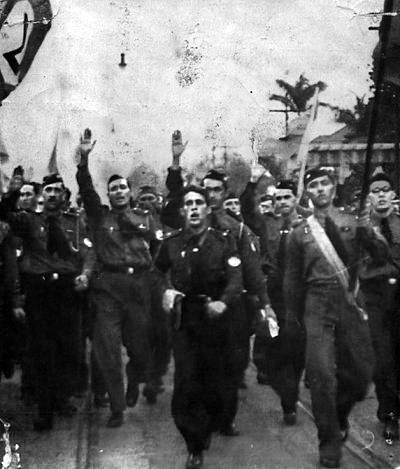
Italians of the "Fasci all' Estero" from southern Argentina donating a commemorative tribute to the "Monumento della Patria" in Roma's Vittoriale, in the late 1930s.


In early 1940 there were Fasci in all the Latin America countries (including Quebec-Canada, that had nearly one hundred members in 1939).

Indeed a huge amount of the activity of these Fasci was done in South America, mainly in Argentina and Brazil, the countries with the biggest Italian communities:

ARGENTINA

While there was never a completely fascist regime in Argentina, the influence of Italian policies and politics in Argentina was unique. There were Argentine politicians that supported Mussolini’s government and so, “like the Argentine state, Argentine society remained extremely receptive to Fascism between the years of 1919 and 1945. Finchelstein”. The fundamental reason for Italian interests towards Argentina was a result of the huge wave of Italian immigrants in Argentina, the most significant group in the whole of Argentina. Through I Fasci Italiani all’Estero (Italian Fascists Abroad), the different programs for Italian youth and adults, as well as the education reform for Italian schools abroad, Mussolini obtained the support of many Italian immigrants in Argentina. 

In 1933, there was the first fascist summer camp in Argentina and throughout South America. In the months of January and February, a hundred children of Italian origins participated in the camp. In 1935 there were 3 operating camps throughout Argentina and eventually also developed in Uruguay and Brazil. While the creation of a summer camp may not seem extraordinary, the influence of the summer camp had the potential to change the mentality of youth, towards loyalty to fascism, the homeland, and Benito Mussolini.

In 1930, Vittorio Valdini , the main financier of the operation and the leader of the fascists in Argentina, founded a new fascist newspaper, Il Mattino d’Italia, based in Buenos Aires. As fascism grew, its propaganda also grew.

Above all , Il Mattino d’Italia was a fundamental tool of fascist propaganda. According to the historian Bertagna, the initial edition of Il Mattino d’Italia consisted of around 10,000 copies. During the conflict in Ethiopia between 1935 and 1936, the newspaper reached approximately 40,000 copies 

Fascism was embraced by many Italians living outside Italy. Those who were pro-Mussolini did not characterize themselves ideologically; rather, their appreciation of Il Duce was framed within a kind of nostalgic nationalism that identified Mussolini as a redeemer of the homeland. Among those who fought in Ethiopia was a group of Italian volunteers from abroad who enlisted in the Parini Legion of Italian Fascisms of the East.

In Rome on August 6, 1935, less than a month before the start of operations to conquer Ethiopia, a military communiqué was issued, which, among other things, stated: "The formation of a sixth Blackshirt Division is hereby established, made up of Italian volunteers residing abroad and with battalions composed of amputees, veterans, and former arditi volunteers of the Great War. This division will be called Tevere (Tiber) and will be commanded by General Boscardi." The division's units were the 219th Italian Legion; the 220th Italian Legion; the 221st Italian Legion; and the 321st Italian Legion. With its four legionaries units, the 6th "Tevere" Division had 456 officers and 14,111 other ranks. The division's motto was "Molti nemici, molto onore" (Many enemies, so much more honor).

Italians residing in Argentina were also asked to participate as volunteers in the East African campaign. This Italian imperialist project convulsed the Italian community in Argentina like no other. Men who had nothing to do with fascism joined Mussolini's initiative, while others demonstrated their total rejection. The Italian-Argentine Community recruited a contingent of volunteers to participate in the Ethiopian campaign, composed of more than 700 men who departed in four successive waves. Argentina's case was not unique; the number of volunteers was larger in Brazil (around 1000) with a few from Uruguay (100), and even larger in French Africa.

In September 1936 these legionary volunteers from Latin America returned to Italy and paraded in Rome (https://patrimonio.archivioluce.com/luce-web/detail/IL3000020395/12/la-legione-fasci-italiani-all-estero-ritorno-dall-africa-orientale-sfila-via-nazionale-acclamata-dalla-folla-2.html?startPage=0) in a successful reunion with Mussolini.

Furthermore, from 1919 to 1925, approximately 372,000 Italians emigrated to Argentina. However, in 1926 the numbers began to decrease drastically and between 1926 and 1940 only 80.300 Italians immigrated. But even with the decrease the Italians & their descendants were approximately half of the Argentina population in 1940. And the fascist agenda in Argentina continued with the formation of programs such as the "Dopolavoro", the "Patronato del Lavoro", "Balilla (Gioventù Italiana Littorio nell’Estero)" and the control of some Italian schools mainly in the capital region.

In this year there were more than 4000 active members of the Fascio all' Estero in Buenos Aires: after WW2 (when Fascism was outlawed) they actively supported the rise of "Peronism" in Argentina. 


Argentina "Fasci all' Estero" (volunteers in Mussolini's Ethiopia conquest) parading in front of Mussolini in October 1936, when back in Roma.

BRAZIL

The first "Fascio" of Brazil, named after Filippo Corridoni, emerged in the city of São Paulo in March 1923 on the initiative of Emídio Rochetti, who was implicated in the murder of the Communist Party secretary of Macerata in Italy in 1921. Two months later, the "Pietro Poli" Fascio opened in Rio de Janeiro, and a year later, PNF (National Fascist Party) chapters were created in other centers of the country, also responding to the pressure exerted by Ottavio Dinale, who had been sent to Latin America for this purpose in 1923. In quantitative terms, the growth of such structures is, at first glance, significant. 

At the end of 1924, Mussolini himself provided, in a speech to the Senate, the number of forty units in Brazil (equivalent to a little less than a tenth of the total of Fasci abroad, an indication that, however, does not match those of other sources from the same period. In September 1927, their number rose to 52 and in 1934, according to openly partisan estimates, to 82, of which 35 were in the state of São Paulo, where more than 70% of the Italian population resided. Even leaving aside the accuracy of such indications, the sense of an extraordinary diffusion of Party structures weakens if we handle the partial and fragmentary data on registered members. In Rio de Janeiro, the number rose from 130 in 1924 to 1,000 in 1928 and to 1,100 in 1932; In Minas Gerais there were 700 on this last date, a year in which there were a hundred of them in Bahia; in São Paulo, they increased from 400 in 1924 to 1,745 in 1928 and to approximately 2,000 shortly after the mid-1930s. 

Considering that the states of São Paulo, Minas Gerais, and Rio de Janeiro hosted more than 80% of Italians, it is no exaggeration to state that, until the mid-1930s, the total number of registered Italians in Brazil never exceeded 5,000-6,000, a laughable number compared to the number of peninsular residents, which was 558,000 in the 1920 census, 435,000 according to reliable estimates in 1930, and 325,000 in the 1940 census. This inconsistency is also documented in the records seized from the São Paulo Fascio by Brazilian police in the early 1940s, which demonstrates that in 18 years of life, the total number of all affiliations of fascist Italians never exceeded 18,000, a percentage relatively insignificant compared to the adult Italian males residing in the city.

The proliferation of PNF sections in Brazil must, therefore, be related not so much to an effective capacity for rooting among immigrants, but rather to their territorial dispersion over a very broad area, which encouraged the establishment of Party structures – under the impetus of the consular corps or the ethnic elite – in every location where there was even a minimal Italian presence.

On the cultural front, there was a weak effort to open scholastic courses and a stronger one to promote theatrical performances, staged by amateur immigrant companies, sometimes during afternoons or evenings of dancing, in complete harmony with what had been a common practice in previous decades of the ethnic labor movement, especially of anarchist orientation. Ultimately, the organization of free time ended up representing one of the main concerns of the Fasci, who created musical bands, opened dance and singing courses, organized Sunday outings, a perfect copy of the popular trains in Italy, and promoted sports events, sometimes having their own facilities for these latter activities. The custom of creating summer camps was also widespread, and the insistence on such operations was motivated both by the importance of instilling Italian identity in the hearts of the children of immigrants born in Brazil—and therefore Brazilians to all intents and purposes, according to local legislation based on the principle of ius soli—or because of the awareness of the high propaganda value of these initiatives in the political sphere. The colonies and primary schools ended up being centers of indoctrination and proselytism.

The spread of the colonies was also supported by the Opera Nazionale Dopolavoro (OND) with such energy that it even placed Brazil at the top of the list of Latin American countries for these specific initiatives. In this sense, the ONDs ended up competing with the Fasci throughout the 1930s.

The overlapping of functions was objectively ineliminable, given that the directives given by the regime to the ONDs in the world were to provide physical and sports education for Italian workers, the institution of professional training courses, the organization of free time, patriotic propaganda, economic and moral assistance—that is, in a word, the task of "absorbing every manifestation of the life of our emigrant masses." 

Thus, even working in harmony with the PNF sections, of which they were partially projections and instruments in the eyes of the immigrants, the ONDs took over their space, especially thanks to the favor they found, not so much in terms of the multiplication of branches (19 throughout Brazil at the end of the 1930s) as in terms of registered members: in the city of São Paulo there were 1,500 in 1931, the year of their opening, 5,437 in 1934, and 7,100 in 1937 (while the Fascio members remained only a bit increased in the late 1930s).

In other words: the sport and social organizations of the Italian government were more followed than the Fascism politics of the Fascio all' Estero by the Italians and their descendants in Brazil.

Only with the rupture of diplomatic relations in January 1942 and even more so with the declaration of war in August of the same year would the definitive dissolution of Fasci be achieved, as well as the closure of Italian schools, associations and newspapers.


1936 photo of "Fasci all'Estero" from Brazil, parading in Roma's Vittoriale

Tuesday, August 5, 2025

FASCISM IN LATIN AMERICA BEFORE WW2 (AND UNTIL THE 1970S)

 A brief account of Fascism & fascist movements in Latin America in the 1920s, 1930s and 1940s:

The question of Fascism in Latin America (including French Canada) dates back to the 1920s and 1930s. Certain fascist-type movements emerged in Brazil, Argentina, Chile, Uruguay, Peru, Venezuela and Mexico, among others, while in Europe, Fascism was on the rise amidst an atmosphere of intellectual and political radicalism.

There was even a relatively small number of Italians in Latin America who were members of the "Italian Fascist Party", but this will be researched in another future monthly issue. And we must pinpoint that the Casa d'Italia (Italian House) Bulletin in Caracas wrote in 1939 that there were "Fascio all'Estero" in Caracas, Valencia, Puerto Cabello, Duaca, Santa Cruz de Mora (in the state of Mérida), San Cristóbal, Valera, and Villa de Cura (and that these organizations had more than 1000 members).

However it is noteworthy to pinpoint that the important fascist Giuseppe Bastianini in 1922 was appointed in Roma as head of the "Fasci Italiani all'Estero", a movement aimed at co-ordinating the activities of Italian fascists not currently living in Italy. He called on members to seek to diffuse proper Italian fascist ideals wherever they were living. This group gained a considerable following amongst Italian expatriates in the mid-1920s, mainly in South America. Indeed, in 1925 he submitted a report to the Fascist Grand Council claiming to have groups in 40 countries worldwide, most of them in Latin America.

 However the Italian fascists had a partially negative opinion of the fascist movements that were arising in Latinoamerica (please read and google-translate from spanish: https://www.academia.edu/64653626/Fascismo_en_Am%C3%A9rica_Latina_La_Perspectiva_Italiana_1922_1943_?email_work_card=view-paper ). The only major movement recognized by the Italian fascists as "fascist" was the Brazilian Integralist Action (AIB). Diplomats, publications, the press, and Ciano all expressed this view. Everything else that appears fascist, however, was viewed with skepticism or rejected. The documentation of the Italian Ministry of Foreign Affairs (MAE) was particularly forceful in this regard. Similar fascist movements, or those reputed to be such, that emerged in many countries during the 1930s, such as the Argentine Fascist Party (1932), the National Socialist Movement of Chile (1932), and the Mexicanist Revolutionary Action (1934), aroused more pessimism than hope among Italian observers.

 Another factor behind the development of forms of Italian Fascism in Latin America was the huge emigration of Italians in the region. Countries like Argentina had half of its population made of Italians and their descendants in the first half of the XX century.

We will now briefly review these movements in Latin America:

Argentina fascists in 1939: the "Fascio" of Buenos Aires had more than 4000 members. After the WW2 disappearance of Fascism, nearly all of them become fanatical supporters of Peronism


In 1922, the year Mussolini became prime minister of Italy, a reactionary and anti-communist group called "The Leopards" was founded in Colombia, inspired by the ideas of the Duce (nickname of Mussolini). In 1933, as Hitler consolidated his totalitarian regime, the "Golden Shirts" (called "Camisas Doradas" in Spanish) were founded in Mexico, an anti-Semitic and anti-Chinese movement inspired by the Führer's National Socialism. In Brazil, in 1932, the largest fascist group in Latin America, the Brazilian Integralist Action, was born, led by Plínio Salgado claimed as many as 200,000 member.  In 1937 many thousands of Brasilian fascists militants used the Greek letter sigma (∑) as the equivalent of the Italian "Fascio" and united under the motto "God, Homeland, and Family."

Imitating the Nazis, Brazilian fascists raised their right arms in greeting. Unlike the Germans, they added something extra to the greeting: "Anauê!", an indigenous Tupi word meaning something similar to "you are my comrade".  A short word to indicate that the Latin-American fascists were similar to their European friends, but not entirely the same. 

Of course, the country in Latin-America where Fascism was more followed and powerful -because it was the most populated by Italians- was Argentina. Even Uruguay experienced a similar situation.

Argentina

In 1919, the "Argentine Patriotic League" emerged in Argentina during the presidency of Hipólito Irigoyen. This event coincided with the rise of Fascism in Italy. The Patriotic League had a nationalist program that combined right-wing politics and liberalism in economics. It enjoyed broad support from the government, the military, the Catholic Church, and the upper class, and formed civilian paramilitary squads called "White Guards"  (similar to Mussolini's "Black Shirts")  to suppress strikers, anarchists, Jews, and Catalans. 

Vittorio Valdani, vice president of the Argentine Industrial Association, was charged by the Italian Fascist Party with organizing and directing Italian fascist groups in Argentina, creating in 1930 the main fascist press organ in South America, the newspaper "Il Mattino d'Italia", which was published in Italian language until October 1944.

"In order to disseminate the Fascist ideology abroad, different organizations were built up by Mussolini, most importantly the "Fasci italiani all’estero", which operated in many countries and had 8 million members worldwide. The local Fascio in Buenos Aires was the first to be founded on Latin American soil, even before the March on Rome in October 1922 and in the continental comparison also remained the most important. Further Fasci in other Argentine cities followed. Claiming the interpretative monopoly of italianità, which under fascism coincided with the Fascist ideology, the Fasci in Argentina tried to instigate patriotic sentiments and resuscitate emotional connections towards the former homeland among the otherwise ideologically heterogeneous Italian community in Argentina. Therefore, the Fasci engaged in the social, cultural and educational sphere, rivaling among others with the various traditional associations of Italian immigrants in Argentina, mostly of charitable, social or cultural nature. Katharina Schembs"

There were other fascist-type movements in the 1920s, such as the "Argentine Social League", whose objective was to fight modernism and tendencies they considered subversive. From 1930 to 1943 (the "infamous decade"), several dictatorships followed one another: Uriburo, Justo, Ortíz, and Castillo. In 1930, the coup-monger General Uriburo attempted to create a fascist regime, but failed due to opposition from broad sectors, including conservatives linked to the USA.

In 1923 was created the "National Fascist Party" (Partrido Nacional Fascista) of Argentina, a fascist political party that was directly linked to Mussolini. It had five thousand members in 1927 and was centered in Buenos Aires and Cordoba. 

In 1932 the "Argentine Fascist Party" (Partido Fascista Argentino) was founded\ by Italo-argentines, as a split from one of the factions of the National Fascist Party. The PFA was founded on the ideological and doctrinal basis of Italian Fascism, and in fact in 1935 it was recognized by the Italian National Fascist Party. In the 1930s the party became a mass organization, especially in the city of Córdoba. Nicholas Vitelli led the Córdoba faction of the Argentine Fascist Party until his death in 1934, when Nimio de Anquín took the reins of the party leading it towards a new orientation close to Catholic nationalism,

The "National Fascist Union" (Union Nacional Fascista) was a fascist political party formed in Argentina in 1936, as the successor to the Argentine Fascist Party. It was dismantled during WW2.

         Flag of the "Partido Fascista Argentino", created by the Italian-Argentine  Nicola Vitelli


Between 1943 and 1946, the so-called United Officers Group ("GOU") took power and imposed a dictatorship. Its main leaders included high-ranking officers Farrell, Ávalos, Vernengo, and Colonel Juan Domingo Perón. Before Perón prevailed over this group of officers, who at one point conspired, imprisoned him, and forced his retirement, masses of mostly workers demanded his release on October 17, 1945, and later prevailed in the 1946 elections.

It's important to note that Peron publicly admired Mussolini. His support for Mussolini is well documented, and during a trip to Europe in 1938 he said:

"Italian Fascism made people's organizations participate more on the country's political stage. Before Mussolini's rise to power, the state was separated from the workers, and the former had no involvement in the latter."

Payne emphasizes the fascist characteristics of Peronism, especially the years Perón spent in power between 1946 and 1955, but not the subsequent history of the "Peronist Party" as a mass labor union movement. Several scholars of the early stages of the Peronist movement argue that it shared many characteristics of Italian Fascism.

Although Perón's goal was to found a single party, it was never achieved in practice. Peronism enjoyed strong support from the Union sector and was based on a limited authoritarianism that tolerated pluralism. Germani defined Peronism as a "national populism," adding a populist approach to the discussion. Lipset, on the other hand, classified it as "left-wing Fascism," highlighting that its largely union-based social base could shift from right to left.

Brazil

In Brazil, between 1932 and 1938, a movement with fascist influences emerged, the "Ação Integralista Brasileira" (Brazilian Integralist Action, AIB), founded by the writer Plinio Salgado. The AIB was inspired by an anti-parliamentary, traditionalist, and monarchist Portuguese movement, known as "Lusitanian Integralism". It was an important mass political movement that at one point had more than 500,000 members and met virtually all the conditions of a fascist organization. However, the ruler Getulio Vargas, after flirting with the movement, finally demobilized and banned it under US influence during WW2. 

In Integralism, the attitude and production of its ideologues, its publications and propaganda, and its rigorously hierarchical structure tend to demonstrate its eminently fascist character, obviously in a different historical context. Integralism possesses characteristics of European fascist movements with certain indigenous elements, without being a simple replica of those movements.

 In the Italian fascist organizations, both immigrants and their descendants were accepted, such as in the case of the "Fascio di Sao Paolo", one of the main organizations of Italian fascism in Brazil. 

The Fascio di Sao Paolo was formed in March 1923 approximately 6 months after the fascists took power in Italy; it achieved huge success among the Italians of the city and rapidly spread to other cities and Italian communities. In November 1931, a branch of the Opera Nazionale Dopolavoro, which had existed in Italy since 1925, was founded in São Paulo and subsequently placed under the control of the Fascio di Sao Paulo. The Fascio was responsible for spreading the fascist doctrine among the popular classes. 

Another institution at the time was the Circolo Italiano di Sao Paolo which was established in 1910 and still active today. Its aim has been to preserve and disseminate Italian culture to Italian-Brazilians and Brazilians in general. In the mid-1920s, the fascist doctrine began to infiltrate the community and institution through the influence of Serafino Mazzolini, the Italian consul to Brazil

In 1927, it was reported that many in Brazil "felt strongly Italian" and supported Mussolini. According to that 1927 report, Brazil had 52 fascist groups, and by 1934, this number had increased to 82. Of these, 35 were concentrated in São Paulo alone. By 1938, there were nearly 100 Fasci groups in the country

Brasilian integralist in a 1935 Sao Paulo manifestation doing the fascist salute


Regarding Vargas's government from 1930 to 1937, it fluctuated between the anti-oligarchic "dictatorship" (1930 to 1934) and the constitutional-liberal government from 1934 to 1937; in the next stage, before the election of his successor, he carried out a coup d'état with the support of the Armed Forces and imposed an authoritarian and repressive system ("Estado Novo", 1937 to 1945); finally, Vargas was elected President of the Republic by universal suffrage in 1950 through the Brazilian Labor Party.

Under his successor, he carried out a coup d'état with the support of the armed forces and imposed an authoritarian and repressive system (Estado Novo, 1937 to 1945). Finally, Vargas was elected President of the Republic in 1950 by universal suffrage through the Brazilian Labor Party.

Uruguay

In Uruguay, a group of far-right intellectuals and politicians took advantage of the 1929 depression and began to criticize the executive branch for its poor handling of the economic situation. The Uruguayan economic elite founded the "Vigilance Committee" with the intention of promoting a change in economic policies. 

In Uruguay there was a huge Italian community (that was nearly one third of the total population of Uruguay) and the influence of Italian Fascism was very strong and important like in nearby Argentina (please read with google translation:.http://www.chasque.net/frontpage/relacion/9909/uruguay.htm).

Indeed elected President Gabriel Terra (an italo-uruguayan), who had already expressed fascist ideas, led a coup d'état and dissolved Parliament and the National Administrative Council in 1933. The "March on Montevideo" (similar to the March on Rome led by Mussolini) was called in support of him in April 1933.

Gabriel Terra's followers became known as "Marzists" due to their adherence to the "March Revolution," the official name of the coup. Elections were called for the Constituent Assembly that drafted the 1934 Constitution. The constitution, founded on corporatist principles, formally recognized the human rights to education, health care, and work, as well as freedom of assembly and association. Terra broke off diplomatic relations with the USSR and the Second Spanish Republic, recognizing Franco's Spain.

The "March regime" developed anti-immigration policies, such as controlling Jewish immigration and establishing a minimum of 80% Uruguayan labor in public works. Despite holding favorable opinions about the system, the 1934 Constituent Assembly rejected the full implementation of corporatism in Uruguay, considering it too radical.

Indeed during the Terra regime (1933-1938), several political leaders expressed their intentions to incorporate certain fascist premises into Uruguay. Gabriel Terra and César Charlone made no secret of their fascist sympathies. The latter emphasized the need to introduce corporatism into Uruguayan legislation, proposing "union pacts" and concepts of "the newest labor rights" taken from Mussolini's "Carta del Lavoro". These ideas were put into practice with the creation of the Higher Council of Labor in 1933, which required it to be composed of Unions that would enjoy legal status. 

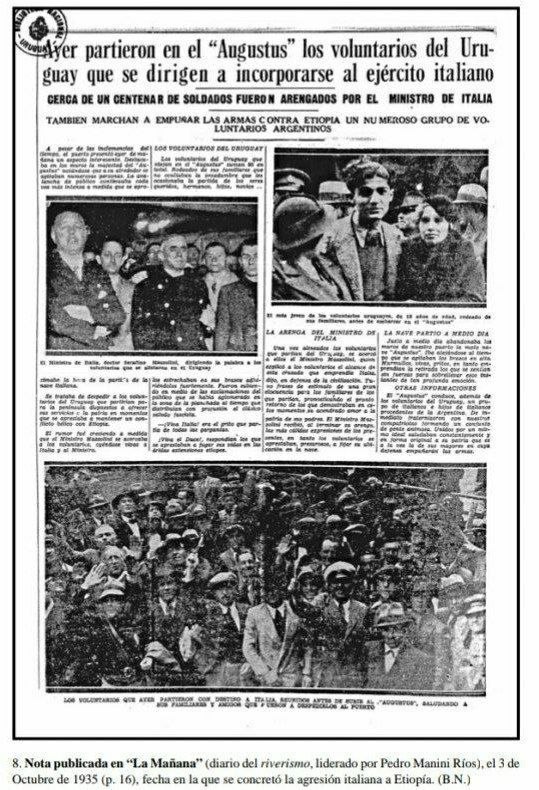
It is noteworthy to remember that president Terra allowed 100 Uruguayans to fight as volunteers in the Italian conquest of Ethiopia in October 1935. Terra was also the first south-american politician to recognize the Franco regime in Spain.

The Italian language acquired considerable importance in Uruguay in those years under Terra and his successors: in 1942, under the presidency of Baldomir Ferrari (who admired Italian Fascism), its study became compulsory in all the high schools of Uruguay.

Uruguayan newspaper showing the 100 Uruguayan volunteers who went to Ethiopia to fight for Mussolini's conquest of this African country in 1935. In the headlines there it is written: "Yesterday sailed in the Augustus (ship) the volunteers of Uruguay who go to unite to the Italian Army (in Ethiopia)...Nearly one hundred soldiers were enrolled by a Minister of Italy...Also, a huge group of volunteers from Argentina goes to fight Ethiopia with armaments "

Chile

The Fascist Party of Chile (PFC) was founded in 1932 by Carlos Keller. The PFC was inspired by Italian fascism and Spanish Falangism and promoted national unity, dictatorship, and corporatism. Unlike the MNS, the PFC had a more limited social base, composed primarily of intellectuals and members of the lower middle class.

Chilean fascism was characterized by its strong nationalism and authoritarianism. Fascist leaders emphasized the importance of Chile as a nation and the need for charismatic and authoritarian leadership to address the country's problems.

Chilean fascism championed corporatism, a system in which workers organized into their respective unions and participated in the management of the economy, and in which the antagonism between capital and labor was suppressed. Furthermore, Chilean fascism was openly anti-communist, which earned it the support of a significant segment of the Chilean population, who viewed communism as a threat to property and individual freedoms.

The Chilean Fascist Party participated in the 1938 presidential elections but was defeated by the Popular Front candidate, Pedro Aguirre Cerda. From that moment on, Chilean fascism lost ground and ceased to be a relevant political option in Chile.

Despite its short life, Chilean fascism left a lasting legacy in Chilean politics. The nationalist and authoritarian discourse it championed influenced the formation of later political groups, such as the National Union and the military dictatorship of Augusto Pinochet. Furthermore, some historians argue that elements of Chilean fascism are present in contemporary Chilean politics, especially in the populist and authoritarian currents that have emerged in recent years.

Furthermore , in 1933 Chile, a movement emerged that aspired to adopt the principles of Nazism. The National Socialist Movement of Chile, or Nazi Party (MNS), was created. The MNS was configured with a hierarchical command structure, which was completed in 1933 with the "Nacist Assault Troops." 

In 1938, before the elections, it organized a demonstration called "The Victory March." The following day, a group from the MNS took over the Workers' Insurance Fund and the University of Chile's main campus to launch a coup against President Arturo Alessandri and impose General Ibáñez on power. The coup failed, and the government ordered the execution of the insurgents. 

In 1939, the MNS was renamed the Popular Socialist Vanguard (VPS), adopting a leftist stance, which caused most of its members to abandon the party, which dissolved in 1942.

Mexico

In Mexico, especially after the economic crisis of 1929, groups of ultranationalists, xenophobes, or racists emerged, among whom one was anti-Semitic and another anti-Chinese.

The "Revolutionary Mexicanist Action"  (Spanish: Acción Revolucionaria Mexicanista), better known as the Gold Shirts (Camisas Doradas), was a Mexican fascist, anti-Semitic, anti-Chinese, anti-communist, ultra-nationalist paramilitary organization; it originated on March 10, 1934 in Mexico City and disbanded in 1936. It was led by Nicolas Carrasco, an admirer of Mussolini and Hitler.

The National Synarchist Union defended the values of Catholicism and anti-communism. It was inspired by the National Catholicism of the Spanish Falangist movement.

The Traditionalist Spanish Phalanx also emerged, gaining the support of Mexican President Lázaro Cárdenas, who facilitated the integration of Spanish Republican exiles into Mexico.

Peru

In Peru, the "Revolutionary Union" (RU) was created in 1931 by Sanchez Cerro, who admired Mussolini. In 1933, it was led by the Prime Minister of Peru -Luis A. Flores Medina- and became an openly fascist party that opposed liberalism and communism, and in particular the APRA party. They promoted xenophobia against Japanese and Chinese immigrants. They proposed a corporatist and totalitarian society similar to the model of European fascist movements of the interwar period. 

Beginning in 1933 and after the murder of President of Peru Sanchez Cerro, the Revolutionary Union propagated a resoundingly fascist discourse similar to that used in Mussolini's Italy. At the end of 1933, the "Blackshirt Legion" was created, comprised of youth, following the authoritarian line. Furthermore,  the RU promoted the rights of equality for women under the leadership of the Italo Peruvian Yolanda Coco Ferrero. She is considered one of the first feminist leaders in world History.

Indeed under the leadership of Luis A. Flores, who sought to mobilize mass support and even set up a Blackshirt movement in imitation of the Italian model (called "Camicie Nere" in Italy),  the Revolutionary Union successively planned a coup d'état which was discovered in 1937, leading to Flores exile in Chile.

Flores was allowed to return to Peru in the early 1940s and reorganized his political fascist party, which never achieved the same results it reached in 1936 and disappeared with the final defeat of Fascism in 1945 WW2.

Photo of funeral for murdered President of Peru Sanchez Cerro in 1933, showing behind the priest the leader of the "Revolutionary Union" (RU) Luis Flores (dressed with fascist black shirt) and the Italo Peruvian feminist RU leader Yolanda Ferrero (who was the first to equalize woman rights in Peru).


Bolivia

The governments of David Toro and Germán Busch were vaguely committed to corporatism, ultra-nationalism, and national syndicalism, but they lacked coherence in their ideas. Such concepts were later adopted by the "Revolutionary Nationalist Movement" (MNR), which openly acknowledged its ideological debt to Fascism and joined the military under Gualberto Villarroel's pro-Axis government in 1943. But after WW2 the MNR moved away from the defeated Fascism.

Because historically the Bolivian army contained some German advisors and German-trained soldiers, the President Busch (of part-German ancestry himself) was suspected to have sympathy for Fascism and have Nazi tendencies; this was reinforced by the fact that only a week after taking power in 1937, he had requested economic and oil advisors from the German legation. On 9 April 1939, shortly before his declaration of dictatorial rule on the 24th, Busch had spoken with Ernst Wendler, the German minister in Bolivia, to request "moral and material support" for the establishment of "order and authority in the state through [...] the transition to a totalitarian state form". To do this, Busch asked for German advisors in almost every field of government administration. 

While Wendler expressed interest, the final reply by the German government on 22 April cordially denied Busch's request, stating that it wished to avoid "conspicuous measures, such as the sending of a staff of advisors". The possible reason was the refusal of Bush to accept the racism of Hitler and accept the immigration of Jews into Bolivia while escaping from Europe in 1939. 

Furthermore from an initially oppositional stance, Óscar Únzaga's "Bolivian Socialist Falange" was an important group in the 1930s that sought to incorporate the ideas of the leader of fascism in Spain, the falangist José Antonio Primo de Rivera, in Bolivia. However, like the MNR, it gradually de-emphasized its faith in Fascism over time after 1945.

Paraguay

Paraguay has been often declared as "The paradise of the extreme-right fanatics in South America", because the first Nazi party in the Americas was created there in 1929, 4 years before Hitler took power in Germany. The ideals of Fascism were promoted in the capital La Asuncion by the relatively huge Italian and German communities of the country during the 1920s and 1930s.

Indeed the "Febrerista movement", active during the second half of the1930s, demonstrated some support for Fascism by seeking revolutionary change, endorsing strong nationalism, and seeking to partly introduce corporatism of Italian Fascism. Their revolutionary Rafael Franco-led government, however, proved decidedly non-radical during its brief presidential tenure in 1936. 

The Febreristas have since regrouped as the "Revolutionary Febrerista Party", that supported after WW2 the 35 years of the dictatorship of the Paraguay President Stroessner (a declared admirer of Mussolini's Fascism).

Ecuador

In Ecuador there was a small Italian community concentrated in Guayaquil (with nearly two thousand members), where was created an italian  "Fascio" in 1933 with 82 members. However politically Fascism in Ecuador was without importance in the 1930s.

Only in 1942 Jorge Luna Yépes formed the "Accion Revolucionaria Nacionalista Ecuatoriana" (ARNE) party, inspired by the European fascist political parties of the first half of the 20th century, particularly the Spanish Falangism of Francisco Franco. His party described itself as "nationalist, anti-communist and anti-capitalist".  During its existence it had an important political participation, both in the legislative and executive branches, being part of the government of Ecuador president José María Velasco Ibarra in 1944.

Panama

The Central American leader who came closest to being an important domestic fascist was Arturo Arias who in Panama during the 1940s, became a strong admirer and advocate of Italian Fascism, following his ascension to presidency in 1940. 

Arias in the 1930s was Panama ambassador in Mussolini's Italy and this fact led some historians to claim he was pro-Axis. During his presidency he created the "Doctrina Panamista" promoting  independence from the USA and some forms of fascist corporativism. As a consequence he was forced to resign by a coup  (probably ruled by Roosevelt) and go in exile in October 1941.

Costa Rica

 In Costa Rica there was a big community of Italians (nearly half a million descendants actually) and also a relatively huge of Germans, mainly in the San Jose capital's region.

The existence of figures who were sympathetic to Fascism and Nazism in high political positions has been pointed out in the administrations of León Cortés Castro and Rafael Ángel Calderón Guardia.

 Cortés,  having spent some time in Italy and Nazi Germany, was publicly viewed as an important sympathizer of Mussolini's Fascism. He was President fro 1936 to 1940 and during his presidency, he appointed as "immigration advisor" the German-Costarican Max Effinger, who restricted immigration for "Non-Aryans". In particular, he prevented many Polish Jewish refugees from entering Costa Rica

In the late 1930s, a movement which was sympathetic to Nazism developed among a large community of Germans. Supporters of Nazism (numbering 66 in 1939) met in a local German Club of San Jose, but during WW2 all Germans and Italians were sent to concentration camps for security reasons promoted by the USA .

Quebec (French Canada)

Among the right-wing nationalists in French Canada in the 1930s, the "National Social Christian Party" (NSCP) was founded. Its founder, Adrien Arcand, would be known as the “Canadian Duce/Fuhrer.” 

European influence, anti-Semitism, Christianism, and the Great Depression all played an important role in the expansion of extremist right-wing nationalism in Quebec. There were two main groups among the nationalists of the extreme right in the 1930s: the separatist group of Abbé Lionel Groulx, and the federalist group of Adrien Arcand.

Groulx was an historian and a teacher at the University of Montreal. Pro-separatist, Catholic, racist, and anti-democracy, he was very influential among his fellow ultranationalists. Groulx was the mentor of the radical nationalist group Les Jeune Canada (“The Young Canadians”). Also linked to his circle was the magazine L’Action Nationale and intellectual newspaper Le Devoir, which published anti-Semitic articles.

Adrien Arcand was a professional journalist. In 1929, he and his friend Joseph Ménard started Le Goglu, a satirical review. Later on, they added Le Miroir and Le Chameau. The three weekly newspapers served as a platform for fascist propaganda. When the economic crisis started to strongly affect Quebec, they announced the creation of a “proto-fascist” movement called the "Ordre Patriotique des Goglus". The Order held mass meetings promoting racism and proudly wore blue shirts with swastika logos. 

Pierre Trudeau -when young- was sympathetic with Fascism and promoted the French language as official in Quebec (French Canada) when was Prime Minister of Canada after WW2.


Recently the academic Esther Delisle wrote that Pierre Trudeau (Prime Minister of Canada and creator of bilingualism in French Canada) was sympathetic with Fascism, when was a young university student. She wrote that "In his memoirs, Trudeau remains mute on the anti-liberal and anti-democratic ideology of many of his Jesuit teachers at the college Jean-de-Brébeuf. He also fails to mention the support for Fascism and Nazism in Le Quartier latin, his membership of Les Frères Chasseurs/LX and the Bloc Universitaire and his deep attachment to La Laurentie that lasted into adulthood"). Please read:https://journals.uclpress.co.uk/ljcs/article/id/3154/ "Hidden in Plain sight: Fascism in Quebec during the Second World War", by Esther Delisle.

With WW2 all the fascist organizations in Quebec were outlawed and closed.

Colombia

The fascist-style politics of the conservatism of the "Leopardos" would be closely linked to the actions of the different elements of Colombian conservatism at the beginning of the 20th century.

These different ideological orientations would begin their career as fascist-style cultural and economic movements, eventually revealing their true purpose and minimally achieving their political goals and projects. They imitated practices of the fascist models that would triumph in Europe, such as those of Italy, but also of Germany and Spain.

The year 1936 saw the proliferation of Fascist and Falangist groups. In January, El Tiempo of Bogotá announced the creation of a fascist group called "Haz de Fuego" (Fire Beam) and the appointment of the Falangists from the "Primo de Rivera" center as its leader. Fascist groups were formed in Bogotá's universities. In Medellín, a military organization called "La Cruz de Malta" (The Cross of Malta) and another group with a clearly fascist character called "Haz de Juventudes Godas" (God Youth Beam) appeared. Under the auspices of the Antioquia's "Haz Godo" (God Youth Beam) were created, several phalanxes of university students, workers, "rearguard of children," and also a phalanx of women.

Some right-wingers promoted the formation of a right-wing organization separate from the Conservative Party, structured around a program directly inspired by Hitler, Mussolini, and Oliveira Salazar.

This led to the emergence of various support organizations for these fascist models, influenced by the results and support obtained as a political movement before WW2.

Venezuela

Dictator Gomez from 1908 until 1935 ruled Venezuela with a "colonial" dictatorship that had only a few fascist characteristics, mostly related to Germany's racism. He favored the "Blanqueamiento" (whitening) of the Venezuelan population, blocking the immigration of Chinese, Asian & African people into oil-rich Venezuela and promoting the creation of the Nazi party of Venezuela.

The Italo venezuelan Alberto Adriani, who was the creator of the famous "Sembrar el petroleo" phrase when was minister of Economy & Finance in 1936 Venezuela, in 1923 wrote:

"Fascism is not a passing episode. It has its roots in the purest Latin and Italian tradition. The fascist state is the Roman state that the Church maintained in its ironclad organization; the same state as Machiavelli's "The Prince." Despite the diversity of starting points, the same results are reached as with liberalism. For Fascism, the nation is paramount; it accepts freedom from a national perspective; it desires equality, but focuses on possibilities; it wants, if possible, to turn the entire country into a vast aristocracy, but it refuses to destroy the elite to place everyone at the level of the least" A.Adriani (please read for complete info: https://albertoadriani.substack.com/p/liga-de-naciones-y-fascismo).  

In 1939 there was an Italian "Fascio" in Venezuela with more than one thousand Italian members, of which 200 were in the capital Caracas:  this fascist organization was ordered to be closed in 1941, following political pressures from USA's president Roosevelt (please read https://lombardinelmondo.org/italiani-venezuela-fascismo/ with google translator from Italian language).

The renowned writer and key figure of the literary "Magical Realism" movement of Venezuela, Arturo Uslar Pietri (whose mother was Italian), held pro-Axis and anti-US sentiments, attempting to sway President Medina Angarita towards aligning with Germany and Italy during the beginning of WW2. Subsequently, Pietri went on to serve as a senator and establish the Nationalist party known as the National Democratic Front (Frente Nacional Democrático). 

A noteworthy detail of fascist Venezuelans is that Ettore Chimeri, recognized as the first Venezuelan to compete in Formula 1, was a member of Squadron 73 in the Royal Italian Aeronautics during World War II, serving in the African campaign.

Enrique Parra Bozo, who was noted for his admiration of Franco & Mussolini as well as his Catholicism and anti-communism, led the Partido Auténtico Nacionalista along Fascist lines. The group lent its support in the 1950s to the military regime of Perez Jimenez and even attempted, though unsuccessfully, to nominate him as their candidate for the 1963 presidential election.

Conclusions:

In short, there is no doubt that during the 1920s and 1930s, fascist models emerged in Latin America that mimicked Italian, German, or Spanish Fascism, in some cases a minority, such as "Nacism" in Chile, or broad and well-rooted movements such as "Integralism" in Brazil or "Marzism" in Uruguay, clearly founded on European interwar Fascism. 

However, in no case were these truly consolidated fascist regimes. The Italian fascist government always "separated" himself from these movements and created a fascist organization only for Italians residents in Latin America & the World: the "Fascio degli Italiani all'Estero" (the "Fascism of Italians in the World"). It promoted mainly the italianita' (italianity) in Latin America, while obtained only the official use of the Italian language in Uruguay's schools and the participation of hundreds of Argentine & Uruguayan volunteers in the Italian army (during the Italian conquest of Ethiopia).

The case of Peronism is special, because presents native complexities as it is a populist movement with fascist features, based on Trade Unions, which has a broad mass base, and which brings it closer to a left-wing Fascism, but accepting pluralism at first to a greater extent and then to a lesser extent, as it shifted toward repression in its final stage.

The Second World War sealed, in a certain sense, the fate of the Fascism overseas in Latin America. Patriotic pride of Italy was followed by the humiliation of defeat. But the fascists did not disappear, nor did they lose prestige. Nor did the corporatist ideology, anti-Americanism, distrust of democracy, and the cult of the leader that these Italians and their descendants had professed disappear, and which merged with other ideologies in the rhetoric and practice of subsequent populisms (like Peronism in Argentina).

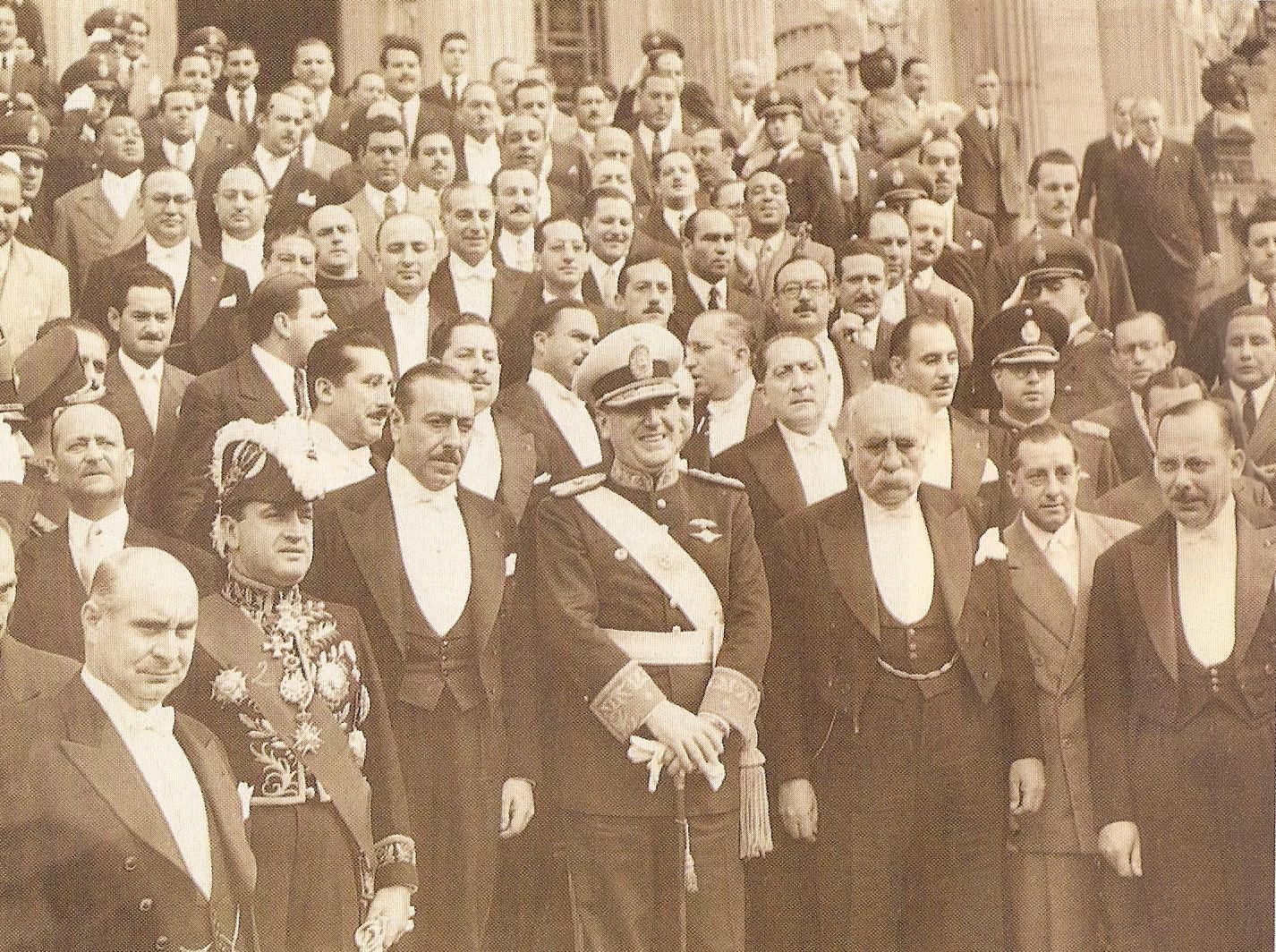
Juan Domingo Perón (in the photo center), President of Argentina from 1946 to 1955 and from 1973 to 1974, admired Italian Fascism and, according to some authors, modeled his economic policies on those followed by fascist Italy.


Latin America dictatorships and Fascism until the 1970s.

Some academics identify a group of dictatorships in Latin America with Fascism (for furtherr info read http://www.loeser.us/flags/hate.html#top) :

According to them, the first dictatorships in Latin America classified as fascist were those imposed in the Dominican Republic by Rafael Trujillo, giving rise to "Trujillismo" (1930–1961), in El Salvador by Maximiliano Hernández Martínez, giving rise to the "Martinato" (1931–1944), and in Nicaragua by General Anastasio Somoza, giving rise to what is known as "Somocismo" (1937–1979). 

All three imposed types of state without the possibility of political opposition, which extended over several decades, with the support of the United States and the economic elites, characterized by an ideology with a marked anti-communist accent, profoundly liberal in economics, and repressive of union, student, indigenous movements, and politicians with social justice programs. 

The first dictatorship in Argentina also dates from that early period, explicitly -according to them- inspired by Italian Fascism, led by General José Félix Uriburu (1930-1932), whose aim was to prevent the Yrigoyenist Radicalism, with its broad popular base, from governing the country, an objective which it achieved although it did not manage to consolidate its hold on power.

Furthermore, certain dictatorships sparked a widespread debate about whether or not they constituted fascist regimes after WW2

In this group, we include the coups d'état in Brazil (1964), Uruguay (1973), Chile (1973), and Argentina (1976). Many scholars questioned how similar or different they were to the dictatorships of historical interwar fascism.

In Venezuela the dictatorship of Perez Jimenez (that had some characteristics of a moderate Fascism) lasted from 1952 until 1958 and promoted the "Europeization" of the country allowing nearly one million emigrants from Europe to reside in Venezuela (that had only 5 million inhabitants in the early1950s).

In 1959 took control of Cuba the communist leader Fidel Castro, who in his youth was an admirer of Mussolini, according to one of his teachers at the Colegio Belén, the Jesuit priest Armando Llorente.

According to Tzeiman, the 1960s, following the impetus of the Cuban Revolution, witnessed a growing intensification of class struggle in various parts of Latin America, whether through national-popular or socialist political movements. This climate of radicalization spread throughout the early 1970s. The military coup that took place in Chile in 1973 initiated a wave of dictatorships that would spread to other Latin American nations. 

Thus, by the end of the 1970s, the southern cone of Latin America was invaded by military dictatorships whose establishment acted as a brake on the aforementioned popular advance. Cueva paints a bleak picture of the 1970s. Brazil's military dictatorship seemed fully consolidated after twelve years. In Bolivia, the Banzer dictatorship seemed to have imposed a stable pro-imperialist order. Uruguay and Chile were suffering the effects of the fascist regimes established since 1973; while in Argentina, the government of Mrs.Estela Martínez de Perón was dying, giving way to the dictatorship of General Videla. And in Uruguay, the Stroessner tyranny had remained unshaken in power since 1954. 

In 1971, Nicos Poulantzas, who studied the processes of fascistization, examined these processes, concluding that, amidst the imperialist phase and class struggle, Fascism arose from a political and ideological crisis of the ruling group that generated a new hegemony of monopoly and financial capital. It is a political reaction to reinvent itself as a hegemonic power. 

In other words, this bourgeoisie, in the midst of a crisis, "changes its clothes" and presents itself to the masses as the "solution," which includes elements such as order, corporatism, nationalism, and stability. Its displacement culminates in the obliteration of the opposition and the emergence of a fascist police state. 

According to O'Donell, some of the inherited characteristics of historical Fascisms in Latin America are: hierarchical social organization, political exclusion, repression of the popular Marxist sector, suppression of foreign citizenship and participation, reconsideration and defense of the nation, violent elimination of dissent, patriotic and militarized discourse, promotion of Catholicism with Latin History & Culture links and  -of course- sympathy for European Fascisms (mainly the Italian).


1936 photo showing in Roma the "Legion of Italians emigrants" (Legione Italiani all'Estero)  parading in front of Mussolini (who was saluting them), after their return from conquering Ethiopia.  Nearly all these "Legionaries" were volunteers Italians and Italian descendants from Argentina, Brasil, USA, Paraguay, Chile and Uruguay.