Sunday, April 4, 2021

CENTAURO DIVISION TENTATIVE TO INVADE ALGERIA IN 1943 KASSERINE PASS BATTLE

Only a few historians remember an episody of World War 2: the Axis attack inside Algeria during the famous Kasserine Pass Battle of February 1943. This was the only time when Algeria (in 1943 a french territory nicknamed "Algerie Francaise") was invaded -even if in a minimal "area"- by the Italian-Germans under Field-Marshal Rommel leadership.

Official US Map showing with red arrows the Centauro attacks toward Tebessa (and Bou Chebka) in eastern Algeria, on the red "Line of February 24"
The American force in the region was the II Corps, spearheaded by the 1st Armored Division. In charge of the Americans and operating semi-autonomously was Lieutenant General LLoyd Fredendall. He chose to command his corps from Tebessa, some 80 miles to the rear of his forward units (after the debacle of Kasserine Pass battle, Fredendall was relieved of command of II Corps by General Dwight Eisenhower, the Supreme Allied Commander in North Africa, and replaced by Major General George Patton on March 6, 1943).

In the Axis, Rommel began to cherish the dream of a spectacular action of all his forces towards Tebessa to try to reverse "the bulk of the allied troops from Algeria". The "Desert Fox" (nickname of Rommel) tried to force Kasserine's Pass in order to finally point to Tebessa. However, Hitler and his generals thwarted these plans as they were reluctant to embark on an action of this magnitude. Rommel was furious: he contacted the Italian Supreme Command which only on the evening of February 18 gave the go-ahead for the operation with italo-german armored divisions. However, the attack had to be conducted towards Thale and El Kef instead of Tebessa. According to Rommel, this decision was "an incredible example of myopia" The British Sixth Armored Division with numerous contingents of US infantry and artillery in support was positioned in Thala.

On the 20th, the german 10th and 15th Panzer Divisions with the italian 131st Armoured Centauro division conquered the Kasserine Pass inflicting a very heavy series of losses on the American troops. Over 4,000 Americans were taken prisoner, 200 wagons and hundreds of vehicles were burned, illuminating the African night, while the Axis units hoarded all kinds of rations and armaments that these inexperienced soldiers had at their disposal. Eisenhower enraged by the great defeat replaced Fridendall with the energetic Patton. Complete victory was now within reach: American troops faltered and fuel depots and warehouses began to be burned in the rear (mainly at Tebessa).

In terms of kilometers, the Kasserine Pass battle represented the largest defeat of US forces in all World War II, pushed back 140 km in a single week. But on this occasion, however, Rommel decided -for reasons that are still debated by historians- on late February 23/early February 24 to retire and return to the frenzied "Mareth line" in southern Tunisia.

Centauro tank destroyed, inspected by US troops after the Kasserine Pass battle


The Italian "131st Armoured Centauro Division" attack

The Centauro Division was composed of the:

131st Tank Regiment (13th, 14th & 15th Armored Battalions, with M14/41 tanks)
5th Bersaglieri Regiment (14th, 22nd & 24th Bersaglieri Battalions)
131st Artillery Regiment
132nd Anti-Tank Artillery Regiment
“Lodi” Recce Battalion (with AB41 Armored Cars)


On February 19, 1943 the Centauro Division & the German divisions were ordered by Field-Marshal Rommel to capture Kasserine Pass from elements of the U.S. 1st Armored Division. On February 20th, during the opening attack on the key American position of the town of Djebel, the 5th Bersaglieri Regiment made a frontal assault on the U.S. positions that lasted most of the morning and finally conquered the position, loosing the Regimental commander ( colonel Bonfatti) in the process. This action cracked open the Allied defenses, opening the road to Thala and Tebessa. By midday the accompanying Axis armored units poured through the pass, routing U.S. forces into the worst U.S. defeat of the Tunisian Campaign. The 5th Bersaglieri Regiment was complimented for their achievement by General Bulowius, commander of the "Assault Group" toward Tebessa, who sighted their actions as the instrumental event of the Axis victory.


In the way to Kasserine, on February 15 the famous general Rommel captured 50 tons of fuel and lubricants that the Americans had failed to destroy when partially defeated near Kasserine Pass. But even though he was pleased with his spoils, he was looking farther up the road, past Kasserine toward Tebessa, where the US II Corps was headquartered and where there were enormous dumps of fuel and supplies. If he captured Tebessa, his advance could swing all the way to the city of Bône on the eastern Algerian coast, cutting off the British—who were advancing on Tunis from Libya—from their supplies in Algeria. Kasserine Pass was the key to making these triumphs real.

Indeed on February 19, 1943, two Italo-German battle groups probed the American line of defense around the Kasserine Pass. "Kampfgruppe Deutsches Afrika Korps" (the German Afrika Corps Battle Group), including elements of the Italian Centauro Division, approached that morning from the west and, after skirmishing there, crossed the front of the American line, dismounted from their trucks in the foothills of Djebel Semmama, and prepared for the assault.

Exploratory Axis groups went from Thelepse and Feriana toward Tebessa, but stopped in the Bou Chebka area (inside Algeria territory, just a few miles from Tebessa), that was strongly defended by the Command Combat B (CCB).

In the afternoon the second battle group, from the 10th Panzer Division, arrived from the east and launched the attack on the American line. By early evening, the US 19th Engineer Regiment, defending Highway 17, was being infiltrated by groups of enemy infantry. A new German weapon, the Nebelwerfer six-barreled rocket mortar (soon to be nicknamed “Screaming Meemie” by the Americans), was hitting the engineers and the tanks and tank destroyers supporting the American line. Under fierce artillery bombardment, the line gave way during the night, with men at all points running away from the bombardment. The roads leading out of the north of the Kasserine Pass and the foothills on either side were beginning to fill with fleeing American soldiers.

Axis forces also made a breakthrough on Highway 13, where the Italians of the Centauro Division spearheaded the attack. In the early morning hours, the Italians pressed their offensive, broke through the remains of the American line, and continued up Highway 13 toward Tebessa.

At Tebessa (in the border of eastern Algeria, just 10 miles from Tunisia), preparations were being made to shift Fredendall’s headquarters out of harm’s way and to destroy the dumps of fuel, ammunition, and supplies in the nearby US Speedy Valley base area. Morale was slipping badly, including that of Fredendall himself.

A "Semovente"75/18 of the Centauro. Next to it, can be seen Field-Marshal Rommel (with his typical hat) on his desert military vehicle


US General Harmon, en route to the battlefield, would later comment on his journey to the front: “I have never forgotten that harrowing drive: It was the first—and only—time I ever saw an American army in full rout....... Jeeps, trucks, wheeled vehicles of every imaginable sort streamed up the road toward us, sometimes jammed two or even three abreast. It was obvious there was only one thing in the minds of the panic-stricken drivers—to get away from the front, to escape to someplace where there was no shooting.”

Harmon reached Tebessa and met Fredendall, who asked if the command post should be moved. Harmon said it should stay where it was. Fredendall then handed Harmon a typed sheet that assigned Harmon command of the 1st Infantry Division and the British 6th Armoured, the latter of which Fredendall did not control.

The next day the Kasserine Pass fell. The bersaglieri of the "Centauro" division brilliantly carried out the final assault. 2450 valid prisoners against 192 fallen: the Americans were harshly defeated for the first time in the WW2 African battleground, suffering the loss of many who were made POWs. Kesselring met Rommel on the hill conquered and the two marshals walking in the middle of an impressive amount of abandoned material, said: “We have a lot to learn from them,” said Rommel pointing out to the perfection of the American Supply/managerial system. Kesselring then answered: "but they too have something to learn from us!".

The 131st Centauro Armored Division, which at the time had only 23 tanks M14/41 and some "Semoventi" 75/18, and the Bersaglieri of the 5th and 7th Regiment, engaged in harsh close combat with the Americans (Colonel Luigi Bonfanti, commander of the 7th, heroically fell in combat receiving the 'Gold Medal'), while advancing toward Tebessa and the Bou Chebka Pass.

Rommel wrote in his memories that the "5th bersaglieri" of the Centauro Division won the US defenses in the Kasserine Pass and opened the road to attack Thalia and Tebessa, but lost his commander (Bonfanti).

But on the western side of the valley, Command Combat B (CCB) was blocking the road to Tebessa. Elements of the Centauro Division hit a CCB outpost early on the morning of February 21, and after a brisk fight, the outpost withdrew. The Afrika Korps group continued up Highway 13. The CCB defenders held firm that long day against repeated Italian and German attacks. That night "Panzergrenadier Regiment Afrika" (Afrika Korps motorized infantry) tried to flank CCB to the south near the Bou Chebka Pass, but in the darkness it ascended the wrong hill. Luck was beginning to swing toward the Americans.

Indeed after having broken through the defenses of the Kasserine Pass, FieldMarshal Rommel sent two groups toward the Algeria border: part of his forces along the road to Thala and another part towards the road to Tébessa. Apparently undecided on the best direction in which to exploit the success, the German "Desert Fox", after consultations with general Kesselring, who on 20 and 21 February stayed in Tunisia to try to coordinate the offensive and to push to attack in turn towards Pichon, kept the two groups divided (also separated by the course of the Hatab river -located in the middle of Kasserie Pass- whose main bridge had been destroyed by the American engineers). He remained with the main group of the 10th Panzer-Division of General von Broich marching with about 30 tanks, 20 self-propelled and two motorized battalions on the northernmost of the two roads, towards Thala and Le Kef, while an Italian-German mixed force (made mainly with the Centauro) under General Bülowius took the southern route towards Haïdra and Tébessa.

The next day, February 22, found the Italians and Germans of the second group pushing against two stubborn lines of Allied defense. They spent the day pounding away at Command Combat B, which was defending the road to Tebessa. But the group had been somewhat dispersed by the previous day’s maneuvers and could not pry the defenders out of their positions at Bou Chebka area.

Map showing the location of Bou Chebka, the place inside Algeria reached by the Italian-German Axis troops during the Kasserine Pass battle


Moreover, we must not forget the value of the “Grado” battalion of the Centauro: it had had an extremely difficult task; it had to conquer and then unblock the very armed “Pass” of Tefifila, which American and French troops were trying to defend at any cost; the conquest of that Pass, in fact, opened the way to central Algeria. It was an obligatory passage, between Jebel Alfa and Jebel Bou Dabbous.

After a strenuous struggle, which cost some losses to the "Grado" that also captured two entire Algerian units, that Pass with skilful nocturnal action was conquered, thus giving the 10th German armored division the opportunity to advance. It is worth mentioning the heroic behavior of Lieutenant Rodolfo Pampalone Morisani, who was the battalion's liaison officer and came from the 'Grenadiers of Sardinia'. In concert with the commander of the "Grado" battalion, Lieutenant of Vascello Ernesto De Brazzi, Lieutenant Morisani organized and conducted the night attack that surprised the enemy defenders of the western sector of the Pass of Tefifila, constituted, as mentioned above, by the two harsh hills of Gebel Alfa and Bou Dabouss (for weeks in vain attacked by the Superga Division, by Bersaglieri and by a unit of Italian Tunisian volunteers). In fact, these were well fortified positions, which rose to over 800 meters above sea level, dominating the extensive plain of Kairouan where low dunes rose that gave only a very modest shelter and were the only starting point for the attackers. The conquest of that Pass unlocked that stagnation situation and allowed the German 10th division to approach the outskirts of Thala (that was temporarily occupied).

Finally, the Axis forces (5th Bersaglieri, a Semovente group from Centauro and 15 Panzer) launched another assault on the U.S. position on the late morning of the 22 February toward Bou Chebka. Although the American defenders were pressed hard the line held and, by mid-afternoon, the U.S. infantry and tanks launched a counterattack that broke the combined German and Italian force. More than 400 Axis prisoners were taken as the counterattack was pressed into the Axis positions on late February 23. Rommel decided to stop the fightings for the Kasserine Pass area on February 24.

The battle was over.....it was a "tactical" victory for the Axis troops, but it was the last they obtained in Africa. According to US historian Brian John Murphy, the Centauro division overran a part of the US forces defending Highway 13 during the Battle of the Kasserine Pass: "Axis forces also made a breakthrough on Highway 13, where the Italians of the Centauro Division spearheaded the attack. In the early morning hours, the Italians pressed their offensive, broke through the remains of the American line, and continued up Highway 13 toward Tebessa."

The Centauro division on March 10, 1943 had only 30 combat-ready units (2 "semoventi" 75/18, 18 tanks M14 and 10 "autoblindo" AB41): on April 7, 1943 -after other "desperate" battles in Tunisia in which lost nearly all the remaining men and armaments- the ''131st Armoured Division Centauro'' was dissolved.

ADDENDUM

1) Video of the "Centauro Division" (made in July 1942, just before the Centauro was sent to north Africa):

Tuesday, March 2, 2021

ACTUAL NEOLATINS IN SERBIA

We all know that the presence of neolatin people in what is now Serbia has suffered huge reductions since the Middle Ages. The descendants of latin colonists, that mixed with local populations during the centuries of the Roman Empire, have nearly disappeared while being "assimilated" by the Slavs who settled in these territories after the seventh century.

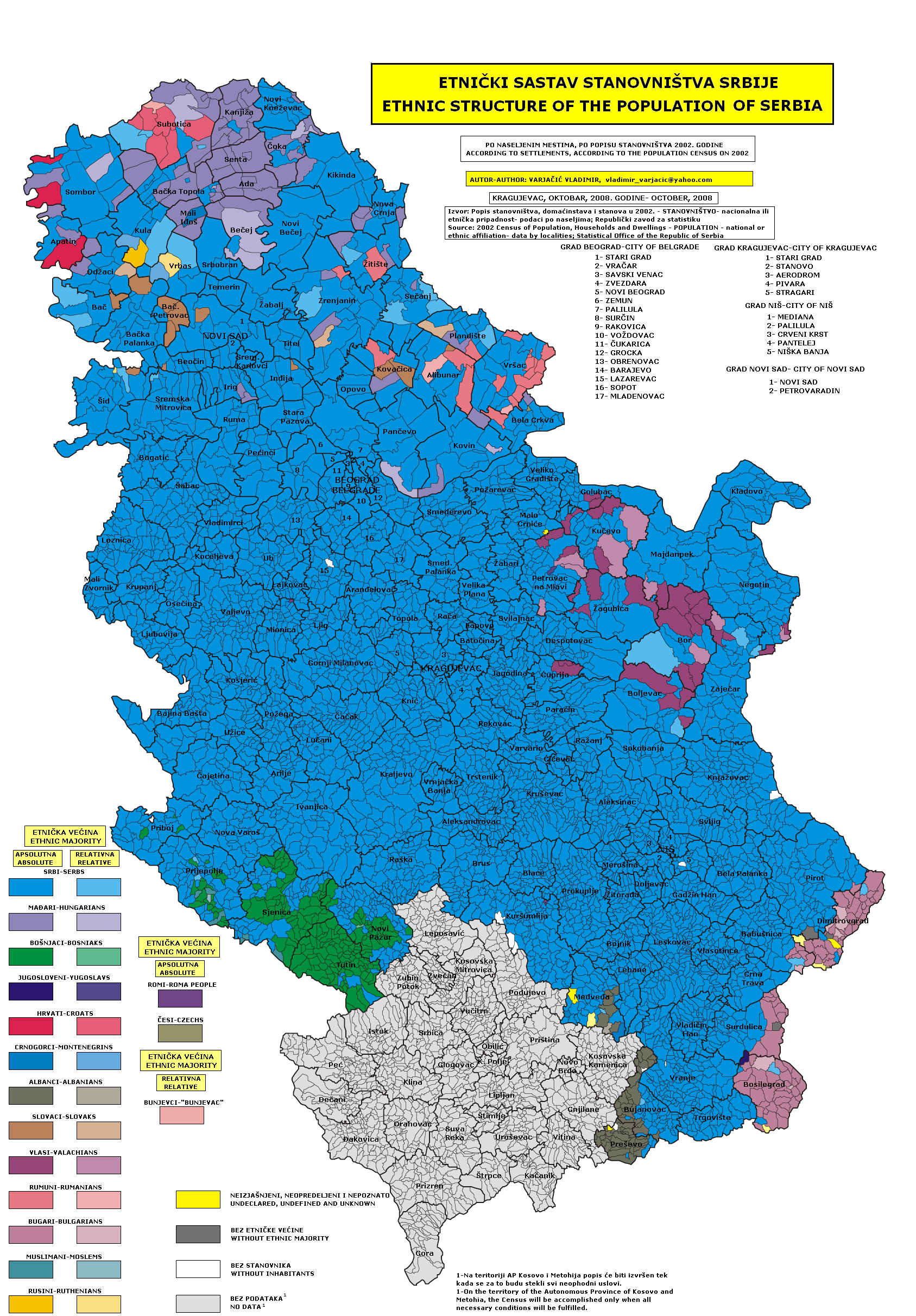
This reduction has been precisely detailed only since the XIX century, especially in the region of Timok (northeastern Serbia), as can be seen in the following maps:

2008 ethnic map of Serbia (in violet color the Timok Vlachs)


1860 ethnic map of Timok Vlachs (in light blue). Note their extension reaching the Morava & Danube river, while in the above 2008 map -after 150 years- they are reduced to small areas away from those rivers


Actually Serbia is home to three small neolatin (Vlach-Romanian) communities, as stated by Annemarie Sorescu:

The first are the "Romanians of Vojvodina" (Serbian Banat), officially recognized as a Romanian minority in Serbia.They have access to schooling, mass media and religious service in the Romanianlanguage. According to the last Serbian population census, of 2011, they number 29,332 persons and inhabit around 40 settlements in Central and Southern Vojvodina. Some of these settlements are already mentioned in medieval archives,others were established in the 18th or beginning of the 19th century, during the Austro-Hungarian colonization of the Banat. They speak dialectal variants of the Romanian language and have knowledge of the standard romanian language.

The second community are the "Bayash" or Rudari. They live dispersed throughout Serbia and the Balkans. Their mother tongue is Romanian, but they are considered "Roma" (gypsies) by the surrounding populations, because of their semi-nomadic way of life, mentality and physical characteristics. However, but their belonging to the Romanian nation has been intensely contest.

The third neolatin community are the "Vlachs of Timok" (Eastern Serbia), who speak archaic dialectal variants of Romanian. According to the last census, they number 35,330, but members of the community put forth unofficial estimates between 150,000 and 300,000. They are not officially recognized as a Romanian minority. Within the Vlach community there are divergences whether or not they belong to the Romanian nation, and whether or not they should merge, at a political level, with the Romanian minority in Vojvodina.

Today, most of the Vlachs have a dual, contextual or politicized identity: they register as Romanians, Vlachs or Serbs and accordingly, but not necessarily in an overlapping manner, they declare their mother tongue to be Serbian, Vlach or Romanian. Romania does not question the Vlachs” origin and considers them Romanians living in Serbia.

However, Serbia declares that “there are no concordance and sameness between the Romanian and the Vlach languages and their speakers” (Comments Government Serbia 2009). Until recently, they have not been granted any minority rights regarding the use of their mother tongue. Vlach has been restricted to family use, but even its transmission to the younger generation was endangered.

Nevertheless, 2013 saw the publication of the first grammar of Vlach, in 2014 the first textbook for Vlach was printed, and Vlach introduced as an optional object in primary schools. In September 2015 the Vlach National Council adopted the standardization of the Vlach language.

Finally, according to the results of the 2011 census Vlachs are concentrated in three districts in Eastern Serbia: in Bor where they make up 10.65% of the population, in Branicevo where they make up 21.7%, and in Zajecar district where they make up 21.5%. In these same three districts the number of those who declared themselves as Romanians is less than one per cent - 0.63% in Bor, 0.4% in Branicevo and 0.26% in the Zajecar district. What strikes more is the reduction of Vlachs and Romanians since the 1948 census: in that census there were 93440 Vlachs and 63130 Romanians, while in the 2011 census there are only 35330 Vlachs and 29332 Romanians!

It seems that the process of disappearance of the neolatin populations in Serbia keeps going on and on and on and on.......

The historical "bridge" between Romanians and Dalmatian Italians

There was a continuum of romance speaking populations in Europe at the end of the Western Roman Empire, from Portugal and Spain to France and Italy: this continuum reached the Balkans until the Danube river delta, from Italian Istria until the Romanian Dobrugia.

But actually there it is a "hole" of this continuum in the area that was former Yugoslavia (Slovenia, Croatia, Bosnia-Herzegovina and Serbia), because of the Slav invasions that happened during the early Middle Ages. However for many centuries this hole between Italy and Romania was partially occupied by a kind of "bridge" of neolatin populations (usually called "Vlachs", a word from latin 'vallum', meaning 'people of the Roman vallum' near the barbarian borders of the Western Roman empire) during the late Middle Ages until the Renaissance centuries. These Vlachs lived in the mountains of the western Balkans, but were slowly "assimilated" by the Slavs and actually they have practically disappeared, leaving only some evidences of themselves in the names of the Balkan topography & history (like "Romanija", "Stari Vlah", etc..).

Map showing the remains of the "Bridge" (Romanija Planina & Stari Vlah) in the XIII century, between the neolatin territories of Ragusa Republic & Spalato of the Dalmatian Italians and those of the Valko (Vojvodina) & Kucso (Timok)


Indeed Ilona Czamańska wrote in "Vlachs and Slavs in the Middle Ages and Modern Era” (Res Historica, 41, (Lublin, 2016), 19) that: "The majority of Serbs from the Republika Srpska of modern Bosnia is of Vlach origin, as well as the majority of the population from Bosnia and Herzegovina in general." This fact is clearly related to the historical bridge -now disappeared- that existed until the Middle Ages between the romance speaking Romanians and the Italian populations in Dalmatia and Istria.

The following are excerpts -related to this "bridge"- from an essay written by Octavian Ciobanu (Professor of Iasu University) and titled "The Heritage of Western Balkan Vlachs":

A lot of Latin or Vlach place names still resist until today in Western Balkans. Jirecek wrote about the Vlach impressive presence in Montenegro, Herzegovina and Dalmatia in a period which lasted from the XIIIth to the XVIth centuries.The Serbian documents from the 12th to the 15th centuries revealed a large number of Vlach placenames and Vlach personal names which are still in use by the Slavs of the Western Balkans. The Romanian character of the language of these Vlachs is generally recognized.

According to Stelian Brezeanu, among the toponyms attesting the presence of the Romanic element in the region, there are two that have an importance: Palaioblacoi and Stari Vlah. Palaioblacoi is attested in Thessaly (later Μεγάλη Βλαχία/Megali Vlahia) and the second toponym, Stari Vlah, is attested in the Medieval Serbia and in Herzegovina: “It was a region inside of the Kingdom of the Nemanids that attached the Kopaonik Mountains to the Romanija Mountains, around the city of Sarajevo. That region had as centre the Drina and the Lim rivers valley.”

Next to Stari Vlah it is Romanija. This area has the mountain still called Romanja.Therefore, the region of Stari Vlah belonged to a more extended area, intensively romanised at the end of the antiquity.Ştefan Stareţu writes that “it is clear that Stari Raska comes from Stari Vlaska, with a rothacism, and Raska from Vlaska (this is exemplified by the double name of Banat, as Vlaska or Raska)”. He also advances a hypothesis: “The Serbs and Vlachs are probably a single ethnic substance, constructed in the Balkan Peninsula as a unity in the 8th-14th century.”


Furthermore, according to Ilona Czamańska the Vlach population was already established in the western Balkans during the migration of Slavs. But she pointed out that both ethnic groups occupying the same land were not in conflict. Slavs, as farmers, occupied lands in the valleys, which were suitable for them, while Vlachs exploited mountains. Slavs, next to agriculture, also engaged in breeding, but did not practice transhumance pastoralism, which was the domain of the Vlachs. For the Slavs the land and the right to its cultivation and ownership was most important, for the Vlachs the ownership of land did not matter as long as the mountains were common property. The element, which bound their community together, was not the land, but family relationships and the sense of belonging to the same "clan".

In the Middle Ages the Vlachs lived in most of the mountain areas in the western Balkans up to the Adriatic coast. In the Middle Ages, the territory between the rivers Lim and Drina in the west, and Raska and Studenica in the east, was called “Old Wallachia” (Stari Vlah), and the Orthodox Church province of the Rasca – “eparchy Old Wallachian”.

In the Serbia of the Nemanjić dinasty (1166-1371) and the states that have later arisen on its ruins, the Vlachs created a fairly closed community because of their special privileged status, in contrast to the rest of Slavic peasant population. Mixed marriages with representatives of other social classes, especially the peasant population, were very difficult here. Despite that, here the processes of Slavisation and assimilation proceeded very quickly. It was also facilitated because of the vanishing of the areas where the Vlach shepherds could wander, because of the distribution of the mountain areas to particular owners. Vlachs defended themselves against dependence for example by buying pastures, which resulted in their definitive transition to semi-sedentary and sedentary life.

The Knez and provincial governors (often Vlach ones) became major landowners, entering the group of nobles and even the aristocracy of Serbia. Among the Slavic Balkan rulers many had Vlach roots – most probably the families Balšić, Hrvatinić – Kosača, and perhaps also Mrnjavcević. Already the earliest records of the names of the Vlachs as well as the names of localities preserved in the sources of the 13th century show a hybrid combination of Vlach and Slav element. Even then, many Vlach names were Slavic, often with Romanian endings (i.e. Dragul, Radul and Bogdan and afterwards even Milutin, Vukašin and Momcil).

Starting from the 14th century the term “Vlach” began to lose its ethnical meaning in favour of a societal meaning in the areas of Serbia and Bosnia and Herzegovina. In these areas the Vlachs were strongly mixed with the Slavic population and the name “Vlach” was frequently used interchangeably with the term “Slav”.

In the "bridge", Slavisation (in fact Serbisation) of the Vlachs was also encouraged by the period of the Ottoman rule. As Orthodox, Vlachs belonged to the same millet as Serbs, and after the reconstruction of the Serbian Patriarchate of Peć they were subordinated to civil authority of the Serbian patriarch. Thus, Vlachs were integrated with Serbs very quickly, especially that the religious affiliation was the main identifier. The persons who belonged to the Serbian Orthodox Church were called by the name of Serbs, not only in the lands which were traditionally Serbian, also in Bosnia. This process was intensified by the fact that many Vlachs abandoned their activities, especially since enclosed social classes did not exist in the Ottoman state.

Actually -according to Marian Wenzel- the majority of the population from Bosnia and Herzegovina in general is of Vlach origin.

Map showing the location (with small points) of the 'Stecci', medieval funerary monuments, in an area that is very similar to the one of the "historical bridge". Note that the easternmost 'Stecci' are located in Serbia's "Stari Vlah" and the westernmost are near the Republic of Venice's Zara area (linking -as a kind of "bridge" through Serbia and Bosnia/Herzegovina- western Romania and Italy's Dalmatia)


Indeed the medieval Vlachs (called often Aromanians) of Herzegovina are considered authors of the famous funerary monuments with petroglyphs (usually called "Stecci") from Herzegovina and surrounding countries. The theory of the Vlach origin of these 'Stecci' was proposed by Bogumil Hrabak (1956) and Marian Wenzel and more recently was supported by the archeological and anthropological researches of skeleton remains from the graves under these 'Stećci'. For Wenzel the Vlachs did not continue to create other 'Stecci' since their conversion -in the sixteenth century- to moslem religion because of Turks domination.

The theory is much older and was first proposed by Arthur Evans in his work "Antiquarian Researches in Illyricum" (1883): while doing research with Felix von Luschan on 'Stecci' graves around Konavle, he found that a large number of skulls were not of Slavic origin but similar to older romanised Illyrian population, as well as noting that Ragusa memorials recorded those parts inhabited by the Vlachs until the 15th century. In other words: these 'Stecci' made by neolatins confirm the existence of this "bridge" betweeen Dalmatia and "Stari Vlah"

Last but not least, we have to remember that in the area of southern Croatia and internal Dalmatia these Vlachs -who were present in the early Middle Ages- were called 'Maurovlachs', or 'Morlachs'(Morlacchi) by the Italians, and they relatively quickly succumbed to Slavisation and Catholic faith. They differentiated themselves from the rest of society through their social status, which took on a special meaning in these lands. In the 17th and 18th centuries the term 'Morlachs' determined both Slavisised Vlachs from the area of Dalmatia, as well as Croatian peasants who were mixed with Dalmatian Italians (and who actually speak a croatian dialect -called "Chacavian"- that has more than 50% of words loaned from latin & romance languages).

In a few final words: The neolatin "bridge" (between Italy and Romania) existed from the barbarian invasions until the first Renaissance centuries, remaining in a few isolated mountain areas until the XVIII century: it seems to have disappeared with the end of the "Repubblica di Venezia" and the beginning of the 'nationalism' in the Balkans. But if we include in the "bridge" also the Dalmatian Italians of coastal Dalmatia, we must remember that the last speaker of this autochtonous Dalmatian language (Tuone Udaina) died in 1898 in Veglia (actual Krk) and so the "bridge" remains survived in some way until the XIX century's end.

However -according to Italian historians like Della Volpe- a legacy of this "bridge" can be seen in the existence of the Republic of Bosnia & Herzegovina, populated mainly by descendants of the romanised populations who created the worldwide famous "Stecci".

Wednesday, February 3, 2021

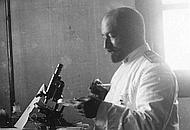
DR. TIBERIO AND THE DISCOVERY OF ANTIBIOTICS

It has been known in the international scientific community since 1947, but the general public is mostly unaware, that the young Italian physician Vincenzo Tiberio discovered the antibacterial power of molds in 1895 (read: https://www.ncbi.nlm.nih.gov/pmc/articles/PMC1903577/pdf/amjpathol00223-0040.pdf), more than thirty years before the famous Alexander Fleming.

Dr. Tiberio was the first to discover something fundamental for the health of Humankind: the antibiotics.
Vincenzo Tiberio was the real discoverer of Penicillin. He found out antimicrobial effect produced by some moulds, thirty-four years before Alexander Fleming, observing a well situated in family's house.L.B (History medicine database)

To divulge this truth for the first time, with documents that dispel any doubt, is the feature film 'Vincenzo Tiberio, the man who discovered antibiotics', made by 'Imago Film' and directed by Claudio Rossi Massimi. The DVD is free (only shipping costs are required) and to get it, just write to:" imago.film@libero.it "

History of the Dr. Tiberio's discovery

Vincenzo Tiberio was a brilliant Italian doctor and biochemist who was also a medical officer of the Italian Royal Navy.

He was born in Sepino (a small city of Molise in central Italy) on May first, 1869 and after brilliant classical studies he enrolled in the Faculty of Medicine at the Royal University of Napoli.

Even before graduating, he passionately devoted himself to microbiological research in the field of Hygiene and Microbiology which he continued throughout his life (until his death, when was only 45 years old).

In the last decade of the 19th century when Tiberio attended the Faculty of Medicine and Surgery in Napoli, this Athenaeum was not only a place of education, but also and above all of research, especially in the bacteriological field. At that time, in fact, Professor Eugenio Fazio published a work on the vital competition between the bacteria of putrefaction and those of anthrax and typhus and Professor Arnaldo Cantani was experimenting with a therapy for tuberculosis, applying Louis Pasteur's principle of antagonism, and obtaining interesting results.

In this environment, Tiberio, still a student in Medicine, began to attend the Hygiene laboratories, to verify some of his intuitions. In the courtyard of the house in Arzano, where he lived, there was a cistern for rainwater which was also used for drinking. On the edge of the cistern, molds grew which were, for obvious hygienic reasons, periodically eliminated. Soon, Tiberio noticed that when the molds were not there, gastrointestinal infections occurred in the water users, while when there were the use of water was harmless. He sensed a connection between the presence of molds and the growth of pathogenic bacteria for the human organism. Subjected this intuition to experimental verification....and so Tiberio was able to demonstrate how the therapeutic action of molds was linked to some substances present in them. He also succeeded in isolating some of these substances and experimenting with their beneficial effect up to the preparation of a substance with antibiotic effects.

In 1895, in the scientific journal "Annals of Experimental Hygiene of the University of Rome", he published an article with the title "On the extracts of some molds" as an account of his work in which he identified for the first time the bactericidal power of some particular molds: "The author observed the action of aqueous extracts [of various types of molds] on some pathogenic [microorganisms] ... finding them provided ... with considerable bactericidal power ... The properties of these molds are strong obstacle for life and for the propagation of pathogenic bacteria."

"Risulta chiaro da queste osservazioni che nella sostanza cellulare delle muffe esaminate son contenuti dei principi solubili in acqua, forniti di azione battericida: sotto questo riguardo sono più attivi o in maggior copia quelli dell' Asp. flavescens, meno quelli del Mucor mucedo e del Pennicillum glaucum." (It is clear from these observations that in the cellular substance of the molds examined are contained some water-soluble substances, provided with bactericidal action: in this respect are more active or in greater abundance those of Aspergillus flavescens; less, those of Mucor mucedo and Pennicillum glaucum.)Tiberio, Vincenzo (1895) "Sugli estratti di alcune muffe" [On the extracts of certain molds], Annali d'Igiene Sperimentale (Annals of Experimental Hygiene), 2nd series (5 : 91-103)


The results of his research, collected in the aforementioned publication, allowed him to observe that: "The cellular substance of the molds examined contains water-soluble principles, provided with bactericidal action." The above work describes the method of preparing the culture medium and taking the liquid from the plates, the chemical and organoleptic characteristics of the liquid and the study techniques. The ability to stimulate the response of white blood cells to infections (chemotaxis), and the bactericidal power of various strains of the Aspergillus mold on the typhus bacillus were subsequently confirmed by several researchers.

Despite the extreme accuracy and replicability of the Tiberio's research and its evident therapeutic results, the discovery did not have any diffusion or follow-up in the Napoli university environment. Disappointed in his academic and clinical aspirations, he entered the Regia Marina in 1896 as a medical officer.....and so he abandoned his research for some years!

Almost simultaneously also Bartolomeo Gosio, in Rome, in a kind of mold discovered a metabolite with antibiotic properties, and purified it. Mycophenolic acid (MPA) -created by Gosio- was the first true antibiotic in History! In 1922 Gosio was proposed to receive the Nobel in Medicine research, but nothing happened because in that year Mussolini took the control of Italy and in the political chaos in which Italy plunged nothing was done to support the nomination.

However the scientific activity of Tiberio, who completed, at the end of the 19th century, the entire experimental cycle from observation, to the verification of the initial hypothesis, up to the preparation of the antibiotic substance, was much more advanced than that of Alexander Fleming in 1928/29. The latter knew the researches of Tiberio (according to Ernst Chain, who received the Nobel together with Fleming) and certainly those of Gosio despite the scarce diffusion of the same outside Italy, and came to the discovery of "penicillin", as he himself reported, due to an error: "the involuntary contamination of a capsule containing colonies of Staphilococcus aureus with fungal colonies”, which then produced “an inhibition of bacterial growth in the colonies of Staphilococcus aureus”. However, Fleming then failed to experimentally prepare the drug, thus not closing the research cycle, as they had instead done in Napoli Tiberio and later in Rome, Gosio.

Dr. Vincenzo Tiberio wanted to follow his research in 1914, when returned to Italy and was named "Director" of the Service of Hygiene and Bacteriology of the Hospital of the Italian Navy in Piedigrotta (a district of Napoli's metropolitan area), probably with the hope of being able to resume his studies on molds like the "Peniccilium". Indeed we must pinpoint that the famous name "penicillin" comes from the mold "penicillium".

When he returned to Napoli, however, he had little time to carry out his research further, for he was struck down by a myocardial infarction on January 7, 1915, at the age of only 45 years.

In 1947, two years after the awarding of the Nobel Prize to Alexander Fleming, the 1895 book of the Annals of Experimental Hygiene of the University of Rome was found, in which the work on the extracts of some molds was published. The results and methods of the research were disseminated in national scientific journals, but, obviously, they did not have the deserved resonance.

Today the truth is well known since 1947, but the fame of Dr. Tiberio is, despite everything, known only by passionate lovers of the History of Medicine and ignored by most. The Italian Vincenzo Tiberio -34 years before Fleming- had discovered the power of "Penicillin", that has saved millions of human lives, according to the "Presidenza della Regione Molise" (read http://www.regione.molise.it/web/grm/cspr.nsf/7ca3c8cc9740728ec1256e2d00734512/00f68c3d2c011aeec125727d005b80dc?OpenDocument).

Saturday, January 2, 2021

THE CONSOLATA MISSION IN ITALIAN SOMALIA

The Catholicism in Italian Somalia

We all know that Catholicism (and Christianity) in what was Italian Somalia has practically disappeared in the last decades of the civil war in this African country. According to catholic sources there are less than 100 catholics practising in actual Somalia (mostly in the capital Mogadishu and nearly all foreigners). But it was not so "minimal" this number during the years when Italy had a colonial control of Somalia. Let me explain better.

As I wrote in wikipedia, Catholicism was introduced in Italian Somaliland in the late 19th century. Initially, it was only practiced by the few Italian immigrants in Mogadishu and between the Bantu of the Shebelle River farmer areas, thanks to some missionaries of the Trinitarian Fathers. In 1895, the first 45 Bantu slaves were freed by the Italian colonial authorities under the administration of the chartered Catholic company Filonardi: they were later converted to Catholicism and were the first "Christians" in all Somalia's native population, a country totally moslem since the early Middle Ages.

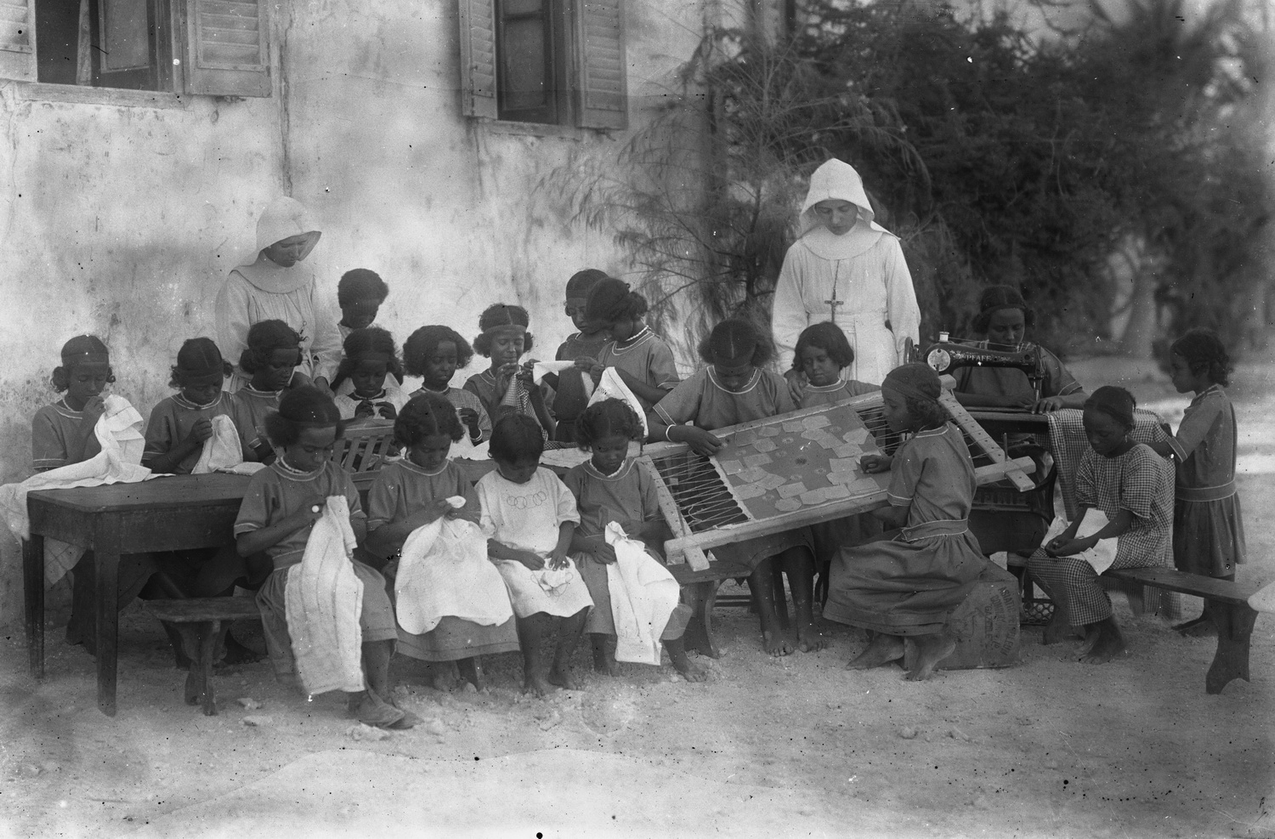
A sewing class for Somalian kids, done by an Italian missionary nun in 1928 Mogadiscio
Massive emancipation and conversion of slaves in Somalia only began after the anti-slavery activist Luigi Robecchi Bricchetti informed the Italian public about the local slave trade and the indifferent attitude of the Italian colonial government toward it. For further information, please read https://www.asei.eu/it/2011/11/le-missioni-cattoliche-italiane-allestero-il-caso-della-consolata-nella-somalia-di-cesare-maria-de-vecchi-1924-1928/.

After World War I Catholicism started to be actively promoted in "Somalia italiana", as historian Listowel wrote:

In 1903 the "Trinitarian Fathers" were the first missionaries to arrive in what was to become Somalia. They started teaching and providing social assistance to the poor and the sick. Fr. Jelib set up a leper colony at the mouth of the Juba river, and cared for about 350 to 400 lepers. In 1924 the Consolata Fathers and Sisters (from Turin) arrived; the Fathers to be replaced in the 1930s by the Franciscan Friars Minor from the Milan Province.
Italian missionaries promoted Catholicism in the capital Mogadiscio, but also in the farm area of the Scebeli river (where the Duca d'Abruzzi created a huge farm colony): many Bantu -former slaves & their descendants- of the area converted to Catholicism.

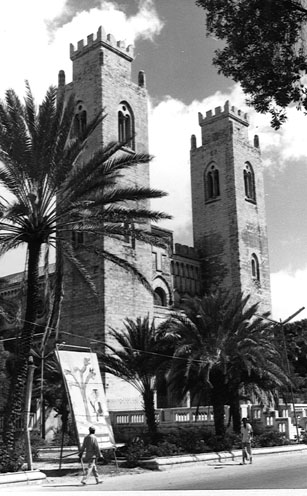
In 1928, a huge Catholic cathedral was built in Mogadishu by order of Cesare Maria De Vecchi, a Catholic governor of "Somalia italiana" who promoted the "Missionari della Consolata" Christianization of Somalian native people.

In Mogadishu, Consolata missionaries (in all Somalia they were 25 in total and additionally there were 30 nuns) opened a male school of arts and crafts for woodworkers, smiths, printers, mechanics, and shoemakers, as well as a female school for sewing and domestic work. In 1929, the two schools had started, respectively, a printing house, a bookbinder, a bakery, and a textile factory(please read https://link.springer.com/chapter/10.1007/978-3-030-27801-4_6).

In the late 1930s Catholicism started to be accepted by some native Somalians, thanks to the "seeds" that the Consolata missionaries had created.

Indeed the Bishop of Mogadishu Franco Filippini declared in 1940 that there were about 40,000 Somali Catholics due to the work of missionaries in the rural regions of Juba and Shebelle, but WWII damaged in an irreversibly way most of the catholic missions in Italian Somalia. Most were somali Bantu, but some thousands were illegitimate sons of Italian soldiers and somali girls (who received Italian citizenship when baptized).

In the 1950s Indro Montanelli wrote on "Il Borghese" magazine that Italian Mogadishu in 1942 after the arrival of the British was an African capital where most of inhabitants were Catholics: he indicated that of the 90,000 inhabitants more than 40,000 were Italians, while inside the 50,000 Somalis there were nearly 7,000 Catholics (including the many illegitimate sons of Italian soldiers and Somali native girls who were baptized in order to get Italian identification). From this he concluded that nearly 3 out of 5 Mogadiscio inhabitants were Catholics.

But in 1954 there were only 9000 catholics in all Somalia............and in 2004 there were less than 200........Sincerely, it is an astonishing & shocking disappearance!

The (now destroyed) Cathedral of Mogadiscio was also promoted by the Consolata missionaries
The Consolata Mission

In 1923 the catholic Cesare Maria De Vecchi was named governor of Italian somalia: he was a strong fascist who wanted to "italianize" (in everything) the colony of Somalia. In order to get this, he invited the missionaries of the "Consolata mission" to come to Mogadishu and promote catholicism between the native population.

in 1924 -when arrived the Consolata- in Somalia there were about 1600 Catholics, almost all represented by Italians who moved to the colony - government employees, merchants, entrepreneurs and simple settlers -, as well as about one hundred Eritrean Catholic askari employed by the government for secondary services. Among these, the Consolata missionaries could have carried out a work of full religious assistance, while "among the indigenous" they should have acted "with great caution", because of the strong moslem presence in the country.

The following are excerpts related to the Consolata mission in Italian Somalia, from an essay written by Alberto Sbacchi and titled:

"The archives of Consolata mission and italian colonialism"

The Institute of the Consolata for foreign missions was founded in Turin, Italy, in 1901, by the generai superior, Giuseppe Allamano (1851-1926). The primary purpose of the mission is to evangelize and educate pagan peoples. Allamano believed in the benefit of religion and education when he stated that the people «will love religion because of the promise of a better life after death, but education will make them happy because it will provide a better life while on earth». The Consolata distinguishes itself for stressing the moral and secular education and its enthusiasm for missionary work.

In 1919 it entered Tanzania, and accepting a government invitation in 1924 the Consolata installed itself in Italian Somalia and in 1925 in the Portuguese colony of Mozambique.


THE CONSOLATA MISSION IN SOMALIA, 1925-1930

In contrast with Ethiopia, Somalia was not a priority of the Consolata mission. Instead it can be inferred that it was a means of fulfilling its aim of converting the Oromo to Christianity, entering Ethiopia from Somalia with the support of the colonia! government. Filippo Perlo, apostolic vicar of Kenya, sought and received permission for his plan by promising to conducting politica! activity in Ethiopia in favor of Italy. Perlo's proposals attracted the attention in 1910 of governar Giacomo De Martino, who considered the Consolata mission to be an ally of the government in furthering Italian colomal policy in Somalia.

The Italian government favored the presence of an Italian mission in Kaffa as counter measure to Great Britain's influence in Southern and Western Ethiopia. De Martino agreed with the Ministry of foreign affairs that the Consolata mission must be supported in its effort to install itself in Ethiopia to coordinate the Italian penetration between the sources of Ganale and Shebeli rivers and to consolidate the Italian presence in the lake regions from lake Rudolf to lake Margherita, thus facilitating political expansion from Somalia into Ethiopia. With the Consolata mission Italy would be able to establish a strong Italian presence in Southern and Western Ethiopia, stimulating commerciai relations. In return the Consolata provided Rome with information.

With the backing of Italian authorities, Perlo set up a caravan in 1913 entering Ethiopia from the South, with Angelo Dal Canton, Anselmo Jeantet and Aquilino Caneparo pretending to be merchants. They were stopped and retained as prisoners at Burgi under suspicion for three years, during the first world war, of being spies and hiding weapons. Perlo used the imprisonment of the missionaries to force a politica! decision on the Ethiopian government and on minister Colli, eventually extracting from ras Tafari permission to enter Kaffa. It took three years, however, for Colli to prevail over the Ethiopian government and to free the missionaries.


Photo showing (from left) governor Giovanni Ferroni, the Prince 'Duke of Abruzzi' and governor Carlo Ricci Riveri in the "Villaggio Duca degli Abruzzi" (actual Jowhar). They allowed the italian missionaries (of the Trinitarian, Consolata and Franciscan Orders) to do some promotion of Catholicism to the native Somalian population during the 1920s.


Meanwhile governor Cesare de Vecchi called the Consolata to Somalia. De Vecchi believed that in the colonies the army must be followed by religion and education. The border land of Somalia, he sai d "the land toward the west [Ethiopia] is where the future of the greatness of Rome will come". Expansion at the expense of Ethiopia and bringing civilization to Somalia was the colonia! program of De Vecchi, which he hoped to implement with the assistance of the Consolata. In the governor's estimation the Consolata was indispensable for him because the missionaries were hard workers and loyal supporters of the governments colonia! policy.

De Vecchi and the Consolata made a list of priorities.Perlo saw that a church and a house for the missionaries were necessary, while De V ecchi's program included an asylum, elementary andtrade schools, housing for the half-cast children, and the provision of missionary help at the government hospital. However, Perlo complained that although De Vecchi had called the Consolata to Somalia,and the mission was under his protection operating in absolute freedom, his materia! help was slow in coming. On another occasion he reported that "the governor had many good words for us but he has not fulfilled his promises".

While the Consolata did its part in terms of religious, social, educational and medicai assistance, the Consolata felt that the governor was taking time implementing the promise for the building of a church cathedral and giving agricultural concession to the Consolata, to help the mission defray its operating cost. The colonia!administration was also slow in paying the subsidies on time. The Consolata received a yearly payment of 48.000 lire for schools, and 16.000 lire for the Hospital. In addition the Turin headquarter provided the mission in Somalia with a 50.000 lire grant, Propaganda fides 29.000 lire and Società antischiavista italiana with 22.500 lire per year.

To urge the missionaries to do more, De Vecchi promised to get 1.500.000 lire from the government for the Cathedral of Mogadiscio. The building, resembling a church-fortress, would reflect the architecture of the homeland of the colonialists, conveying a sense of strength to affirm the power of Italy among the people of Somalia. The church was necessary for the Consolata fathers because of the solemnity of worship, affirmation of the catholic faith, of patriotism and of prestige before the colonia! people. Having erected these major buildings, the Consolata also received 200 hectares of land on the Ganale river (Merca) to be cultivated with cotton.


An Italian professor teaching how to print to Somalian boys in a 1928 Consolata school
By the end of its five year tenute in Somalia, the Consolata mission contributions, with the generous financial contribution of the government, were from a practical point of view relevant, leaving behind a Cathedral, an industriai school, a school for half-cast children and an elementary school system with five classes attended by 2.000 students.

In 1930 the Consolata left Somalia and was replaced by the "Padri Minori" of Franciscan order. Officially the Consolata moved oùt of Somalia because it was involved in too many countries and did not have enough personnel for staffing its missions.

However, the Consolata was requested to leave Somalia by the Vatican's "Propaganda Fides" since it did not have enough conversions on account of the fact that Somalia was a Muslim country, but above all the catholic Church wanted to limit the power of the Consolata, by concentrating its efforts only in Kenya and Ethiopia.

Archival evidence, however, suggests that the ending of the Consolata operation in Somalia was motivated by financial mismanagement. Filippo Perlo had too much authority in his hands as generai superior of the mission. He in turn had appointed his brother Gabriele apostolic vicar of Mogadiscio and another brother Luigi, was the administrator of the mission in Kenya. Hence there were good reasons to limit the personal rule of the Perlo clan, for the benefit of the Consolata mission!

Alberto Sbacchi


However the Consolata missionaries remained in charge until 1933 of the "Hospital Giacomo De Martino" in Mogadiscio. Their management was directly paid by the Italian government under orders of the governor De Vecchi (who was nicknamed "Little missionary of Christ").

Tuesday, December 1, 2020

ROMANIZED BERBERS DISAPPEARANCE

One of the biggest "disappearances" in History is the one that happened in northwestern Africa with the so called "Roman Africa", a region actually called "Maghreb" and that includes modern Tunisia and the Mediterranean areas of contemporary Morocco, Algeria and Libya's Tripolitania.

This area was one of the most romanized of the Roman empire in the fourth century, when started the barbarian invasions in western Europe: it was similar in everything to "Roman Hispania", according to the famous historian Theodor Mommsen.

Roman emperor Macrinus, a romanized berber born in Caesarea (now Cherchell in Algeria)

Roman Africa was populated by the autochtonous "Berbers" who were fully "latin speaking" in an area that coincides with actual central-northern Tunisia and who were fully christians on the coastal regions (from Gibraltar to modern Tripolitania).

There were also some descendants of the Phoenician settlers that founded Carthago, but they were assimilated by the autochtonous Berbers by the fourth century (indeed the same happened with some italian colonists that settled in coastal Numidia, mainly around Cirta).

But after the arrival of the Arabs in the late seventh century it "disappeared" in a terrible bloodbath. While Hispania remained forever linked to Rome, this African region lost nearly all the Romanization & the links with western Europe -from the local neolatin language to the early christianity (https://www.google.com/books/edition/The_Extinction_of_the_Christian_Churches/r1RbAAAAMAAJ?hl=en&gbpv=1&dq=christians+of+tunis&pg=PA241&printsec=frontcover).

However something of Roman Africa has survived, like the few Christian Berbers of our times and the small Spanish enclaves of Ceuta and Melilla

Indeed estimates show that actually there are nearly half a million Christian Berbers, many living in a situation of diaspora in Western Europe and the Americas and nearly 300,000 living in the Maghreb region of North Africa (from Morocco to Libya).

Notable Romanized Berbers

Accomplished Berbers of Roman Africa include famous writers such as Martianus Capella. There were also Christian saints such as Augustine, Roman popes such as Pope Victor I and even the pagan Roman emperors Macrinus & the famous Septimius Severus.

Most of them appeared in a socio-cultural period of development in Roman Africa following the introduction of Christianity. Most of these figures are historical, and we have to remember that now the Christians in North Africa do not have as much of a dominant community as they used to have in Roman times.

Roman writers such as Terentius, Lactantius, Martianus Capella (previously mentioned), Marcus Cornelius Fronto, Apuleius and Tertullianus were Berbers. Christian Berber saints include the Scillitan Martyrs, Cyprian, Victor Maurus and Saint Monica (mother of Saint Augustine). Roman popes like Pope Miltiades and Pope Gelasius I and Roman emperors such as Macrinus, Emilianus and Caracalla (son of the famous Septimius Severus) were also romanized Berbers.

Berber kings of exclusive Christian Berber realms known as the 'Romano-Berber states' include Masuna, Mastigas and Garmul of the "Kingdom of Altava", called initially "Mauro-Roman Kingdom" or "Kingdom of the Moors and Romans" (477-578 AD). They are known for making Christian Jedars and Mausoleums such as the "Tomb of the Christians" near Caesarea (also known as the 'Royal Mausoleum of Mauretania'). Also Caecilius (often called Koceila in berber language) of the Kingdom of Altava was an important Christian Berber.

History

The massacre of Christian Berbers by the Arab conquerors is one of the biggest exterminations in History. Nearly 90% of the Berbers living in actual Tunisia and Algeria "disappeared" in a few decades, with their own romano-berber civilization. Most of them died, but more than 350,000 were enslaved and sold in the slavery markets of the Arabs. A shameful genocide/ethnocide that only now is being studied and analyzed in all its enormous dimensions.


We know that the Kingdom of Altava (578-708 AD) fought harshly the Arabs. The last recorded ruler of the Kingdom of Altava was Caecilius, called Koceila or Kusaila ("leopard" in 'Tamazight' berber language). He died in the year 690 AD fighting against the Muslim conquest of the Maghreb. He was also leader of the Awraba tribe of the Imazighen and possibly Christian head of the Sanhadja confederation. Caecilius as a berber prince was probably educated in a roman christian way and consequently fought the moslem invasion with religious passion. He is known for having led an effective Berber martial resistance against the Umayyad Caliphate's conquest of the Maghreb in the 680s.

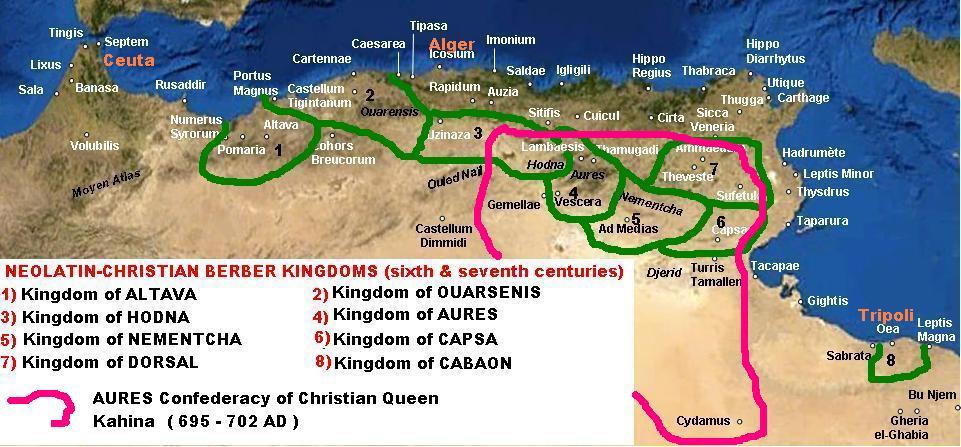
Indeed, in 683 AD the arab leader Uqba ibn Nafi was ambushed and killed in the Battle of Vescera near Biskra by Kusaila, who forced all Arabs to evacuate their just founded Kairouan and withdraw to Cyrenaica. But in 688 AD Arab reinforcements from Abd al-Malik ibn Marwan arrived under Zuhair ibn Kays. Caecilius met them in 690 AD -with the support of Byzantine troops- at the Battle of Mamma. Vastly outnumbered, the Awraba and Byzantines were defeated and Caecilius was killed. With the death of Caecilius, the torch of resistance passed to a tribe known as the Jerawa tribe, who had their home in the Aurès Mountains: his Christian berber troops after his death fought later under Kahina, the last Queen of the romanized Berbers.

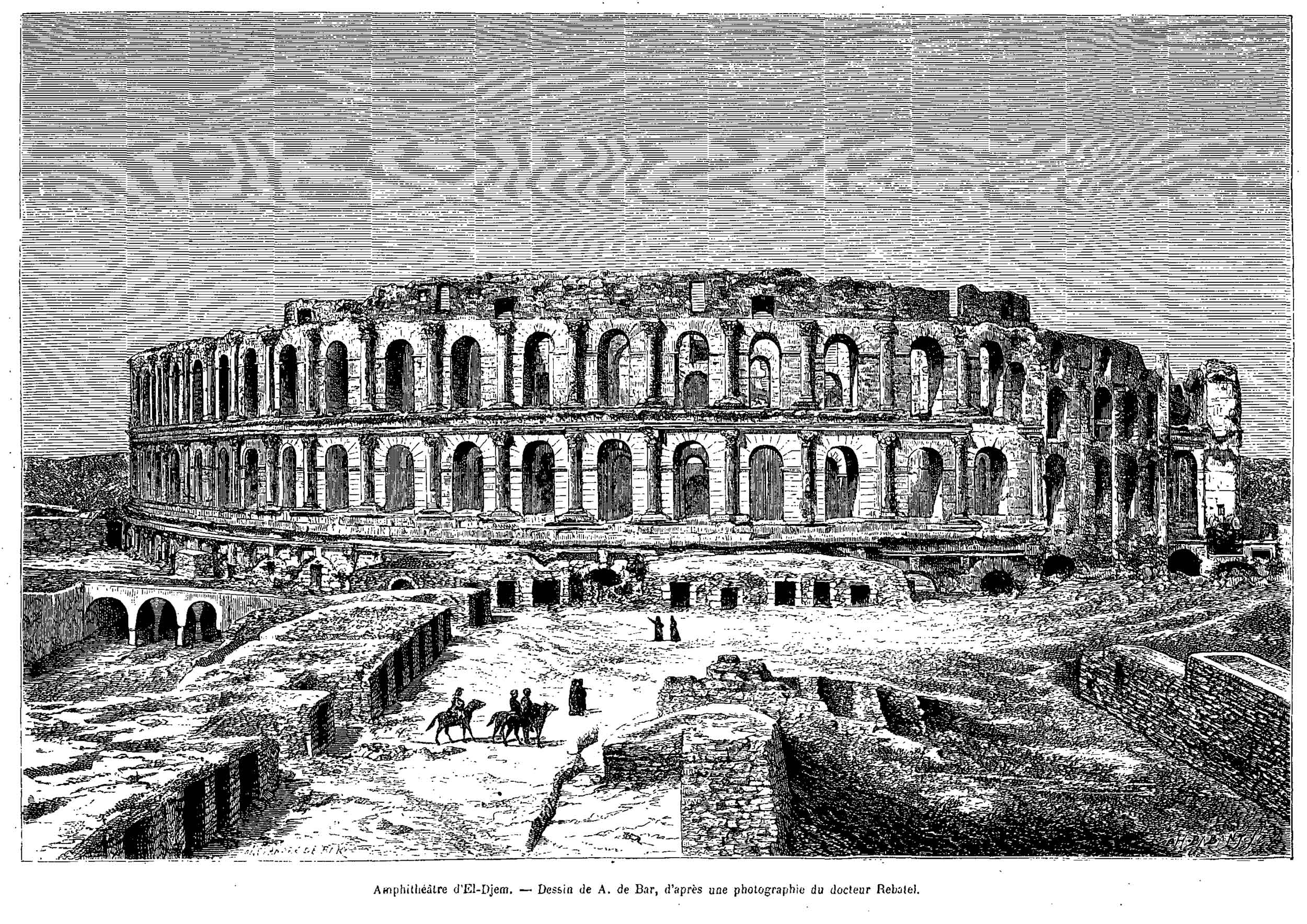
Kahina (called also Dihya) was born in the early 7th century and may well have been of mixed descent: Berber and Byzantine Christian, since one of her sons is described as a 'yunani' or Greek. Kahina ruled as a Christian queen (but some arab historians wrote that she was a Jewish "sorcerer") and was able to defeat the Arab invaders who retreated to Tripolitania: for more than five years ruled a free berber state from the Aures mountains to the oasis of Gadames (695-702 AD). But the Arabs, commanded by Musa bin Nusayr, returned with a strong army and defeated her. She fought at the El Djem Roman amphitheater of Thysdrus, but finally died around the beginning of the eight century (most probably in 703 AD) in modern-day Algeria in a battle near Tabarka. Her defeat and death was followed by the "disappearance" of Roman Africa in what the Arab conquerors later called 'Maghreb' (the word 'maghrib' means "western territories" in arab language).

Musa bin Nusair, a Yemeni general, was made governor of "Ifriqiya" (as Arabs called Roman Africa) and given the harsh responsibility of putting down this renewed romanized Berber rebellion and converting the population to Islam. Musa and his two sons prevailed over Queen Kahina and the rebels and enslaved 300,000 Berber captives. The caliph's portion was 60,000 of the captives. These the caliph sold into slavery (mainly in Damascus), the proceeds from their sale going into the public treasury. Another 30,000 captives (who rejected their Christian faith in order to survive) were pressed into military service and forced to convert to Islam.

We know that all Roman Africa had only one million inhabitants when Musa enslaved those 300,000 Berber captives....and this means that one third of the Romanized Berber population was reduced to slavery in those years! Furthermore 60,000 were sent mostly to Damascus. We know that in those years the Arabs did not have a huge navy, so most of those captives had to reach Damascus (in Syria) walking by foot thousands of kms! Imagine the massacre along the way through the desert of Libya and western Egypt! As an example, we know that in the XX century the moslem Turks forced many christian Armenians to walk a few hundred kms in captivity and there was the death of nearly one quarter of them: consequently imagine how huge was the massacre suffered by those Berbers enslaved, forced to walk in captivity the big distance between their homeland until Damascus....It was one of the most terrible exterminations of an entire population in ancient History!!!!


The El Djem Roman amphiteater was a stronghold of Queen Kahina: it was destroyed by the Arabs around 701 AD after a fierce defense by the romanized Berbers.

Historian Daniel Pipes also wrote in his famous book 'Slave Soldiers and Islam: The Genesis of a Military System' (https://books.google.com/books?id=ByLG-2hZX-MC&q=musa+300,000&pg=PA124#v=snippet&q=musa%20300%2C000&f=false), that Musa Nusayr enslaved nearly 300,000 berbers in those years when defeated Kahina and reduced nearly to ashes for two centuries the city of Carthago! Indeed in 705 AD Roman Carthago was reduced from 500,000 inhabitants during Trajan/Hadrian years to a village full of ruins with just 3,000 survivors (all Muslims, of course).

Additionally we must remember that when lived the most famous Christian Berber in Antiquity, Saint Augustine, there were five million inhabitants in the provinces of the Roman empire that now are called the "Maghreb", but -after the 50 years of Muslim Arab conquests- in 705 AD there were only one million Berbers (while nearly all the Roman colonists' descendants were murdered or flew back to Italy) and one third of them was enslaved: this was one of the biggest massacres registered in History, with the bloody end of nearly all Christianity in the region.


Capsa & the last Romanized Christians

Only a few areas of Roman Africa maintained (in the moslem Maghreb) until the early XVI century the so called "African Romance" language and practised christianity: one of them was Capsa.

The Roman town of Capsa, now modern day Gafsa in Tunisia, was conquered by Rome in 106 BC and made a colonia and municipium by emperor Trajan. It grew in importance as can be seen in the Roman baths that were 4 meters deep and the recently discovered mosiacs. During the decades of Septimius Severus the town had more than 300,000 inhabitants and was a key important commercial center of the Roman limes in Africa. Capsa was a fully romanized city by the third century.

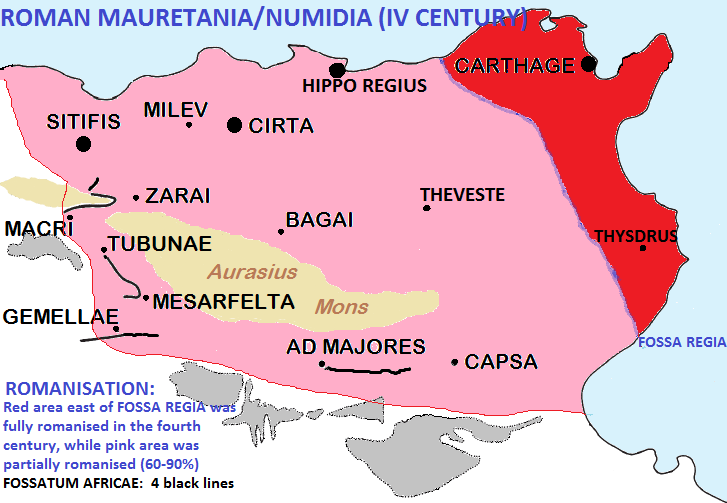
Map I created for wikipedia, showing Capsa location in the Romanized areas of Roman Africa

Although Capsa was conquered by the Vandals, it soon became independent and the capital of a newly founded Romano-Berber kingdom in the 6th century (until happened a Byzantine invasion).

Under the Byzantines the city was the capital of the Bizantine province "Byzacena" and enjoyed a period of economic revival. General Solomon build in 540 a new city wall and named the city "Capsa-Justiniana".

When the Arab Oqba Ibn Nafi conquered Capsa in 688 AD he faced fierce resistance from the Berbers, during & after the Arab conquest. It however subsequently lost importance to the Muslim founded Kairouan. Christians living there still were considered Romanized Berbers and continued to speak an "African Latin" as part of their language and remained loyal to the Christian religion.

Capsa is the last place in North Africa where speakers of African Romance could be found "officially" in the thirteenth century, and Christianity was found there for another century, worshiped also in the Roman pools of the old ruins. Christians moved towards Capsa and its surroundings around the 10th century, strengthening its position.

In 1135 to 1155 the Normans conquered Capsa and protected the Christians there for a few years until the Muslim Almohads reconquered the city. Ibn Khaldun hinted at a native Christian community in 14th century in the villages of Nefzaoua, south-west of Tozeur and not far from Capsa. These paid the "Jizuah" and had some people of Sardinian descent among them.

After 1170 the remaining North African churches began to decline and disappear. This was a slow process, and popes continued to appoint bishops to sees like Carthage and Tripoli until the middle of the thirteenth century, but traces of organised, indigenous Christian communities become rare after that time.

Additionally we must pinpoint that the presence of Berber Christians in Libia's Tripolitania is attested at least until the late eleventh century and in the Jebel mountains for another century(https://books.google.com/books?id=pIkmvKB8OlsC&pg=PA121&lpg=PA121&dq=christians+of+Gef%C3%A0ra&source=bl&ots=wq6i_ZLi8O&sig=hdNYBH-szy0dBcioINSxoJwYl_k&hl=en&sa=X&ei=EwyFU4bLO9GEqga474LYAw&ved=0CCkQ6AEwAA#v=onepage&q=christians%20of%20Gef%C3%A0ra&f=false): in the necropolis of En-Gila to the south of Tripoli, a dozen Latin texts dating between 945 and 1003 were discovered (https://www.cairn-int.info/article-E_RHR_2293_0325--byzantine-churches-converted-to-islam.htm#re66no66).

In the second half of the fifteenth century, the Roman humanist Paolo Pompilio noted that the territory of Gafsa was populated by a land of small villages in which the inhabitants spoke a "Latinity" language. Berber Christians continued to live there until the 15th century, while they didn't recognize the new Catholicism of the Renaissance Roman Papacy. This would perhaps deny them support from other Christian powers. A letter in Catholic Church archives from the 14th century shows that there were still four bishoprics left in North Africa (http://www.orthodoxengland.org.uk/maghreb.htm): it was a sharp decline from the over four hundred bishoprics in existence at the time of the Arab conquest!

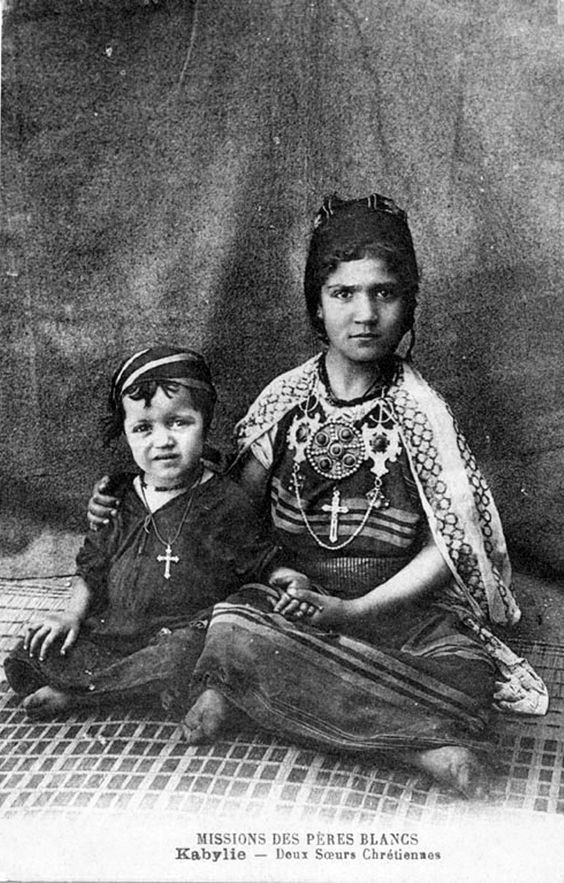
French photo of two young Christian Berbers of the Algeria's Kabylia in the XIX century

The Berber Christians of Roman Mauretania's Septem (actual spanish Ceuta) seem to have been assimilated into the Christianity of nearby Spain. Septem was another pocket of Christianity left over from the Roman period, at least until the X century. Then, in the 1400s Spain conquered the city and Christianity returned to be worshipped in Ceuta, but it was Catholicism linked to Madrid.

In the first quarter of the fifteenth century, the native Christians of Tunis, even though they were heavily assimilated into Islam in various aspects, extended their church, as the last Christians from all over the Maghreb were gathered there. This is the last reference to native Christianity in North-West Africa; Tunis and Capsa seemed to be the last Christian citadels for over fourteen hundred years of continuous Christianity.

Several families of the old African Christian Church were found in Tunis when the spanish emperor Charles V landed there in 1535. Leo the African described the remaining autochtonous Christians in Tunis with these words:
"In the suburb near the gate of El-Manera is a particular street, which is like another little suburb, in which dwell the 'Christians of Tunis'. They are employed as the guard of the Sultan and on some other special duties"
.
The "Christians of Tunis" survived until 1583, when the Turks conquered the city and ordered the extintion of the local christianity. Native romanized Christianity was assimilated into Islam, and it died out forever all over the Maghreb.

For the following centuries, until the XIX century and the arrival of the French in the arabised Maghreb, practically no Christianity was worshipped in this northwestern-african region. But -of course- the spanish Ceuta and Melilla were the exception (as happened even with Algeria's Oran until 1792, when the city was given by Spain to the Algerian Turks/Arabs).

Wednesday, November 4, 2020

SPRING/SUMMER 1941:WHEN THE ITALIANS WERE WELCOMED IN SOUTHERN SLOVENIA

Many forget that the Italian troops were welcomed even with enthusiasm in some territories of Yugoslavia, when Italy (together with Germany) defeated Yugoslavia in April 1941. Unfortunately this "special idyll" between Italians and Slavic populations did not last long, beginning to deteriorate after the Axis attack on Stalin's Soviet Union in June 1941.

Obviously it should be noted that the followers of the Yugoslav king Peter II were almost the only ones who "really" fought against the Italian troops, even if only in Montenegro there was a serious and strong opposition. General Roatta reported in his 'Memories' that "all available forces in northern Italy gathered at the Yugoslav frontier between Tarvisio and Fiume in early March 1941: two armies on the front line, and a third in reserve. Altogether there were thirty-seven divisions, eighty-five groups of medium-caliber artillery, and all the special formations, with corresponding services and supplies".

Representatives of Slovene political parties with the Italian High Commissioner Emilio Grazioli (with military dress) on May 3, 1941. The first to Grazioli's right is Marko Zlatacen
General Ambrosio's troops broke through the yugoslav lines of defense with relative ease in Zara and Venezia Giulia and in a couple of days they arrived in Lubiana and Spalato in what was propagandistically called the "Italian blitzkrieg", making many prisoners of war while were also welcomed by many Croats who greeted them because they wanted independence from the Serbs.

Equally favorable were the Albanian populations in the southern Yugoslavia territories that were conquered by the Italians and which were subsequently united to the "Italian Albania". And almost the same happened in Montenegro and southern Slovenia, at least initially.

But it was the Serbs of northern coastal Yugoslavia who most "liked" the Italian presence in those lands, especially after the surrender of the Yugoslav kingdom and the rise to power of the immediately created "independent state of Croatia" ('Nezavisna Država Hrvatska', abbreviated in NDH) of Ante Pavelic's "Ustascia". In fact the fascist Pavelic, who came to power after 10 April with the declared support of Mussolini (who had helped him for many years: read for more information my 2015 paper, translating it from Italian language http://brunodam.blog.kataweb.it/2015/06/01/quando-la-croazia-sembrava-poter-essere-italiana/), had arrived in Zagreb early in the morning of April 15, leading a few hundred followers dressed in Italian uniforms to become the "Poglavnik" (the Croatian equivalent of "Duce"). Its first "Legal Ordinance for the Defense of the People and the State", dated April 17, 1941, prescribed the death penalty for the breaking of the honor and vital interests of the Croatian people and the survival of the Independent State of Croatia ": it was a clear omen of what would happen in his territories.

Indeed, the Ustascia immediately began to conduct a deliberate campaign of massacres, deportations and forced religious conversions in an attempt to remove the unwanted from their territory: Serbs, Jews, Gypsies, Croatian dissidents and others. The atrocities against non-Croats began on April 27, 1941, when a new unit of the Ustascia army massacred the Serbian community of Gudovac, near Bjelovar. Some days later another massacre happened at Kosinj, in the Lika region. When the Italians knew of these massacres, they strongly rejected what has been done: it was the first 'fracture' between Mussolini and Pavelic

More than a month after the creation of the NDH, the anti-fascist movement emerged in 1941 occupied Yugoslavia mainly under the command of the Communist Party, led by Josip Broz Tito. Slovenian and Croatian partisans (partizans) began what would be recognized as the 'War of Yugoslav Liberation' on June 22, 1941 (shortly after the German attack on the Stalin's Soviet Union), when their first armed unit was formed in Brezovica, near Sisak. The partisans engaged in combat for the first time on June 27 in the Lika region.

Postcard of Lubiana under Italian control in summer 1941
But in Slovenia for more than 3 months - after the defeat of Yugoslavia in April 15 and until the end of July - there was a "relatively quiet" peace without anti-Italian resistance, initially supported by the Slovenes who today are generically called "Domobranci" (Slovenian anti-communists). In August and September there were some sabotages, but only on October 1941 there was the first military action of Italian troops against the Slovenian resistance, when two Tito partizans were killed

At the same time in southern Slovenia nearly 20,000 Slovenians collaborated with the Italians (as members of anticommunist organizations, from "Civic Guards" to "BelaGardists").

The welcome to the Italians

As we all know, Yugoslavia was divided between areas of influence/occupation "(that of Italy, Germany, Bulgaria and Hungary). The Italian presence took place in four regions of its area, populated mainly by: Slovenes, Croats, Montenegrins and Albanians. The Slovenian one was special, because the "Provincia di Lubiana" was created as an attempt to assimilate/integrate this area into Fascist Italy.

Emilio Grazioli was made by Mussolini the main Italian authority in Lubiana: his nomination was welcomed by many slovenian leaders, from Marko Natlacen (the last Governor of the Yugoslavia's "Drava Banovina") and Juro Adlesic (mayor of Lubiana) to Leon Putnik (general & anti-communist politician) and Gregory Rozman (bishop of Lubiana).

Lubiana, April/22/1941. From left: Ignacij Nadrah,Emilio Grazioli,Gregorij Rožman,Frank Kimovec


Furthermore, it is noteworthy to pinpoint that some slovenians were grateful to the Italians because of the 1941/1942 removal of the German speaking population of the so called "Gottschee" in the southernmost area of Slovenia: it was the same kind of agreement between Mussolini and Hitler that was done for the Germans in Italy's Alto Adige. Since then the Gottschee area has been a fully Slovene territory.

SLOVENIA ITALIANA

The southern part of Slovenia which was occupied by the Italians was annexed to the Kingdom of Italy on May 3, 1941, with the official name: "Provincia italiana di Lubiana" ('Italian province of Ljubljana') with 4545 km2 and 337,000 inhabitants (nearly 80,000 in Lubiana). This province, which took its name from the capital Lubiana (the Roman "Emona"), was in fact partially administered as an occupation zone. However there were no real attempts at Italianization (there were only 600 Italian civilians in all the 'Provincia'!), neither by the public administration (in which only some personnel from the mother-country were included) nor by the school (bilingualism was allowed) and cultural institutions (maintained and only in some cases accompanied by the fascist ones).

In addition, works were started by the Italian authorities in order to improve health services, public structures, electricity services and sewage systems in Lubiana & surroundings. A new huge & modern hospital was planned. Also, the railway service between Italian Slovenia and Trieste was improved; and the Polje airport in western Lubiana was greatly enlarged.

The Lubiana airport was greatly improved by the Italians. It was one of the easternmost airports in the "Seconda Squadra" (second division) of the Italian Air Force during WW2
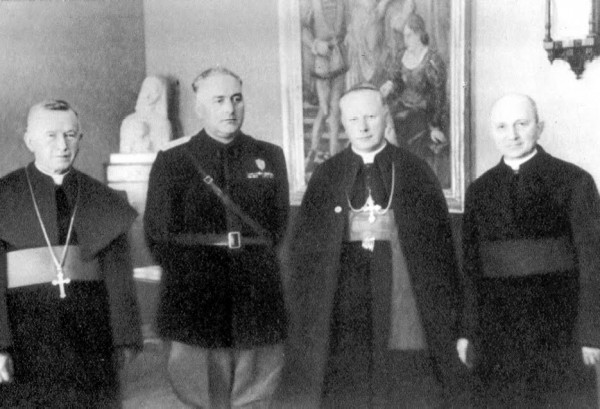
The high commissioner Emilio Grazioli initially carried out a moderate policy, in an attempt to involve the conservative business classes and the Catholic Church, giving life to a "Consulta", an assembly of local notables that was supposed to cooperate and support the work of the italian authorities. Indeed, the influential bishop of Lubiana, Gregorij Rožman, and most of the country's pre-war politicians, led by political leader Marko Natlačen, immediately expressed in early May 1941 their willingness to collaborate with the fascist authorities, writing public letters of support for the annexation of the province of Lubliana to Italy. On June 8, 1941, Natlačen led Slovenian politicians and industrialists to meet Mussolini in Rome, after which they reaffirmed their loyalty, and began to officially collaborate with the Italians in the 'Consulta', an advisory body.

In the days immediately following, 105 Slovenian mayors sent a message to Mussolini, expressing "joy and pride for the incorporation of Slovenian territories into the great Kingdom of Italy". A similar message of congratulations also reached the Duce from the archbishop of Lubiana, Gregorij Rozman. This catholic "vescovo" (with Ignacj Nadrah and Frank Kimovec) became one of the most important collaborators of the fascist regime, guaranteeing the loyalty of large sections of the 'believing' catholic population.

Lubiana: Military parade of Italians on first week of April 1941, with slovenian civilians attending


The result of German harsh policy in the nazi occupied area north of Lubliana was the influx of tens of thousands of Slovenes into the Italian province. A few weeks after the end of the war against Yugoslavia, 27,000 people crossed the border between German and Italian Slovenia (17,000 settled in Lubiana). The Italian reports on these facts left no room for doubt about the causes of the exodus, identified in the German "inhuman yoke". Germany was accused of stripping Slovenian land and stripping the local population of the basis for their survival. In doing so, Berlin forced the population to seek a less "barbaric" place for its existence. And even in the final months of 1941 hundreds of Slovenians crossed the border between the two occupation zones to settle in the Italian territory. This created problems (of food, lodging, health assistance, etc..) to the Italian authorities, but showed to the Slovenians the "good side" of Italian presence in southern Slovenia.

However this continuous influx of people from the north was viewed with suspicion -after summer 1941- by the Italian administration, which feared that once they arrived, especially men, they could become a threat to the internal security of the province (because linked to Tito's partizans): according to general Roatta they were the main culprit of the guerrilla & terrorism attacks that destroyed the good relationships between Italians and Slovenians at the end of 1941/beginning of 1942 (M. Roatta, "Otto milioni di Baionette. L’esercito italiano in guerra dal 1940 al 1944". Mondadori. Milano, 1946).

Some historians pinpoint that the original population of Lubiana & southern Slovenia was going to behave in a relatively "quiet way" with the Italians, like happened in the Governorate of Dalmatia at least untl the end of 1942: it was people from northern Slovenia (and other areas of Iugoslavia) who enrolled in Tito's partizan groups and who created the fracture between Italians and local Slovenians, mainly after fall 1941!

Although very few, Slovenian fascists had made themselves known in Slovenian politics since the 1920s: in 1923 a small fascist party of Slovenes of Venezia Giulia ("Vladna Stranka", government party) was born, which then in 1925 merged into the 'Party National Fascist', and a certain amount of unemployed Slovenian youth joined the Fascist militia. In Lubiana in May 1941, immediately small groups of Slovenian fascists were created who obviously supported the union with the Kingdom of Italy (but only on 21 October 1941 the National Secretariat of the National Fascist Party established - on Mussolini's orders - the "Federation of Fascists of Combat of Lubiana ": Grazioli was appointed Federal Secretary).

After all, some Slovenes (fascists and non-fascists) immediately promoted the establishment of collaborationist armed bands, subsequently called MVAC (Voluntary Anti-Communist Militia) and integrated into small units in the Italian army. The MVAC had a decidedly notable importance in Slovenia, where some old adherents of the conservative pre-war parties, tightened around the highest ecclesiastical hierarchies and animated by a heated anti-communism, created a political-military structure that obtained a wide consensus and came to mobilize more than 6,100 men in 1941 and 1942. In fact, the Italian authorities immediately supported the anti-communist Slovenian political forces, especially of Catholic inspiration, which, fearing the communist revolution, had at that moment identified the greatest danger in the partisan communist movement, and had therefore made themselves available for collaboration.

These political forces had thus created "self-defense formations" (the most numerous "Vaška Straža" and the most militant "Legija Smrti" or 'Legion of Death' - the latter also called more commonly 'White Guard' or "Bela Garda"- under the direct inspiration and coordination of the Bishop of Lubiana Gregorij Rožman: the Italian commands (under General Mario Roatta of the 2nd Italian Army) organized these formations, in the following August 1942, in the" Anti Communist Voluntary Militia" or MVAC (new name collective hired by the pre-existing Slovenian organizations from 6 August 1942), using them successfully in the anti-partisan struggle.

Also worth mentioning is the "Civic Guard" ('Vaške Straže' or village guards), which was created in November 1941 by Ernst Peterlin. It was a militia of Slovenian Catholic peasants set up to prevent the robberies and assaults of the "Tito" communist partisans in the Slovenian countryside. The Civic Guard was also created (in the intentions of its leaders) to prevent the establishment of communist political and military power on Slovenian territory, with the ultimate aim of contributing to the establishment of a Catholic political system in the country.

The 'Civic Guard' (with dark berrets) of Rakitna -a village between Lubiana and Postumia- with Italian officers and some civilians & religious groups, in summer 1941
It should be noted that in addition to the approximately 6,100 of the MVAC, the Slovenian Catholic auxiliary forces deployed a total of 7,000 men alongside the Italian authorities at the end of 1941, when the communist resistance in Slovenia began to be present in a serious form (with attacks and murders): the idyll in Slovenia was over!

Furthermore, in December 1941 an Italian teacher was killed by the Slovenian Communists in front of her pupils in Lubiana (read for further informationhttps://books.google.com/books?id=SGCuAgAAQBAJ&pg=PA49&lpg=PA49&dq=uccisione+di+maestra+italiana+a+lubiana+nel+1941&source=bl&ots=ygJ_DFeepV&sig=ACfU3U3Yj0uJ0xTobF-TUmYVwjonIXFQew&hl=en&sa=X&ved=2ahUKEwjanuau8-LsAhWuxFkKHSo7DDIQ6AEwEnoECAEQAg#v=onepage&q=uccisione%20di%20maestra%20italiana%20a%20lubiana%20nel%201941&f=false). She was the first Italian civilian (and the first Italian woman) assassinated by the Tito partizans in Slovenia, sparking the reaction of the Italian military authorities (who consequently -also because of this murder- enclosed with a barbed wire fence all the city of Lubiana in January 1942).

In other words, this "special idyll" had been quite successful and even happy in the months of May and June 1941, but with the Axis attack against Stalin's Soviet Union it began to disintegrate and by early 1942 it had completely vanished: it didn't even last one year!
Map of 1942, showing the new northeastern borders of the kingdom of Italy.