Wednesday, February 3, 2021

DR. TIBERIO AND THE DISCOVERY OF ANTIBIOTICS

It has been known in the international scientific community since 1947, but the general public is mostly unaware, that the young Italian physician Vincenzo Tiberio discovered the antibacterial power of molds in 1895 (read: https://www.ncbi.nlm.nih.gov/pmc/articles/PMC1903577/pdf/amjpathol00223-0040.pdf), more than thirty years before the famous Alexander Fleming.

Dr. Tiberio was the first to discover something fundamental for the health of Humankind: the antibiotics.
Vincenzo Tiberio was the real discoverer of Penicillin. He found out antimicrobial effect produced by some moulds, thirty-four years before Alexander Fleming, observing a well situated in family's house.L.B (History medicine database)

To divulge this truth for the first time, with documents that dispel any doubt, is the feature film 'Vincenzo Tiberio, the man who discovered antibiotics', made by 'Imago Film' and directed by Claudio Rossi Massimi. The DVD is free (only shipping costs are required) and to get it, just write to:" imago.film@libero.it "

History of the Dr. Tiberio's discovery
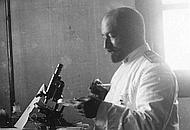
Vincenzo Tiberio was a brilliant Italian doctor and biochemist who was also a medical officer of the Italian Royal Navy.

He was born in Sepino (a small city of Molise in central Italy) on May first, 1869 and after brilliant classical studies he enrolled in the Faculty of Medicine at the Royal University of Napoli.

Even before graduating, he passionately devoted himself to microbiological research in the field of Hygiene and Microbiology which he continued throughout his life (until his death, when was only 45 years old).

In the last decade of the 19th century when Tiberio attended the Faculty of Medicine and Surgery in Napoli, this Athenaeum was not only a place of education, but also and above all of research, especially in the bacteriological field. At that time, in fact, Professor Eugenio Fazio published a work on the vital competition between the bacteria of putrefaction and those of anthrax and typhus and Professor Arnaldo Cantani was experimenting with a therapy for tuberculosis, applying Louis Pasteur's principle of antagonism, and obtaining interesting results.

In this environment, Tiberio, still a student in Medicine, began to attend the Hygiene laboratories, to verify some of his intuitions. In the courtyard of the house in Arzano, where he lived, there was a cistern for rainwater which was also used for drinking. On the edge of the cistern, molds grew which were, for obvious hygienic reasons, periodically eliminated. Soon, Tiberio noticed that when the molds were not there, gastrointestinal infections occurred in the water users, while when there were the use of water was harmless. He sensed a connection between the presence of molds and the growth of pathogenic bacteria for the human organism. Subjected this intuition to experimental verification....and so Tiberio was able to demonstrate how the therapeutic action of molds was linked to some substances present in them. He also succeeded in isolating some of these substances and experimenting with their beneficial effect up to the preparation of a substance with antibiotic effects.

In 1895, in the scientific journal "Annals of Experimental Hygiene of the University of Rome", he published an article with the title "On the extracts of some molds" as an account of his work in which he identified for the first time the bactericidal power of some particular molds: "The author observed the action of aqueous extracts [of various types of molds] on some pathogenic [microorganisms] ... finding them provided ... with considerable bactericidal power ... The properties of these molds are strong obstacle for life and for the propagation of pathogenic bacteria."

"Risulta chiaro da queste osservazioni che nella sostanza cellulare delle muffe esaminate son contenuti dei principi solubili in acqua, forniti di azione battericida: sotto questo riguardo sono più attivi o in maggior copia quelli dell' Asp. flavescens, meno quelli del Mucor mucedo e del Pennicillum glaucum." (It is clear from these observations that in the cellular substance of the molds examined are contained some water-soluble substances, provided with bactericidal action: in this respect are more active or in greater abundance those of Aspergillus flavescens; less, those of Mucor mucedo and Pennicillum glaucum.)Tiberio, Vincenzo (1895) "Sugli estratti di alcune muffe" [On the extracts of certain molds], Annali d'Igiene Sperimentale (Annals of Experimental Hygiene), 2nd series (5 : 91-103)


The results of his research, collected in the aforementioned publication, allowed him to observe that: "The cellular substance of the molds examined contains water-soluble principles, provided with bactericidal action." The above work describes the method of preparing the culture medium and taking the liquid from the plates, the chemical and organoleptic characteristics of the liquid and the study techniques. The ability to stimulate the response of white blood cells to infections (chemotaxis), and the bactericidal power of various strains of the Aspergillus mold on the typhus bacillus were subsequently confirmed by several researchers.

Despite the extreme accuracy and replicability of the Tiberio's research and its evident therapeutic results, the discovery did not have any diffusion or follow-up in the Napoli university environment. Disappointed in his academic and clinical aspirations, he entered the Regia Marina in 1896 as a medical officer.....and so he abandoned his research for some years!

Almost simultaneously also Bartolomeo Gosio, in Rome, in a kind of mold discovered a metabolite with antibiotic properties, and purified it. Mycophenolic acid (MPA) -created by Gosio- was the first true antibiotic in History! In 1922 Gosio was proposed to receive the Nobel in Medicine research, but nothing happened because in that year Mussolini took the control of Italy and in the political chaos in which Italy plunged nothing was done to support the nomination.

However the scientific activity of Tiberio, who completed, at the end of the 19th century, the entire experimental cycle from observation, to the verification of the initial hypothesis, up to the preparation of the antibiotic substance, was much more advanced than that of Alexander Fleming in 1928/29. The latter knew the researches of Tiberio (according to Ernst Chain, who received the Nobel together with Fleming) and certainly those of Gosio despite the scarce diffusion of the same outside Italy, and came to the discovery of "penicillin", as he himself reported, due to an error: "the involuntary contamination of a capsule containing colonies of Staphilococcus aureus with fungal colonies”, which then produced “an inhibition of bacterial growth in the colonies of Staphilococcus aureus”. However, Fleming then failed to experimentally prepare the drug, thus not closing the research cycle, as they had instead done in Napoli Tiberio and later in Rome, Gosio.

Dr. Vincenzo Tiberio wanted to follow his research in 1914, when returned to Italy and was named "Director" of the Service of Hygiene and Bacteriology of the Hospital of the Italian Navy in Piedigrotta (a district of Napoli's metropolitan area), probably with the hope of being able to resume his studies on molds like the "Peniccilium". Indeed we must pinpoint that the famous name "penicillin" comes from the mold "penicillium".

When he returned to Napoli, however, he had little time to carry out his research further, for he was struck down by a myocardial infarction on January 7, 1915, at the age of only 45 years.

In 1947, two years after the awarding of the Nobel Prize to Alexander Fleming, the 1895 book of the Annals of Experimental Hygiene of the University of Rome was found, in which the work on the extracts of some molds was published. The results and methods of the research were disseminated in national scientific journals, but, obviously, they did not have the deserved resonance.

Today the truth is well known since 1947, but the fame of Dr. Tiberio is, despite everything, known only by passionate lovers of the History of Medicine and ignored by most. The Italian Vincenzo Tiberio -34 years before Fleming- had discovered the power of "Penicillin", that has saved millions of human lives, according to the "Presidenza della Regione Molise" (read http://www.regione.molise.it/web/grm/cspr.nsf/7ca3c8cc9740728ec1256e2d00734512/00f68c3d2c011aeec125727d005b80dc?OpenDocument).

Saturday, January 2, 2021

THE CONSOLATA MISSION IN ITALIAN SOMALIA

The Catholicism in Italian Somalia

We all know that Catholicism (and Christianity) in what was Italian Somalia has practically disappeared in the last decades of the civil war in this African country. According to catholic sources there are less than 100 catholics practising in actual Somalia (mostly in the capital Mogadishu and nearly all foreigners). But it was not so "minimal" this number during the years when Italy had a colonial control of Somalia. Let me explain better.

As I wrote in wikipedia, Catholicism was introduced in Italian Somaliland in the late 19th century. Initially, it was only practiced by the few Italian immigrants in Mogadishu and between the Bantu of the Shebelle River farmer areas, thanks to some missionaries of the Trinitarian Fathers. In 1895, the first 45 Bantu slaves were freed by the Italian colonial authorities under the administration of the chartered Catholic company Filonardi: they were later converted to Catholicism and were the first "Christians" in all Somalia's native population, a country totally moslem since the early Middle Ages.

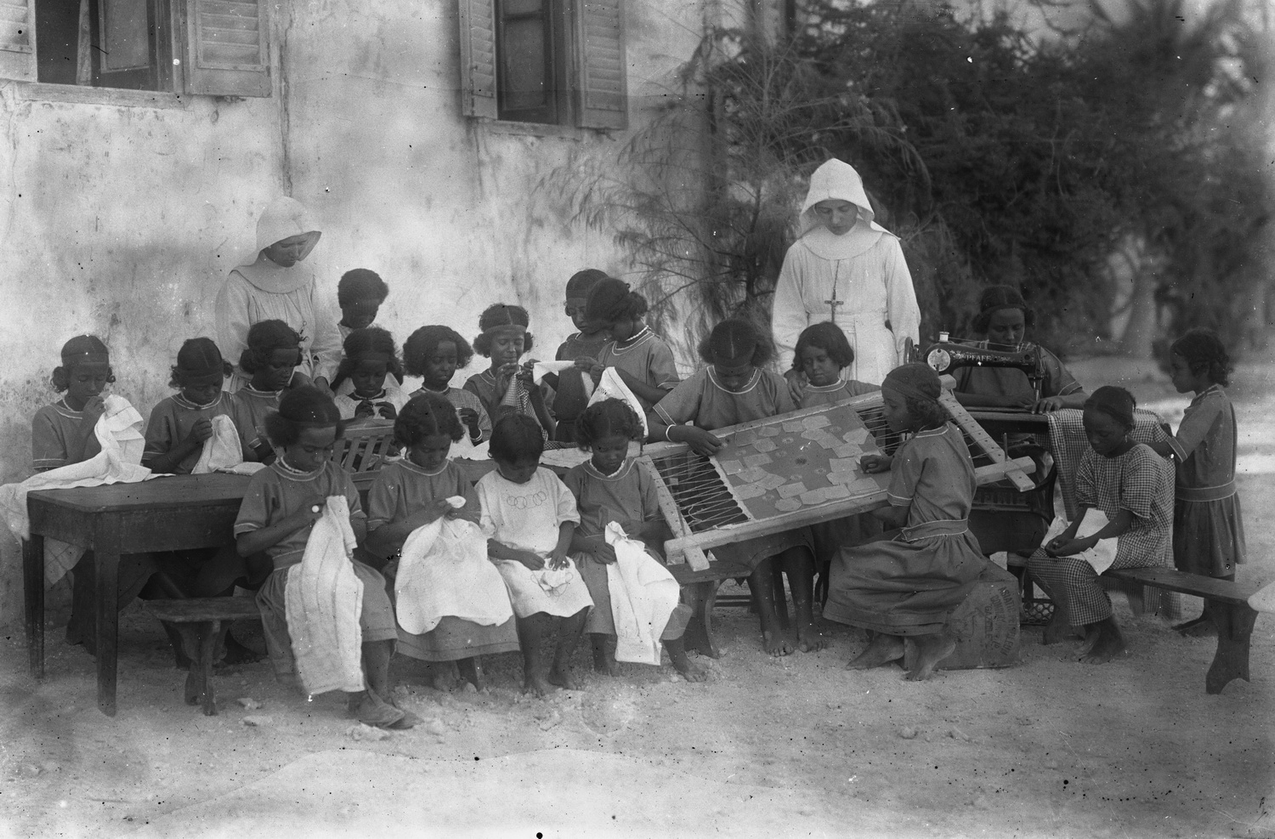
A sewing class for Somalian kids, done by an Italian missionary nun in 1928 Mogadiscio
Massive emancipation and conversion of slaves in Somalia only began after the anti-slavery activist Luigi Robecchi Bricchetti informed the Italian public about the local slave trade and the indifferent attitude of the Italian colonial government toward it. For further information, please read https://www.asei.eu/it/2011/11/le-missioni-cattoliche-italiane-allestero-il-caso-della-consolata-nella-somalia-di-cesare-maria-de-vecchi-1924-1928/.

After World War I Catholicism started to be actively promoted in "Somalia italiana", as historian Listowel wrote:

In 1903 the "Trinitarian Fathers" were the first missionaries to arrive in what was to become Somalia. They started teaching and providing social assistance to the poor and the sick. Fr. Jelib set up a leper colony at the mouth of the Juba river, and cared for about 350 to 400 lepers. In 1924 the Consolata Fathers and Sisters (from Turin) arrived; the Fathers to be replaced in the 1930s by the Franciscan Friars Minor from the Milan Province.
Italian missionaries promoted Catholicism in the capital Mogadiscio, but also in the farm area of the Scebeli river (where the Duca d'Abruzzi created a huge farm colony): many Bantu -former slaves & their descendants- of the area converted to Catholicism.

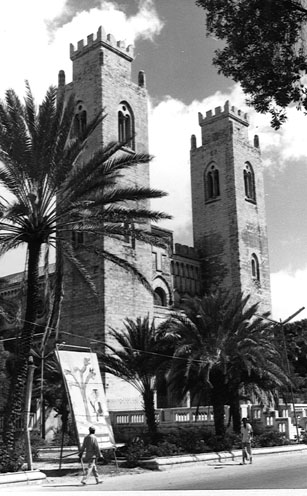
In 1928, a huge Catholic cathedral was built in Mogadishu by order of Cesare Maria De Vecchi, a Catholic governor of "Somalia italiana" who promoted the "Missionari della Consolata" Christianization of Somalian native people.

In Mogadishu, Consolata missionaries (in all Somalia they were 25 in total and additionally there were 30 nuns) opened a male school of arts and crafts for woodworkers, smiths, printers, mechanics, and shoemakers, as well as a female school for sewing and domestic work. In 1929, the two schools had started, respectively, a printing house, a bookbinder, a bakery, and a textile factory(please read https://link.springer.com/chapter/10.1007/978-3-030-27801-4_6).

In the late 1930s Catholicism started to be accepted by some native Somalians, thanks to the "seeds" that the Consolata missionaries had created.

Indeed the Bishop of Mogadishu Franco Filippini declared in 1940 that there were about 40,000 Somali Catholics due to the work of missionaries in the rural regions of Juba and Shebelle, but WWII damaged in an irreversibly way most of the catholic missions in Italian Somalia. Most were somali Bantu, but some thousands were illegitimate sons of Italian soldiers and somali girls (who received Italian citizenship when baptized).

In the 1950s Indro Montanelli wrote on "Il Borghese" magazine that Italian Mogadishu in 1942 after the arrival of the British was an African capital where most of inhabitants were Catholics: he indicated that of the 90,000 inhabitants more than 40,000 were Italians, while inside the 50,000 Somalis there were nearly 7,000 Catholics (including the many illegitimate sons of Italian soldiers and Somali native girls who were baptized in order to get Italian identification). From this he concluded that nearly 3 out of 5 Mogadiscio inhabitants were Catholics.

But in 1954 there were only 9000 catholics in all Somalia............and in 2004 there were less than 200........Sincerely, it is an astonishing & shocking disappearance!

The (now destroyed) Cathedral of Mogadiscio was also promoted by the Consolata missionaries
The Consolata Mission

In 1923 the catholic Cesare Maria De Vecchi was named governor of Italian somalia: he was a strong fascist who wanted to "italianize" (in everything) the colony of Somalia. In order to get this, he invited the missionaries of the "Consolata mission" to come to Mogadishu and promote catholicism between the native population.

in 1924 -when arrived the Consolata- in Somalia there were about 1600 Catholics, almost all represented by Italians who moved to the colony - government employees, merchants, entrepreneurs and simple settlers -, as well as about one hundred Eritrean Catholic askari employed by the government for secondary services. Among these, the Consolata missionaries could have carried out a work of full religious assistance, while "among the indigenous" they should have acted "with great caution", because of the strong moslem presence in the country.

The following are excerpts related to the Consolata mission in Italian Somalia, from an essay written by Alberto Sbacchi and titled:

"The archives of Consolata mission and italian colonialism"

The Institute of the Consolata for foreign missions was founded in Turin, Italy, in 1901, by the generai superior, Giuseppe Allamano (1851-1926). The primary purpose of the mission is to evangelize and educate pagan peoples. Allamano believed in the benefit of religion and education when he stated that the people «will love religion because of the promise of a better life after death, but education will make them happy because it will provide a better life while on earth». The Consolata distinguishes itself for stressing the moral and secular education and its enthusiasm for missionary work.

In 1919 it entered Tanzania, and accepting a government invitation in 1924 the Consolata installed itself in Italian Somalia and in 1925 in the Portuguese colony of Mozambique.


THE CONSOLATA MISSION IN SOMALIA, 1925-1930

In contrast with Ethiopia, Somalia was not a priority of the Consolata mission. Instead it can be inferred that it was a means of fulfilling its aim of converting the Oromo to Christianity, entering Ethiopia from Somalia with the support of the colonia! government. Filippo Perlo, apostolic vicar of Kenya, sought and received permission for his plan by promising to conducting politica! activity in Ethiopia in favor of Italy. Perlo's proposals attracted the attention in 1910 of governar Giacomo De Martino, who considered the Consolata mission to be an ally of the government in furthering Italian colomal policy in Somalia.

The Italian government favored the presence of an Italian mission in Kaffa as counter measure to Great Britain's influence in Southern and Western Ethiopia. De Martino agreed with the Ministry of foreign affairs that the Consolata mission must be supported in its effort to install itself in Ethiopia to coordinate the Italian penetration between the sources of Ganale and Shebeli rivers and to consolidate the Italian presence in the lake regions from lake Rudolf to lake Margherita, thus facilitating political expansion from Somalia into Ethiopia. With the Consolata mission Italy would be able to establish a strong Italian presence in Southern and Western Ethiopia, stimulating commerciai relations. In return the Consolata provided Rome with information.

With the backing of Italian authorities, Perlo set up a caravan in 1913 entering Ethiopia from the South, with Angelo Dal Canton, Anselmo Jeantet and Aquilino Caneparo pretending to be merchants. They were stopped and retained as prisoners at Burgi under suspicion for three years, during the first world war, of being spies and hiding weapons. Perlo used the imprisonment of the missionaries to force a politica! decision on the Ethiopian government and on minister Colli, eventually extracting from ras Tafari permission to enter Kaffa. It took three years, however, for Colli to prevail over the Ethiopian government and to free the missionaries.


Photo showing (from left) governor Giovanni Ferroni, the Prince 'Duke of Abruzzi' and governor Carlo Ricci Riveri in the "Villaggio Duca degli Abruzzi" (actual Jowhar). They allowed the italian missionaries (of the Trinitarian, Consolata and Franciscan Orders) to do some promotion of Catholicism to the native Somalian population during the 1920s.


Meanwhile governor Cesare de Vecchi called the Consolata to Somalia. De Vecchi believed that in the colonies the army must be followed by religion and education. The border land of Somalia, he sai d "the land toward the west [Ethiopia] is where the future of the greatness of Rome will come". Expansion at the expense of Ethiopia and bringing civilization to Somalia was the colonia! program of De Vecchi, which he hoped to implement with the assistance of the Consolata. In the governor's estimation the Consolata was indispensable for him because the missionaries were hard workers and loyal supporters of the governments colonia! policy.

De Vecchi and the Consolata made a list of priorities.Perlo saw that a church and a house for the missionaries were necessary, while De V ecchi's program included an asylum, elementary andtrade schools, housing for the half-cast children, and the provision of missionary help at the government hospital. However, Perlo complained that although De Vecchi had called the Consolata to Somalia,and the mission was under his protection operating in absolute freedom, his materia! help was slow in coming. On another occasion he reported that "the governor had many good words for us but he has not fulfilled his promises".

While the Consolata did its part in terms of religious, social, educational and medicai assistance, the Consolata felt that the governor was taking time implementing the promise for the building of a church cathedral and giving agricultural concession to the Consolata, to help the mission defray its operating cost. The colonia!administration was also slow in paying the subsidies on time. The Consolata received a yearly payment of 48.000 lire for schools, and 16.000 lire for the Hospital. In addition the Turin headquarter provided the mission in Somalia with a 50.000 lire grant, Propaganda fides 29.000 lire and Società antischiavista italiana with 22.500 lire per year.

To urge the missionaries to do more, De Vecchi promised to get 1.500.000 lire from the government for the Cathedral of Mogadiscio. The building, resembling a church-fortress, would reflect the architecture of the homeland of the colonialists, conveying a sense of strength to affirm the power of Italy among the people of Somalia. The church was necessary for the Consolata fathers because of the solemnity of worship, affirmation of the catholic faith, of patriotism and of prestige before the colonia! people. Having erected these major buildings, the Consolata also received 200 hectares of land on the Ganale river (Merca) to be cultivated with cotton.


An Italian professor teaching how to print to Somalian boys in a 1928 Consolata school
By the end of its five year tenute in Somalia, the Consolata mission contributions, with the generous financial contribution of the government, were from a practical point of view relevant, leaving behind a Cathedral, an industriai school, a school for half-cast children and an elementary school system with five classes attended by 2.000 students.

In 1930 the Consolata left Somalia and was replaced by the "Padri Minori" of Franciscan order. Officially the Consolata moved oùt of Somalia because it was involved in too many countries and did not have enough personnel for staffing its missions.

However, the Consolata was requested to leave Somalia by the Vatican's "Propaganda Fides" since it did not have enough conversions on account of the fact that Somalia was a Muslim country, but above all the catholic Church wanted to limit the power of the Consolata, by concentrating its efforts only in Kenya and Ethiopia.

Archival evidence, however, suggests that the ending of the Consolata operation in Somalia was motivated by financial mismanagement. Filippo Perlo had too much authority in his hands as generai superior of the mission. He in turn had appointed his brother Gabriele apostolic vicar of Mogadiscio and another brother Luigi, was the administrator of the mission in Kenya. Hence there were good reasons to limit the personal rule of the Perlo clan, for the benefit of the Consolata mission!

Alberto Sbacchi


However the Consolata missionaries remained in charge until 1933 of the "Hospital Giacomo De Martino" in Mogadiscio. Their management was directly paid by the Italian government under orders of the governor De Vecchi (who was nicknamed "Little missionary of Christ").

Tuesday, December 1, 2020

ROMANIZED BERBERS DISAPPEARANCE

One of the biggest "disappearances" in History is the one that happened in northwestern Africa with the so called "Roman Africa", a region actually called "Maghreb" and that includes modern Tunisia and the Mediterranean areas of contemporary Morocco, Algeria and Libya's Tripolitania.

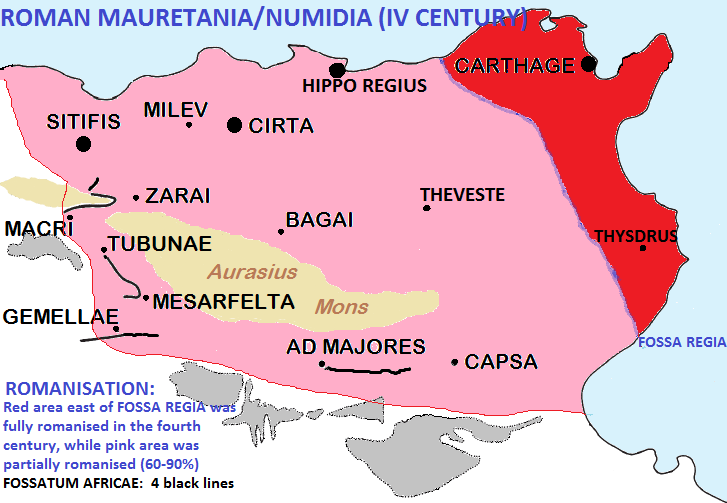
This area was one of the most romanized of the Roman empire in the fourth century, when started the barbarian invasions in western Europe: it was similar in everything to "Roman Hispania", according to the famous historian Theodor Mommsen.

Roman emperor Macrinus, a romanized berber born in Caesarea (now Cherchell in Algeria)

Roman Africa was populated by the autochtonous "Berbers" who were fully "latin speaking" in an area that coincides with actual central-northern Tunisia and who were fully christians on the coastal regions (from Gibraltar to modern Tripolitania).

There were also some descendants of the Phoenician settlers that founded Carthago, but they were assimilated by the autochtonous Berbers by the fourth century (indeed the same happened with some italian colonists that settled in coastal Numidia, mainly around Cirta).

But after the arrival of the Arabs in the late seventh century it "disappeared" in a terrible bloodbath. While Hispania remained forever linked to Rome, this African region lost nearly all the Romanization & the links with western Europe -from the local neolatin language to the early christianity (https://www.google.com/books/edition/The_Extinction_of_the_Christian_Churches/r1RbAAAAMAAJ?hl=en&gbpv=1&dq=christians+of+tunis&pg=PA241&printsec=frontcover).

However something of Roman Africa has survived, like the few Christian Berbers of our times and the small Spanish enclaves of Ceuta and Melilla

Indeed estimates show that actually there are nearly half a million Christian Berbers, many living in a situation of diaspora in Western Europe and the Americas and nearly 300,000 living in the Maghreb region of North Africa (from Morocco to Libya).

Notable Romanized Berbers

Accomplished Berbers of Roman Africa include famous writers such as Martianus Capella. There were also Christian saints such as Augustine, Roman popes such as Pope Victor I and even the pagan Roman emperors Macrinus & the famous Septimius Severus.

Most of them appeared in a socio-cultural period of development in Roman Africa following the introduction of Christianity. Most of these figures are historical, and we have to remember that now the Christians in North Africa do not have as much of a dominant community as they used to have in Roman times.

Roman writers such as Terentius, Lactantius, Martianus Capella (previously mentioned), Marcus Cornelius Fronto, Apuleius and Tertullianus were Berbers. Christian Berber saints include the Scillitan Martyrs, Cyprian, Victor Maurus and Saint Monica (mother of Saint Augustine). Roman popes like Pope Miltiades and Pope Gelasius I and Roman emperors such as Macrinus, Emilianus and Caracalla (son of the famous Septimius Severus) were also romanized Berbers.

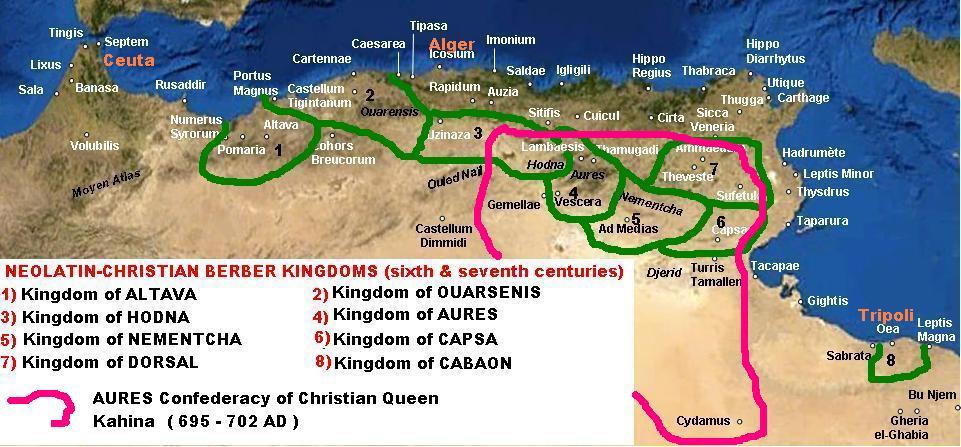
Berber kings of exclusive Christian Berber realms known as the 'Romano-Berber states' include Masuna, Mastigas and Garmul of the "Kingdom of Altava", called initially "Mauro-Roman Kingdom" or "Kingdom of the Moors and Romans" (477-578 AD). They are known for making Christian Jedars and Mausoleums such as the "Tomb of the Christians" near Caesarea (also known as the 'Royal Mausoleum of Mauretania'). Also Caecilius (often called Koceila in berber language) of the Kingdom of Altava was an important Christian Berber.

History

The massacre of Christian Berbers by the Arab conquerors is one of the biggest exterminations in History. Nearly 90% of the Berbers living in actual Tunisia and Algeria "disappeared" in a few decades, with their own romano-berber civilization. Most of them died, but more than 350,000 were enslaved and sold in the slavery markets of the Arabs. A shameful genocide/ethnocide that only now is being studied and analyzed in all its enormous dimensions.


We know that the Kingdom of Altava (578-708 AD) fought harshly the Arabs. The last recorded ruler of the Kingdom of Altava was Caecilius, called Koceila or Kusaila ("leopard" in 'Tamazight' berber language). He died in the year 690 AD fighting against the Muslim conquest of the Maghreb. He was also leader of the Awraba tribe of the Imazighen and possibly Christian head of the Sanhadja confederation. Caecilius as a berber prince was probably educated in a roman christian way and consequently fought the moslem invasion with religious passion. He is known for having led an effective Berber martial resistance against the Umayyad Caliphate's conquest of the Maghreb in the 680s.

Indeed, in 683 AD the arab leader Uqba ibn Nafi was ambushed and killed in the Battle of Vescera near Biskra by Kusaila, who forced all Arabs to evacuate their just founded Kairouan and withdraw to Cyrenaica. But in 688 AD Arab reinforcements from Abd al-Malik ibn Marwan arrived under Zuhair ibn Kays. Caecilius met them in 690 AD -with the support of Byzantine troops- at the Battle of Mamma. Vastly outnumbered, the Awraba and Byzantines were defeated and Caecilius was killed. With the death of Caecilius, the torch of resistance passed to a tribe known as the Jerawa tribe, who had their home in the Aurès Mountains: his Christian berber troops after his death fought later under Kahina, the last Queen of the romanized Berbers.

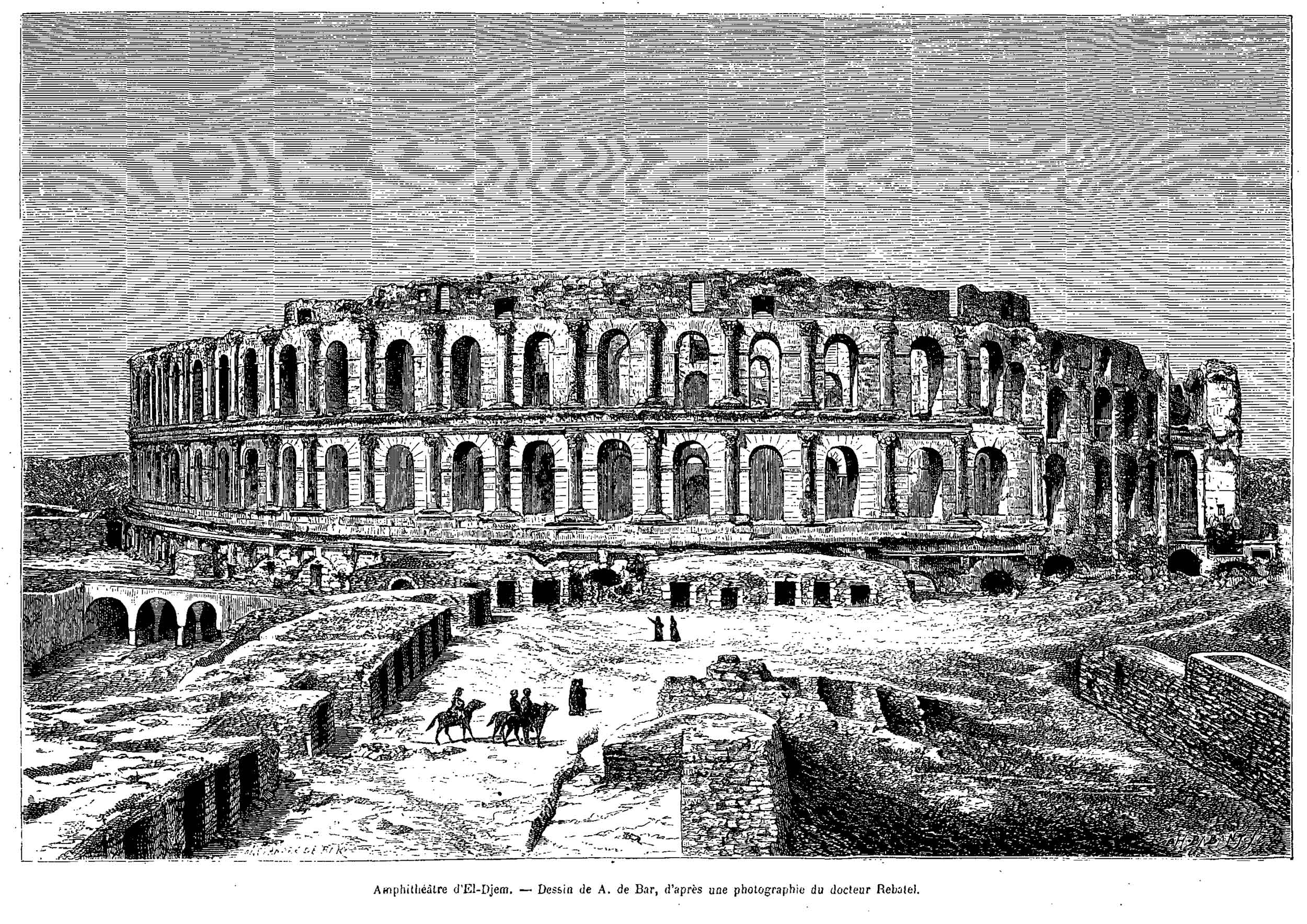
Kahina (called also Dihya) was born in the early 7th century and may well have been of mixed descent: Berber and Byzantine Christian, since one of her sons is described as a 'yunani' or Greek. Kahina ruled as a Christian queen (but some arab historians wrote that she was a Jewish "sorcerer") and was able to defeat the Arab invaders who retreated to Tripolitania: for more than five years ruled a free berber state from the Aures mountains to the oasis of Gadames (695-702 AD). But the Arabs, commanded by Musa bin Nusayr, returned with a strong army and defeated her. She fought at the El Djem Roman amphitheater of Thysdrus, but finally died around the beginning of the eight century (most probably in 703 AD) in modern-day Algeria in a battle near Tabarka. Her defeat and death was followed by the "disappearance" of Roman Africa in what the Arab conquerors later called 'Maghreb' (the word 'maghrib' means "western territories" in arab language).

Musa bin Nusair, a Yemeni general, was made governor of "Ifriqiya" (as Arabs called Roman Africa) and given the harsh responsibility of putting down this renewed romanized Berber rebellion and converting the population to Islam. Musa and his two sons prevailed over Queen Kahina and the rebels and enslaved 300,000 Berber captives. The caliph's portion was 60,000 of the captives. These the caliph sold into slavery (mainly in Damascus), the proceeds from their sale going into the public treasury. Another 30,000 captives (who rejected their Christian faith in order to survive) were pressed into military service and forced to convert to Islam.

We know that all Roman Africa had only one million inhabitants when Musa enslaved those 300,000 Berber captives....and this means that one third of the Romanized Berber population was reduced to slavery in those years! Furthermore 60,000 were sent mostly to Damascus. We know that in those years the Arabs did not have a huge navy, so most of those captives had to reach Damascus (in Syria) walking by foot thousands of kms! Imagine the massacre along the way through the desert of Libya and western Egypt! As an example, we know that in the XX century the moslem Turks forced many christian Armenians to walk a few hundred kms in captivity and there was the death of nearly one quarter of them: consequently imagine how huge was the massacre suffered by those Berbers enslaved, forced to walk in captivity the big distance between their homeland until Damascus....It was one of the most terrible exterminations of an entire population in ancient History!!!!


The El Djem Roman amphiteater was a stronghold of Queen Kahina: it was destroyed by the Arabs around 701 AD after a fierce defense by the romanized Berbers.

Historian Daniel Pipes also wrote in his famous book 'Slave Soldiers and Islam: The Genesis of a Military System' (https://books.google.com/books?id=ByLG-2hZX-MC&q=musa+300,000&pg=PA124#v=snippet&q=musa%20300%2C000&f=false), that Musa Nusayr enslaved nearly 300,000 berbers in those years when defeated Kahina and reduced nearly to ashes for two centuries the city of Carthago! Indeed in 705 AD Roman Carthago was reduced from 500,000 inhabitants during Trajan/Hadrian years to a village full of ruins with just 3,000 survivors (all Muslims, of course).

Additionally we must remember that when lived the most famous Christian Berber in Antiquity, Saint Augustine, there were five million inhabitants in the provinces of the Roman empire that now are called the "Maghreb", but -after the 50 years of Muslim Arab conquests- in 705 AD there were only one million Berbers (while nearly all the Roman colonists' descendants were murdered or flew back to Italy) and one third of them was enslaved: this was one of the biggest massacres registered in History, with the bloody end of nearly all Christianity in the region.


Capsa & the last Romanized Christians

Only a few areas of Roman Africa maintained (in the moslem Maghreb) until the early XVI century the so called "African Romance" language and practised christianity: one of them was Capsa.

The Roman town of Capsa, now modern day Gafsa in Tunisia, was conquered by Rome in 106 BC and made a colonia and municipium by emperor Trajan. It grew in importance as can be seen in the Roman baths that were 4 meters deep and the recently discovered mosiacs. During the decades of Septimius Severus the town had more than 300,000 inhabitants and was a key important commercial center of the Roman limes in Africa. Capsa was a fully romanized city by the third century.

Map I created for wikipedia, showing Capsa location in the Romanized areas of Roman Africa

Although Capsa was conquered by the Vandals, it soon became independent and the capital of a newly founded Romano-Berber kingdom in the 6th century (until happened a Byzantine invasion).

Under the Byzantines the city was the capital of the Bizantine province "Byzacena" and enjoyed a period of economic revival. General Solomon build in 540 a new city wall and named the city "Capsa-Justiniana".

When the Arab Oqba Ibn Nafi conquered Capsa in 688 AD he faced fierce resistance from the Berbers, during & after the Arab conquest. It however subsequently lost importance to the Muslim founded Kairouan. Christians living there still were considered Romanized Berbers and continued to speak an "African Latin" as part of their language and remained loyal to the Christian religion.

Capsa is the last place in North Africa where speakers of African Romance could be found "officially" in the thirteenth century, and Christianity was found there for another century, worshiped also in the Roman pools of the old ruins. Christians moved towards Capsa and its surroundings around the 10th century, strengthening its position.

In 1135 to 1155 the Normans conquered Capsa and protected the Christians there for a few years until the Muslim Almohads reconquered the city. Ibn Khaldun hinted at a native Christian community in 14th century in the villages of Nefzaoua, south-west of Tozeur and not far from Capsa. These paid the "Jizuah" and had some people of Sardinian descent among them.

After 1170 the remaining North African churches began to decline and disappear. This was a slow process, and popes continued to appoint bishops to sees like Carthage and Tripoli until the middle of the thirteenth century, but traces of organised, indigenous Christian communities become rare after that time.

Additionally we must pinpoint that the presence of Berber Christians in Libia's Tripolitania is attested at least until the late eleventh century and in the Jebel mountains for another century(https://books.google.com/books?id=pIkmvKB8OlsC&pg=PA121&lpg=PA121&dq=christians+of+Gef%C3%A0ra&source=bl&ots=wq6i_ZLi8O&sig=hdNYBH-szy0dBcioINSxoJwYl_k&hl=en&sa=X&ei=EwyFU4bLO9GEqga474LYAw&ved=0CCkQ6AEwAA#v=onepage&q=christians%20of%20Gef%C3%A0ra&f=false): in the necropolis of En-Gila to the south of Tripoli, a dozen Latin texts dating between 945 and 1003 were discovered (https://www.cairn-int.info/article-E_RHR_2293_0325--byzantine-churches-converted-to-islam.htm#re66no66).

In the second half of the fifteenth century, the Roman humanist Paolo Pompilio noted that the territory of Gafsa was populated by a land of small villages in which the inhabitants spoke a "Latinity" language. Berber Christians continued to live there until the 15th century, while they didn't recognize the new Catholicism of the Renaissance Roman Papacy. This would perhaps deny them support from other Christian powers. A letter in Catholic Church archives from the 14th century shows that there were still four bishoprics left in North Africa (http://www.orthodoxengland.org.uk/maghreb.htm): it was a sharp decline from the over four hundred bishoprics in existence at the time of the Arab conquest!

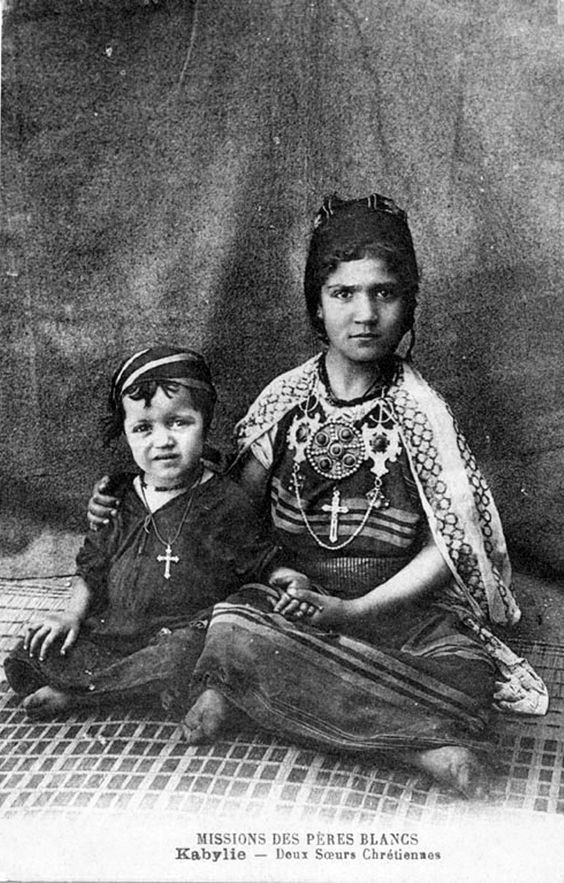
French photo of two young Christian Berbers of the Algeria's Kabylia in the XIX century

The Berber Christians of Roman Mauretania's Septem (actual spanish Ceuta) seem to have been assimilated into the Christianity of nearby Spain. Septem was another pocket of Christianity left over from the Roman period, at least until the X century. Then, in the 1400s Spain conquered the city and Christianity returned to be worshipped in Ceuta, but it was Catholicism linked to Madrid.

In the first quarter of the fifteenth century, the native Christians of Tunis, even though they were heavily assimilated into Islam in various aspects, extended their church, as the last Christians from all over the Maghreb were gathered there. This is the last reference to native Christianity in North-West Africa; Tunis and Capsa seemed to be the last Christian citadels for over fourteen hundred years of continuous Christianity.

Several families of the old African Christian Church were found in Tunis when the spanish emperor Charles V landed there in 1535. Leo the African described the remaining autochtonous Christians in Tunis with these words:
"In the suburb near the gate of El-Manera is a particular street, which is like another little suburb, in which dwell the 'Christians of Tunis'. They are employed as the guard of the Sultan and on some other special duties"
.
The "Christians of Tunis" survived until 1583, when the Turks conquered the city and ordered the extintion of the local christianity. Native romanized Christianity was assimilated into Islam, and it died out forever all over the Maghreb.

For the following centuries, until the XIX century and the arrival of the French in the arabised Maghreb, practically no Christianity was worshipped in this northwestern-african region. But -of course- the spanish Ceuta and Melilla were the exception (as happened even with Algeria's Oran until 1792, when the city was given by Spain to the Algerian Turks/Arabs).

Wednesday, November 4, 2020

SPRING/SUMMER 1941:WHEN THE ITALIANS WERE WELCOMED IN SOUTHERN SLOVENIA

Many forget that the Italian troops were welcomed even with enthusiasm in some territories of Yugoslavia, when Italy (together with Germany) defeated Yugoslavia in April 1941. Unfortunately this "special idyll" between Italians and Slavic populations did not last long, beginning to deteriorate after the Axis attack on Stalin's Soviet Union in June 1941.

Obviously it should be noted that the followers of the Yugoslav king Peter II were almost the only ones who "really" fought against the Italian troops, even if only in Montenegro there was a serious and strong opposition. General Roatta reported in his 'Memories' that "all available forces in northern Italy gathered at the Yugoslav frontier between Tarvisio and Fiume in early March 1941: two armies on the front line, and a third in reserve. Altogether there were thirty-seven divisions, eighty-five groups of medium-caliber artillery, and all the special formations, with corresponding services and supplies".

Representatives of Slovene political parties with the Italian High Commissioner Emilio Grazioli (with military dress) on May 3, 1941. The first to Grazioli's right is Marko Zlatacen
General Ambrosio's troops broke through the yugoslav lines of defense with relative ease in Zara and Venezia Giulia and in a couple of days they arrived in Lubiana and Spalato in what was propagandistically called the "Italian blitzkrieg", making many prisoners of war while were also welcomed by many Croats who greeted them because they wanted independence from the Serbs.

Equally favorable were the Albanian populations in the southern Yugoslavia territories that were conquered by the Italians and which were subsequently united to the "Italian Albania". And almost the same happened in Montenegro and southern Slovenia, at least initially.

But it was the Serbs of northern coastal Yugoslavia who most "liked" the Italian presence in those lands, especially after the surrender of the Yugoslav kingdom and the rise to power of the immediately created "independent state of Croatia" ('Nezavisna Država Hrvatska', abbreviated in NDH) of Ante Pavelic's "Ustascia". In fact the fascist Pavelic, who came to power after 10 April with the declared support of Mussolini (who had helped him for many years: read for more information my 2015 paper, translating it from Italian language http://brunodam.blog.kataweb.it/2015/06/01/quando-la-croazia-sembrava-poter-essere-italiana/), had arrived in Zagreb early in the morning of April 15, leading a few hundred followers dressed in Italian uniforms to become the "Poglavnik" (the Croatian equivalent of "Duce"). Its first "Legal Ordinance for the Defense of the People and the State", dated April 17, 1941, prescribed the death penalty for the breaking of the honor and vital interests of the Croatian people and the survival of the Independent State of Croatia ": it was a clear omen of what would happen in his territories.

Indeed, the Ustascia immediately began to conduct a deliberate campaign of massacres, deportations and forced religious conversions in an attempt to remove the unwanted from their territory: Serbs, Jews, Gypsies, Croatian dissidents and others. The atrocities against non-Croats began on April 27, 1941, when a new unit of the Ustascia army massacred the Serbian community of Gudovac, near Bjelovar. Some days later another massacre happened at Kosinj, in the Lika region. When the Italians knew of these massacres, they strongly rejected what has been done: it was the first 'fracture' between Mussolini and Pavelic

More than a month after the creation of the NDH, the anti-fascist movement emerged in 1941 occupied Yugoslavia mainly under the command of the Communist Party, led by Josip Broz Tito. Slovenian and Croatian partisans (partizans) began what would be recognized as the 'War of Yugoslav Liberation' on June 22, 1941 (shortly after the German attack on the Stalin's Soviet Union), when their first armed unit was formed in Brezovica, near Sisak. The partisans engaged in combat for the first time on June 27 in the Lika region.

Postcard of Lubiana under Italian control in summer 1941
But in Slovenia for more than 3 months - after the defeat of Yugoslavia in April 15 and until the end of July - there was a "relatively quiet" peace without anti-Italian resistance, initially supported by the Slovenes who today are generically called "Domobranci" (Slovenian anti-communists). In August and September there were some sabotages, but only on October 1941 there was the first military action of Italian troops against the Slovenian resistance, when two Tito partizans were killed

At the same time in southern Slovenia nearly 20,000 Slovenians collaborated with the Italians (as members of anticommunist organizations, from "Civic Guards" to "BelaGardists").

The welcome to the Italians

As we all know, Yugoslavia was divided between areas of influence/occupation "(that of Italy, Germany, Bulgaria and Hungary). The Italian presence took place in four regions of its area, populated mainly by: Slovenes, Croats, Montenegrins and Albanians. The Slovenian one was special, because the "Provincia di Lubiana" was created as an attempt to assimilate/integrate this area into Fascist Italy.

Emilio Grazioli was made by Mussolini the main Italian authority in Lubiana: his nomination was welcomed by many slovenian leaders, from Marko Natlacen (the last Governor of the Yugoslavia's "Drava Banovina") and Juro Adlesic (mayor of Lubiana) to Leon Putnik (general & anti-communist politician) and Gregory Rozman (bishop of Lubiana).

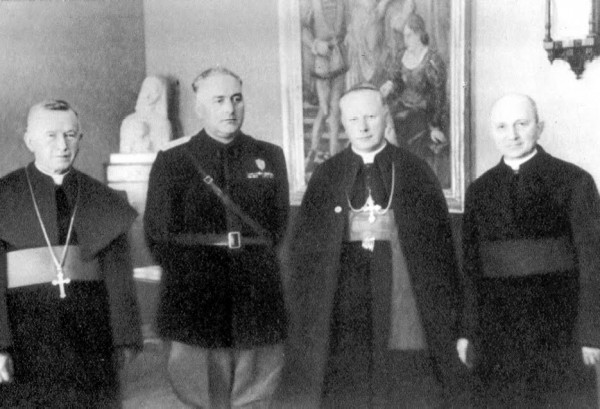
Lubiana, April/22/1941. From left: Ignacij Nadrah,Emilio Grazioli,Gregorij Rožman,Frank Kimovec


Furthermore, it is noteworthy to pinpoint that some slovenians were grateful to the Italians because of the 1941/1942 removal of the German speaking population of the so called "Gottschee" in the southernmost area of Slovenia: it was the same kind of agreement between Mussolini and Hitler that was done for the Germans in Italy's Alto Adige. Since then the Gottschee area has been a fully Slovene territory.

SLOVENIA ITALIANA

The southern part of Slovenia which was occupied by the Italians was annexed to the Kingdom of Italy on May 3, 1941, with the official name: "Provincia italiana di Lubiana" ('Italian province of Ljubljana') with 4545 km2 and 337,000 inhabitants (nearly 80,000 in Lubiana). This province, which took its name from the capital Lubiana (the Roman "Emona"), was in fact partially administered as an occupation zone. However there were no real attempts at Italianization (there were only 600 Italian civilians in all the 'Provincia'!), neither by the public administration (in which only some personnel from the mother-country were included) nor by the school (bilingualism was allowed) and cultural institutions (maintained and only in some cases accompanied by the fascist ones).

In addition, works were started by the Italian authorities in order to improve health services, public structures, electricity services and sewage systems in Lubiana & surroundings. A new huge & modern hospital was planned. Also, the railway service between Italian Slovenia and Trieste was improved; and the Polje airport in western Lubiana was greatly enlarged.

The Lubiana airport was greatly improved by the Italians. It was one of the easternmost airports in the "Seconda Squadra" (second division) of the Italian Air Force during WW2
The high commissioner Emilio Grazioli initially carried out a moderate policy, in an attempt to involve the conservative business classes and the Catholic Church, giving life to a "Consulta", an assembly of local notables that was supposed to cooperate and support the work of the italian authorities. Indeed, the influential bishop of Lubiana, Gregorij Rožman, and most of the country's pre-war politicians, led by political leader Marko Natlačen, immediately expressed in early May 1941 their willingness to collaborate with the fascist authorities, writing public letters of support for the annexation of the province of Lubliana to Italy. On June 8, 1941, Natlačen led Slovenian politicians and industrialists to meet Mussolini in Rome, after which they reaffirmed their loyalty, and began to officially collaborate with the Italians in the 'Consulta', an advisory body.

In the days immediately following, 105 Slovenian mayors sent a message to Mussolini, expressing "joy and pride for the incorporation of Slovenian territories into the great Kingdom of Italy". A similar message of congratulations also reached the Duce from the archbishop of Lubiana, Gregorij Rozman. This catholic "vescovo" (with Ignacj Nadrah and Frank Kimovec) became one of the most important collaborators of the fascist regime, guaranteeing the loyalty of large sections of the 'believing' catholic population.

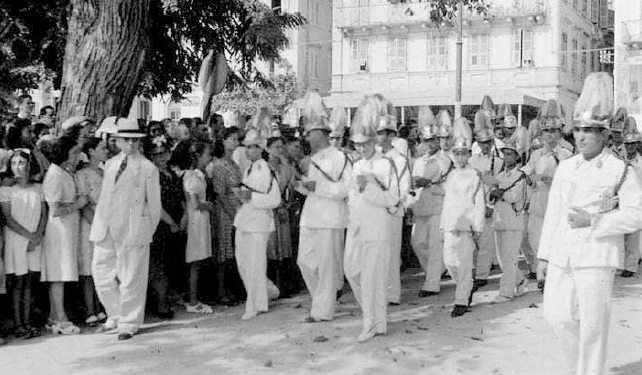
Lubiana: Military parade of Italians on first week of April 1941, with slovenian civilians attending


The result of German harsh policy in the nazi occupied area north of Lubliana was the influx of tens of thousands of Slovenes into the Italian province. A few weeks after the end of the war against Yugoslavia, 27,000 people crossed the border between German and Italian Slovenia (17,000 settled in Lubiana). The Italian reports on these facts left no room for doubt about the causes of the exodus, identified in the German "inhuman yoke". Germany was accused of stripping Slovenian land and stripping the local population of the basis for their survival. In doing so, Berlin forced the population to seek a less "barbaric" place for its existence. And even in the final months of 1941 hundreds of Slovenians crossed the border between the two occupation zones to settle in the Italian territory. This created problems (of food, lodging, health assistance, etc..) to the Italian authorities, but showed to the Slovenians the "good side" of Italian presence in southern Slovenia.

However this continuous influx of people from the north was viewed with suspicion -after summer 1941- by the Italian administration, which feared that once they arrived, especially men, they could become a threat to the internal security of the province (because linked to Tito's partizans): according to general Roatta they were the main culprit of the guerrilla & terrorism attacks that destroyed the good relationships between Italians and Slovenians at the end of 1941/beginning of 1942 (M. Roatta, "Otto milioni di Baionette. L’esercito italiano in guerra dal 1940 al 1944". Mondadori. Milano, 1946).

Some historians pinpoint that the original population of Lubiana & southern Slovenia was going to behave in a relatively "quiet way" with the Italians, like happened in the Governorate of Dalmatia at least untl the end of 1942: it was people from northern Slovenia (and other areas of Iugoslavia) who enrolled in Tito's partizan groups and who created the fracture between Italians and local Slovenians, mainly after fall 1941!

Although very few, Slovenian fascists had made themselves known in Slovenian politics since the 1920s: in 1923 a small fascist party of Slovenes of Venezia Giulia ("Vladna Stranka", government party) was born, which then in 1925 merged into the 'Party National Fascist', and a certain amount of unemployed Slovenian youth joined the Fascist militia. In Lubiana in May 1941, immediately small groups of Slovenian fascists were created who obviously supported the union with the Kingdom of Italy (but only on 21 October 1941 the National Secretariat of the National Fascist Party established - on Mussolini's orders - the "Federation of Fascists of Combat of Lubiana ": Grazioli was appointed Federal Secretary).

After all, some Slovenes (fascists and non-fascists) immediately promoted the establishment of collaborationist armed bands, subsequently called MVAC (Voluntary Anti-Communist Militia) and integrated into small units in the Italian army. The MVAC had a decidedly notable importance in Slovenia, where some old adherents of the conservative pre-war parties, tightened around the highest ecclesiastical hierarchies and animated by a heated anti-communism, created a political-military structure that obtained a wide consensus and came to mobilize more than 6,100 men in 1941 and 1942. In fact, the Italian authorities immediately supported the anti-communist Slovenian political forces, especially of Catholic inspiration, which, fearing the communist revolution, had at that moment identified the greatest danger in the partisan communist movement, and had therefore made themselves available for collaboration.

These political forces had thus created "self-defense formations" (the most numerous "Vaška Straža" and the most militant "Legija Smrti" or 'Legion of Death' - the latter also called more commonly 'White Guard' or "Bela Garda"- under the direct inspiration and coordination of the Bishop of Lubiana Gregorij Rožman: the Italian commands (under General Mario Roatta of the 2nd Italian Army) organized these formations, in the following August 1942, in the" Anti Communist Voluntary Militia" or MVAC (new name collective hired by the pre-existing Slovenian organizations from 6 August 1942), using them successfully in the anti-partisan struggle.

Also worth mentioning is the "Civic Guard" ('Vaške Straže' or village guards), which was created in November 1941 by Ernst Peterlin. It was a militia of Slovenian Catholic peasants set up to prevent the robberies and assaults of the "Tito" communist partisans in the Slovenian countryside. The Civic Guard was also created (in the intentions of its leaders) to prevent the establishment of communist political and military power on Slovenian territory, with the ultimate aim of contributing to the establishment of a Catholic political system in the country.

The 'Civic Guard' (with dark berrets) of Rakitna -a village between Lubiana and Postumia- with Italian officers and some civilians & religious groups, in summer 1941
It should be noted that in addition to the approximately 6,100 of the MVAC, the Slovenian Catholic auxiliary forces deployed a total of 7,000 men alongside the Italian authorities at the end of 1941, when the communist resistance in Slovenia began to be present in a serious form (with attacks and murders): the idyll in Slovenia was over!

Furthermore, in December 1941 an Italian teacher was killed by the Slovenian Communists in front of her pupils in Lubiana (read for further informationhttps://books.google.com/books?id=SGCuAgAAQBAJ&pg=PA49&lpg=PA49&dq=uccisione+di+maestra+italiana+a+lubiana+nel+1941&source=bl&ots=ygJ_DFeepV&sig=ACfU3U3Yj0uJ0xTobF-TUmYVwjonIXFQew&hl=en&sa=X&ved=2ahUKEwjanuau8-LsAhWuxFkKHSo7DDIQ6AEwEnoECAEQAg#v=onepage&q=uccisione%20di%20maestra%20italiana%20a%20lubiana%20nel%201941&f=false). She was the first Italian civilian (and the first Italian woman) assassinated by the Tito partizans in Slovenia, sparking the reaction of the Italian military authorities (who consequently -also because of this murder- enclosed with a barbed wire fence all the city of Lubiana in January 1942).

In other words, this "special idyll" had been quite successful and even happy in the months of May and June 1941, but with the Axis attack against Stalin's Soviet Union it began to disintegrate and by early 1942 it had completely vanished: it didn't even last one year!
Map of 1942, showing the new northeastern borders of the kingdom of Italy.

Saturday, October 3, 2020

ROMANS IN THE AZORES ISLANDS?

Romans -as we know- travelled outside the Mediterranean sea reaching in the Atlantic ocean the British isles to the north and the Canary islands to the south. Probably they were merchants, like in the commerce between Rome and India described with the famous "Periplus of the Erythraean sea" (if interested in further information, please read what I wrote in 2015 at https://researchomnia.blogspot.com/2015/10/romans-in-azaniaraphta.html ).

However we don't know for sure if they reached the Azores islands in the middle of the northern Atlantic ocean. But now some researchers have found a few archaeological evidences about this possibility. One of the most interesting is the one related to an epigraph -in latin letters- found in the Terceira island of the Azores. Here it is what I found in my research:

Map of the Azores, showing "Terceira" island (where a possible Roman epigraph has been found)
The president of the Portuguese Association of Archaeological Research (APIA), Nuno Ribeiro, revealed in 2019 having found rock art on the island of Terceira in the Azores, supporting his believe that human occupation of the Azores predates the arrival of the Portuguese by many thousands of years. “We have found a rock art site with representations we believe can be dated back to the Bronze Age,” Ribeiro told at a presentation in "University of the Azores" on the topic of early human occupation of the Azores. The oldest cave art known in Europe is of prehistoric origin, dating back to approximately 40,000 years ago.

In the last three years, Ribeiro has been claiming that archaeological remains of structures discovered on several Azorean islands are of pre-Portuguese origin by its architecture and construction. “WE HAVE AN EPIGRAPH FROM ROMAN TIMES, according to two scientists who were invited to interpret the inscription, a cave art site, megalithic structures, and an important set of structures scattered throughout the islands that need to be interpreted in new ways,” he said. “In some cases, we believe that there are temples and hypogea. We have no doubt that there are sanctuaries,” he said, remarking that some data still needs to be dated. Ribeiro also said that the archaeological research findings in the Azores have been published in scientific articles and presented at international conferences on archaeology, and have received “great acceptance among the international scientific community.”

Nuno Ribeiro (with Anabela Joaquinito & Antonio Pereira) wrote the following essay with the title "New Unknown Archaeological Data in Azores: The Hipogea of the Brazil Mount, Terceira Island (Azores, Portugal) and its Parallels with the Cultures of the Mediterranean"

".....The presentation intends to give to know the recent discoveries of found hypogeal structures in the Island of Terceira (Açores), Mount Brazil. The monuments in question are placed in an area next to where in August of 2010 it was discovered the 1º hypogeum. These new monuments present trapezoidal plants, with circular entrances, one of them present four small circular sockets in its interior, being on for channels, another one present a tank probably ceremonial, which if accedes through stairs. The existence of murex in the region and the fact of this island to make use of the best natural ports of the Atlantic islands and if to point out enters the North of Africa and the Europe, had apparently made of this area an obligator point of stopping between the Canaries, the colonies of Lixus and Mogador (in coastal Roman Mauretania) and Europe......

.....Of the various kinds of similar monuments present on the different Azores islands, most prominent are the Hypogeum-like ones, especially from Terceira Island, on a military restricted area, and actually classified as being of World Heritage status by UNESCO. This area, called Mount Brazil, bears several nuclei, the most important one being at the Fort of São Diogo. More structures are present in this open-air area, on one of the highest peaks of the Mount Brazil, “one called the Pico do Facho”, located near historical structures. The ancient remains are characterized by the presence of dozens of postholes of various dimensions, small canals, basins, possible chairs excavated from the outcrop and by at least one reservoir (figure 2 and 3). They might form a proto-historic sanctuary. This assemblage was discovered by the prehistorian Manuel Calado during a visit organized by APIA in December 2010......

....The artificial caves or hypogea (identified with an arrow) are situated on the western slope of the Zimbreiro Peak and just above the sea, at the border between the woody part of the slope and the severely eroded area.Our interpretation, at the moment is based on the architecture of the existing monuments only, and awaiting archaeological excavations, needs confirmation.

However, a medieval or modern origin of the remains is ruled out, we compared them with what we know about XVth and XVIth century Portuguese and Spanish architecture - the time when the island was supposedly first colonised. We shall also stress that these monuments were already marked on XIXth century maps, but not as military structures.

And present inscription, engraved on what is possibly the base of a statue now in a house in Posto Santo, near the city of Angra on Terceira Island. It was also possible to establish the origin of the material composing the base for the inscription: about 4 Km away from where it is now (Figure 13). The association of these monuments with an inscription of Dacian origin confirms an occupation of the island earlier than what is generally accepted.

The base of a light coloured volcanic rock, trachyte, which is rough on the touch, shaped round as a column and inscribed outside by about 2/3 of the round. The inscribed stone is conserved in a private home, situated in the city of Angra Heroism, Terceira Island already since several decades. The circumstances of the found are not known. The stone base was originally at about 4 km at a place named Posto Santo, where the trachyte rock is present.

According Prof. Herbert Sauren, we can see two lines of script, some letters very well known as Latin (or Greek) majuscules, but others with strange forms and irregular in height (Figure 14). A base for a statue with the given size was an important monument. The lost statue was also very important. We can guess the statue of a governor, of a king, or of a God.

The beginning of the inscription is broken. The letter D at the beginning of the second line marks the limit of the inscription at the left side. The last letters of both lines are preserved. The inscription could be read when the reader stood in front of the statue.

Transliteration, vocalized form, translation:

[OD]ROY ELOFC ION
D A C C I C OFC
Odroy Elo’ǀs ’Ayon / Dacciǀs The’os

Odroy, the Lord of the gods,
the god of the Dacians.

Spanish investigator Antonio Rodriguez Colmenero, (Professor at the Santiago de Compostela University) interprets the epigraph in another way: Converging in Roman times however should not be a base of a statue but a milestone. The scientist also reads other content at the beginning of the text: OPELIO (indeterminate text) and at the end fecit, usually the inscriptions of Emperor usually have: IMP M. OPELIO SEVERE Macrinus, but according to the author that is not text that is in the epigraph...."


If interested, please read the full essay with interesting photos (and with the epigraph's Latin letters shown) at http://www.apia.pt/doc.php?co=118&in=0

Of course there are other researches about this epigraph. If interested read also the following article written by Herbert Sauren and related to similar items & topics:https://www.academia.edu/8132405/Azores_Inscription_on_the_base_of_a_statue

Wednesday, September 2, 2020

ITALIAN PROVINCES IN GREEK REGIONS

The Kingdom of Italy (1861-1947) expanded Italian influence and control on some islands of Greece. In the first half of the XX century there were also a few tentatives to create the following "italian provinces" in those islands: "Provincia di Corfu", "Provincia di Rodi", "Provincia delle Cicladi" and "Provincia delle Sporadi".

Initially these tentatives were due to some ideals linked to the "Italian Irredentism", like as happened with Corfu and the Ionian islands. Those islands (mainly Corfu, actual Kerkyra, please read also http://wwwbisanzioit.blogspot.com/search/label/Corfu) in the beginning of the XIX century had a huge community of venetian speaking inhabitants (the island of Cefalonia -actual Kephalonia- was nearly totally venetian speaking in the XVIII century, according to: Kendrick, Tertius T. C. (1822). "The Ionian islands: Manners and customs"; p. 106 ), as a consequence of the Republic of Venice "dominions" in this region since the Middle Ages. For example one of the Italian "Risorgimento" fathers was Ugo Foscolo, born in Zante (actual Zakynthos).

Festa di San Spiridiano in "Citta di Corfu" (Corfu city) in early summer 1942, showing some of the 2000 Corfiot Italians of the island. The city was proposed to be the capital of a possible 1943 "Provincia di Corfu", but WW2's Italian defeat blocked this project
In Corfu, the "Corfiot Italians" were helped by Mussolini, when he took control of Italy in the 1920s (read, if interested in further information, the article I created in wikipedia and named "Corfiot Italians" or see: https://6612springbottomway.blogspot.com/2018/12/blog-post.html).

Additionally it is noteworhty to pinpoint that the island of Corfu was "administratively" separated from Greece, when was occupied by Italy in spring 1941, while the Corfiot Italians welcomed the Italian troops in those 1941 days: see https://www.youtube.com/watch?v=HCktc3anQo4. There were -also- some comments from the same Mussolini in order to create a "Provincia di Corfu" in late 1942.

Furthermore in 1911 the Italians conquered from Turkey the "Rodi archipelago islands", that they called "Dodecaneso italiano". They added in 1932 to this possession also the island of Castellorizo with the small surrounding little islands, that were the remains of the Italian possessions in Licia (southwestern Anatolia) after WW1

The Dodecanese islands were formally annexed by Fascist Italy, as the "Possedimenti Italiani dell'Egeo" in 1923, following an agreement between Mussolini and Kemal Atatürk. Italian interest in the Dodecanese was rooted in strategic purposes, and the islands were intended to further the Italian Empire's long range imperial policy: the islands of Leros and Patmos were used as bases for the Royal Italian Navy. In the 1930s, Mussolini embarked on a program of Italianization, hoping to make the island of Rhodes a modern transportation hub that would serve as a focal point for the spread of Italian culture in Greece and the Levant.

Dodecaneso Italiano (Rhodes archipelago)
The Fascist program did have some positive effects in its attempts to modernize the islands, resulting in the eradication of malaria, the construction of hospitals, aqueducts, a power plant to provide Rhodes' capital with electric lighting and the establishment of the Dodecanese Cadastre. In 1940 there were nearly 9000 italian colonists in these islands, mainly in Rodi that was greatly improved with monumental buildings in accordance with fascist architecture. Some Italian nationalsts proposed to create a "Provincia italiana di Rodi" in the early 1940, but the start of the war blocked all these projects.

Additionally, during WW2 the Italian authorities proposed to create two provinces in the Aegean sea: the "Provincia delle Cicladi" and the "Provincia di Samo" (named also "Provincia delle Sporadi"). Here it is an interesting article related to this tentative (it was written for the University of Genova by B. D'Ambrosio):

PROVINCIA DELLE CICLADI E PROVINCIA DELLE SPORADI (SAMO)

Few scholars have thoroughly analyzed the Italian occupation of the Sporades and Cyclades islands in the Second World War.

After all the war difficulties, Italy - with the "suffered" victory over Greece - in 1941 obtained control of most of mainland Greece (Epirus, Thessaly, Attica and Peloponnese), in addition to the Ionian islands with Corfu, Zante and Kefalonia, Cyclades, and the southern Sporades with Samos, Furni and Icaria plus a territory at the eastern tip of Crete.

HISTORICAL SITUATION IN 1941-1943

The territorial division of Greece was fundamentally decided by the Germans and communicated to the Italians as a 'fait accompli' ("the Germans communicated a boundary to us, we could not but acknowledge" Mussolini himself recognized), as was the Athens settlement of the Tsolakoglu government.

Italy's plans for the annexation of various Greek territories (the Ionian Islands, the Cyclades and the Sporades to be added to the Dodecanese, the Epirus to be annexed to Albania) were postponed by the Germans themselves at the time of the final victory in the war.

The military occupation of the Greek regions, entrusted to the "XI Armata", represented a heavy commitment for Italy in terms of men and resources employed, even if very uneven in terms of the armed opposition encountered: the Greek Resistance was active in the northern regions, Epirus and Thessaly, while in the Peloponnese and in the islands it was never particularly strong, leaving to the Italian units there more police-related tasks than violent repression.

However, in spite of the hostility shown at the time of surrender in April 1941, with the passage of time the attitude of the Greek population became more benevolent towards the Italians, whose behavior in principle had little to do with the methods of violent occupation of the Germans. After all, it is enough to see a famous film about the Italian occupation of Kefalonia - "The mandolin of Captain Corelli" - to understand how the Greek populations showed themselves "benevolent" towards the Italian occupants (and vice versa).

CYCLADES AND ITALIAN SPORADES: "PROVINCE OF THE CYCLADES" AND "PROVINCE OF SAMO"

The irredentism of Fascism wanted to include in its project of enlargement of imperial Italy - going back to the maritime republics of Venice and Genoa - even the islands of the Aegean between the Dodecanese and the Ionian islands. In this way Mussolini wanted to create (after his victory in WW2, as he hoped) a historical-geographical continuity of Italian islands that from Corfu '(in front of Albania) arrived until Castellorizzo (in front of southern Anatolia).

For this purpose - after the occupation of almost all of Greece in April 1941 - the Italian authorities proceeded to implement a forced "Italianization" of the local populations of these Greek islands together with the administrative creation of "Italian Provinces" (such as the Ionian provinces, p[us the Cyclades and Samo provinces).

For Corfu' Mussolini went back to the "Italian Corfioti", immediately detaching the Ionian islands from Greece (at least administratively), while for the Aegean islands he limited himself to wait until the end of the war in order of not going against the will of Hitler.

The Cyclades islands and some of the Sporades islands were militarily occupied in the spring of 1941 and were immediately incorporated into the "Italian islands of the Aegean". Ettore Bastico had the title of "Civil and Military Governor" of the Italian Isles of the Aegean, just like the previous governor of the "Islands of the Dodecanese" Cesare Maria De Vecchi of Val Cismon.

ETTORE BASTICO was governor from 10/12/1940 to 1/7/1941. Admiral Inigo Campioni, later shot by the Germans, succeeded him from 15/7/1941 to 11/9/1943. Consul General Igino Ugo Faralli was its last governor, from 11/9/1943 to 18/9/1943. Indeed Ettore Bastico was an artillery general. Thanks to his noble conduct, he earned the esteem and affection of the civilians and the military in the Italian Aegean islands, taking measures to improve their lives. He occupied Castellorizzo, the Cyclades, Samos and Icaria as well as the east part of Crete. He was suddenly transferred, perhaps as a reward, to the African front (Fanizza Rugerro: "De Vecchi, Bastico, Campioni, the last governors of the Aegean." Vasbonesi, Forlì, 1947).

INIGO CAMPIONI followed Bastico. He tried to impose a process of "Italianization" in these islands, but with only minor results.

ITALIAN CYCLADES

CYCLADES: The Cyclades were administered as a future "Italian province": the "CIVIL COMMISSIONER FOR THE PROVINCE OF CYCLADES" was established on the island of Syra (also called "Siro" in Italian). Ermopoli, the administrative capital of the Cyclades islands, was and is the capital of the island. In Siro, the Italian authorities created a police station that promoted - among other things - food aid to the civilian populations of the Cyclades: in this way the terrible famine that hit the Greek population in 1942 did only a few thousand victims in the Cyclades (and were relatively few in all the other Greek islands that, in Mussolini's projects, should have been annexed to Italy at the end of the "victorious" world war). Only a few minor islands suffered a great deal initially - but they were immediately rescued by the Italian government, unlike the huge disaster (with many deaths: over 300,000 between 1941 and 1944!) that occurred in the Greek mainland. If interested, read on page 144-149 the book "Famine and Death in Occupied Greece, 1941-1944", written by Violetta Hionidou

The Italian occupation began on the islands in the Aegean on May 6, 1941. The island of Siro, with the capital of the Cyclades, was occupied after only five days. The invasion force was formed by units of the "Regina" Division, which were transported by destroyers Crispi and Sella (departing from the nearby Dodecanese). The following 10 July 1941 took over the "Cuneo" Division to the "Queen" units in the southern Cyclades and Sporades garrison. An air link between Rhodes and Siro guaranteed the postal service. In Italian Cycladic schools the study of the Italian language became compulsory.

Among the civilian population there was a substantial approval of the Italian presence only in the area of ​​the capital of Siro and in the island of Tino, where many boasted distant Venetian roots and were numerous Catholics for centuries - especially in the town "Ano Syros", founded in 1200 by the Venetians. Ano Syros, the Catholic stronghold in Siro, supported the Italianization of the Cyclades even if moderately: this was assisted by the Italian authorities and did not suffer death from the famine that damaged the Greek population especially in February 1942. Many Catholic inhabitants of Ano Syros (and someone from Tino) were later imprisoned by the Greeks (Orthodox) with the charge of collaborationism in 1945.

ITALIAN SPORADES

SPORADES: The same happened with the southern Sporades islands occupied by the Italians. In fact the three main islands of the Italian Sporades (Samo, Icaria and Fourni) were administered with the creation of the "CIVIL COMMISSIONER FOR THE PROVINCE OF SAMO". Also in this case it was expected that at the conclusion of the war these islands were to unite to the Kingdom of Italy in the newly created "Province of Samo".

On May 9, 1941 the island of Samo, the main island of the southern Italian Sporades, was occupied by the "Regina" Division and Vathy (near the historic town of Samo) declared its administrative capital. In the following September, the "Cuneo" Division took over the "Regina". In Samo a first telegraph service was set up in September 1941. A forced attempt at Italianisation was also begun here, especially in schools.

The attempt by the wife of the political commissioner Bianco Tizianotti to organize social events in Samo and Icaria, failed miserably. The antipathy of the population was such that very few local Greeks (less than a hundred in all) were accused of collaboration after the end of the war (in 1945).

At Samos from the end of 1942 there was a reduced action of Greek partisans against the Italian troops, unlike the other Cycladic islands and Sporades where until September 1943 - when Italy surrendered to the Allies - there was no military or paramilitary activity.

In fact, at the time of the Badoglio armistice, in September 1943, on the island of Samos, there were two groups of resistants of about 300 men. These groups, which politically were of the extreme left, had been organized in October 1942. The ELAS (Greek Resistance Army) of Samos received the armament and financial help of the British service SOE, located in Asia Minor, with whom it had been in permanent contact since the end of 1942.

The essential contribution of this resistance was the harassment of the Italian authorities and the main purpose was a general uprising. The plan failed because the anti-fascist committee, waiting for the maneuvers of Badoglio who took over from Mussolini, did not dare to move openly. Restless, the Italian authorities of Rhodes sent two battalions of Italian fascist 'Black Shirts' to observe the possible maneuvers of these resisters.... and all remained quiet (Nicola Tsagas: "Icaria under the Italian occupation, 1941 - 1943").

Map of the theoretical provinces of Italy in Greece's Aegean sea:

PROVINCIA DELLE CICLADI
PROVINCIA DI SAMO (SPORADI)

Tuesday, August 4, 2020

AROMANIANS IN MACEDONIA'S FIGHT FOR INDEPENDENCE (ILINDEN UPRISING)

Many books have been written about the "Ilinden Uprising" and Macedonia's independence, but only a few study in detail the Aromanians and their interaction with Macedonian organizations.

First of all we must remember that during the summer 1903 rebellion in the region of Macedonia most of the central and southwestern parts of the Ottoman "Monastir Vilayet" were devastated by the Ottoman forces. These Turks attacked the independence fighters, who were receiving the support of the local Slav peasants with a huge help from the Aromanians (called also "Vlachs") living in the region. Provisional government was established in the town of Krusevo, where the insurgents proclaimed the "Krusevo Republic" which was overrun in a bloody way after just ten days, on August 12.

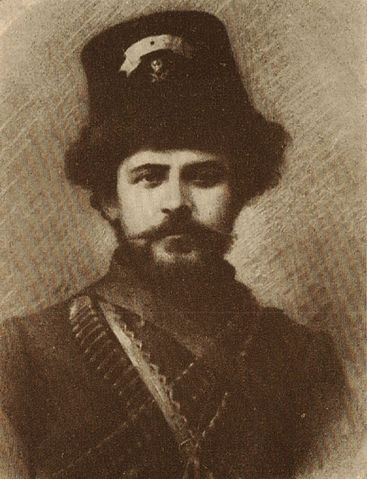
Indeed in March 1903, the Aromanian Pitu Gulli began commanding a revolutionary squad, crossing the Bulgarian-Ottoman border heading for Krusevo. From April to August 1903, he trained and prepared his irregulars for the upcoming Ilinden Uprising. He died in Kruševo, defending the Krusevo Republic with his nearly 1000 Aromanian fighters.

Many of the independence fighters in Krusevo were Aromanians: according to the ethnographer Vasil Kanchov's statistics based on linguistic affinity, at that time the town's inhabitants counted: 4,950 Slavs, more than 4,000 Vlachs (Aromanians) and 400 Orthodox Albanians.

The "prime minister" of the Krusevo republic was the Aromanian Vangel Dunu.  

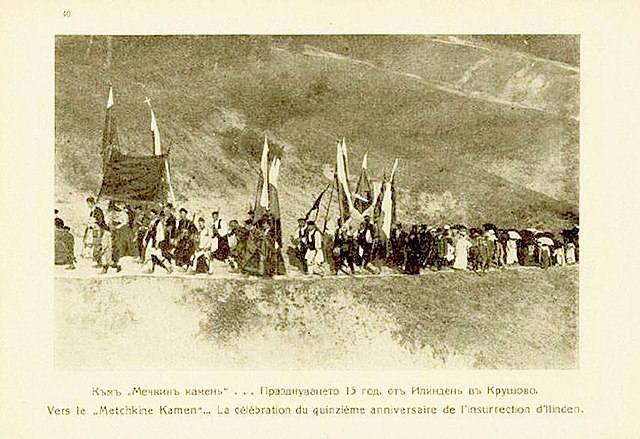
Mečkin Kamen (where today there it is a commemorative monument) was the place where Pitu Guli's fighters (most of them Aromanians) defended the town of Kruševo from the Turkish troops coming from Bitola. Nearly the whole squad and their leader perished during the battle. And Kruševo as well as many of the nearby villages were set to fire by the Ottomans.

However, following the revolt, Romania, with the support of Austria-Hungary and Italy, succeeded in the acceptance of Vlachs as a separate millet with the decree ("irade" in turkish) of May 22, 1905 by Sultan Abdulhamid; so in the "Ullah millet" (the millet of the Vlachs, the first "proto-state" of the Aromanians in their History) they could have their own churches and schools.

Photo showing the 2011 celebration of the "Krusevo Republic". Note the monument to the Ilinden Uprising of summer 1903.


In the following decades the Aromanian population in Krusevo has been reduced because of many reasons, but in 2020 there are -still- more than 1200 Aromanians in this macedonian city of nearly 6000 inhabitants.

An interesting essay has been written by Nikola Minov about the Aromanians and Macedonia's independence. Here it is a resumen (with excerpts from the "Macedonian Historical Review"):


THE AROMANIANS AND THE IMRO


The Macedonian revolutionary national-liberation movement, organized and led by the Internal Macedonian Revolutionary Organization (IMRO) has long provoked the interest of contemporaries and scholars of the modern Macedonian history. The interest shown by the numerous diplomats, historians, journalists and analysts has produced an enormous historiographic work which examines IMRO and the Macedonian revolutionary movement from every aspect. 

However, the origins, acts and goals of IMRO can naturally be viewed differently, taking into account each author’s provenance and the time at which the work was published. 


The same can be said for the Aromanian participation in the revolutionary organization. 

While historians in the Republic of Macedonia and Bulgaria acknowledge the Aromanian contribution within IMRO, the two sides who have traditionally invested the most interest in the Aromanian question – Romania and Greece – have preferred either to ignore the Macedo-Aromanian collaboration, or to present the Aromanian involvement in the Organization as “forced collaboration”, under pressure from the “Bulgarian bandits”. 

This stance has its roots in Romania and Greece’s Macedonian policy from the end of the 19th and the beginning of the 20th century. The Romanian propagandistic presence in Macedonia focuses on the Aromanian population, presenting them as being part of the Romanian nation. On the one side, the future existence of this propaganda in Macedonia required the Aromanians – seen as Romania’s pawn on the Balkan chess table – to remain faithful subjects of the Sultan. On the other side, Bucharest did not want to see (or simply could not see) IMRO’s indigenousness, and no matter how much IMRO kept proving its independence from the Bulgarian cabinet, Romanians considered the Macedonian revolutionary movement to be spurious, fostered by Sofia, and in it the Romanian politicians saw nothing else but an extended arm of Bulgaria’s expansionistic policy. 

For this reason Aromanian participation in IMRO complicated Romania’s position, not only for the fear that Bulgaria would steal Bucharest’s main trump card in its Macedonian policy, but also due to the realistic danger of disturbing amicable relations with the Ottoman Empire. 

The Greek Kingdom also had important plans with the Latin speaking people north of its border, and for this it gave the Aromanians a vital role in the Great Idea’s fulfillment. Greece had little to worry about while the various nationalities in the Ottoman Empire were under the jurisdiction of the Ecumenical Patriarchate of Constantinople, but when the Slavic population of Macedonia joined the Exarchate en masse, the number of “Greeks” in Macedonia started its uncontrollable decrease. 

Were the Aromanians to follow the same example, then it is likely that Hellenism would have to completely vanish from a number of cities in Macedonia, whose presence was principally represented by the Aromanian population. If the Aromanians were shown to be Greeks, then Greece could claim to have citizens north in Bitola and Krushevo. If, on the other hand, the Aromanians were not considered to be Greeks, then Greece’s claims in Macedonia were seriously threatened, with only a negligible minority living more than 100 kilometers north of its border. Hellenism would be forced to retreat south of the river Bistritsa (Haliacmon) and the Greeks would cut a poor figure among the statistics of the Macedonian races. The Aromanians were Greece’s predetermined prize and Athens could not let them fall in the hands of its arch enemy in Macedonia, the Bulgarians. 

This line of thinking was the main reason for the numerous statements given by Romanian and Greek diplomats, distributed to the public in both countries through pro-governmental media, in which they deny the Aromanian involvement in IMRO and the Ilinden Uprising. Whenever the Aromanian presence in the revolutionary bands was confirmed by the Ottoman authorities, Bucharest and Athens found a convenient excuse, claiming that the Aromanians were subjects of atrocities committed by the “Bulgarian bands” and that they were forced to join IMRO. This is the reason for which the Greek consul in Bitola, Kypreos, claims that the Aromanian settlements were under strong pressure from the


Photo of the squad of aromanian leader Pitu Guli near Birino, in 1903


The pro - governmental media in the Romanian capital came out with similar statements that “the Romanians from Macedonia did not take part in the Bulgarian revolutionary movement, nor did they sympathize with it, and when they did take part, they were doing so because they were forced by the Bulgarian bands” . It was claimed that “The Romanians endure the consequences from the bitter war between the bands of the committees and the Turkish army. The Romanian settlements are occupied due to strategical or other motives and forced to… give youngsters to the bands”. Certain Romanian newspapers were informing the public how those killed in the Ilinden Uprising in Krushevo were mostly “Romanians who became victims of a battle with which they have nothing in common, while the insurgents were described as pseudo-liberators and “Bulgarian bands who killed most of the Romanians who refused to support the rebellion”. 

Not many were willing to deny the claims coming from the political circles in Athens and Bucharest, with certain notable exceptions. Those who were most informed about the Aromanian involvement in the Organization and in the Ilinden uprising, i.e the leaders and the members of IMRO, preferred not to talk about it in order to protect the Aromanian villages from the regular Ottoman army and the bashi - bazouks. In the few historical studies that deal with the Aromanian presence in IMRO, it is indicated that the main reason which attracted the Aromanians to join the Organization were “the terrible cruelties and injustices committed over them by the Ottoman authorities”. This claim is correct in principle, but it is too simplified and only partially explains why the Aromanians showed solidarity with the Macedonian revolutionaries. 

The rationale behind why one part of the Aromanian population accepted IMRO, one part showed indifference and the third part refused any sort of cooperation, therefore openly showing its animosity towards the Organization, is much more complex and requires more space for analysis. We do not aspire to write a complete analysis of the Aromanian involvement and influence in IMRO, so we will limit the inquiry to the reasons which resulted in a part of the Aromanian population joining the Macedonian Revolutionary Organization. 

A large number of Aromanian and Megleno-Vlach villages did indeed feel the weight of the Ottoman yoke. The terror inflicted by the Ottomans and the nearby Islamized village of Nonte was felt the most by the Megleno-Vlachs. When the German linguist Gustav Weigand visited Meglen in 1890, the first thing he noticed was the horrible poverty, atypical for the Aromanian villages he had previously visited. The village of Birislav was a chiflik of Nonte and the villagers were regularly terrorized by their masters and by the soldiers. Oshin, Luguntsi and Huma were properties belonging to Turks and Jews from Salonica, while the Aromanian village of Livadi was chiflik of Turkish beys from Yannitsa. Most of the other MeglenoVlach villages were also chifliks.  

Relatively isolated and yet situated in an excellent strategic position near the main road that led to Salonica, under strong influence from their Slavic neighbors and with little to no Greek influence among them, the Megleno-Vlach villages quickly attracted the attention of IMRO’s leaders. The first article of IMRO’s constitution from 1897, which allowed all unsatisfied element of the population in Macedonia and Odrin to be included in the Organization regardless of ethnicity, widely opened IMRO’s doors for the non-Slavic population in Meglen. Argir Manasiev and Vasil Chekalarov set up the organizational foundation in Barovitsa and in 1897 the same two visited many villages on Mount Pajak (Paiko) after which IMRO’s ideas finally reached the Megleno-Vlachs. Manasiev’s tremendous organizational qualities soon bore their fruit. According to one of IMRO’s leaders in the Gevgeli region, Sava Mihajlov, all the Vlach villages in the Gevgeli area were faithful to the Organization. The number of IMRO band leaders (voivods), corporals and normal band members emerging from the villages in Vlacho-Meglen was impressive. The huts of the Aromanian nomads from Livadi and the Vlach huts on mount Kozhuf were regularly used as shelters by IMRO’s bands.

The living conditions of the Aromanians in kaza Kastoria were not too dissimilar to those in Vlacho-Meglen. It is enough to read Vasil Chekalarov’s diary to confirm the Aromanian presence in Koreshtata and Nestram (Kastoria region) and the participation of the Aromanians from this area in the revolutionary battles. Few in numbers, some comprised of five, others of ten or fifteen houses in a particular village, the life of these Aromanians was no different than the life of their Macedonian neighbors. They attended the same schools, went to the same churches and suffered the same torments. The coexistence and sharing of mutual problems produced a trust between the two cultures, to the point where the IMRO makes no distinction between the Macedonians and the Aromanians in the Kastoria region, the latter being included in IMRO’s lines since its early beginnings in this area.

 If the researcher carefully follows the memoirs of the IMRO leaders and the historical documentation of the time, they will notice that apart from the Megleno-Vlach and Aromanian villages in Gevgeli, Yannitsa and Kastoria, the Aromanians who were most open to IMRO were those living in the Krushevo and Bitola regions. 

Photo of Aromanian leader Pitu Guli, killed in the Ilinden Uprising defending the Krusevo republic

What pushed these Aromanians from western Macedonia towards the Organization partially differentiates from the events which forced the villagers from Vlacho-Meglen, Koreshtata and Nestram to join the revolutionary battle. Granted, the living conditions in Krushevo and Aromanian villages near Bitola were far from ideal. These Aromanians were feeling the Ottoman pressure as well. However, issues of a different nature strongly contributed to speeding up their access to IMRO. 

Divided into pro-Greeks and pro-Romanians, the Aromanians from the Krushevo and Bitola regions started a period of hostility long before IMRO’s appearance. Organically weaker, without its own religious hierarchy, far from the state - protector and with no greater illusions to being liberated by a force outside the Ottoman Empire, the pro-Romanian group was forced to seek an ally for their educational-religious battles. The only natural partner for these Aromanians were the Macedonians and the Exarchate. The same religious allegiance of the Macedonian exarchists and the Aromanians who accepted the religious jurisdiction of the Bulgarian Exarch, as well as the mutual enemy – Greek propaganda – increased the mutual trust of these two elements and facilitated the approach of the so called “romanized Aromanians” in IMRO. It was not a mere coincidence that most of the Aromanians in IMRO were former students of the Romanian educational institutions of the Ottoman Empire. 

Unlike their compatriots from Krushevo, Bitola, Kastoria and Meglen, the Aromanians from other parts of Macedonia rarely approached the Organization. Although the Aromanian population from Ohrid, Struga, Lerin, Resen and Kajlari was oppressed in the same manner as their fellow countrymen from the above mentioned areas, IMRO did not manage to attract the same great number of these Aromanians. The probable explanation for this lack of success should be sought in the weaker organizational qualities of IMRO’s activists who were operating in these zones. As in the case of the Aromanians from other regions in Macedonia, the majority of the Aromanians in IMRO from Ohrid, Blatsa, Pisoderi, Neveska, Resen etc were exarchists or “romanized”. 

A different and more specific category of Aromanian collaborators with IMRO were the Aromanian nomads. These endogamous communities, organized in a kinship-based shepherd community (taifa) and headed by the wealthiest and most authoritative member (chelnik), lived on the mountains, together with their large flocks of sheep. Those same mountains were regularly visited by outlaws, for which the Aromanian huts were the most natural shelter from the authorities and the inclement weather. Refusing to grant hospitality was not an option: the shepherds could have been killed, while the flocks, their only property, could be destroyed. Welcoming the IMRO bands was one of the most delicate problems. To be on good terms both with the revolutionaries and the authorities seemed highly improbable; this is why we will accept with reserve Georgi Bazhdarov’s and Jane Sandanski’s statements that the Aromanians from Pirin supported IMRO. Cooperation certainly existed, but it would be incorrect to talk about certain deep beliefs among the transhumance. 

Aromanians in IMRO’s ideas, nor about the strong wish to be liberated from Ottoman rule. The contact these Aromanian nomads had with the authorities was minimal, and to them it did not matter who would rule the country, as long as they would be able to preserve their traditional way of life. The cooperation between the Aromanian nomads and IMRO can only be explained by a mutual need to help each other. The bands needed food and shelter, while the Aromanian nomads needed IMRO’s protection from those who might steal from them. 

Another form of cooperation between IMRO and the Aromanians was the supply of weapons to bands in west Macedonia, regularly conducted by Aromanians. Experienced merchants and muleteers, harmless nomads and fluent Greek speakers, the Aromanians were the most natural choice to supply the western Macedonian regions with weapons from Greece. In kaza Kastoria the arms trafficking was conducted by the Aromanians Hristo Gyamov, Nako Doykov, brothers Todor and Kicio Levenda from Kastoria, brothers Ioryi and Mitre Bijov from Hrupishta, Vasil Mitrov and Ioryi Vasilev from Smrdesh and Naum Pangiaru from Konomladi.28 The guns in Krushevo were transported from Greece by the local Aromanians: Cola Boiagi, Tega Hertu, Petre Pare, Vanghiu Beluvce, Vanghiu Makshut, Tachi Liapu and Tachi Ashlak, as well as Zisi Mihali, Steriu Tanas, Steriu Taho and Andrea Kendro from Trnovo (near Bitola). 

In some cases these gun smugglers were devoted workers of the Organization. Some of them, though, worked strictly for profit. However, we will emphasize what the Lerin regional voivod Mihail Chekov said about the Aromanian “smugglers”. After the disastrous ending of the Ilinden Uprising, Chekov paid two Turkish lira to three Aromanian nomads from Blatsa to take him over the Greco-Turkish border. After numerous vicissitudes, when the voivod had been at times dressed in female clothes, hidden among the horses and presented as their shepherd, the three Aromanians successfully transported Chekov to Greece. Impressed by the risk taken by his saviors, the voivod said: “On the road I understood that the Vlachs weren’t helping me for the two lira. They helped me because they sympathized with us”.

IMRO could not penetrate into some Aromanian settlements until 1906. These were primarily Aromanian villages in Veria and Grevena, on the Vermio and Pindus mountains. Despite the fact that a large number of these Aromanians were supporters of the Romanian party which, as discussed, was not an impediment to Aromanians wishing to join IMRO, these people lived far from the territory where the Organization operated and they did not have an opportunity to establish closer relations with IMRO’s leaders. Therefore, with some small exceptions, there is no data about the level of participation of Aromanians from Veria and Grevena in the Macedonian national-liberation movement in its earlier stages. 

Turkish sources report of a battle that took place on June 14th 1903 between the Ottoman army and a “Bulgarian band led by Oani Papa Arghir from Veria”, in which the only casualty was “Nikola, Vlach from Selia”, but this short note remains the only source of information about the Aromanian involvement in IMRO’s pre-Ilinden actions in south-west Macedonia. A similar situation is recorded in Macedonia’s south-eastern territories. According to Hristo Kuslev the entire Aromanian village Ramna (Demirhisar kaza) joined IMRO, but unfortunately he does not mention any names or give additional data.

The Ilinden Uprising and the information taken from the battlefields as to the massive Aromanian involvement in the insurrection (confirmed by the insurgents, the foreign diplomatic representatives and the Ottoman military authorities) undermined every attempt of Romanian and Greek politicians to prove that the Aromanian presence in the revolutionary movement was insignificant, it was on an individual basis and as a result of the pressure put on them by the “Bulgarian bandits”. 

However, news arriving from Macedonia gave a completely different picture, in which Aromanians took part in attacking and capturing towns and villages, in the set up of the local administration in the newly captured territories, as well as in defending their conquered land. In Krushevo, Kastoria and Bitola, as well as the regions that did not massively rise and continued the guerilla warfare, “the Vlachs did not only show compassion with the revolutionary struggle, but they actively took part in it ; they accepted all the difficulties and risks for achieving the common goal”.

The new post-uprising reality created excellent conditions to further develop the collaboration between the Aromanians and IMRO. The Ilinden Uprising and the Mürzsteg reforms gave credence to the Macedonian question internationally. For the neighboring Balkan states it was a clear signal that in more favorable international circumstances the Macedonian question could have been solved against their will and against their interests, hence the change in their propagandistic policies. The educational and religious propaganda became militaristic. Bands from Greece, Serbia and Bulgaria were sent to Macedonia, with the clear task to defend the obtained positions and later, if possible, to attempt and further expand them. 

It was at this point that an unofficial civil war started in Macedonia. In it, the contingent of the Aromanian population which stubbornly refused “to be Greek”, found itself under strong fire from the Greek guerilla groups. What started with threats and orders to close the Romanian schools and return to the “Greek flock”, ended with a horrific terror, killings on the roads, as well as the attacking of farms and burning of Aromanian villages after the Sultan recognized the Aromanians as separate nation, Ulah Milet, with the Irade from May 1905.

Faced with extermination, the pro - Romanian faction began to arm itself. 

The first bands worked independently. Later, the Aromanian bands worked under IMRO’s flag. The early local Aromanian bands were formed spontaneously, as a direct consequence of the terror committed by the Greek bands. These groups suffered from a lack of coordination, and were hindered greatly by the fact that their radius of movement was far too limited, and thus most of them could not fulfill the task for which they were formed. The first acting bands were those of Mihail Handuri from Livadi and Hali Joga from Gramatikovo. Certain Nesho from Livadi, supported by the nobility in the Vlacho-Meglen villages, formed a band independent from IMRO, but after a short illegal life he turned himself in to the Ottoman authorities. 

In 1906 Apostol Petkov sent his corporal Shteriu Canacheu – Yunana with ten Aromanian fighters to cruise the Megleno-Vlach villages and protect them but, influenced by the “Aromanian agitators” and the Romanian propagandists, Yunana soon became a separatist. The voivod from Livadi did not act independently for too long, soon returning to IMRO, and in 1907 he was appointed regional band leader in the Kriva Palanka area, leading a band of 13 fighters. The pro-Romanian group in Krushevo tried to separate from IMRO as well, and to form an independent band led by Vanciu Gione, but were not even allowed to start the Preparations since their plan would have further decomposed the front against the various foreign propaganda in Macedonia.

According to the Ottoman authorities, in 1907 there were four Aromanian bands in Macedonia fighting against the Greek bands.

Photo of the 1918 celebration of the Ilinden Uprising


Indeed on July 26th 1903 the Romanian consul in Bitola, Alexandru Padeanu, informed his superiors that the Aromanians from Jankovec, Resen, Gopesh, Magarevo, Trnovo and Krushevo were sick of the terror from the Turkish bashi-bazouks, and that they had armed themselves and voluntarily joined the “Bulgarian bandits”. During the Ilinden Uprising, the Greek consul in Bitola, Kypreos, reported that “the Vlahophones” took part in the uprising because they wanted to live in freedom, not because the uprising is Bulgarian. 

It is with these words from the Greek consul that we can see the principle idea that attracted so many Aromanians to IMRO, and we can see the clearest proof that the Aromanians did voluntarily join the Organization.