Saturday, June 6, 2020

ROMANS IN FINLAND

We all know that Roman legions never reached the northern european country that is now called "Finland", but Roman merchants did this accomplishment. 

The Romans brought in the southern coast of Finland -along an influx of imported iron (and other material) items- artifacts like Roman wine glasses and dippers as well as various coins of the Empire. During this period the (proto) Finnish culture stabilized on the coastal regions and larger graveyards become commonplace. The prosperity of the Finns rose to the level that the vast majority of gold treasures found within Finland date back to this period.

The Roman merchants probably introduced the first elementary agriculture in southern coastal Finland: at the moment, the earliest remains of ploughed fields in Finland are in the village of Salo in Laitila. According to Birgitta Roeck-Hansen and Aino Nissinaho, the dating is between ca. 330–450 AD. 


Map showing the southern coast of Finland (in yellow color), where the Roman merchants traded between the first and fourth century AD.


Historical basckground


In Finland, the earliest finds of imported iron blades and locally processed iron objects date from around 500 BC. From around 50 BC there are indications of more intense exchange of goods from the coastal areas with areas far from the country (like the Roman Empire). The inhabitants traded their local products, probably things such as weapons for the arms and jewelery with people from the Baltic and Scandinavia as well as with people who lived along the original eastern Roman trade routes. The existence of tombs with many special objects, especially weapons, suggests that there was a ruling group of chiefs to the south and west of the country. Elevated castles spread throughout most of southern Finland at the end of the Iron Age and early Middle Ages. There is now widely accepted evidence of early state formation from that period, and there is no doubt that actual urbanization should have begun in the Iron Age.

From the beginning of the Iron Age, for the first time, it is possible to come across a word similar to "fins" in writing. It is the Roman Tacitus who, as the first, mentions the word "Fenni" in his famous book "Germania". However, it is unclear whether this word is related to the Finnish people. The first Scandinavian documents that mention a "country of the Finns" are two rune stones: one in Söderby in Estonia, where the inscription "finlont", and one in Gotland with the inscription "finlandi" - both stones from the 11th century.

However Tacitus might have been referring -when writing about the "Fenni"- to the Sámi or their forebears, whose nomadic existence fits the description of Tacitus  better than the agricultural peoples of the south. Nomadic cultures leave little archaeological evidence, but proto-Sámi sites do occur from roughly this period on, and it seems the Sámi migrated gradually northwards, probably displaced by the southerners. Verses of the Kalevala, derived from ancient oral tradition, seem to refer to this conflictual relationship.

In the south, the two main Finnish tribes, Hämenites (Swedish: Tavastians) and Karelians, lived separately, in the west and the east respectively, but were constantly at war with each other. Roman merchants probably contacted those tribes. 
Older Roman Iron Age in Finland The older Roman Iron Age, also referred to in the research literature as the B-period of the Iron Age, is a period related to the prehistory of Central Europe and the Nordic countries, which lasted from about 50 BC to 150/200 AD. The Roman Empire then pushed its borders all the way to the Rhine and the Danube. Strong Roman influences extended all the way to the Nordic countries.

The Roman artifacts discovered are concentrated in Uusimaa, Southwest Finland, the Kokemäenjoki estuary and Southern Ostrobothnia. In these areas, metal objects were placed in the graves. Some partially developed population -with commerce merchant links- was also found elsewhere in coastal areas and inland (like in the area of ​​Lake Finland, i.e. the so-called Luukonsaari pottery-producing population). There were also fishing industries in the coastal areas, but additionally there are also clear indications of agriculture and animal husbandry
In Uusimaa and at the mouth of the Kokemäenjoki River, there are so-called orchard cemeteries, which refer to connections with the regions of present-day Estonia and northern Latvia (thanks to the Roman amber trade: read for further information https://researchomnia.blogspot.com/2018/09/romans-in-lithuania-amber-trade.html).
In southwestern Finland, in the area from Piikkiö to Laitila, there are many types of grave forms, the equivalents of which can be found in eastern Sweden (that are culturally related to the Roman civilization). According to an interpretation given by Professor Unto Salo in 1968, Germanic men had arrived in the area to procure furs for the Veikseljoki trade route (the northermost section of the famous "Roman amber road"). There are a lot of weapons in the graves, which, according to Salo’s interpretation, refers to the warlike ideals of the newcomers and the acquisition of furs through taxation. Additionally, a Roman "wine bucket" and a nice ring made of gold and silver are known from Laitila's Sonkkila cemetery, probably linked to the amber trade.
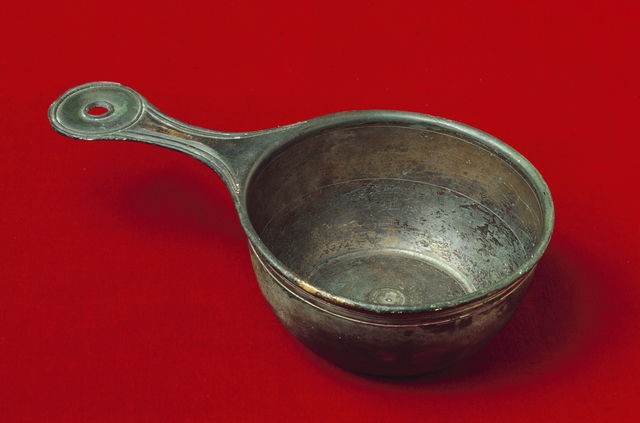


Viinikauha Vähästäkyröstä, 300-luvun (mahdollinen) polttohautaus. Alun perin esine on valmistettu Capuan lähellä 100-luvulla, mutta kulkeutunut Suomeen todennäköisesti valtakunnan pohjoisosista pari sataa vuotta myöhemmin. Ainoa tämänmallinen Skandinaviasta. (Salo 1968: 170). © Kansallismuseo/FinnaA bucket of wine from Vähästäkyrö. The object was originally made near Capua -60 km from Napoli (southern Italy)- in the 100s, but probably arrived in Finland from the northern parts of the Roman empire a couple of hundred years later (around 300 AD).
The heyday of the Veiksel trade route ends with the Marcomann War during the reigns of Roman Emperors Marcus Aurelius and Commodus, which perhaps explains the scanty phase observed in Finland at the turn of the older and younger Roman Iron Age.
Southern Ostrobothnia has mound graves from this period. Younger Roman Age in Finland The younger Roman Iron Age in Nordic prehistory means about 200-400 years from the end of Augustus rule. The Roman Empire weakened at that time (mainly after the Trajan-Hadrian years), but it was still a force of influence whose important effects extended strongly to the Baltic Sea. The era was warlike and bloody. For example, the famous war booty finds from Danish territory tell of the fierce battles between the more solid societies that were forming in southern Scandinavia.

Archaeological finds are known mainly from the coastal areas of Uusimaa, Southwest Finland and Southern Ostrobothnia, where metal objects (weapons and jewelery) were buried. Tomb finds are also known from Pirkanmaa, Kanta- and Päijät-Häme, Central Ostrobothnia and even Central Finland (Viitasaari). Since the 1980s, Oulu archaeologists have also found cemeteries (burial sites) on the shores of the Gulf of Bothnia (Kaakkuri in Oulu, Tervakangas in Raahe (Saloisten), Rakanmäki in Tornio). In other parts of the country, residence finds also indicate civilized -meaning: partially Romanized- settlement (eg.: Luukonsaari pottery in Lake Finland, similar to Roman pottery).
The population of Finland's coasts maintained connections to both Scandinavia and the Baltics, in addition to which some objects also arrived from the residential areas of the Finnish-speaking population in Central Russia.
Rich grave finds at Laitila's Soukais and Salo's (formerly Uskela) Ketohaaa tell about the formation of some kind of social "upper class", mainly after the third century. Two parallel stone chests were found in the mound tomb of Soukainen, one of which contained a pair of Roman-style spearheads. The richer stone coffin had a pair of spearheads, a shield, a sword in a silver sheath, and a glass Drinking Horn & a bronze bucket made in the territory of the Roman Empire. Professors Ella Kivikoski and Unto Salo have interpreted the graves as belonging to a great man from Gotland, even a "prince", and his weapon bearer. Archaeologist Christian Carpelan, for his part, has also seen local features in the tomb and regarded it as evidence of connections in many different directions. Pieces of a golden neck ring are known from the mound of the keto, which refer to high-level connections to Scandinavia. A famous golden necklace has been found in the area as early as the 18th century, and it is preserved in Stockholm.
Main Roman and Roman-influenced discoveries from Finland
In Finland, the material culture of the Roman Iron Age is known mainly due to cemetery finds. Habitats have been relatively little studied and focus on the pre-Roman phase. Based on the findings, the core area of Finland's pre- and older Roman settlements was the coastal zone from western Uusimaa to Satakunta. In younger Roman times, cemetery settlement spread: more and more cemeteries can also be found in the interior and in Southern Ostrobothnia. The concentration of densely populated areas in western and southern Finland does not mean that there were no inhabitants elsewhere. The population of Eastern and Northern Finland was less in numbers, with only "Lapland ruins" (inland stone mound tombs).
Significant cemetery sites include Kärsämäki and Saramäki in Turku (formerly Maaria), Sonkkila and Untamala in Laitila, Kroggårsmalmi in Karjaan, Koskenhaka in Piikkiö and Vanutehtaanmäki in Salo. Very rich burials, rich in burials (and nice luxuries), are exceptions, with most burials scarce or completely undiscovered. It is possible that the occasional generalized undiscoveredness reflects social conditions, variations in burial practices, and/or connections to neighboring areas. The majority of objects imported to Finland during the Roman Iron Age come from the Baltic Sea region. The number of “Roman objects” found in Finland is very small compared to, for example, southern Scandinavia. Certainly there are a dozen items and money from the provinces of Rome or (in a couple of cases) from Italy. Several other objects show the Roman influence, even though they were made elsewhere (usually in Germany).
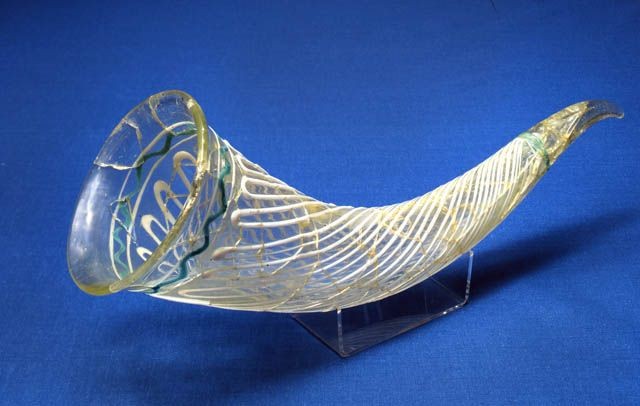


Laitilan Soukainen, uudelleen koottu juomasarvi (löydettäessä 47 osassa) nuoremmalta roomalaisajalta. Samasta hautauksesta löytyi mm. Hemmoor-sanko. Salon Vanutehtaanmäeltä on löytynyt kahden vihertävän juomasarven paloja. Lasiset juomasarvet olivat tyypillisesti provinssiroomalaisia esineitä. (Raninen & Wessman 2015: 242; Salo 1987c: 245). Kuva: Museovirasto/Finna.fi.


A re-assembled Drinking Horn (found in 47 parts) from the younger Roman period found in the Soukais of Laitila. In the same burial, Hemmoor-pail, pieces of two green drinking horns have been found in Salute Vanutehtaanmäki. Glass drinking horns were typically provincial Roman objects.
Only a few weapons referring to the Roman Empire have been found: a pugio-type dagger from Maaria's Kärsämäki (the dagger is shaped from a sword by forging it again) and three gladiators, or double-edged, Roman swords from Kaarina, Maaria's Saramäe and Kärsämäki. Pugio is possibly an original Roman object, but the gladiator swords are imitations of the ones of the Elbe and Veiksel. Pugies have been found in few areas north of the Roman provinces, which has been considered evidence of their Romanity (i.e., this type of pugio was not widely copied, like some other Roman artifacts). Bronze parts of the sign have been found in the Kikkienhaa cemetery in Piikkiö, where the Roman design language can be seen, although the sign was probably made in Bohemia. In addition to the above, a couple of wine buckets, three drinking horns, one Hemmoor-type bronze bucket, a bronze platter and some smaller metal objects (including drinking horn ornaments) are known from Finland, possibly originating in the Roman Empire. No jewelry directly from the Roman Empire has been found. Some of the jewelery of the younger Roman period shows the influence of Mediterranean fashion. However, the origin of Finnish Roman jewelery is in the areas east of the Veiksel River, in Central Europe and in Scandinavia. According to some scholars, some of the Roman-era glass beads -that begin to appear in burials in the younger Roman period- may have originated in the Roman Empire. Twenty coins from the imperial period (copper and silver coins) have also been found in Finland, most of which were probably brought here much later than Roman times. Certainly there are a few coins imported from Roman times and they come from burials whose other finds support the timing. Some money has also been found in fields close to well-known Roman antiquities. The money found in the tombs is from the core areas of Roman settlement, but individual loose finds have been made even as far as Lake Saarijärvi.
To sum up, only a few objects are known in Finland that certainly originate in the Roman Empire. Although the territory of Finland cannot be considered to be under the influence of Rome, the artefacts of Finland from the Roman Iron Age definitely show connections to at least the northern provinces of the empire (like Germania I & II, Noricum and Pannonia). The Roman objects and money that ended up here were probably related to trade and other regular contacts from Finland to southern Scandinavia, the Baltics, and the settlements of the Germanic tribes.
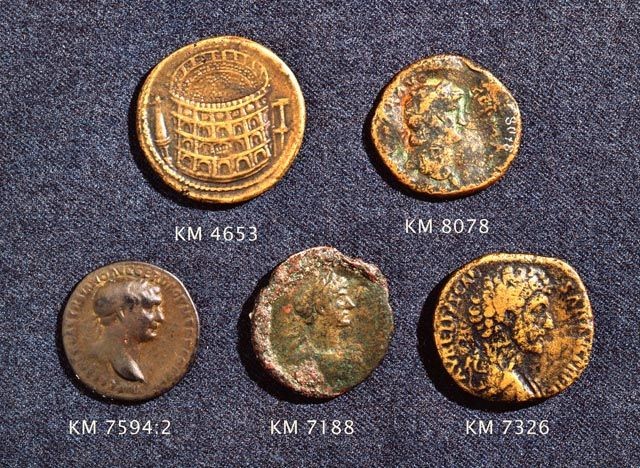


Joitakin Suomesta löytyneitä roomalaisia rahoja. Todennäköisesti tänne jo roomalaisaikana päätyneitä kolikoita ovat Hadrianuksen (keskellä alhaalla), Neron (oikealla ylhäällä) ja Trajanuksen (vasemmalla alhaalla) lyöttämät rahat. Ylhäällä vasemmalla oleva kolikko on väärennös ja alhaalla oikealla oleva on paljon myöhäisempää tuontia.
Some Roman money found in Finland: the above coins include Hadrian’s (bottom center), Nero (top right) and Trajan’s (top left)
A possible Roman trading post Some researchers (like F. Aiello) argue that the Turku castle, the oldest castle in Finland, was probably built on a ancient Roman trading post near the mouth of the Aura river (in the most southwestern area of Finland). This trading post was -in their opinion- similar to the one at Drumanagh in the eastern coast of Ireland near Dublin. Unfortunately until now nothing has been discovered in the castle that goes back to Roman centuries, but the area has been inhabited since Neolithic times and archaeological research is being done in the related territory. Indeed the early construction of the castle was done in the XIII century, with a shape similar to the one of a Roman castrum on the mouth of a river. The following image shows an astonishing similarity of the early Turku castle with the Roman fortifications for the legions:
Turku Castle on its early stages during the 1200s
Furthermore, we must remember that Roman merchants also traded with southern Sweden, where the Öland island (not far away from the finnish Turku - also called "Abo" in Swedish) was a romanized trading outpost, according to recent archaeological discoveries.

The Romans who travelled north for ‘the gold of the Baltic’ would take with them various items to be traded, including fabrics, ceramics, metal objects, trinkets, wool, as well as bronze and brass artefacts. They brought back sacks of amber, animal skins, wax, feathers and beaver coats. Due to increasing intense economic contacts, Roman coins also were started to be used (nearly one thousand "solidii" -from the fourth and fifth centuries AD- have been found in the southern Scandinavia region and a few also in Finland, please read
numismatics.org/digitallibrary/ark:/53695/nnan59692).

But actually there it is not a huge research by academics on this matter. However new studies are being done and soon we'll be published.

Saturday, May 2, 2020

MOUNT MUSINE'S UFO SIGHTINGS

In these months of "coronavirus crisis" there has been the first official confirmation by US military authorities of the existence of the UFO (Unidentified flying Objects): https://www.nbcnews.com/news/us-news/navy-confirms-videos-did-capture-ufo-sightings-it-calls-them-n1056201. It seems that it has been chosen the period of time when all the world attention was concentrated on the terrible pandemia and so this UFO news was going to be quickly forgotten by the mass media.

Original "letter" about the 1960 UFO sighting in mount Musine


But what strikes me most is that a few researchers argue that the Coronavirus can be "linked" to the UFO problem, because the pandemia hits the most powerful countries in the world (from the US to the main western European nations and to China), while the third world is practically untouched. India, Latin America and Black Africa, they argue, are being mostly spared by the terrible disease.....why?..... The answer for these researchers is that they think that this is a way to "weaken" the only countries that could "fight" a possible invasion by extraterrestrials, that is going to happen soon (please read this Italian website about many UFOs approaching our planet: http://www.centroufologicomediterraneo.it/wp/enormi-flotte-di-ufo-entrano-nellatmosfera-terrestre-la-nasa-registra-levento-in-diretta-tv-dalla-iss/). And they add that this is the beginning of the end of the "human" world, as prophecies show in their apocalypses writings (for some of them the 2000 year 'finis mundi' -predicted by Nostradamus et al- has been confused with the "similar number" 2020....and so it is going to happen now the end of the world...).

Sincerely, I don't think this is possible: it makes me even laugh! In my opinion, this proves that the human mind can create every stupidity.

Anyway, something seems to be "real" in all these UFO problems, with so many questions related. As I wrote in April 2017 (https://researchomnia.blogspot.com/2017/04/the-truth-about-ufo-in-1933-italy.html ), in northern Italy there have been historically many sightings in the Piedmont/Lombardy region. And a place seems to be continuously linked to the UFO: mount Musine, in the Alps near Torino.

Mount Musine


The mountain is 1.150 meters high, overlooking the "Val di Susa" and characterized by a supposedly "sterile" belt, in which nothing grows, midway up. Also, optical anomalies have been recorded in the Musiné area, resulting in strangely distorted photographs, double shadows and similar oddities (on the northeastern slopes of Mount Musinè several "magnesite" quarries were active between 1875 and the Second World War) . 
It has also been said that at the foot of the Musiné there would be a "shadow cone", that is, an interference zone that obscures any radio transmission. Even private planes that fly over the place are disturbed in their radio broadcasts. These problems cease the moment you move away from the mountain.

History


Originally called "Mons Asinarius" (Donkey's Mountain) by the Romans, Mount Musiné was always considered ominous by the locals. From the earlier times, strange lights have been seen by night and sudden fires have scarred the sides of the mountain.

One of the best documented cases was witnessed by many in 966 AD , while on the opposite side of the Susa valley, on Mount Pirchiriano, the newly built S. Michael monastery and shrine was being visited by Bishop Amizone. Lights (described as "planks and globes made of fire") were seen by the monks during the night; they started on the Musiné mountain, then rose in the sky and started circling around the new building (please read detailed information in the Italian website:http://www.marianotomatis.it/index.php?special=musine&doc=musine04 ) .


Similar events are documented since the IV century AD, and have been ascribed often to "angels". The most famous legendary event is that related to the battle that in 312 AD saw the future emperor Constantine clash with the troops of his rival Maxentius.

On that occasion (but it is not historically ascertained) Constantine the Great would have had the well-known vision of a cross in the clouds with the writing "in hoc signo vinces", that would have led him to impose the Christian religion in the Roman empire. According to "ufologists", the cross was a "huge cigar" UFO with wings!

In memory of that battle, In 1901 a 15 m high cross was built on the top of the mountain using reinforced concrete. 

The top of the mountain with the concrete cross


Indeed both the CISU (Centro Italiano Studi Ufologici) and the CUN (Centro Ufologico Nazionale), plus lots of "independents", are keeping an eye on the mountain. Many cases of UFO sightings have been reported and documented in the area in the last 50 years. According to this people, the "sterile belt" could be caused by radiations leaks from some UFO engines. 

Also, the mountain is said to be riddled with galleries, possibly of volcanic origin and later artificially enlarged, to be used as a UFO base. Indeed when Mussolini’s fascist government recovered a crashed UFO in Lombardy in 1933, it was suggested by some members of the above UFO centers-groups that space aliens had a secret base under Monte Musinè (but I totally disagree with them, even because it is not geologically proved that there was a volcano in the area). 


Furthermore,there are countless testimonies of sightings of unidentified flying objects, both nocturnal and diurnal, in the last two centuries. Numerous witnesses also recall the apparitions on the top of flaming spherical globes. There are tales of strange lights sighted in the sky, attributed by "ufologists" to alien visitors. This has led to believe that the mountain is a destination for extraterrestrials: samples of scorched earth would witness the passage of spaceships spotted by some local farmers.

Recent UFO sightings


One of the most interesting UFO sightings in the Mount Musine is that of an object observed on the evening of July 12, 1960 in the locality called Mati, while passing slowly on the mountain illuminating the top (see the "letter" at the beginning of this article). On December 8, 1978, on the other hand, some young people who had climbed specifically to the Musinè to see some mysterious lights, observed a strong light source in the trees. Traces of one of the boys were lost for an hour and, once found, he said he had been wrapped in a mysterious light and had glimpsed humanoid figures. In detail: his mate, with the help of some passers-by, searched for him and after a while found his friend in a state of shock and with a noticeable scald on one leg. After regaining consciousness the young man reported having seen an elongated vehicle and that some strangely shaped beings descended from it, touching and efting him: 3-4 men with "melon" heads had appeared, silhouetted silently in the light; the man felt paralyzed and was able to feel only lights and sounds, also feeling touched and pushed higher from ground. Both the young hikers suffered from conjunctivitis for some time.


Five years before the incident with the two hikers, on 2nd December 1973, the crew and passengers of an Italian commercial airliner witnessed strange glowing orbs seemingly traversing the skies over the top of Mount Musine. When later details emerged from witnesses, it appeared that the orbs had a definite disc-shape structure to them.

Furthermore, the Italian Air Force sent  jets to the region, whose pilots did also see the bizarre craft. They didn’t, however, manage to intercept it, with the strange object simply disappearing each time they would approach. According to newspaper reports at the time, hundreds of people on the ground also witnessed the bizarre events unfold. For further information of other sightings in that decade, please go to the website (in Italian): http://www.merlino.org/ufo-nw73.htm


Sensational episodes got the media attention on march 1996 when two hikers saw – or at least claimed to see – a bright object with a circular shape and a yellow-green color, fluttering in the sky for more than a quarter of an hour. The object – always according to the statements of the two spectators- had two large cups transparent through which could be seen moving apparently humanoid shapes. The location of the sighting was, in fact, the Monte Musinè.

On march 10, 2005 Luca Avenati -a Torino citizen- saw a red globe moving from Mount Musine toward Avigliana (in the outskirts of Torino) around 9 pm; when it was 300 meters over this locality the globe remained without movement for 5 minutes while all the lights in the area suffered a full blackout (La Stampa newspaper, march 26/2005).


On July 18, 2008 Claudio Neve -a news reporter- wrote that a father in Gassino Torinese (near Val di Susa) took a photo in the morning of his two sons playing in the garden of his house. When developed the photo, it showed behind the kids an UFO (in the direction of nearby Mount Musine), as can be seen in the above image of a section of the photo.

On October 2019 a drone was able to make a video showing an UFO flying at 1400 km/h in a place called Nichelino, not far away from mount Musine. Please see the videos in this Italian website: http://www.centroufologicomediterraneo.it/wp/ufo-velocissimo-circa-1400-kmh-sfreccia-davanti-ad-un-drone-nichelino-nei-pressi-di-torino/