Sunday, September 8, 2019

THE AROMANIAN NATIONAL REBIRTH

In my weblog in Italian language I have researched about the so called "Aromanian rebirth", that has happened with the development of nationalism in the Balkans since the XVIII century. Here it is a partial translation in English language of this research, titled in Italian "La rinascita degli Aromuni fino alla Grande Guerra" ('The rebirth of the Aromanians until WW1'). If interested read the original here: http://brunodam.blog.kataweb.it/2019/09/05/la-storia-recente-degli-aromuni/.

Map showing the territorial requests, at the 1919 Peace Conderence of Paris, for the creation of an Aromanian state in the Pindus region of northern Greece
THE AROMANIAN REBIRTH IN THE LAST TWO CENTURIES

The following text is based on a research by N.S. Tanasoca (a well-known Romanian writer) on the historical story of the Aromanians in the Balkans. I want to clarify from the outset that this translation in Italian comes to be the opinion - in some way partialized - of many writers and historians of Romania and that it does not coincide with the opinion of other writers, especially Greeks and Bulgarians.

Furthermore, I personally believe that - to save something of the aromanian presence in the southern Balkans, after the failure of the two attempts to create an aromanian State (one supported by France & Italy in the first world war and the other by Italy in the second) - all that remains is to renounce to the idea of ​​an aromanian nation and to accept the Romania's support in creating a small Balkan area -with limited autonomy, inside other nations- with a "Romanian" dialect. In short, a kind of "reserve" of Aromanians, as it exists for Indians in the USA.

Only in this way could be prevented in the next few decades the total assimilation of the remaining aromanian areas in the Pindus, saving one of their substantial communities within a 'United Europe' (given that the aromanian presence -although official- in Albania and Macedonia is 'minimal and irrelevant').


Under the impact of historical circumstances, the Aromanians did not experience the phase of the full rebirth of small European nations in the 19th century and did not, therefore, become a standard ethnic group. However there was a kind of rebirth, but full of problems.

As Nicolae Tanasoca pinpointed, starting during the second half of the Eighteenth Century, a considerable number of Aromanians emigrated from the Balkan Peninsula because of certain economic concerns and political needs in an attempt to preserve their nationality. One can cite, in particular, the founding of some important settlements by Aromanian merchants, most of whom were born in Epirus and who were forced, as the result of Ottoman persecutions at the end of the Eighteenth Century, to settle in the Habsburg Empire (Austria, Hungary, and Transylvania). Then, after the First World War, came the efforts on the part of the Romanian government to colonize Dobrudja (at the mouth of the Danube river) with a few thousand Aromanian families. In addition to the latter, some compact Megleno-Romanian groups also settled on Romanian territory and preserved both their ethnic features and their language.

The settling of Aromanians in the Habsburg Empire is linked to the so called 'first Aromanian national renaissance'. Continuing a cultural direction undertaken as early as their presence in the Balkan Peninsula within the flourishing urban center of Moscopolis (that was destroyed by the Ottoman Ali Pasha of Yanina), those Aromanians who had emigrated to Central European cities came into contact with Habsburg Empire Romanians (chiefly Transylvanian Romanians ). Here, in the effervescent atmosphere of the 'Enlightenment', they developed a movement of cultural assertion in their own language which they tried to promote by writing grammars, primers, and even histories of their people. Focusing on the Romanity of Aromanians and even on recovered Romanity, this movement triggered the response of the Greek-Orthodox clergy grouped around the Oecumenical Patriarchate. They viewed the possible Aromanian departure from the cultural boundaries of a Hellenism that they had supported both intellectually and materially, as being akin to religious apostasy.

The 'second Aromanian national renaissance' began to take shape in the second half of the nineteenth century through the efforts of mid-century revolutionaries, also known in Romania as the Forty-Eighters. These revolutionaries, in their national aspirations to bring together all Romanians into one national state and to creatively assert the cultural identity of the Romanian people in its own language, did not want to exclude the Balkan Romanians.

Stages of the “Aromanian Issue” in the Development of Balkan Policy

Tanasoca also wrote that many pages of Balkanology have been devoted to the so-called national rebirth of the Aromanians in the Nineteenth and Twentieth Centuries. Generally speaking, both Romanian and foreign researchers claim that this Aromanian national rebirth, identifiable at the level of both written culture and institutional life, was the result of an initiative taken by Romanian Forty-Eighters. These persons, owing to the mediation by outstandingémigrés in the aftermath of the 1848 Revolution, Christian Tell, Nicolae lcescu, Ion Ghica, Ion Ionescu de la Brad made contact with the Aromanians who lived in the Ottoman Empire. As a result, they experienced intensely the rediscovery of many distant “brothers” and decided to fulfil, as soon as possible, the ideal of reinserting them into the mass of a culturally and politically reborn Romanianism.


The schools were later followed by a similar network of churches in which religious services were conducted in Romanian. These actions marked the beginning of a Balkan Romanian policy intended to strengthen a status of cultural autonomy and to provide protection to the Aromanians by the Romanian State. Carried out with tenacity and diplomatic skill in the changing and often unstable circumstances of political life in the Balkan Peninsula, this action proved successful and remained a constant direction of Romanian foreign policy until 1945.

In terms of both political practice and the writing of history, the Aromanian issue was also a source of high-pitched confrontations and controversies between Romanians and other Balkan inhabitants. Romanian historians and statesmen considered the Aromanians to be “brothers” – or “first cousins”, in the words of René Pinon (1908) at the beginning of the Twentieth Century – of the Daco-Romanians, openly considering them Balkan Romanians or even Romanians who had emigrated, over the centuries, from ancient Dacia to the South. While these Romanians supported their distant relatives according to what they deemed to be a moral duty and a national political imperative, non-Romanian Balkan historians and statesmen claimed, with very few exceptions, that the Aromanians were not Romanians and that the intervention of Romania in their favour was a form of cultural imperialism, an act the hidden agenda of which was an attempt at political and territorial expansion and annexation.

Having reached the peak of its influence during the Balkan Wars, the Aromanian policy of Romania underwent a decline as further wars determined the dismemberment of the Ottoman Empire and the strengthening of Balkan national states. Thenetwork of Romanian schools and churches shrunk quite considerably and was only tolerated in Greece, owing to certain special circumstances.

The Second World War and the changes it brought about in the social and political structures of Southeastern Europe simply did away with the Aromanian issue and sealed the fate of Aromanians under the guise of a gradual, but increasing, de-Romanianization. Today, the “Aromanian issue” is no longer a political reality, but rather a topic of great interest for objective research that has so far been insufficiently developed.

The “Aromanian Issue” between 1879 and the First World War

Between 1879 and 1919 the Aromanian national rebirth reached its peak.

The year 1879 witnessed the founding of the Bucharest Society for Macedo-Romanian Culture. Chaired by Calinic Miclescu, the Primate of Romania, and having Vasile Alexandrescu Urechia as its secretary, the institution was led by a Council made up of thirty-five personalities. These included Dimitrie and Ion Ghica, Dumitru Brătianu, C. A. Rosetti, Ion Câmpineanu, Gh. Chiţt, Nicolae Ionescu, Christian Tell, Menelas Ghermani, Dr. Ioan Kalinderu, D. A. Sturdza, Titu Maiorescu, Vasile Alecsandri, and Ioan Caragiani. As it had a legal status, the Society represented the genuine core of the Aromanian rebirth movement. Although the Society was not a government body, it had highly unusual responsibilities, such as the right to issue documents attesting civil status, including certificates of nationality intended to assist Aromanians in obtaining Romanian citizenship with comparatively reduced bureaucratic efforts.

Since it was a representative structure for the Aromanians, the Society also guided and coordinated their education in the Romanian language. Its initial objectives were to establish a Romanian bishopric for Aromanians and a boarding school for young people who were studying in Turkey, to raise funds and to subsidize the publication of Aromanian journals and books, and to support the Church. Beginning in 1880, the Society issued an Aromanian journal called Brotherhood for Justice, but it could only continue this effort for one year. Still, in 1880, it published a Macedo-Romanian album with 173 Romanian and foreign contributions to the cause.

The fact that the Society for Macedo-Romanian Culture was founded in 1879 was not purely coincidental. Immediately after gaining full state independence in 1878, Romania had the opportunity to freely develop a foreign policy of its own and used this Society to express its legitimate claim to play a part in the Balkans. However, this claim never implied territorial annexations, only the strengthening of Aromanian cultural autonomy. The Society functioned until 1948.

On the eve of the Balkan Wars, there were over 100 Romanian primary schools in the Ottoman Empire, as well as several secondary schools, including a high school in Bitola and a trade school in Salonika. Although these schools all required their students to pay tuition fees, they were subsidized by the Romanian government. The Aromanian schools outside Romania were placed under the direct authority of the Romanian State that appointed all the teachers. They were also subordinated to a General Inspectorate.

For several decades, this Inspectorate was headed by Apostol Margarit. With the help of the French priest Jean Claude Faveryal, he supervised the birth of many Romanian schools for the Vlach population of the Ottoman Empire. Apostol Margarit dedicated many works to the Aromenian question - Raport despre persecuŃiile şcoalelor române în Macedonia din partea Grecilor in 1875; Réfutation d'une brochure grecque par un Valaque épirote in 1878, Etudes historiques sur les Valaques du Pinde in 1881, Les Grecs, les Valaques, les Albanais et l'Empire turc par un Valaque du Pinde in 1886; La politique grecque en Turquie in 1890; Memoriu privitor la şcoalele de peste Balcani in 1887.

The Romanian schools in the Ottoman Empire were highly successful. They produced generations of graduates, many of whom later chose to settle in Romania. Yet, the main problem for these schools was that of persuading Aromanians to remain in their native environments. This goal could not be accomplished. Indeed the other Balkan nationalities displayed an open hostility to the Romanian education system, for they were competing for the Ottoman legacy even before the formal collapse of the Empire, ready to partition it as best they could. The support of Romanianism could be interpreted as engaging in open combat against all the Christian nationalities in Macedonia.

As for church organization, its progress did not match the positive evolution of the education system. Although on 16 June 1889, the Patriarchate finally permitted the use of the Romanian language in churches built by Aromanians, its attitude, in principle, remained aloof, if not hostile, either openly or through well-hidden manoeuvres. On 27 June 1891, a Sultan’s "irade" (decree) was promulgated, authorizing the use of the Romanian language in Aromanian churches and the use of Romanian books during religious services. Despite all efforts and in spite of an attempt, in 1896, to elect Antim, who was known to support the Aromanian cause, as the Ohrid metropolitan bishop, there were no possibilities of establishing an Aromanian bishopric able to free the Aromanians from the authority of the Greek church and to support their unhindered development.

Catholic propaganda, conducted mainly by a Lazarist named Faveyral of Bitola, was strongly directed toward the conversion of the Aromanians. Apostol Margarit was linked to certain attempts to bring about a religious union with Rome. But the Aromanian community was too attached to the Orthodox tradition to make such a shift. This tradition was a critical element in its national consciousness.

For some years a church in Voskopojë was managed by the Aromanian priest Cosma Demetresescu even after he was closed in a monastery, in 1891. In the same year another decree allowed Aromanians to use their language not only in the religious functions but also in the ritual books. The first years of XX century continued to stage violent attacks on Aromanian clergymen and notables, while romanian diplomacy increased its efforts to obtain from the Sultan privileges as the creation of an indipendent patriarchate. In 1903 Aromanians were among the victims and at the same time the partecipants of the Ilinden insurrection (in the Soviet of Krushova republic there were around 20 Aromanians and later, in the reform commission apponted by the Turks there was the Romanian Pandele Maşu). In 1903 an Aromanian cemetery was set in Monastir while in 1904 a Romanian consulate was opened at Yanyna.

The sympathies showed towards the Sultan were soon repaid and in 1905 sultan Abdul Hamid issued a decree ("irade") to grant Aromanians all the rights of a millet with the exception of a religious head, creating in this way the "Ullah millet". The irade of 22th May 1905 granted to the Vlachs the use of their language in religious matters and the freedom of electing mayors (muhtar). But it caused many angry protests among Greek ecclesiastical authorities, starting from the patriarch Joachim. Besides the opposition of the Greek priests, the irade caused the violent reaction of the bands born to fight the Bulgarian "komitadji". The repression of Aromanian rights included the killing of clergymen, the denial of the Sacraments and violent attacks against the attendants of Aromanian schools

According to Italian military sources, violence continued to mark the inter-ethnic relationships in the Balkans, as denounced by the Romanian press which continued to invoke drastic measures against the discriminatory and violent treatment of the Aromanians by bands of Greeks (and also of Bulgarians and Albanians, but in a minor scale). "Aromanul" (13th November 1913) protested against the assassination of some Romanian activists (Dem. Zicu of Petrici and Mitra Arghieri of Şatra), "Viitorul" (Rominii maeedoneni, 20th December 1913) and "Fulgerul" (Exterminarea Aromanilor, 20th January 1914) against the risk Aromanians could disappear; “Dreptatea" (Romanii albanezi şi asasinarea preotului Balamace, 26th March 1914) and “Adevarul" (Un mitropolit bandit, 29th March 1914) talked abut the fury caused by the murder of the Romanian bishop Haralambie Balamace and accused the Greek metropolit Ghermanos. Finally other protests were caused by the Greek response given by Venizelos, who accused the Albanians of having comitted the massacres of the Aromanians in Coritza (Guvernul şi masacrele din Corita, in “Adevarul", 30th March 1914; Incorigibilii, in “Mişcarea", 3rd April 1914).

Happily satisfied by the recognition of both their ethnic individuality and their cultural and administrative rights, the Aromanians after only 8 years were dealt a harsh blow in the aftermath of the Balkan Wars. The August 1913 Treaty of Bucharest sealed the establishment of national states in the European territories of the Ottoman Empire and divided the Aromanians among these states. Their cohesion was thus shattered, and they were left at the mercy of various national governments that had made no formal commitment to respect Aromanian ethnic autonomy and national rights.

During the first years of WW1, when Greece was divided between Ententists and supporters of the Central Powers, the Pindus Aromanians began an insurrectional movement with Italian support in order to establish, in the Pindus region, an Aromanian political body, completely independent of Greece. Supported by the Society for Macedo-Romanian Culture and by certain Romanian personalities, this movement was exploited by other political actors to obtain recognition of Romanian claims to the whole region of Banat.

But later, represented at Versailles by a delegation led by George Murnu, the Aromanians found themselves in a no-win situation. The Utopian intention to establish an Aromanian or an Aromanian-Albanian state was invalidated by Balkan and general realities. The geographical characteristics of the area concerned failed to provide for economic self-sufficiency. The Aromanians were overly dispersed throughout this area and were surrounded by more numerous neighbours who opposed the whole idea. Finally, there was a lack of consensus among Pindus Aromanians in favour of such an arrangement. The frailty of the dream of a Romanian-Albanian state could be observed in the treatment that Albania meted out to its Romanian minority. The Albanian state did its best to do away with all educational and religious activities carried out by the Aromanians and quickly took the next logical step, that of questioning the very existence of Aromanians on its territory.

The French and Italian intervention

In 1914, in the aftermath of Balkan wars, an Autonomous Republic of Epirus was formed around Gjirokastër. It was led by a distinguished local Greek politician, Georgios Christakis-Zogràfos, who referring to the Megàli idèa gave birth to an autonomous administration, put under formal Albanian sovereignty and recognized also by the Great Powers with the Protocol of Corfu. The experiment took also to the creation of an autocephale church whose chiefs soon reconciled with Athens. The end of the principate was then followed by a period of Greek administration and, after the division between royalists and Venizelos’ supporters had thrown Greece into an unstable position, by the arrival of French and Italian troops at Korcë and Gjirokastër.

The two provinces of Korytsa and Argyrokastro were inhabitated by a melting pot of creeds and populations and included also some Vlachs. During the Epirus autonomy, the Greek administration viewed all Albanian Aromanians as part of the Greek minority without taking into account their different nationality. The region later fell under the control of the Bulgarians, who tried to join Austrian allies, before being stopped by French intervention. Also some groups of rebels were active in the region of Korçë, one was led by Themistokli Gërmenji and another by Sali Butka. The latter, sacked completely the Aromanian Moscopole and threatened with the same perspective Korçë.

When the city of Koritza came under French control, the French tried to get a compromise and an "Autonomous Albanian Republic of Korçë" was established with a council made up of seven Christians (someone Aromanian) and seven Muslims and with Themistokli Gërmenji as prefect of police. The new authorities introduced Albanian as the official language and replaced Greek schools with Albanian ones, which had been forbidden during the Greek administration of the city.

Italy reacted against this French policy aimed at influencing Albanian affairs and, as Italian armies were also present in many parts of Albania - the port of Vlorë and the southern region of the Albanian principality- proclaimed Albanian indipendence and tried to counter-balance French dominion.

In 1917, when Italian troops advanced into Albania they were welcomed in all Aromenian villages, for example in Ciamuria and Samarina. A National council for Pindus was created and it took a very pro-Italian attitude. They later founded, with the help of some local representative as Alkiviadis Diamantis, the "Principate of Pindos" in the area of Aromanian settlement. Italy undertook attempts to convert the proRomanian Aromanians into pro-Italian one, taking advantage of the historical and language relations these communities had with Italian latinity. In this particular context, Italian military forces felt the need to improve the ethnic and political conditions of the Aromanians, and sketched some documents on their history and customs. Their villages could be distinguished for the solidity and a certain elegance and were often placed in positions of military interest, next to the mountains and road junctions. The Aromanians were described as calm, wealthy, occupied in trade or sheep-breeding, resistant to any persecution or massacre, even though the denaturalization policies pursued by the Greeks, as reported by colonel Casoldi on 29th May 1917 in his account 'Note circa la questione valacca'.

The Aromanian presence was particularly evident in two districts, Grammos – expecially in the city and around Koritza - and Pindus, where 36 villages were clearly detachable. Even if they were not as populous as the old Moscopole, these settlements mantained their ethnic identity. The language, instead, was in some case abandoned, also as a consequence of the Greek propaganda, pressures and abuses. Aromanians even arrived at creating national armed bands against those sent by Greeks to terrorize the region and this resistance was considered almost incredible by Italians, due to the peaceful and calm traditions of the Aromanians. It was also noted that many Aromanians enlisted in the Romanian army staying in Moldova asked to be sent back to the Balkans to fight for the security of their lands.

Trying to conquer the sympathies of those communities, the Italians thought that the strategy to follow was that of sponsoring the birth and increase of local authorities in order to prepare for the peace negotiations a fertile ground for the establishments of cantons or political and administrative autonomy. These hopes were increased also by the demands of Aromanian communities, who after the years of the Greek-Romanian dispute and the troubles of war searched in the kingdom of Italy a stronger protector.

Pindus Aromanian villages which signed a letter sent from Samarina and Metzovo to US President Wilson, Italian authorities and Romanian Prime Minister I. C. Brătianu asking "autonomy" on the 27th July 1917: 1)Samarina (Samarina-Σαμαρίνα);2)Abella (Avdella - Αβδέλλα Γρεβενών);3)Perivole (Περιβόλι Γρεβενών);4)Baïassa (Βοβούσα Ιωαννίνων);5)Amintchou (Metzova - Μέτσοβο);6)Paléosseli (Παλαιοσέλλι Ιωαννίνων);7)Padzes (Πάδες Ιωαννίνων);8)Tourïa (Κρανέα Γρεβενών);9)Breazna (Δίστρατο Ιωαννίνων);10)Laca (Λαΐστα Ιωαννίνων);11)Dobrinova (Ηλιοχώρι Ιωαννίνων);12)Armata (Άρματα Ιωαννίνων);13)Zmixi (Σμίξη Γρεβενών)
On 27th July 1917 the Italian commander in Valona, General Giacinto Ferrero, received a telegram coming from the mayors of many Aromanian villages who met in Metzovo, representing the Pindus-Zagori people.

“Figli non degeneri di Roma sempre memori della madre nostra antica e tenaci custodi della lingua e delle tradizioni dei nostri padri dopo lunghi secoli di lotta sanguinosa contro la straniero che tentava tutti i modi di cancellare nostro carattere nazionale latino respiriamo finalmente le pure aure della libertà che le nuove legioni di roma vittoriose agli ordini vostri hanno apportato ai loro fratelli di sangue dispersi lontani sul Pindo e Zagori” ('Non-degenerate children of Rome always mindful of our ancient mother and tenacious guardians of the language and traditions of our fathers after long centuries of bloody struggle against the foreigner who tried always to cancel our national Latin character, we finally breathe the pure auras of freedom that the new legions of Rome victorious on your orders have contributed to their scattered blood brothers on the Pindus and Zagori')

Besides the enthusiastic recalling of ancient Roman roots, in this appeal the Aromanians underlined the security given to them by the Italian troops; their leaving would mean falling easily prey of the enemies who looked forward to the extermination of Aromanians. The latter invoked Italy and her powerful and careful protection, the only means of defence against the superiority of the enemies. Finally, the signataries self-appointed themselves the 'sons of Rome', who throughout millenary events had kept intact and preserved the remembrance of the Roman civilization in the valleys and the mountains of Pindus. Even if in a shorter form, the same declarations were included in the comunication sent the same day to the President of the United states, to the president of the Provisory Russian Government, to the Romanian Prime Minister I. C. Brătianu, to the Belgian Foreign Affairs minister, to the French, English and Russian consuls in Yanina, to General Ricciotti Garibaldi in Rome and to the mayor of Rome.

In late 1918 a "memorandum" of the Aromanian people was sent to the 'Peace Conference in Paris' through the volume "Les Macedo-Roumains (Koutzo-Valaques) devant le Congrè de la Paix" redacted by the National Council of the Pindus Roumanians and signed by G.Munru, Nicolae Tacit, Arghir Culina, T. Papahagi. Besides the historical connection, the Aromanians recalled their will of joining the Roman Catholic Church repairing “le plus grave erreur historique” (their biggest historical mistake) and restablishing the relationships that Kalojan Asan had with the Pope, which proved the never-ending Latin character of the Aromanian people Italy was the natural benchmark of the Aromanians and her prestige deriving from the victory of the war increased her power and attraction towards the Aromanians, who kept on invoking Italian protection for the safeguard of their Latin culture. At Delvino, on 28th December 1918 and 10th January 1919, a special Assembly was convoked. The meeting defined a precise political project: the autonomy of Pindus and Zagori united with Albania and under the protection of Italy and pointed out a strategy to avoid any other undesired solution.

But the Paris Peace conference was not favorable to the Aromanians.

After 1919

The years, 1919-1948, represented a period of stagnation and decline in the evolution of the Aromanian issue. The Turkish-Greek War that ended with the Treaty of Lausanne of 1923 entailed the resettlement in Greek Macedonia of over one million Greeks from Asia Minor. This act was a truly finishing stroke for Aromanians in Greece.

Aromanian shepherding was destroyed by the parcelling of the large pastures so that all the newcomers could receive a piece of land. The latter were protected in the practice of the liberal professions and in trade through a process perceived as a threat by Aromanians who suddenly faced competition. The situation being what it was, those Aromanians who were still keen on their Romanity decided to emigrate to Romania. With the support of the Romanian State, the Dobrudja Quadrilateral was settled by several thousand Aromanians who were then forced to move into Romanian Dobrudja, when the Quadrilateral was retroceded to Bulgaria, in 1940. To this systematic movement of people, must be added the more gradual emigration of all the Salonika and Grebena secondary school aromanian graduates to Romania during the 1920s and 1930s.

The last intervention of Italy happened during WW2, when the Aromanian leader Alkibiades Diamantis created -under Italian control- the "Principate of Pindus" with the support of one thousand Aromanian volunteers of his 'Roman Legion', but the Axis defeat in this war left a complete destruction of the aromanian rebirth as a possible small State. Alkibiades Diamandis and his Aromanian troops of the 'Roman Legion' in 1941

Tuesday, August 6, 2019

ROMANS IN SOUTHEAST ASIA

The following is an essay that I have written years ago. It is about the travels of Roman merchants in what is now "Indochina" and the islands south of this region that are called "Indonesia". These travels to the southeast Asia were done mainly in the first four centuries of the Roman empire.

Romans went further east until China (all these contacts are well documented) and possibly until the Philippines, the Korean peninsula and southern Japan (but only coins have been found in these countries; read for example about the Philippines: http://www.filipinonumismatist.com/2008/09/a-rare-ancient-coin-surfaced-in.html).

Map showing places where Roman coins have been found until 2010
ROMAN MERCHANTS BEYOND THE INDIA PENINSULA

Romans reached India and Ceylon with their trade, but also some Roman merchants have gone further east until the islands of what is now Indonesia and until the Indochina peninsula (actual Birmania, Malaysia, Thailand, Laos and Vietnam). Pliny -the famous Roman historian- wrote that "cinnamon" and other spices from the "Spice islands" (as were called the Moluccans and other islands of Indonesia during the Roman centuries and Middle Ages) reached Rome mainly via East Africa (actual Somalia). Romans also reached China and some historians suggest that in China there was a Roman colony in the first century AD (https://www.academia.edu/1952695/Romans_in_China )!

Indeed in 2016 Warwick Ball wrote ( in his "Rome in the East: Transformation of an Empire") that the scarcity of Roman and Byzantine coins discovered in China, and the greater amounts found in India & Ceylon, suggest that most silk & other items from China purchased by the Romans were from maritime India, largely going through the Indochina & Indonesia seas.

In this essay I am going to write about the Roman presence in Indonesia and Indochina, a topic that has not received a lot of attention from historians (who seems to be attracted mainly to deal with India and China. We still have nearly the same knowledge we had in 1917: read http://penelope.uchicago.edu/Thayer/E/Journals/JAOS/37/Navigation_to_the_Far_East_under_the_Roman_Empire*.html#ref16).

I N D O N E S I A

According to Kristina Hoppal (et al:http://dissarch.elte.hu/pdf.js/web/viewer.html?file=http://dissarch.elte.hu/index.php/dissarch/article/download/362/341), "apart from a number of Roman interpreted soda natron glass beads excavated in Bali, Indonesia has not yielded convincingly Roman finds so far". She pinpointed that a dozen Roman coins found recently in the Java island (city of Tuban Regency and Brantas river) are not surely related to Roman commerce, but could have been deposited there in the following centuries.

However other academics remember that there are many coins found in Indonesia (too many to have "casually" arrived there) and at least a couple are nearly surely related to Roman merchants, registered historically by Chinese texts. The "Weilüe" (a Chinese historical text written by Yu Huan between 239 and 265 AD) recorded the arrival by ship in 226 AD of a merchant from the Roman Empire (called "Daqin" in Chinese language) at Jiaozhi (Chinese-controlled northern Vietnam). According to the "Weilüe" (and later also the "Book of Liang") Roman merchants were active in Cambodia and Vietnam, a claim supported by modern archaeological finds of ancient Mediterranean goods in the Southeast Asian countries of Vietnam, Thailand, Malaysia, and Indonesia. Probably the Roman coins found in Indonesia were used by these merchants to buy spices.

Furthermore, Jeffrey Hays has written an interesting essay about this Roman trade with Indonesia: here there are some excerpts.

"Spices from Indonesia in Ancient and Medieval Europe"

Spices such as "cinnamon" and "pepper" that were known in ancient Rome and traded on the Silk Road originated from India and the East Indies. Pliny wrote of how cinnamon and other spices from Indonesia reached Rome via Madagascar and East Africa. By the A.D. 1st century, spices were making their way to China and India and from there taken by ship and Silk Road caravans to Europe.

Spices were among the most valuable commodities carried on the Silk Road. Without refrigeration food spoiled easily and spices were important for masking the flavor of rancid or spoiled meat. Basil, mint, sage, rosemary and thyme cold be grown in family herb gardens in Europe along with medicinal plants. Among the the spices and seasonings that came from the East--affordable to merchants and burghers but not ordinary people--were pepper, cloves, mace and cumin. Ginger, nutmeg, cinnamon and saffron--the most valuable of spices from the East--were worth more than their weight in gold.

Pepper, one of the spices that Columbus was looking for when he landed in the America in 1492, had been coming to Europe along the Silk Road at least since Roman times, when many Roman cookbook recipes called for pepper. In the A.D. first century, the satirist Persius wrote:

"....The greedy merchants, led by lucre, run To the parch'd Indies and the rising sun From thence hot Pepper and rich Drugs they bear, Bart'ring for Spices their Italian ware... "

Spices and the Spice Islands

"Cloves" were the most valuable early spice. They originated from the islands of Ternate, Tidore and Bacan in the Mollucca group in Indonesia. Before the birth of Christ, visitors to the Han Dynasty court in China were only permitted to address the emperor if their breath has been sweetened with “odoriferous pistols”---Javanese cloves. Because of limited geographical range cloves didn’t make their way to Europe until around the first century of the Roman empire. They were introduced by Arab traders who controlled the trade of many spices to Europe.

During the early byzantine times and the Middle Ages, Chinese, Arab and Malay traders purchased "nutmeg" in what is now Indonesia and Southeast Asia and carried it in boats to the Persian Gulf or by camel and pack animal on the Silk Road. From the Gulf the spices made their way to byzantine Constantinople and Damascus and eventually Europe.

Successively, for a long time the same spice trade was controlled by north Moloccan sultanates, name Ternate, founded in 1257, and Tidore, founded in 1109. Both were based on small islands and often fought among themselves. Their most valuable crop was cloves. Protecting their kingdoms were fleets of kora-kora, war canoes manned by over 100 rowers. The sultans relied on Malay, Arab and Javanese merchants to distribute their goods.

Cloves

Cloves are the dried, unopened flower buds of the cenkeh, or clove tree, an evergreen tree related to myrtle. Grown primarily in Indonesia, Zanzibar and the West Indies, cloves are about a half inch long with a knob at one end with unopened pedals. The word "cloves" is derived from the French word for nail, chou, a reference to the cloves shape.

Strongly aromatic and sweetly pungent, cloves are used as a flavoring and scent for mulled wines, chewing gum, perfumes, toothpaste and Indonesian cigarettes. The oil of cloves, derived by distillation with water, has antiseptic properties and is an ingredient in soaps, ointments and drugs. Synthetic vanilla is made from eugenol an ingredient of clove oil. Cloves are a key ingredient in the British "Worcestershire sauce". In the past they were prescribed as cure for toothache, bad breath and a low sex drive.

Cloves originated from Ternate, Tidore and Bacan, Indonesian islands in the Moluccas. They were mentioned by the Chinese in 400 B.C. During the Han dynasty Chinese were permitted to address their emperor only once their breath has been sweetened with “odoriferous pistols”---a reference to cloves. Cloves were delivered to the Romans by Arab traders and later were prized as a medicament also in medieval times.

Nutmeg

Nutmeg is the bright red and black kernel (seed) of a yellow, edible, apricot-like fruit from the nutmeg tree, a large evergreen, native to the Moluccas (the "Spice Islands" in Indonesia). The "filmy" red membrane of fruit that coats the nut is the source of mace, another spice which has a flavor quite different from nutmeg. The nutmeg kernel is an unreal-looking red color that looks hand painted.

Nutmeg takes very little effort to grow. Life was good and easy the islanders that raised it. They had do little but watch the nutmeg grow, collect it from trees and take out the nuts and trade them for food, cloth and all the things they needed with Chinese, Malay, Arab and Bugi spice traders. There was competition between Muslims and Chinese over control of the Indonesian spice trade during the Middle Ages.

Nutmeg itself is poisonous. Only a small amount of it should be eaten. The flavor and fragrance comes from myristica, a mild, poisonous narcotic. Other chemicals are similar to those found in the rave drug ecstacy. Nutmeg has historically been a hypnotic agent. Some people take it to get high. Large amounts can induce hallucinations, epileptic-style seizures and even death. Some 80 percent of the word's nutmeg still comes from Indonesia. Wild nutmeg trees still grow in the forest of Butu and other islands in the Spice Islands.

A Roman merchant ship for ocean trade

I N D O C H I N A

In 2nd century AD Egypt, Claudius Ptolemy put the extent of the known world onto paper. From his home in Alexandria, he gathered reports from sailors who had made perilous journeys to India and possibly beyond. Though details were sparse, a voyager named Alexander described a distant port called "Cattigara" on the Sinus Magna (Great Gulf) to the east of the "Golden Chersonese peninsula" – widely considered to be mainland Malaysia (https://books.google.com/books?id=4W5tBQAAQBAJ&pg=PT357&lpg=PT357&dq=romans+in+cattigara&source=bl&ots=pty3ZOqMCu&sig=ACfU3U0tJ_20kXh4r4RmlWL0aJnUJldN-A&hl=en&sa=X&ved=2ahUKEwjm5PzEw7fjAhXXWM0KHQsaCRk4ChDoATAEegQIBRAB#v=onepage&q=romans%20in%20cattigara&f=false.)

Halfway across the world around the same time, the bustling seaport "Oc Eo" (located in modern Vietnam’s An Giang province near the Cambodian border) was part of the flourishing "Funan Kingdom", the earliest known pre-Angkorian civilisation and origin of the earliest Khmer-language inscriptions.

Excavation at Oc Eo suggests it was a major centre for international maritime trade: many academics believe it is Cattigara. Unearthed jewellery, pottery statues, coins and gold pieces – including depictions of Hindu deities and Sanskrit inscriptions – indicate busy trade with the Indian subcontinent. The remains found at Óc Eo also include tools, casts for making jewelry and religious statues. Among the finds are gold jewellery imitating coins from the Roman Empire of the Antonine period. Furthermore Roman golden medallions from the reign of Antoninus Pius, and possibly his successor Marcus Aurelius, have been discovered at Óc Eo, which was near Chinese-controlled Jiaozhou and the region where Chinese historical texts claim the Romans first landed before venturing further into China to conduct diplomacy in 166 AD.

Most curious and interesting, however, are the 2nd century AD Roman coins, found by French archaeologist Louis Malleret, who is credited with discovering the archaeological site in 1942.

However, while certainly one of Vietnam’s most important archaeological sites, it is not sure that Oc Eo was Ptolemy’s Cattigara. But it is possible that Roman mariners could have travelled there and encountered Cambodia’s ancient ancestor. This notion was even suggested by the late George Coedes, arguably the most influential historian of ancient Southeast Asia.

“Funan may even have been the terminus of voyages from the Eastern Mediterranean, if it is the case that the Cattigara mentioned by Ptolemy was situated on the western coast of Indochina on the Gulf of Siam,” he wrote in a 1964 article from the Journal of Southeast Asian History.

An important account of Romans in Southeast Asia can be found in the "Hou Hanshu", an official Chinese history compiled by the courts of the Liu Song dynasty in the 5th century AD. The document states that Roman sailors arrived in 166 AD at Rinan – located in modern day northcentral Vietnam – with gifts of ivory and tortoise shells for the Chinese who then ruled the area. The meeting, reads the document, was the first instance of direct communication between the two empires.

But it has yet to be fully demonstrated whether Romans directly met the peoples of East and Southeast Asia or only picked up scattered titbits and artefacts via intermediaries.

However a nice Roman green glass cup (ca. 220 AD) was discovered in a tomb of Guangxi, near northern Vietnam

Cattigara, said professor Miriam Stark, a specialist in the Funan period at the University of Hawaii, could have been as far south as Sumatra or Borneo according to modern peer-reviewed scholarship on the subject.

“I can’t say that Oc Eo (or even the Mekong delta more generally) was the Cattigara that Ptolemy describes,” said Stark in an email, adding that archeologists have yet to find firm evidence confirming Cattigara’s location.

Concordance with multiple sources, she said, was also lacking, and the Roman coins unearthed at Oc Eo were of dubious provenance because Malleret mostly purchased them from locals rather than excavating them himself.

However Oc Eo’s importance in contemporary maritime trade along the Gulf of Thailand, the discovered Roman relics and Ptolemy’s description are compelling evidences in favour of the theory that Cattinara was a trading port for Roman merchants. Furthermore, Sinologists and modern scholars have also come to the consensus that any Roman peoples visiting the Orient east of India-Ceylon were most likely merchants, not official diplomats or military soldiers.

In Cambodia (in Angkor Borei, not far away from Oc Eo) in 1993 have been found a dozen Roman coins ranging from the first to the fourth century (from Augustus to Valenus). But it is very difficult to understand if these coins arrived there in ancient times or -centuries later- in the Middle Ages.

Finally, in the central region of Thailand where there were settlements built next to the waterways which flowed into the Gulf of Siam. Archeological evidence attests the entry of foreign merchants into this region. There are, for example, terracotta figurines from the sites of Khu Bua to Ratchaburi Province, depicted as having long noses and wearing head-dresses resembling those of Roman and Middle Eastern merchants. At U Thong, an imitation of a Roman coin from the reign of Emperor Victorius was found dating between 259 – 210 AD is considered to have been brought in from the west by seamen, but the insufficient amount of archeological data from the location of the port cannot be established.

To the west of Thailand, in Myanmar (called also "Burma" or "Birmania") in 2017 were excavated the sites of Aw Gyi and Maliwan at the south of Thanintaryi region. These are the first ever Silk Road ports to be researched in Myanmar, and they are amongst the oldest in South-East Asia, with occupations from some centuries BC until Roman empire centuries. There are many archeological evidences of roman commerce in these ports, mainly amphorae remains (read https://www.mmtimes.com/news/se-asias-earliest-maritime-silk-road-ports-found-myanmar.html).

Of course, some ancient merchants from the Roman empire may have traveled as far as China in search of profitable commerce. Given that the voyage to India was relatively commonplace in the first century AD, it seems more than plausible that a few sailed further east than Indochina and southeast Asia.

This is supported by chinese court records, that detail visit by Roman traders to Southeast Asia and China. The most famous of these accounts is found in the "Hou Han-Shou", or Annals of the Later Han Dynasty, a far eastern source compiled in the fifth century C.E. by Fan Yeh of the Sung Dynasty (420-477 C.E.). These annals, which cover the period between 23 C.E. and 220 C.E., record that in 166 C.E. an embassy from king An-tun from Ta-chʻin (alternately Ta-ts’in) arrived from Annam (Vietnam) and sent gifts of ivory, rhinoceros horn, and tortoiseshell to the Han court. Ta-chʻin, or Ta-ts’in, has been identified by Friedrich Hirth as the Chinese name for the Roman Empire and An-tun as the Chinese rendering of Antonius. Ferguson additionally comments that the term Ta-ts’in was generally applied to mean those from the Mediterranean and underscores this as applicable to the Seleucid kingdom, to Nabataean traders, to the Egyptian empire of Alexandria, and to Rome and all its domain.

T-chuan, i.e. “traditions regarding Western Countries,” part of the Hou Han-Shou, contains a description of the westernmost countries described in Chinese literature prior to the Ming dynasty. Mentions of storax, glass, and precious stone architectural ornaments, foreign ambassadors, and dangerous road conditions with tigers and lions causing travelers to resort to caravans, suggested to Hirth that Ta-ts’in was not Rome itself, but one of its eastern provinces. Historian Hirth further presumed from such records that goods went by Chinese junks from Annam to Taprobanê, or the coast of Malabar, whence they were shipped to the Red Sea. This account may provide evidence of Roman merchant activity in the area of Southeast Asia, and such activity is additionally attested in later Chinese records.

The Liang shu, which chronicles some of the events of the period following the collapse of the Han Dynasty in 220 C.E., records that in 226 C.E. Chi’in Lun, a merchant from Ta-chʻin, arrived in Chiao-chih (the Han province of northern Vietnam) and was sent on to the court of the Wu Emperor at Nanjing. Although the work’s compilation in the later seventh century C.E. renders its accuracy about events some 400 years earlier somewhat questionable, it is still worth mentioning here. These same annals indicate that merchants from Ta chʻin were active in parts of Cambodia and Vietnam.

As pinpointed before, discoveries of Roman coins & gold medallions at the trading port of Oc-eo, near Ho Chi Minh City in Vietnam, give greater credibility to Chinese and Roman sources that speak of Roman trading activity in Southeast Asia, especially in the second century C.E. Recent finds of Mediterranean artifacts in Thailand, Vietnam, Malaysia, and Indonesia further support contact between these areas and the Roman empire.

Historian Young ( Young, Gary K. - "Rome's Eastern Trade: International Commerce and Imperial Policy 31 BC - AD 305" ) wrote that in the Antonine period and later, some Roman traders may have begun to journey further than India and Sri Lanka and launched a huge trading activity in the region of Indo-China and perhaps as far as China, although such contacts were “presumably rare.”

Of course there are some good books and researches about the commerce of Roman merchants in the Eurasian trade networks, like the one of M. Galli (https://www.sciencedirect.com/science/article/pii/S187936651630032X#f0010)

FURTHER READINGS:

1) A Roman colony in southern India ( https://researchomnia.blogspot.com/2019/03/a-roman-colony-in-southern-india.html )
2) Romans in Tanzania ( https://researchomnia.blogspot.com/2015/10/romans-in-azaniaraphta.html )

Wednesday, July 3, 2019

136TH ARMOURED DIVISION "GIOVANI FASCISTI" IN MARETH BATTLE (TUNISIA)

Because British propaganda has often "forgotten" to remember the fighting sacrifice of many Italian troops during WW2, I am adding to my "Researchomnia" (that in the last years has been seen approximately one hundred thousand times by readers, mainly from the USA, Russia, Italy and Ukraine: pageviews ) a related translation from Italian of an interesting article (written by B.D.). The essay is about what did a division of young Italians -during the early months of 1943- at the Battle of Mareth in Tunisia.

Indeed one of the fiercest battles done by the Italians in North Africa was the one of the Mareth in southern Tunisia in March 1943. In the Mareth Line the 5,000 soldiers of the "136th Armoured Division Giovani Fascisti" fought bravely alongside the remaining Axis troops. The Division was nearly totally destroyed in 1943, during all the fighting in Tunisia. Even though decimated, the "Giovani Fascisti" was the last Axis military unit to surrender to the Allies in North Africa on May 13, 1943.

"Giovani Fascisti" in the battle

The following are related excerpts, translated from Benito Mussolini's so-called "Memoirs", originally written as a series of anonymous articles in the pages of newspaper "Corriere della Sera" in the summer of 1944, before being published later that year as a book under the title "Storia di un anno: Il tempo del bastone e della carota":

---------------------------------------------------------------------------------------------------

".....General Messe accepted the task (of holding the Mareth line) though realising its arduous nature; and he left by air for Tunis. Once at his post, he spent the first few weeks in getting the troops into shape both materially and morally; they were, naturally, exhausted, either by their interminable retreat or by their long stay in African territory, a stay which for thousands of soldiers could be reckoned in terms of years. The fate of Tunisia was bound up with supplies. No fewer than three hundred thousand men were concentrated in a small space. The problem of organisation and supplies assumed disquieting dimensions. Naval losses were increasingly heavy. In April alone 120,000 tons of Italian shipping was sunk and a further 50,000 tons was damaged. While the enemy troops were more than well supplied, the Italo-German forces were threatened with mortal anemia.

When the first efforts of the German thrust were spent, having achieved nothing except an extension of the bridgehead, the English went over to the attack along the Mareth line.

In Rome the date of the attack was discussed, and it was thought that Montgomery would delay it in order to profit by the full moon as had been the case at El Alamein. Instead, the English general launched the attack on a pitch dark night. To prevent the artillery mowing down the infantry ahead of them, each soldier wore a white cloth on his back. The Mareth line was strong for some fifteen miles — from the sea to about half its length. The rest was weaker and the last sector almost non-existent; moreover, it was entrusted to the Saharan formations which had reached these positions after a highly exhausting march across the most remote desert trails. These formations, besides, had little artillery and lacked the necessary preparation for meeting the shock of mobile and armoured columns. The Italian troops entrenched on the Mareth line and protected by a broad anti-tank ditch resisted bravely and counter-attacked

Montgomery did not succeed in breaking through. Let us say frankly, too, because it is true, that in that sector the English were beaten.

Then the enemy switched his attack over to the weakest side, on the extreme right of Messe’s position, and there, profiting by an extensive use of armour, he had no difficulty in overcoming the Libyan forces and outflanking them. This forced General Messe to retreat some sixty-odd miles on a line running roughly halfway between the Mareth line and Tunis, Meanwhile, the Germans to the north-west were being hard-pressed by the Americans — here, also, with infinitely greater resources. Thus the circle contracted to the point of making further resistance impossible....Benito Mussolini
"

Giovani Fascisti firing an antitank gun
I sent a letter in my own hand to Messe on April 14th, 1943, couched in these terms:

Dear Messe,
Your report on the first victorious battle on the Mareth line is so vivid, thrilling and exhaustive that I have decided to make it known to the Italian people by having it printed. I have introduced merely a few alterations for comprehensible reasons. By this, and not only by this, I intend to give full recognition to your work as Commander and to the courage shown by your soldiers. Between the end of March and today the situation has changed, that is, has become more difficult. I wish to tell you that I count on you to protract resistance to the uttermost and thus upset the enemy plans, at least with regard to their time-table, which aim at a landing on the mainland, after a landing on the islands. Once again: we are doing and will continue to do the impossible to supply you with what you need.
My hearty good wishes and regards, as always,
MUSSOLINI.


After the battle of the Mareth line, the second delaying battle in Tunisia took place, the battle of the so-called Shotts, a sort of salt marshes. Of this battle, too, Messe sent me a report accompanied by this note:
Duce,

I take the liberty of sending you, after the preceding report on the Mareth-El Hamma battle, the report of the battle of the Shotts, and the beginning of the difficult retreat on to the Enfidaville line. The report relates with perfect frankness the course of the bloody and violent struggle undergone and the extremely grave circumstances in which there occurred the disengagement of the large forces on the Shotts line and their retreat; also our very heavy losses, in virtue, chiefly, of the enemy superiority in the matter of armour and of artillery and, more particularly, in the air, where they had complete and unopposed mastery. But I can say that once again officers and men fought desperately and by their sacrifices did honour to our country’s flag.

The troops are physically very tired, and seriously diminished in numbers. The men fighting are, almost all of them, the same who retreated from Libya. But all my energy and all the energy of the various Commanders is being directed to helping and sup- porting these fine and heroic soldiers of ours, who are really working miracles. There has not been a single point at which the enemy has set foot inside our positions without our launching a fierce and violent counter-attack. ……. And I should like to tell you one thing more — that our troops at this time, compared with our allies (always first-class soldiers), have demonstrated greater willingness and momentum.

Owing to the very serious exhaustion of the troops, the inadequacy of artillery and ammunition and the almost complete lack of armoured vehicles, compared with the enemy’s crushing superiority in material, the situation is growing steadily graver. Our air force — and our ally’s as well — may be called non-existent, compared with the really overwhelming and intensively active enemy air force. In spite of all, you may be sure that the order to resist to the last will be faithfully carried out.


General MESSE.


--------------------------------------------------------------------------------------------------

HISTORICAL BACKGROUND

The Battle of the Mareth Line was done by the British Eighth Army of General Montgomery in Tunisia, against the Mareth Line held by the Italo-German First Italian Army of General Giovanni Messe. It was the first big operation by the Eighth Army since the Second Battle of El Alameint, that happened in Egypt ​nearly 5 months previously.

British tank destroyed by the sacrifice of the "Giovane Fascista" Ippolito Niccolini (who received the 'gold medal to military valor'). His body can be seen to the bottom back side of the tank
The "36th Armoured Division Giovani Fascisti" division was created in 1942, when fought bravely in Libya (Bir el Gobi) and Egypt (Siwa): the division was in Tunisia -with other Italian & German divisions- in early 1943, after occupying the old Mareth defenses created by the French.

On late March 19, 1943, "Operation Pugilist" -the first British attack- established a bridgehead in the Mareth line but a break-out attempt was defeated on March 21/24 by Axis counter-attacks done mainly the 136th Armoured Division Giovani Fascisti and the XV Panzer Division of the German Wehrmacht.

As a consequente Montgomery did a few days later the "Operation Supercharge II", an outflanking manoeuvre via the Tebaga Gap on March 21 - 26: it was successfully and Messe was forced to writhdraw 64 km back in the Shott area of southern Tunisia.

The Battle of Mareth was preceded a few days before by the "Battle of Medenine", a small counterattack by the famous Rommel.

This battle was unsuccessful and was the last done by the "desert fox" before returning to Germany.

After a full day of fighting, Rommel accepted a suggestion from Messe to end the attack, since it could not be continued without risking losses which would compromise the defence of the Mareth line

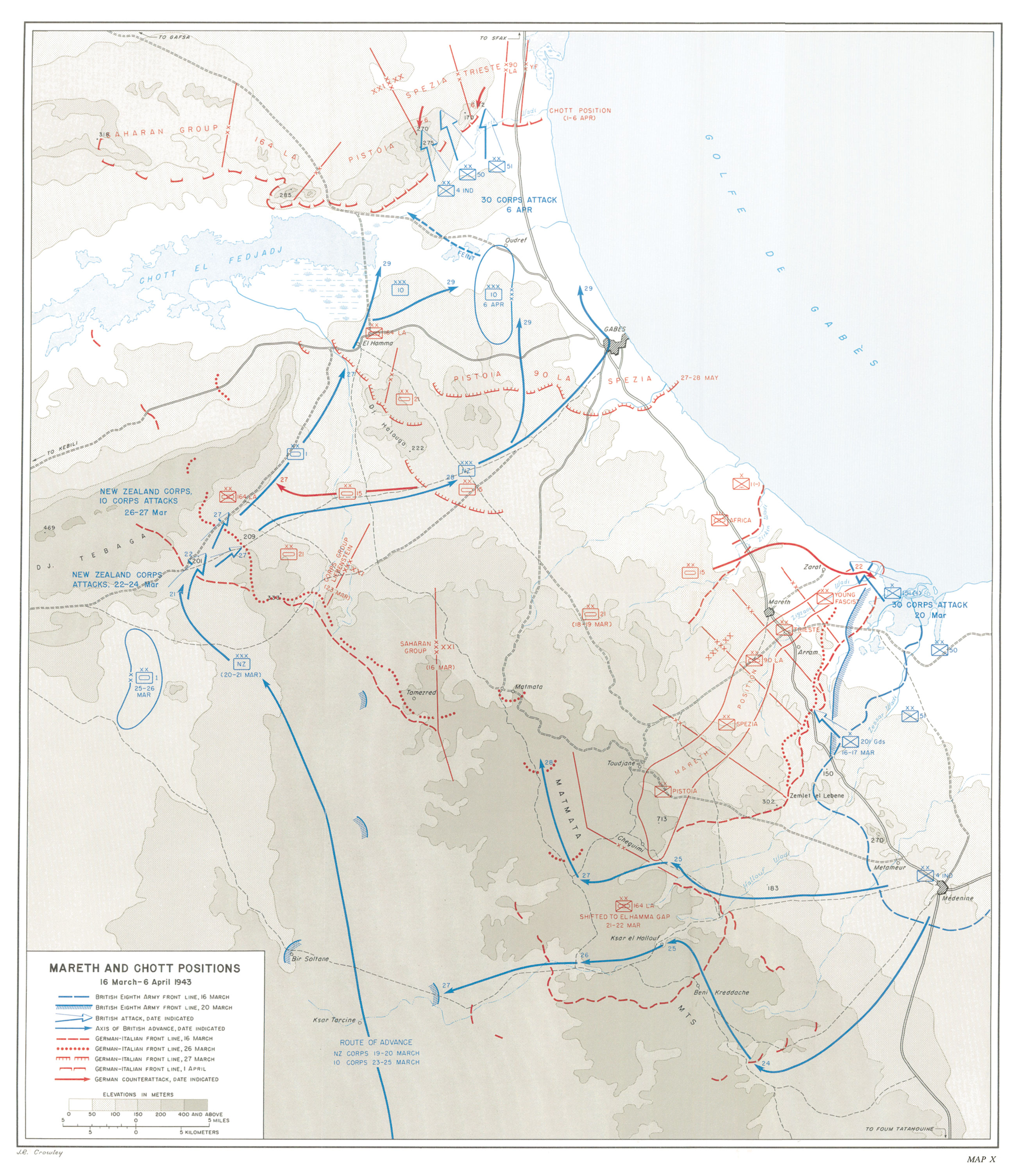
On March 19, 1943, XXX Corps (Lieutenant-General Oliver Leese) of the Eighth Army commenced "Operation Pugilist" (the British code name for the Mareth battle).

The First Italian Army had at its immediate disposal 56 tanks: 29 German and 27 Italian. The German Africa Korps, with the 10th and 21st Panzer Divisions, and a total of 94 tanks, was in army group reserve. The 21st Panzer Division, which had been moved toward Mareth on 17-18 March to counterattack if necessary in conjunction with the 15th Panzer Division, was not expected to arrive in its assembly area before the morning of the 19th. On the coastal plain of Mareth, Messe had from northeast to southwest--the Italian XX Corps under Generale di Divisione Taddeo Orlando, including the 136th (Young Fascists) Division, commanded by Generale di Divisione Nino Sozzani and the 101st (Trieste) Division under Generale di Brigata Francesco La Ferla (the latter's sector embracing the village of Mareth).

Some 50,000 Germans and 35,000 Italians were in the First Italian Army, according to the highest Allied estimate. Montgomery had 125,000 soldiers -according to Major-General W. Stevens, with 1,481 guns to the Axis's 680, with 623 tanks to the Axis's 139 and with air strength of at least two to one.

According to historian George Howe- the Eighth Army of Montgomery entered the battle for the Mareth Line organized into two regular and one provisional corps: the main attack was to be delivered on a 1,200-yard front close to the seacoast (defended by the "Giovani Fascisti" division) by 30 Corps under General Leese. It would include the British 50th (Northumberland) and 51st (Highland) Divisions, 4th Indian Division, and British 201st Guards Brigade. The third major element of the army, 10 Corps, commanded by General Horrocks, consisted of the 1st and 7th Armoured Divisions and 4th Light Armoured Brigade. It was to be held in reserve.

The British opened the main attack on the Mareth Line with an extremely heavy artillery preparation by over 300 guns in the evening of March 19. Howe estimated that 20,000 rounds fell in the Young Fascists sector, nearest the coast, and about 16,000 rounds in the 90th Light Africa Division's area farther west.

The 50th (Northumbrian) Infantry Division (Major-General John Nichols) managed to penetrate the Italian-held line near Zarat (a coastal city), strongly defended by the Giovani Fascisti. The terrain and heavy rain prevented deployment of tanks and anti-tank guns, which left the British infantry partially isolated and a counterattack by the 15th Panzer Division and the Giovani Fascisti division on 22 March, recaptured nearly all of the bridgehead.

It was a clear defeat for Montgomery but his armament superiority soon changed the temporary tactical defeat in a victory, thanks to a flanking maneuver on the Tebaga Gap.

THE BATTLE

Map of the Mareth battle (click to enlarge it)


At 8.30 pm on March 19th, hell broke loose on the front with an initial terrible artillery bombing, like a replica of El Alamein. General Montgomery was aiming to close the conflict in north Africa by the end of the month. But in the next days he was forced to change his opinion, because of the desperate -and often suicidal- fightings done by Italian and German troops like the infantry division "Giovani fascisti" at the Mareth line.

Suggestive names were chosen by general Messe for the Axis defense lines of the Mareth line (that has been created initially by the French in the late 1930s, against possible Italian attacks from Italian Tripolitania): "Biancospino", "Betulla"., "Tiglio", "Timo", etc... The "P2" stronghold was entrusted to the Xth/8th brigate; "Larice" ("P1") and "Tiglio" ("P1 bis") to the 11th/8th. While the LVIIth/8th brigate presided over the strongholds of "A1" and "A2".

When the Montgomery attack started the bersaglieri of the 8th Regiment resisted, but two adjacent positions, "Betulla" and "Biancospino", held by 5 Companies of the German "Grenadiers of Africa" collapsed. So the British attackers could take the backside of the "Trifoglio" stronghold manned by the Xth, who was conquered after a furious struggle.

The British then threw themselves on the stronghold of the 11th/8th, but the attempt was defeated.

In the early dawn, the former Brigates of the 8th and 7th are given the task of attacking the "Betulla" stronghold, occupied by the British. Under the orders of Captain Givone, the fusiliers of the 1st and 2nd Companies, although subjected to three hours of intense artillery fire and mortars, launch themselves into the enemy trenches. Actors of heroic episodes are also two fusilier platoons of the 3rd Company, dragged to harsh combat by Lieutenant Guineani.

On the late morning of the 22nd, after having overwhelmed the stronghold "Timo 2", the British attackers tried against the "Timo 1" defended by the "Giovani Fascisti". But t was rejected.

On the same day the 15th German Armored Division counterattacked and the British were driven back from the strongholds "Betulla", "Trifoglio", "Tamarindo" and "Timo 2", while the "Biancospino" was reoccupied by the "Arditi" and "Young Fascists" soldiers on the day 24.

On this important coastal sector, the reaction of Italian weapons -mainly from the Young Fascists" -opened up frightening voids in the British ranks, destroying numerous tanks and killing many British soldiers. It is noteworthy to pinpoint that Montgomery had 620 tanks attacking the Mareth line on the March 21, defended by only the remaining 94 tanks of Messe: even so the British were initially defeated in the northern coastal section of the Mareth line.

Indeed the Eighth Army assigned the attempt to punch through the final line to British 30 Corps. The 30 Corps assigned it to the British 50th Division, which gave the mission to the 151st Brigade and 50th Royal Tank Regiment (fifty-one tanks, of which eight had 6-pounder guns). The British 69th Brigade and a detachment of the 9th Field Squadron, Royal Engineers, were expected to clear a path to the Zigzaou wadi (defended by the "Giovani Fascisti") and to set up protection on the southwestern flank for the crossing of that barrier at three points--one for each of two infantry battalions and one for the tanks.

Giovani Fascisti at Mareth line
Following closely an artillery barrage, and led by "Scorpions" (tanks equipped with flailing chains on revolving drums to detonate enemy mines), the tanks of the armored column would carry fascines, ten feet long and eight feet in diameter, to make the wadi crossing and that of the steep-sided antitank ditch beyond it passable for the heavy vehicles. The infantry and tanks were to fan out on the far side in a bridgehead from which the enemy was to be cleared by battles at numerous strongpoints.

Severe difficulties impeded the first night's operations. The British force opened the path to the wadi and established the flank protection, but the Scorpions failed and the mines had to be more slowly removed by engineers using detectors. The British infantry crossed successfully but the tanks were delayed. Some of their fascines were ignited and had to be replaced from a stock farther to the rear. The Giovani Fascisti's fire was heavy and continuous and, near the wadi's edge, knocked out several tanks (see photo at bottom of article's comments).

For 3 days - 21, 22, 23 March - the hammering of the artillery and the impact of the armored vehicles were incessant against the Bersaglieri of the 8th brigade and the other "Young Fascists". However, repeated counterattacks of the LVII brigate (Mayor Bassi) succeeded in breaking every British attempt even at the strongholds “A1" and " A2", that were isolated & surrounded.

Like in El Alamein the vain initial efforts of Montgomery were increased tenfold from March 21st, while the New Zealanders were conquering the Tebaga Pass and there was the risk for the Italians & Germans of being circumvented.

Montgomery suffered serious losses; so much so that he was forced to erase his initial comments of easy victory, with the new messages he sent to London: these were very dramatic messages pinpointing a "firm, desperate resistance". (especially from the Germans of the V Army of Von Arnim, which still had efficient vehicles and was not on foot like the Italians of Messe).

ORDER OF BATTLE

Armoured Division Giovani Fascisti (Division GGFF):
(Data from website "Comando Supremo" & data, but in Italian language, from historian A.Cioci)

Reggimento fanteria "Giovani Fascisti" (136th GGFF REGIMENT)
I Battaglione "Mi scaglio a ruina" (1st GGFF Battalion)
II Battaglione "Abbi fede"(2nd GGFF Battalion)
8º Reggimento bersaglieri (8th Bersaglieri Regiment)
V Battaglione bersaglieri motorizzato
XII Battaglione bersaglieri motorizzato
III Battaglione armi accompagnamento
IX Battaglione fanteria autonomo
136º Reggimento artiglieria (136th ARTILLERY REGIMENT)
XIV Gruppo artiglieria su autocannoni da 65/17 su Morris CS8
XV Gruppo artiglieria su autocannoni da 65/17 su Morris CS8
XVI Gruppo artiglieria su autocannoni da 75/27 su Fiat-SPA TL37
XVII Gruppo artiglieria su autocannoni da 100/17 su Lancia 3Ro
88ª Batteria artiglieria contraerea da 20/65 Mod. 35
III Gruppo squadroni corazzato "Cavalleggeri di Monferrato" su AB41
IV Battaglione controcarro autocarrato "Granatieri di Sardegna"
XXV Battaglione misto genio

Comandanti/Commanders (1942-1943)

General D. Ismaele Di Nisio
General D. Nino Sozzani

British photos of the Mareth battle. The first photo shows one of the British tanks destroyed by the "Giovani Fascisti", while crossing the wadi ZigZoau


COMMENTS

The sacrifice of the Giovani Fascisti division in Tunisia has been forgotten.

In two months of desperate & hopeless combat (from mid March to mid May 1943) the 5000 men of their Division suffered terrible losses and only 50 men remained when they surrendered in the area of Cape Bon/Enfidaville (they were the last soldiers of Messe to lower the Italian flag in north Africa in "Quota 141" -http://www.italia-rsi.it/primadell8sett/birelgobi/birelgobi0.htm). All the others were killed, missed in combat or wounded & made prisoners of war (POW) mainly in the battles of Mareth, Enfidaville and Cape Bon. The "damnatio memoriae" (the old roman way to erase the memory of those defeated) fell over their fightings: the Italian government never did a monument or ceremony to them and their British enemies simply gave all the merits to the Germans.

For example, we all know that Montgomery's memoirs are not accurate and are completely biased when minimising Italians efforts. In his memories, usually everytime something goes wrong for him, it’s always because of “Rommel” intervention or for Germans resistance. Italians for him were nearly always "losers".

Even at the Mareth line he wrote the same opinion– despite the fact it was Messe who engineered the resistance and directly commanded the counterattack of the German panzers, which were the only panzers left the 1st Italian had. Moreover, he seems to ignore that were the strongholds held by the Germans the ones that crashed down after the first punch given by the 50th English division: strongholds "Biancospino", "Bosso" & "Betulla” held by the Germans were overrun, while the strongholds “Larice" and "Trifoglio” held by Italians (Giovani Fascisti, X and XI Bersaglieri) resisted the strong initial attack.

Indeed the 21, after assessing that this was effectively the main attach, and after also the stronghold "Trifoglio" was overrun, Messe decided to commit the 15 Panzer Division as well as Italian infantry (Bersaglieri, Giovani Fascisti, Black Skirt and some German infantry – but minority in numbers) for a counterattack. Borowietz, commader of the 15 Panzer, was informed of the plan the 21. The successful counterattack was carried out effectively by Messe without any help by Rommel.

Furthermore, Churchill at the House of Commons and the House of Lords declared on March 24: "The bridgehead constituted at the price of blood by the British 8th Army on enemy positions, has been eliminated by the Germanic counterattack".

For the wounded English pride it was necessary to tell the world that the great British Army of Montgomery has not been defeated by the "weak" Italian soldiers but from the "Fox of the desert" (who no longer was in North Africa since March 8 and who they will continue to "materialize" in the battlefield). Indeed Rommel's army, renamed "1 Italian Army" , in early March 1943 was under General Messe. (He was not promoted Marshal until the last day of fighting in North Africa in May 1943).

This was the first time German divisions has come to be under orders of an Italian general.

Rommel's last act was to appoint a German general to be liaison officer with the "1 Italian Army"", the appointment being effective as from 8 March, which was a day or so before Rommel left North africa. His appointee was Major-General Bayerlein.

Finally, its is important to pinpoint that the division "Giovani Fascisti" was made only by "voluntaries", in many cases university students (just 18/19 years old). They fought for their ideal of an Italian empire that could give to the Italians the prosperity enjoyed by the Italian peninsula during the centuries of the Roman empire. But History was not on their side, because one of the consequences of WW2 was the end of the colonial era.

Indeed, their sacrifice was not totally worthless: they honored their country, even if British "propaganda" (like the one of Montgomery) was too much aggressive and unjust.

VALOR MEDALS

Military Valor Medals given to the "Giovani Fascisti" Division during WW2 (http://www.qattara.it/piccolacaprera_files/ggff.pdf):

2 Gold Medal of Military Valor
38 Silver Medal of Military Valor
61 Bronze Medal of Military Valor
116 War Cross of Military Valor

COMBAT STRENGHT

On the March 19, 1943 the Division was holding the Northern (Coastal) section of the Mareth Line and had a combat strength of 5000 men.

Two months later, when surrendering -on May 13- as the last Axis troops still fighting in Tunisia, what remained of the Division was just 50 men (without food and ammunitions) of the II battalion under captain Baldassari. Only one percent of the original combat force.

Finally it is noteworthy to pinpoint that less than one thousand of the original 5000 were made POWs and survived WW2 and this fact means that more than 80% of the division soldiers and officers died in combat or from wounds received in battle. But sadly general Montgomery (and many British military historians) never wrote one single word about this astonishing ultimate sacrifice.

Giovani fascisti in battle

Wednesday, June 5, 2019

THE TRUTH ABOUT TOLOMEI AND ALTO ADIGE

In the last decades there have been continuous critics (mostly from Austrian & Tyrolean people) of what did Ettore Tolomei in Alto Adige, an alpine region in northern Italy that was united to the Kingdom of Italy after WW1. I am going to try to be the most honestly impartial about this Italian politician and writer, researching information from those who support him and his "Italian irredentism" and from the many who critic his involvements in the process of the Italianization (or re-Italianization as he wrote) of the Alto Adige.

Alto Adige areas with Tolomei's names
Indeed in 1923, three years after Alto Adige had been formally united to Italy, Italian place names, almost entirely based on his "Prontuario dei nomi locali dell'Alto Adige", were made official by means of a decree (read the original version in Italian, with introduction written by Ettore Tolomei, here: http://www.mori.bz.it/toponomastica/index.htm.

Since then the Austrian propaganda has attacked Tolomei saying that Fascism ordered his "Prontuario", but the truth is that it was started to be created in 1906 -according to Eduardo Mori- when Fascism did not exist and officially authorized since 1921 by the liberal governments of Giovanni Giolitti and Ivanoe Bonomi.

This is the translation of historian Mori comments about these complaints against Tolomei and his 'Prontuario':

"....The 'Prontuario' has been the victim of a continuous and lively cultural defamation on the part of a certain South Tyrolean world, but it has always resisted these criticisms, which were interested and uncultivated because, as anyone can see, it is superficially the product of in-depth etymological studies, of vast archival research, of vast linguistic culture and has always tried to give the various localities absolutely reasonable names, always drawing, whenever possible, on prebarbaric substrates, or by adhering to the etymological meaning of surely Germanic names, or by devising assonances that correspond well to spirit with which the people assign names to places. The Prontuario was always presented as a product of the fascist era which is completely false. The handbook is the fruit of the Italian irredentist spirit and had been started in 1906 well before the Great War; it was then continued during the war because it was considered logical that our soldiers conquered lands with Italian and not Austrian names; it was accomplished long before Fascism came to power. Fascism did nothing but the last formal act of its formalization. The Prontuario has always been presented as an instrument of Italianisation of Alto Adige/South Tyrol; nothing more false because, well before the South Tyrolean claims, it already officially established the principle of "bilinguality with the precedence of the Italian name”. And it really takes a huge dose of intellectual dishonesty to argue that a Nation, on its territory, does not have the full right to baptize places in its official language, to have maps with names that its citizens can understand, to attribute to each place the name that best believes, even if completely disconnected from what the linguistic minority continues to freely use....."

Another mistake is the Austrian & SouthTyrolean usual declaration that the Italianization of Alto Adige was only promoted & made by Tolomei and the Italians: Hitler, for example, made harsh critics to the SouthTyroleans and always despised the possibility of German fighting for the South Tyrol. Here there are some of his declarations about this problem:

THE CONTEMPT OF THE FUHRER
1922. - "We must not for a sentiment of brotherhood to 200,000 Germans treated well, forget that elsewhere there are millions of truly oppressed Germans (...) We must openly and sincerely declare to Italy that for us the question Alto Adige does not exist and will never exist again. And these declarations honestly maintain and prove true with facts " (From a speech of November 17, 1922 pronounced in Bad Ems and reported in a report by the Italian delegate of the Inter-allied Commission for Rhineland Tedaldi, for which see also Ingram Beikircher. - Such statements alienated Hitler's sympathetic conservative right-wing sympathies to Hitler also from the fact that, at least then, the NSDAP - National Socialist Workers' Party sought proselytes of preference in the sectors of the traditional left).

. 1923. - "Our eyes must be on the Rhine: Strasbourg is a sacred city for German sentiment far more than Bolzano and Merano" (Objection to a letter by Kurt G. W. Ludecke, published by the "Corriere Italiano" on October 16, 1923. These sentiments were confirmed ten days later by Leo Negrelli, journalist of the said sheet, which was published in Rome in 1923-24).

1925. - «Yes, South Tyrol. If I am dealing with this problem here, it is also to call that shameless rogue on the bill, which relies on the stupidity and forgetfulness of our large strata, dares to simulate a national indignation that is more foreign to our parliamentary cheaters than it is to foreigners a magpie the concept of ownership. I note that I am one of those who took their places from August 1914 to November 1918 where this territory was also defended: that is, in the army. In those years I fought too, not because the South Tyrol was lost, but because it was, like every other German country, preserved at home. Those who did not then fight were the marauders of parliament, all the rogue politician of the parties (...) Who today believes he can solve the problem of Alto Adige with protests, declarations, marches etc. or is a rascal, or is a petty bourgeois German. It is easier to chat today for the recovery of South Tyrol than it was one day to fight for its conservation. Everyone does what he can then we shed our blood: today they let their beaks go (...). If one day we have to shed German blood, it would be a crime to pay it for two hundred thousand Germans when seven million Germans languish under foreign rule ".

1938. - "It is my unwavering will and it is also my political testament to the German people, to consider the frontier of the Alps erected between us by nature forever intangible". The declaration was made public in Rome at 'Palazzo Venezia' on May 7, 1938.

1939. - "Querulanten. This is the word used by Göring to define the South Tyroleans, who paw more than the others".

- Mein Kampf, Chapter XIII, Ed. Bompiani, 311 - In Chapter VI, (Bompiani 120), with his habitual aggressive attitude, Hitler had called the Alto Adige question a Jewish set-up "to support the struggle against a system that precisely we Germans must appear, in the present situation, as the only ray of light in a world that is setting ".

And finally; at the end of a meeting on the subject of the unredeemed German territories, as reported by Ingram Beikircher and Valther, the future Führer would have exclaimed, vulgarly but effectively, "Alto Adige goes on to do fuc...."


Additionally we must remember the official German proposal to settle the South Tyroleans (who "opted" for the Third Reich and did not want to remain in Italy) in Burgundy (actual "Bourgogne-Franche-Comté"), occupied by the Germans in 1940 (read in French: http://www.editions-harmattan.fr/auteurs/article_pop.asp?no=28817&no_artiste=1317): the cities of Besançon, Chalon, Dôle, Pontarlier and Auxonne would take the names of Bozen, Meran, Brixen, Bruneck and Sterzing; the French population would be expelled, while the transfer costs would have been borne by the defeated France. it was an astonishing Hitler's proposal!

Image of Andreas Hofer, the leader of the Tyroleans against Napoleon who was "Sicilian looking", according to some Nazi authorities like Goering: he pinpointed that Hofer clearly showed & represented the appearance of the local "ladins", germanized by a minority of blonde german Bavarians who settled mostly just north of Bolzano (Val Pusteria & Val Isarco) during the Middle Ages

Furthermore in all the Tyrolean & Austrian propaganda against the Italian Alto Adige there it is always a reference to the fact that this territory is considered to have been ALWAYS a German speaking area, that the Italian fascism (of Tolomei et al) wanted to Italianize after WW1. The Austrian Tyroleans always forget in their writings that only in the last four/five centuries before 1918 the romance language has become a minority language in what is now called Alto Adige.

The area around Bolzano has always been the most populated in Alto Adige with a huge romance speaking community; and in Napoleon times it was united to his Kingdom of Italy because ethnically romance speaking. Furthermore the valley "Venosta" west of Merano until the second half of the Settecento (XVIII century) was populated mostly by Ladins.

These facts -together with the existence of Ladins in Val Gardena and surroundings even now- clearly explains why Tolomei considered that the German-speaking Tyroleans were not an autoctonous population in the Alto Adige region: he promoted a "re-Italianization" of the region, starting from the names of geographical places as he wrote in his 'Prontuario'.

Tolomei looked as a reference for his "re-italianization" of Alto adige to the process of assimilation done in France after WW1 with the former mostly German speaking Alsace-Lorraine regions. He was well esteemed by the French authorities: in 1935 Tolomei -promoted to "Senator of the Kingdom of Italy"- received the "Légion d'honneur" from the "République française". The award motivation was: "In giving you this high distinction, the Government of the French Republic has taken care to recognize the outstanding services that you have rendered to the Latinity before, during and after the war (...) with your action in the Alto Adige defense outpost of the Latin block against Germanism".

Tolomei correctly pinpointed that the germanization was huge north of Merano and Bolzano, but in the val Venosta area it has only happened since the century before the French Revolution and in the Bolzano area only since the XIX century. So he indicated that there was an approximate line related to the presence of less or more than 20% of blonde hair in the population, that clearly divided in two the Alto Adige: north of the line there were people mostly German speaking since the Middle Ages, while south of the line the presence of romance population was evident in the darker hair of most people.

Curiously in recent years the genetic studies have confirmed this line, with the genetic signature of the haplogroup "R1b-U152". Indeed ancient Romans, from the original founders of Rome to the patricians of the Roman Republic, should have been essentially R1b-U152 people. See map for further understanding, showing the orange line (related to 33% of the population) of the haplogroup "R1b-U152" that is similar to the one of the 20% blonde hairs in the population (north of the line the habitants are more blonde and germanised, while south are less -because more than the 33% of the total population has this kind of haplogroup- like in northern Italy).

He initially -as a moderate fascist- wanted a slow but steady process of "assimilation" of the German speaking population, but not the expulsion (as happened -for example- in Greece and Turkey with the exchange of populations in the early 1920s).

But Hitler and Mussolini made in 1938 the "Option Agreement" (when the native German speaking people were given the option of either emigrating to neighboring Nazi Germany -of which Austria was a part after the 1938 Anschluss- or remaining in Fascist Italy and being integrated into the mainstream Italian culture, losing their language and cultural heritage and as a consequence over 80% of them opted to move to Germany). Tolomei then enjoyed this agreement (even if he was one the few fascists who opposed the alliance between Mussolini and Hitler, while promoted the creation of the "Vallo Alpino" as a defense against a possible German attack from the Brenner) and strongly supported the "disappearance" of the south Tyroleans.

Of course, this tentative of full Italianization with the "Options" enraged forever the Austrians and Tyroleans against Tolomei, who was seized by German forces and deported, first to the Dachau concentration camp and then to a sanatorium in Thuringia, after the September 1943 surrender of Italy. Tolomei miraculously survived......only to see how all his project fell after WW2.

Tolomei died in 1952 and he is still remembered with appreciation by most of the Italians (mainly of the center-right political parties), while on the other side -of course- most of the German speaking people (mainly in the "South Tyrolean People's Party") despise him.

The following are excerpts translated from the "Treccani" (the Italian encyclopedia equivalent to the British encyclopedia) about the biography of this controversial Italian "irredentist" and about his "Alto Adige":

Ettore Tolomei was born in Rovereto on 16 August 1865. After completing his higher studies, the "irredentist" Tolomei collaborated with several magazines and later founded and directed, together with his brother Arnaldo, the magazine "La Nazione Italiana"; he always dealt with economic, geographical and historical issues. He then organized the Italian gymnasium in Tunis, and spent some time in Thessaloniki, in Smyrna, in Cairo. From 1905 onwards he devoted himself exclusively to the docunmentation/illustration of the Alto Adige side, to the claim of Alto Adige to Italian culture.

Photo of Ettore Tolomei

He succeeded in imposing his thought on the nation, in its current geographical concept, still in the period preceding the first world war, through its Archive for the Alto Adige. He always fought for the political border at the Brenner, also as a war volunteer and then, above all, in peace negotiations.

After the Italian victory in 1918 he was commissioned to govern Alto Adige as a commissioner for language and culture: and he renewed Italian toponimy in lively contrast to the post-war renunciation of many Italian politicians of leftist organizations.

His "Invettive" (Invective note) led the Black Shirts of Fascism to the occupation of the schools of Bolzano (2 October 1922), a prelude to the March on Rome. He was appointed senator on 2 March 1923. He was director of the Alto Adige Institute of Studies: he took care of the development and assimilation of culture, after having formulated the "Provvisioni" (Provisions), the basis of all the action pro-Italy that was taking place in the area of border with Austria in the late 1930s.

After Hitler rise to power in 1933, there was in Alto Adige a period of small virulence: it was when, in the spring-summer of 1934, German Nazism tried in vain, through the assassination of Chancellor Dollfuss, a coup d'état against Austria, which, if successful, would probably have paved the way even for German claims on the Alto Adige, or at least fed, with the presence of the Brenner of Nazi Germany, the irredentist ambitions of the German-speaking population, of which the intense Nazi activity of South Tyrolean exiles was a symptom.

With the development of an industrial area near Bolzano, with the new city plan, the Italian government tried to favor Alto Adige, capitalizing on companies and granting important subsidies to various local industries: with which it also aimed to increase the Italian element in the cities and to reconcile the interested sympathies of the German alloglots; but there was little success in this second purpose. With regard to his friends in Austria, Stahrenberg and Schusschnigg, Italian school policy suffered some attenuation and German private schools were reopened, under the control of the Italian school authorities; but the nationalistic tendency of some elements of the region, especially intellectuals like Ettore Tolomei, did not disarm.

The Italian war against Abyssinia came to bring some relaxation towards the border area, now that the Italian interest seemed to shift mainly towards other lands. The way was open to an agreement: and it was confirmed in the autumn of 1936, when the Italian-German alliance was established.

By bringing Italian interests to Africa and Spain, Germany was behind Italy on the continent and was able to get the latter to resign herself to giving up her influence on Austria and Central European politics, influence that was supported by Dollfuss, Stahrenberg and Suvich. The repercussions of local nature on the southern Brenner side did not fail to make themselves immediately felt in a revival of Nazi anti-Austrian propaganda and in the reawakening of irredentist dreams, which found echo and support in German press, albeit unofficial, as in the magazine "Jungvolkjahrbuch", which highlighted the right of Germany to the 220,000 inhabitants of South Tyrol.

So it is no wonder that the occupation of Austria (March 12, 1938), by bringing the German border to the Brenner Pass, gave a strong injection of enthusiasm to the more fanatical South Tyrolean elements for the third Reich and more blindly confident that the events would have led to the imminent peaceful annexation of their territory to Germany. However, subsequent events slowed down certain excesses, and the annexation of Czechoslovakia imposed some reserve. Hitler signed Italian-Germanic cultural agreements in November 1938, demonstrating his desire for agreement with Italy. However, he completed them shortly afterwards with the "Option agreements" of June 23, 1939, concerning the transfer of German allogens within the borders of the Reich, based on requests freely and individually expressed by the interested parties. For the examination of these questions and related facts, therefore, two high commissions were set up in Bolzano, one Italian (with Ettore Tolomei) and one German: this last one assisted especially by local Optants, who carried out an intense propaganda for the Options in favor of Germany, which gave an impressive result.

In fact, out of a population of 253,953 inhabitants in all Alto Adige, excluding the 42,936 belonging to the Italian ethnic group, 179,503 opted for Germany; 31.514 for Italy. However, within the maximum term set for the evacuation (December 31, 1942), only 72,749 had moved to Germany.

The events of war after June 1940 exacerbated the situation. In clear contrast with the Italian authorities, the action of the 'Streifkommandos' took place in the Alto Adige valleys in search of renouncers or deserters, some of whom were killed in skirmishes: an action that illustrates the silence of the minute population, controlled through the committees of the "Optants", through the propaganda and organization, even in times of alliance with Italy, of the infamous SOD (Sicherheits-Ordnungs-Dienst), in which all men from 15 to 60 years were militarily regimented. The treatment, sometimes inhuman, used in respect of several Optants by the various Nazi commissions, did not fail to provoke strong repercussions, which led to many requests for cancellation of the option. Requests which, in February 1943, had reached the huge figure of about 15,000!

Despite the Hitler declaration of wanting to recognize the Alps as a border between Italy and Germany, at the fall of fascism (25 July 1943) Alto Adige saw the amount of Germanic armored troops grow day by day. At the news of the armistice (8 September 1943), the members of SOD occupied all the important points and hunted down the Italian soldiers (killing 30 of them), also opposed by the treacherous and sometimes cruel demeanor of most of the German speaking population.


Ettore Tolomei, who has received the French award "Légion d'honneur" (see image to the right) and two Italian medal awards ("Ordine della Corona d'Italia" and "Stella di Grande Uffiziale dei Savoia"), during the invasion remained working at his office in Bolzano waiting to be captured without fear to face the Nazi Tyroleans who hated him.

He -nearly eighty years old- was quickly sent to the Dachau concentration camp.

He was lucky and survived.

Tolomei (who had received the noble title of "Conte della Vetta" by the king of Italy in 1938) spent his last days in Rome, where he died in 1952 at 87.

He is buried in his Trentino-Alto Adige, where every year some Italian nationalists honor his tomb (see following photo)